

Refer to CBSE Class 12 History HOTs Kings and Chronicles The Mughal Courts. We have provided exhaustive High Order Thinking Skills (HOTS) questions and answers for Class 12 History Theme II Chapter 09 Kings and Chronicles The Mughal Courts. Designed for the 2026-27 exam session, these expert-curated analytical questions help students master important concepts and stay aligned with the latest CBSE, NCERT, and KVS curriculum.
Class 12 History Theme II Chapter 09 Kings and Chronicles The Mughal Courts HOTS Questions & Answers
Working through Class 12 History HOTS Questions helps you master complex topics in History. Rely on the clear explanations given below to sharpen your analytical skills and prepare well for your Class 12 evaluations.
Theme II Chapter 09 Kings and Chronicles The Mughal Courts HOTS Solutions for Class 12 History
ASSERTION AND REASON BASED MCQs
Directions : In the following questions, a statement of Assertion (A) is followed by a statement of
Reason (R). Mark the correct choice as:
(A) Both A and R are true and R is the correct explanation of A.
(B) Both A and R are true but R is NOT the correct explanation of A.
(C) A is true but R is false.
(D) A is false and R is true.
Question. Assertion (A): Many consider Jalaluddin Akbar (1556-1605) the greatest of all the Mughal emperors.
Reason (R): He expanded and consolidated the empire during his reign.
Answer : A
Question. Assertion (A): After Nur Jahan, Mughal queens and princesses began to control significant financial resources.
Reason (R): Control over resources enabled important women of the Mughal household to commission buildings and gardens. Gul Badan Begum participated in many architectural projects of Shah Jahan’s new capital, Shahjahanabad
Answer : C
Question. Assertion (A): Mughals had a strong grasp on India during the period of the sixteenth and seventeenth centuries. The capital cities of the Mughal shifted frequently from the sixteenth and seventeenth centuries.
Reason (R): In the 1570s, Akbar decided to build a new capital, Fatehpur Sikri. One of the reasons prompting this may have been that Sikri was located on the direct road to Ajmer, where the dargah of Shaikh Muinuddin Chishti had become an important pilgrimage center.
Answer : A
Question. Assertion (A): In the history of Indian painting, Mughal emperor Humayun occupies a secure place. It was during his exile from India in Persia that he established contact with great painters.
Reason (R): The Iranian painters were brought by Humayun were Mir Sayyid Ali and Abdus Samad. Both the painters were the founders of an independent branch of Persian art popularly known as the Mughal school of miniature painting.
Answer : A
Question. Assertion (A): Both for the Rajput clans as well as the Mughals marriage was a way of cementing political relationships and forging alliances.
Reason (R): This ensured a continuing hierarchical relationship between ruling groups.
Answer : A
Question. Assertion (A): The nobility was recruited from diverse ethnic and religious groups in Mughal Court. Iranians gained high offices under Jahangir.
Reason (R): Most of the Persians migrated to South Asia to prosper and obtain high positions in Mughal Empire. Also, Jahangir’s politically influential queen, Nur Jahan (d. 1645), was an Iranian.
Answer : A
Question. Assertion(A): The granting of titles to men of merit was an important aspect of Mughal polity.
Reason (R): A man’s ascent in the court hierarchy could be traced through the titles he held.
Answer : A
Question. Assertion (A): Chronicles commissioned by the Mughal emperors are an important source for studying the empire and its court.
Reason (R): Mughal court chronicles were written in Persian.
Answer : B
Question. Assertion (A): The Christian missions to India during the sixteenth century were part of this process of trade and empire building.
Reason (R): The Portuguese king was also interested in the propagation of Christianity with the help of the missionaries of the Society of Jesus (the Jesuits).
Answer : A
Question. Assertion (A): Abu’l Fazl did not give importance to Mughal kingship in his work.
Reason (R): According to Shihabuddin Suhrawardi there was a hierarchy in which the Divine Light was transmitted to the king.
Answer : D
Question. Assertion (A): News reports and important official documents traveled across the length and breadth of the regions under Mughal rule by imperial post.
Reason (R): Although it takes lots of time to the emperor received reports from distant provincial capitals.
Answer : C
CASE-BASED MCQs
I. Study this Mughal painting entitled ‘Jahangir Shooting the Figure of Poverty’ carefully and answer the following questions by choosing the correct option:

Question. The artist has enveloped the target in a dark cloud to suggest:
(A) The person is of bad character.
(B) The person is a slave.
(C) The person is not real rather it is symbolic of an abstract quality.
(D) The person is a woman.
Answer : C
Question. The chain descending from the heaven is a symbol of:
(A) Divinity
(B) Justice
(C) Power
(D) All of the above.
Answer : B
Question. The animals seen in the painting underneath the feet of the emperor stand for:
(A) a realm in which both the strong (lion) and the weak (lamb) exist in harmony
(B) an ideal world where animals and humans live together
(C) Both (A) and (B)
(D) None of the above
Answer : A
Question. The ‘halo’ shown around the face of Jahangir indicates:
(A) The Mughal concept of Kingship.
(B) The Mughal concept of Sulh-i-kul.
(C) Both (A) and (B)
(D) None of the above
Answer : A
II. Study this Mughal painting entitled Jahangir’s dream carefully and answer the following questions by choosing the correct option:
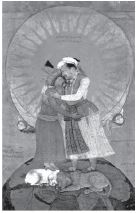
Question. This Mughal painting is given the name of Jahangir’s dream because:
(A) It shows the two rulers Jahangir and Safavid Shah Abbas in a friendly embrace which was Jahangir’s desire.
(B) It gave a sense of authenticity to a scene which was fictional as the two rulers had never met.
(C) An inscription on this miniature records that Jahangir commissioned Abu’l Hasan to render in painting a dream the Emperor had recently seen.
(D) All of the above.
Answer : D
Question. The globe beneath the feet of both the Emperors suggests:
(A) The dream of Jahangir (the world seizure) to conquer the whole world by embracing his rival Shah Abbas.
(B) The globe is used by the painter to provide depth to the painting.
(C) The globe is representing the ideal world of humans and animals existing together.
(D) Both (B) and (C)
Answer : A
Question. The major attributes of the given painting were largely inspired by the:
(A) Incoming European art motifs and imaginaries in the Mughal court.
(B) Persian art motifs and imaginaries in the Mughal court.
(C) Turkish art motifs and imaginaries in the Mughal court.
(D) None of the above.
Answer : A
Question. A comparison of the physique and posture of both the Emperors in the painting portrays:
(A) The superiority of Jahangir over Shah Abbas as shown by the difference in the physical size of their respective portraits.
(B) The dream of Jahangir of embracing his rival Shah Abbas in a friendly manner to retain Qandhar.
(C) Both (A) and (B)
(D) None of the above.
Answer : C
III. Observe the picture and answer any three of the following questions by choosing the correct option.
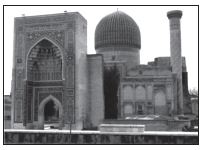
Question. Which building is this?
(A) Agra Fort
(B) Humayun’s Tomb
(C) Mausoleum of Timur
(D) Fatehpur Sikri
Answer : C
Question. Which famous dynasty was started by the descendants of the person connected with this building?
(A) Delhi Sultanate
(B) Mughal Empire
(C) Nizams of Hyderabad
(D) Nawabs of Awadh
Answer : B
Question. Where is it situated?
(A) Samarqand
(B) Agra
(C) New Delhi
(D) Chandigarh
Answer : A
Question. Which author has used a name derived from the descendant dynasty as the name of the superhero of his/her novel?
(A) Rudyard Kipling
(B) Annie Besant
(C) Sarojini Naidu
(D) William Wordsworth
Answer : A
IV. Observe the picture and answer the following questions by choosing the correct option.
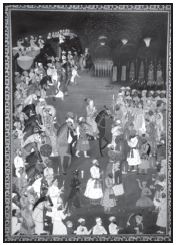
Question. Which auspicious occasion has been depicted in this painting?
(A) Prince Khurram’s crowning
(B) Victory in Battle of Panipat
(C) Dara Shukoh’s wedding
(D) None of these
Answer : C
Question. What is the source of this painting?
(A) Akbar Nama
(B) Humayun Nama
(C) Badshah Nama
(D) Ain-i-Akbari
Answer : C
Question. When did the event take place?
(A) 1633
(B) 1685
(C) 1745
(D) 1799
Answer : A
Question. Which of these festival(s) was celebrated by the Mughal rulers?
(A) Solar birthday of monarch
(B) Lunar birthday of monarch
(C) Nauroz
(D) All of these
Answer : D
Free study material for History
Download Class 12 History Theme II Chapter 09 Kings and Chronicles The Mughal Courts HOTS Practice Questions
Challenging Questions for Class 12 History Theme II Chapter 09 Kings and Chronicles The Mughal Courts
Strengthen your preparation for Class 12 History examinations with specialized Theme II Chapter 09 Kings and Chronicles The Mughal Courts HOTS worksheets. These structured problems are curated to match official CBSE guidelines and help tackle difficult board-level questions.
How to Use These Class 12 History HOTS
Pair these practice sets with our comprehensive NCERT solutions for Class 12 History to clear up doubts. Checking your working against our detailed explanations guarantees absolute mastery over this chapter.
More Study Resources for Class 12 History
To reinforce your revision after completing these HOTS, try our online History MCQ test for Class 12. All learning materials on our platform are completely free and updated for the current academic session.
FAQs
You can download the teacher-verified PDF for CBSE Class 12 History HOTs Kings and Chronicles The Mughal Courts from StudiesToday.com. These questions have been prepared for Class 12 History to help students learn high-level application and analytical skills required for the 2026-27 exams.
In the 2026 pattern, 50% of the marks are for competency-based questions. Our CBSE Class 12 History HOTs Kings and Chronicles The Mughal Courts are to apply basic theory to real-world to help Class 12 students to solve case studies and assertion-reasoning questions in History.
Unlike direct questions that test memory, CBSE Class 12 History HOTs Kings and Chronicles The Mughal Courts require out-of-the-box thinking as Class 12 History HOTS questions focus on understanding data and identifying logical errors.
After reading all conceots in History, practice CBSE Class 12 History HOTs Kings and Chronicles The Mughal Courts by breaking down the problem into smaller logical steps.
Yes, we provide detailed, step-by-step solutions for CBSE Class 12 History HOTs Kings and Chronicles The Mughal Courts. These solutions highlight the analytical reasoning and logical steps to help students prepare as per CBSE marking scheme.