CBSE Class 12 Biology HOTs Organisms And Environment

Here is CBSE Class 12 Biology HOTs Organisms And Environment for your advanced practice. Find detailed High Order Thinking Skills (HOTS) questions and solutions for Class 12 Biology Organisms And Environment. Built for the 2026-27 exam session, these expert-tested questions sharpen your problem-solving skills according to standard CBSE, NCERT, and KVS rules.

Analytical Questions: Organisms And Environment (Class 12 Biology)

Every Class 12 Biology student should practice these HOTS Questions to tackle difficult exam problems. Use the provided solutions to improve your critical thinking and boost your overall performance in Class 12.

Get Organisms And Environment HOTS PDF for Class 12 Biology

 Organisms And Environment
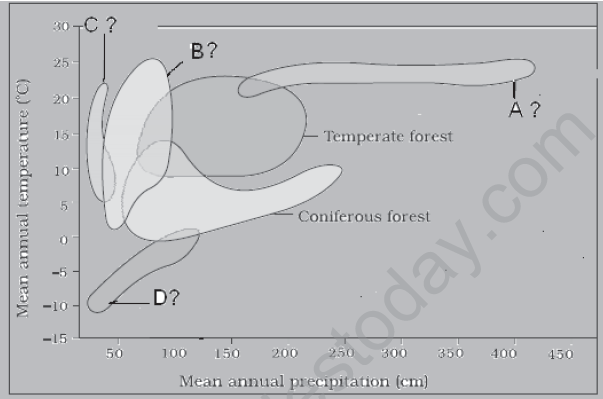
Q.1.Identify the biome distribution with respect to annual temperature and precipitation from the following graph answer the A, B,C&D.
CBSE_Class_12_Biology_organisms_And_Environment_1
Answer: A – Tropical forest
             B - Grassland
             C – Desert
             D – Arctic and Alpine Tundra
 
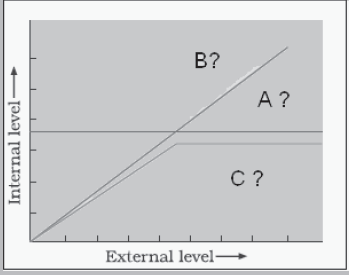
Q. 2. What does the graph A, B&C represent with reference to organismic response to Homeostasis?
CBSE_Class_12_Biology_organisms_And_Environment_2
Answer: A - Regulators
            B - Conformers
            C – Partial Regulator
 
Q.3) From the following ecological pyramid find out the pyramid showing stable population. Why?
CBSE_Class_12_Biology_organisms_And_Environment_3
Answer: B.
 
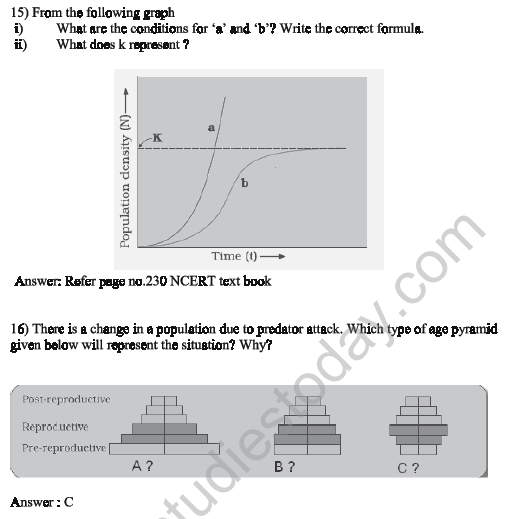
Q.4) From the given ecological pyramid representing pre-reproductive, reproductive and post – reproductive stages of human population. Out of A , B and C which is the declining population?
CBSE_Class_12_Biology_organisms_And_Environment_4
Answer: C.
 
Q.5) Why small animals are rarely found in polar region?
 
Answer: i)Lose body heat very fast
             ii) Spend much energy to generate heat
 
Q.6) Why are marine animals not able to survive for a long time in freshwater and vice versa?
 
Answer: Osmotic Pressure
 
Q.7) How does the special photosynthetic pathway like CAM supports desert plants?
 
Answer: Close the stomata in day and open in the night.
 
Q.8) Ecological pyramid based on reproductive age is given below. Find out the pyramid showing expanding population. Why?
CBSE_Class_12_Biology_organisms_And_Environment_5
Answer: A.
 
Q.9) Why do some animals undergo hibernation and aestivation but the other animals living in the same habitat do not show the process?
 
Answer: i) maintain homeostasis
ii) migrate from the stressful environment.
 
Q.10) Why do animals migrate from one region to the other region in the cold season?
 
Answer: i) Away from stressful environment
ii) Breed and improve population
 
Q.11) What does the stationary phase of a sigmoid curve indicate?
 
Answer: Carrying capacity/ Limited resource availability
 
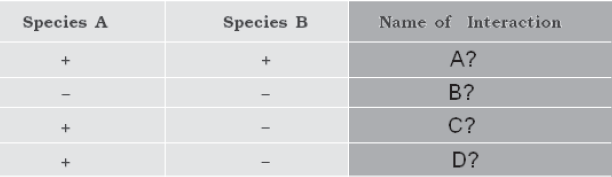
Q.12) Name the type of population interaction A,B,C, D between the species A and B as per the tabular column given below.
CBSE_Class_12_Biology_organisms_And_Environment_6
Answer: A - Mutualism
            B - Competition
            C- Predation/ Parasitism
            D- Parasitism/ Predation
 
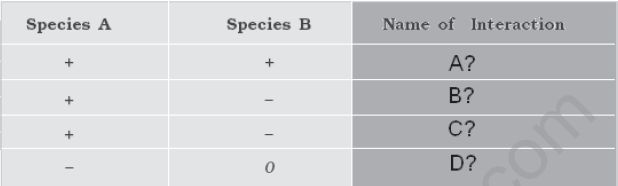
Q.13) What type of population interaction in A,B,C, D between the species A and B as per the tabular column given below.
CBSE_Class_12_Biology_organisms_And_Environment_7
Answer: A- Mutualism
B- Predation/ Parasitism
C - Parasitism/ Predation
D- Amensalism
 
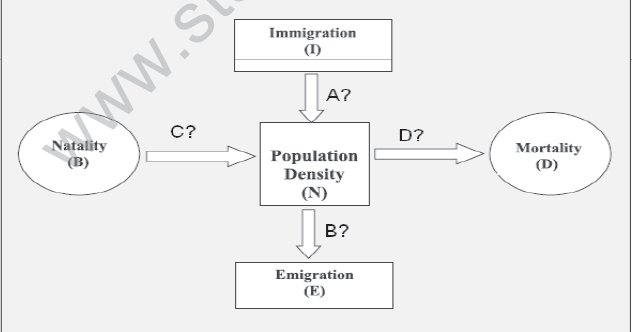
Q.14) Which of the following A, B, C,D represent increase and decrease in population growth?
CBSE_Class_12_Biology_organisms_And_Environment_8
 
Answer: A&C increase in population
B&D decrease in population
CBSE_Class_12_Biology_organisms_And_Environment_9
CBSE_Class_12_Biology_organisms_And_Environment_10
Answer: One petal resembles the female bee in size colour and markings.
 
Q.19) Five species of warblers co-existed on a tree without any sort of competition. How did they avoid competition?
 
Q.20) The leaves of a plant in Tundra resemble that of a plant living in a desert. What do plants living in a such diverse habitats shows similar adaptation?
 
Q.21) When a species becomes extinct, the plant and animal species associated with it in an obligatory way also becomes extinct. But nature has a unique way to prevent this. (a) What is this mechanisim called?
(b) Cite an example to explain the mechanism ?
 
Q.22) Polar regions are usually inhabited by large sized animals. Small sized animals are generally rare. What is the disadvantage of being small in polar regions?

Download Class 12 Biology Organisms And Environment HOTS Practice Questions
High Order Thinking Skills: Organisms And Environment Overview

Master core concepts in Organisms And Environment with these targeted Higher Order Thinking Skills (HOTS) problems. Built for Class 12 Biology students following the CBSE curriculum, these exercises challenge analytical thinking and improve problem-solving speed.

Step-by-Step Answers for Organisms And Environment

Each question in this set is mapped directly to the official NCERT book for Class 12. Review the detailed answer keys provided below each problem to verify your solution steps and correct mistakes early.

Complete Your Chapter Revision

To reinforce your revision after completing these HOTS, try our online Biology MCQ test for Class 12. All learning materials on our platform are completely free and updated for the current academic session.

FAQs

Where can I download the latest PDF for CBSE Class 12 Biology HOTs Organisms And Environment?

You can download the teacher-verified PDF for CBSE Class 12 Biology HOTs Organisms And Environment from StudiesToday.com. These questions have been prepared for Class 12 Biology to help students learn high-level application and analytical skills required for the 2026-27 exams.

Why are HOTS questions important for the 2026 CBSE exam pattern?

In the 2026 pattern, 50% of the marks are for competency-based questions. Our CBSE Class 12 Biology HOTs Organisms And Environment are to apply basic theory to real-world to help Class 12 students to solve case studies and assertion-reasoning questions in Biology.

How do CBSE Class 12 Biology HOTs Organisms And Environment differ from regular textbook questions?

Unlike direct questions that test memory, CBSE Class 12 Biology HOTs Organisms And Environment require out-of-the-box thinking as Class 12 Biology HOTS questions focus on understanding data and identifying logical errors.

What is the best way to solve Biology HOTS for Class 12?

After reading all conceots in Biology, practice CBSE Class 12 Biology HOTs Organisms And Environment by breaking down the problem into smaller logical steps.

Are solutions provided for Class 12 Biology HOTS questions?

Yes, we provide detailed, step-by-step solutions for CBSE Class 12 Biology HOTs Organisms And Environment. These solutions highlight the analytical reasoning and logical steps to help students prepare as per CBSE marking scheme.