

Download Class 11 Computer Science Concept Summaries: CBSE Class 11 Computer Science Programming In C++ Notes
Review targeted revision notes for Class 11 Computer Science with the CBSE Class 11 Computer Science Programming In C++ Notes. Built according to official educational guidelines for the 2026-27 academic year, these downloadable summaries for Programming In C++ support daily study and last-minute exam readiness.
Access Programming In C++ Notes and Study Material
Access the complete concept summary PDF for Programming In C++ below. Regular review of these targeted notes builds familiarity with complex Class 11 Computer Science themes and helps secure higher marks in final school evaluations.
Programming in C++
Investigation of Programming Construct in C++.
OBJECTIVES :
• to emphasize the programming construct available in C++
• to investigate each and every programming construct emphasizing the situation where they can be used perfectly.
• to demonstrate few working program in C++ using the constructs.
1.1 Why and What of Constructs in C++ programming
1.1.1 : Flow of logic
You have seen in the previous unit that a program is implementation of an algorithm (steps involved in problem solving) using a particular programming language like C , C++ , Java etc. In our case we are using C++ as a high level language (HLL) to code our programs.
A programming language like C++ is having a bundle of programming elements like tokens , identifiers , variables , constants , operator symbols , punctuation symbols etc. (please refer to earlier unit if you have not learnt all these terms.) . All these programming elements helps a programmer to write simple C++ programs as shown below :
program 1.1
// a simple program in C++ to add two integers
#include<iostream.h>
void main( )
{
int a = 0 , b = 0 ;
cout<<”Input two numbers”;
cin>> a>>b;
cout<<”The sum of numbers are: ” << (a+b);
}
The above program is a very basic program which asks two integer values from user and prints out their sum. In the above program you may observe that various programming elements like:
# < ( ) { = , a b << >> int void main ―Input two numbers ― ; are being used.

Students the program above is very simple to be thought , written and executed, but in real industrial programming situation we seldom get such programs to write. There are many complex situation in life where we often need to write programs using few advanced programming elements. Let us investigate few of the real life situations :
a) Ram needs to find out whether any number is divisible by both 3 and 5.
b) A shopkeeper wants to give x % discount on a particular purchase only when the net purchase by his customer exceeds Rs. 1000
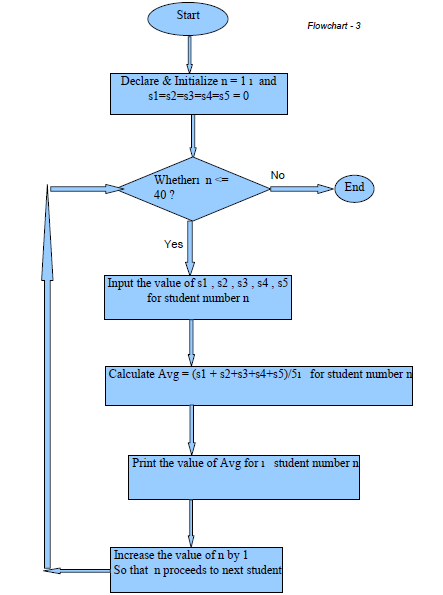
c) A teacher wants to calculate the average marks for each of his 40 pupils in a class.
d) Suresh wants to continue his program till he is pressing escape button on keyboard.
Can you program the above programming problems using the programming elements of C++ which you have learn till now ?
Your answer would be probably a NO , because the C++ programming elements which you have studied till now , will only enable you to write simple linear programs , or sequential programs.
1.1.2: Linear Flow
A simple linear program is one which has a linear flow of execution of programming logic /statements. e.g. program 1.1. The logic of program flows ( or better they are termed as control flow) from top to bottom out of set of statements.
Now let us proof the that program 1.1 follows a sequential flow of logic by the following flow chart diagram :


Please click the link below to download pdf file for CBSE Class XI Computer Science Programming in C++ Concepts.
Revision Notes and Key Concepts for Class 11 Computer Science Programming In C++
Quick Revision Notes: Programming In C++ (CBSE)
Review targeted chapter notes for Class 11 Computer Science Programming In C++. Built according to official CBSE guidelines, these summaries highlight high-yield topics frequently tested in school evaluations.
Expert Study Material for Class 11 Computer Science
Cross-reference your comprehension with comprehensive NCERT solutions for Class 11 to ensure absolute clarity across all sub-topics in this chapter.
Complete Your Chapter Revision
Wrap up your chapter revision by testing your knowledge against standard question formats. Everything on our platform is provided free of charge.
FAQs
You can download the teacher prepared revision notes for CBSE Class 11 Computer Science Programming In C++ Notes from StudiesToday.com. These notes are designed as per 2026-27 academic session to help Class 11 students get the best study material for Computer Science.
Yes, our CBSE Class 11 Computer Science Programming In C++ Notes include 50% competency-based questions with focus on core logic, keyword definitions, and the practical application of Computer Science principles which is important for getting more marks in 2026 CBSE exams.
Yes, our CBSE Class 11 Computer Science Programming In C++ Notes provide a detailed, topic wise breakdown of the chapter. Fundamental definitions, complex numerical formulas and all topics of CBSE syllabus in Class 11 is covered.
These notes for Computer Science are organized into bullet points and easy-to-read charts. By using CBSE Class 11 Computer Science Programming In C++ Notes, Class 11 students fast revise formulas, key definitions before the exams.
No, all study resources on StudiesToday, including CBSE Class 11 Computer Science Programming In C++ Notes, are available for immediate free download. Class 11 Computer Science study material is available in PDF and can be downloaded on mobile.