

Official Class 11 Computer Science Revision Material: CBSE Class 11 Computer Science Functions In C++ Notes
Explore reliable concept summaries and revision materials through the CBSE Class 11 Computer Science Functions In C++ Notes. Tailored for Class 11 learners, utilizing these notes for Computer Science Functions In C++ ensures thorough preparation and strengthens core academic definitions before final evaluations.
Chapter-wise Concept Summaries: Functions In C++
View or download the dedicated Functions In C++ revision resource below. Engaging with these structured concept notes daily ensures continuous academic progress and mastery of the 2026-27 curriculum for Computer Science.
Functions in C++
Objectives :
• to analyze how modularity is implemented in a program at its lowest level.
• To appreciate the use and importance of function in C++
• to program different types of functions and implement them practically.
• To understand difference between User Define Function and Library function.
3.1: Why to use functions ?
Who likes unnecessary repetition of task ? No body in this world. Every body thinks of re usability these days in every aspect of life. What will you do if your cycle wheel rim breaks down on fine day? Do you will throw the whole cycle or sell the cycle as scrap? No exactly not because cycles are designed in such a way that each of its parts can be repaired or replaced. So you will get a new cycle rim from market and will get it fitted in your cycle! This design of cycle where each of its parts have its own unique functionality and could be reassembled together to form a complete cycle is known as
Modular approach of designing. Each of the cycles part can thought as a Module which serves some purpose in the whole cycle but is very essential for proper functioning of the cycle. The whole concept is nothing but based on “Divide and Rule philosophy”. A bigger system is divided into smaller components so that each of these smaller parts could handled easily and effectively. These smaller parts when integrated gives rise to the bigger system.
Just think GOD has also created human beings as a modular entity ! We humans have a body which is integration of organ system and each of these organ system is again integration of some organs. So here organs are acting as modules. These modules (organs) could be taken care of individually when we often fall ill.
Can you rightly describe what is opposite word for modularity ? Any system which is not modular is known as monolithic (अखंड) or indivisible. A monolithic system does not have any parts or modules, from top to bottom it is one piece.
Software industry has also adopted the modular approach of design where a big software is divided into several modules. Each of the modules are designed for performing specialized task in the whole software. These modules interact with other modules of the system to carry out essential functionality of the whole system.
Each module during its course of execution repeats same type of task, so whenever the whole system requires a specific type of task , for which a particular module is responsible , it calls or invokes that module and the task is done. This calling of module to perform a certain action , can be done several number of times while the software as a whole executes.
Let us understand the above concept with the help of a real life example. Suppose our KVS is going to develop a centralized software for managing all Kvs across the country. While designing such a software KVS has to divide the whole operation of the software into three big modules called as : Admin , Academic and Accounts, each of these modules could be again broken down into many simple and small sub-modules like Admin Module can have Admission , Construction , Recruitment, etc. whereas the Academics can again have sub-modules like Student Registration, Examination , Results etc.
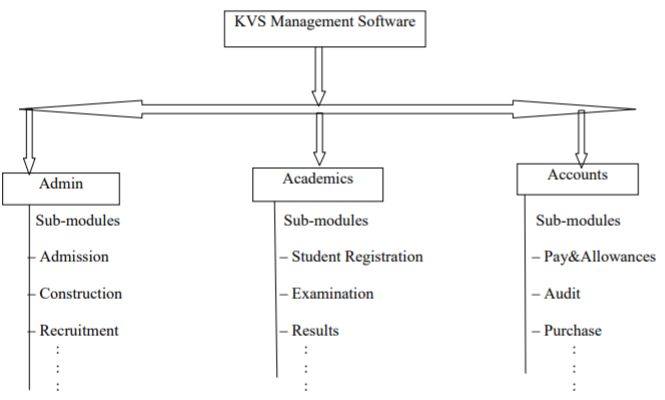
When the whole software is divided into modules as seen in the above case scenario then the following benefits could be harvested :
i) Each module can be tracked individually and separately without taking much care of other modules.
ii) A module is a reusable piece of program which could used again and again. Suppose that Navodaya Vidyalaya now wants to make a software like KVS then they can re-use the same modules of KVS with some changes (customization).
iii) If error is found in one module the functionality of that particular module and its associated modules would be disturbed, the whole software will not suffer. Thus errors can be tracked easily and debugged in much less time, because programmer will know which module is causing error, so he will debug that particular module only not the whole software (much like when you visit doctor suffering from common cold , the doctor does not checks your brain!)
iv) System up gradation (the process of changing from older system to newer one) becomes much easier because only those modules which needs up gradation will be dealt leaving other things as it is. So we see that modularization of a system gives us much independence and flexibility in terms of fast program development , easier debugging , and re-usability.
Please click the link below to download pdf file for CBSE Class XI Computer Science Functions in C++ Concepts.
Download CBSE Revision Notes: Class 11 Computer Science Functions In C++
Quick Revision Notes: Functions In C++ (CBSE)
Review targeted chapter notes for Class 11 Computer Science Functions In C++. Built according to official CBSE guidelines, these summaries highlight high-yield topics frequently tested in school evaluations.
Expert Study Material for Class 11 Computer Science
Each chapter summary is structured around standard CBSE textbooks, allowing students to check their understanding and clarify complex ideas early in their revision.
Complete Your Chapter Revision
Explore our broader library of printable assignments, chapter notes, and mock tests designed to support continuous revision and secure higher marks in CBSE assessments.
FAQs
You can download the teacher prepared revision notes for CBSE Class 11 Computer Science Functions In C++ Notes from StudiesToday.com. These notes are designed as per 2026-27 academic session to help Class 11 students get the best study material for Computer Science.
Yes, our CBSE Class 11 Computer Science Functions In C++ Notes include 50% competency-based questions with focus on core logic, keyword definitions, and the practical application of Computer Science principles which is important for getting more marks in 2026 CBSE exams.
Yes, our CBSE Class 11 Computer Science Functions In C++ Notes provide a detailed, topic wise breakdown of the chapter. Fundamental definitions, complex numerical formulas and all topics of CBSE syllabus in Class 11 is covered.
These notes for Computer Science are organized into bullet points and easy-to-read charts. By using CBSE Class 11 Computer Science Functions In C++ Notes, Class 11 students fast revise formulas, key definitions before the exams.
No, all study resources on StudiesToday, including CBSE Class 11 Computer Science Functions In C++ Notes, are available for immediate free download. Class 11 Computer Science study material is available in PDF and can be downloaded on mobile.