

Download Class 12 Biology Concept Summaries: CBSE Class 12 Biology Endocrine System Notes
Access comprehensive revision notes for Endocrine System using the CBSE Class 12 Biology Endocrine System Notes. Designed to align with the 2026-27 academic syllabus for Class 12 Biology, these concept summaries help students streamline their exam preparation and review complex topics efficiently.
Access Endocrine System Notes and Study Material
Access the complete concept summary PDF for Endocrine System below. Regular review of these targeted notes builds familiarity with complex Class 12 Biology themes and helps secure higher marks in final school evaluations.
Endocrine Glands
Introduction to Human Endocrine System Hormones are the organic chemicals produced by the body, which are released into the blood.
The key feature of the hormones is that they are secreted by the ductless glands. The glands that secrete hormones do not have ducts. Hormones are released directly into the blood stream and reach the target organ.
Differences between Hormonal Control and Nervous Control
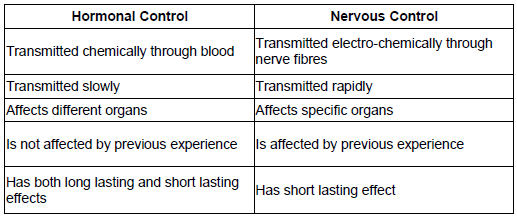
The endocrine system works in association with nervous system to control and coordinate our bodies. They contribute to the maintenance of homeostasis in our bodies.
Homeostasis is the capacity of an organism to adjust itself and cope up with external stress to maintain a steady state.
Glands
A cell, tissue, or an organ that secretes chemical messengers required for coordinating a specific function is called a gland. Glands are mainly divided into two broad categories – endocrine and exocrine.
Exocrine gland :
These glands possess ducts for discharging their secretions on the body surface. The sebaceous glands present in the skin, salivary glands present in the buccal cavity, and gastric glands present in the walls of the stomach etc. are a few examples of exocrine glands.
Endocrine gland: These glands do not discharge their secretions through ducts. Hence, they are also known as ductless glands. They discharge their secretions directly into the bloodstream. Their secretions are known as hormones. The pituitary gland, thyroid gland, adrenal gland etc. are a few examples endocrine glands.
Characteristics of Hormones
- Hormones are the organic chemicals that are secreted in response to environmental changes in or outside the body.
- Hormones are secreted by ductless glands and transported along with the blood stream to the site of their action. The site of their production and the organ of their influence are different. - They can be amino-acid derivatives, proteins, or steroids.
- Being low molecular weight substances, they can easily diffuse through the cell membrane.
- They are produced in small quantities and are effective in extremely lower concentrations.
- Abnormal production of hormones (be it less or more) affects the body in a negative manner. Some of the ductless glands that secrete hormones are thyroid gland, adrenal gland, pituitary gland, parathyroid gland, gonads, etc.
Human Endocrine System
- Pituitary, pineal, thyroid, adrenal, pancreas, parathyroid, thymus, and gonads are the organised endocrine glands in our body.
- In addition, GI tract, liver, kidney, heart also produce hormones.
Human Endocrine System and Adrenal, Pancreas and Gonads
Adrenal Gland
Location: 1 pair − 1 gland at the anterior part of each kidney
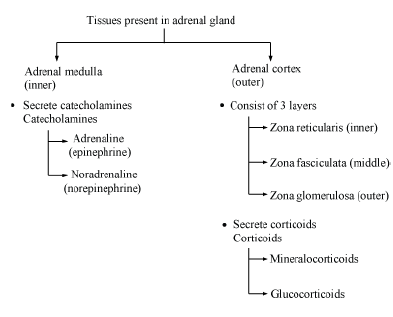
- Catecholamine:
- Emergency hormones or hormones of fight or flight
- Increases alertness, pupilary dilation, piloerection (raising of hair)
- Increases heart beat, respiration rate
- Stimulates the breakdown of glucose, lipids and proteins
- Glucocorticoid:
- Stimulates gluconeogenesis, lipolysis and proteolysis
- Inhibits uptake and utilisation of amino acids
- Suppresses immune response by producing anti-inflammatory reaction (Example − Cortisol)
- Stimulates RBC production (Example − Cortisol)
- Mineralocorticoid: Example − Aldosterone
- Acts on renal tubule and stimulates re-absorption of Na+ and water
- Stimulates excretion of K+
- Maintains electrolysis, osmotic pressure and blood pressure
- Androgenic steroids plays a role in the growth of axial, facial and pubic hair during puberty Hyposecretion of hormones from adrenal cortex results in Addison’s disease.
Symptoms:
- Loss of energy and weight
- Skin pigmentation
- Hypoglycemia
- Sensitivity to cold
- Increased susceptibility to infections, etc Hypersecretion of hormones from adrenal cortex causes Cushing’s Syndrome.
Symptoms:
- Obesity
- Hyperglycemia
- Osteoporosis
- Weakness, etc
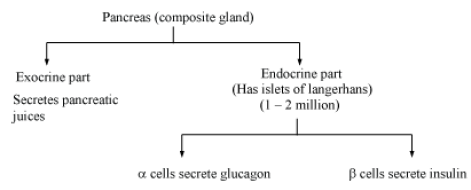
Pancreas
- Glucagon: Hyperglycemic hormone
- A peptide hormone
- Maintains the normal blood glucose level
- Acts on liver cells and stimulates glycogenolysis, resulting in hyperglycemia
- Stimulates gluconeogenesis (synthesis of glucose from sources like fats)
- Insulin: Hypoglycemic hormone
- A peptide hormone
- Stimulates liver cells to enhance the cellular glucose uptake and utilisation
- Moves the glucose from the blood to hepatocytes and adipocytes
- Converts glucose into glycogen
- Glucagon + Insulin = Maintain glucose homeostasis Insufficient secretion of insulin causes Diabetes mellitus
Symptoms:
- High sugar concentration in blood
- Excretion of glucose with urine
- Increased thirst
- Loss of weight
Over secretion of insulin causes hypoglycemia. It results in low glucose level in blood. Under extreme cases, brain may enter in a state of of coma.
An overdose of insulin to a diabetic patient may also result in hypoglycemic conditions. As a result, the patient may become unconscious. This phenomena is called insulin shock. It can be reversed by instant intake of sweet biscuits or candies.
Testis
- Location: scrotal sac, in males
- Testis is composed of seminiferous tubules, and stromal or interstitial tissues.
- In the intertubular spaces, Leydig cells (interstitial cells) are present that secrete androgens, mainly testosterone.
- Functions of androgens:
- Development, maturation and functioning of the male accessory sex organs like vas deferens and seminal vesicles
- Stimulate muscular growth, growth of facial hair, low pitch voice, etc.
- Stimulatory role in spermatogenesis
- Act on the CNS and influence male sexual behaviour (libido)
- Anabolism of proteins and carbohydrates
Ovary
- Location: inside abdomen, in females
- Hormones produced: Oestrogen and progesterone
- Ovary is composed of ovarian follicles and stromal tissues
- Ovarian follicles: Secrete oestrogen

Functions of oestrogen:
- Growth and functioning of the female secondary sex organs
- Development of growing follicles and mammary glands
- Regulates female secondary sex characters (Examples − high pitch voice)
- Functions of progesterone:
- Acts on mammary glands and stimulates formation of alveoli-like structures storing milk
- Milk secretion
Human Endocrine System and Hypothalamus, Pineal, Thyroid, Parathyroid
Hypothalamus
- Basal part of diencephalon in forebrain
- It has several groups of neurosecretory cells (known as nuclei) that produce hormones. The synthesis and secretion of pituitary hormones is regulated by these hormones.
- Hormones originate from hypothalamic neurons, pass through axons, and are released from their nerve endings.
- Reach pituitary gland through a portal circulatory system and regulate the functioning of anterior pituitary
- Hormones from hypothalamus are of two types:
Releasing Hormones Inhibiting Hormones
Stimulate secretion of pituitary hormones
Example − Gonadotropin Releasing Hormone (GnRH) Inhibit secretion of pituitary hormones
Example − Somatostatin
Pineal Gland
- Location − Dorsal side of forebrain
- Secretes melatonin that regulates 24-hour (diurnal) rhythm of the body such as sleep-wake cycle, body temperature, etc.
- Melatonin also regulates metabolism, pigmentation, and menstrual cycle.
Thyroid Gland
- Location − Two lobes of thyroid gland are located on either side of trachea.
- Isthmus − Thin flap of connective tissue interconnecting the thyroid glands
- Composition − Follicles + Stromal tissues
- Follicular cells synthesize two hormones:
- Tetraiodothyronine or thyroxine (T4)
- Triiodothyronine (T3)
- Importance of thyroid hormones:
- Regulates BMR (Basal Metabolism Rate)
- Supports the process of RBC synthesis
- Maintains water-electrolyte balance
- Insufficient secretion of thyroxine results in
- goitre (enlargement of thyroid gland due to deficiency of iodine)
- cretinism (dwarfism and mental retardation in children)
- myxoedema (swelling in hands and face of an adult)
- Excessive secretion of thyroid hormone leads to hyperthyroidism. This may occur due to cancer of thyroid gland or development of nodules of thyroid glands. A person suffering from hyperthyroidism show following symptoms:
- Goitre in neck (exophthalmic goitre)
- Protruded eyes
- Increased heart beat
- Increased metabolic rate Parathyroid Gland
- Location − Four parathyroid glands are present on back side of thyroid glands.
- Secretes − Parathyroid hormone (PTH)
- Secretion of PTH is regulated by circulating level of calcium ions.
- PTH is a hypercalcemic hormone. It increases blood calcium levels by
- dissolution/demineralization from bones
- reabsorption of Ca2+ by renal tubules
- Ca2+ absorption from digested food
Human Endocrine System & Pituitary Gland and Thymus Gland
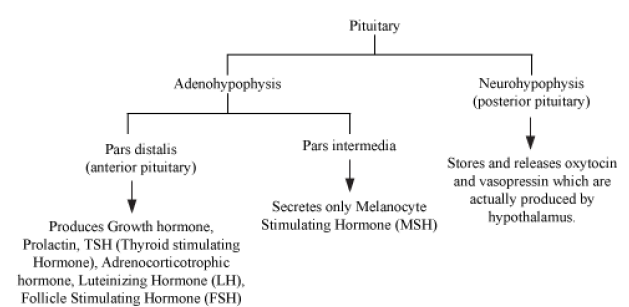
Pituitary Gland
- Location: In the bony cavity called sella tursica; attached to the hypothalamus via a stalk
Pituitary Hormone Functions
GH Over secretion in children − Gigantism
Over secretion in adults − Acromegaly (extra growth of bones in jaws, hands or feet)
Under secretion − Dwarfism
Prolactin Growth of mammary glands and formation of milk in them
TSH Synthesis and release of thyroid hormones
Adrenocorticotrophic hormone Stimulates synthesis and secretion of steroid hormones called glucocorticoids from the adrenal cortex
(ACTH)
LH In males − Stimulates synthesis and secretion of androgens from the testis
In females − Induces ovulation and maintenance of the corpus luteum
FSH In males − Along with androgens, regulate spermatogenesis
In females − Stimulates growth and development of ovarian follicles
MSH Acts on melanocytes and regulates pigmentation of the skin
Oxytocin Helps in the contraction of the smooth muscles of the uterus during child birth, and milk ejection from mammary glands
Thymus
- Location: Dorsal side of the heart and the aorta
- Importance: Development of the immune system
- Secretion: Peptide hormone called thymosins
- Role of thymosins:
- Differentiation of T-lymphocytes (Cell Mediated Immunity)
- Promotes production of antibodies (Humoral Immunity)
- Thymus is degenerated in old people. Hence, their immune response becomes weak.
Functions and Regulation of Hormone
Feedback mechanism regulates the action of the hormones
The glucose present in blood is broken down to produce energy required for the body. If it is present in an excess amount in the blood, then it is converted into glycogen. How does the body know when to convert glucose into glycogen or to breakdown glycogen into glucose? Hormones control most physiological reactions.
How is the timing and the quantity of hormones released regulated? Is there any mechanism to control the system?
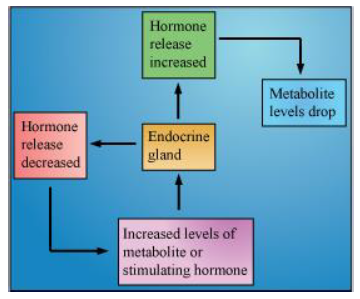
The endocrine glands secrete hormones depending upon the need of the organism. The amount of hormones secreted should be in an accurate amount. The regulation of the quantity of the hormones and the timing of its release are controlled by feedback mechanisms. There are two types of feedback mechanisms—positive and negative feedback.
Positive feedback: In this mechanism, the response accelerates after the feedback. The effect is further intensified in the same direction. It helps in speeding up the process occurring in various body systems. It is the opposite of negative feedback.
Negative feedback: In this mechanism, the information given by the feedback causes a reverse response. It occurs when the system needs to slow down or completely stop a process.
Illustrations to understand the two types of mechanisms
1. Child birth Uterine contractions occur during the onset of labour pain. These contractions stimulate the release of a specific hormone called oxytocin (from the pituitary gland), which intensifies the contractions. The contractions further stimulate the production of oxytocin and this cycle stops only after the birth of the baby. This is an example of positive feedback.
2. Insulin When you consume a carbohydrate-rich diet, it is digested into glucose. The glucose is then absorbed by the blood. This results in the increase of blood-sugar level and leads to the stimulation of the pancreas to secrete insulin. Insulin stimulates the target cells to take up the extra glucose from the blood.
This glucose is either used during respiration or stored as glycogen. Thus, the level of glucose in the blood is maintained. This is an example of negative feedback.
The negative feedback loop is shown in the following illustration.
3. Thyroid Stimulating Hormone (TSH)
The negative feedback loop can also be observed in case of regulation of thyroid hormones. In this particular regulation, the hypothalamus secrete Thyroid Releasing Hormone (TRH) which stimulates anterior pituitary to produce TSH. TSH further activates the cells of thyroid glands and consequently, thyroid hormones are released in the blood.
A gradual rise in the concentration of thyroid hormones serves as an inhibitory signal for hypothalamus and it stops producing TRH. In response to inhibition of TRH, TSH production is also lowered and eventually, the secretion of thyroid hormones is lowered.
Some Interesting Facts:
- Do you know that insulin was first extracted from dog pancreas in 1921 in the University of Toronto?
- Human insulin (Humulin) is produced by using human genes in the bacterium called E.coli.
Functions of Hormones
- To regulate the metabolic activities
- To regulate the morphogenic activities such as growth, development, etc.
- To regulate mental activities, growth maturation, reproductive activities, etc.
- To control the activities of other endocrine glands
- To maintain homeostasis
Free study material for Biology
Download CBSE Revision Notes: Class 12 Biology Endocrine System
Quick Revision Notes: Endocrine System (CBSE)
Explore reliable chapter overviews for Endocrine System tailored for Class 12 learners. Use these structured points to grasp difficult themes and ensure solid preparation for upcoming assessments.
Expert Study Material for Class 12 Biology
Each chapter summary is structured around standard CBSE textbooks, allowing students to check their understanding and clarify complex ideas early in their revision.
Complete Your Chapter Revision
Wrap up your chapter revision by testing your knowledge against standard question formats. Everything on our platform is provided free of charge.
FAQs
You can download the teacher prepared revision notes for CBSE Class 12 Biology Endocrine System Notes from StudiesToday.com. These notes are designed as per 2026-27 academic session to help Class 12 students get the best study material for Biology.
Yes, our CBSE Class 12 Biology Endocrine System Notes include 50% competency-based questions with focus on core logic, keyword definitions, and the practical application of Biology principles which is important for getting more marks in 2026 CBSE exams.
Yes, our CBSE Class 12 Biology Endocrine System Notes provide a detailed, topic wise breakdown of the chapter. Fundamental definitions, complex numerical formulas and all topics of CBSE syllabus in Class 12 is covered.
These notes for Biology are organized into bullet points and easy-to-read charts. By using CBSE Class 12 Biology Endocrine System Notes, Class 12 students fast revise formulas, key definitions before the exams.
No, all study resources on StudiesToday, including CBSE Class 12 Biology Endocrine System Notes, are available for immediate free download. Class 12 Biology study material is available in PDF and can be downloaded on mobile.