

Official CBSE Exam Papers for Class 10 Science
Review targeted exam resources with the CBSE Class 10 Science Question Paper SA1 2010 Set 01. Built according to official CBSE standards for the 2026-27 academic year, these downloadable Class 10 Science question papers support effective revision and performance tracking.
Solved Previous Year Papers for Science
Access the complete question paper PDF for Class 10 Science below. Regular practice with these targeted exam papers builds familiarity with standard question patterns and helps secure higher marks in final evaluations.
CBSE Class 10 Science Question Paper SA 1 2010 (1). Students can download the last year question papers using the link below. Free download of examination question papers with solutions. Last 10 year question papers should be practised to get better marks in examinations.
SCIENCE (Theory)
SECTION - A
1. What changes in the colour of iron nails and copper sulphate solution do you observe after keeping the iron nails dipped in copper sulphate solution for about 30 minutes?
2. State two characteristic features of carbon which when put together give rise to a large number of carbon compounds.
3. Explain why a ray of light passing through the centre of curvature of a concave mirror gets reflected along the same path.
4. What is the nature of the image formed by a concave mirror if the magnification produced by the mirror is + 3 ?
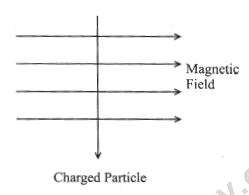
5. A charged particle enters at right angles into a uniform magnetic field as shown. What should be the nature of charge on the particle if it begins to move in a direction pointing vertically out of the page due to its interaction with the magnetic field ?
6. Name the part of our eyes that helps us to focus near and distant objects in quick succession.
7. What happens when an aqueous solution of sodium sulphate reacts with an aqueous solution of barium chloride? State the physical conditions of reactants in which the reaction between them will not take place. Write the balanced chemical equation for the reaction and name the type of reaction.
8. What is the main constituent of biogas ? How is biogas obtained from biomass ? Write any two advantages of using this gas.
10. What is a solenoid ? Draw the pattern of magnetic field lines of a solenoid through which a steady current flows. What does the pattern of field lines inside the solenoid indicate ?
11. A coil of insulated wire is connected to a galvanometer. What would be seen if a bar magnet with its north pole towards one face of the coil is
(i) moved quickly towards it,
(ii) moved quickly away from the coil and
(iii) placed near its one face ?
Name the phenomenon involved.
12. Mention any four limitations in harnessing wind energy on a large scale.
13. At what distance should an object be placed from a convex lens of focal length 18 cm to obtain an image at 24 cm from it on the other side. What will be the magnification produced in this case ?
14. No chemical reaction takes place when granules of a solid, A, are mixed with the powder of another solid, B. However when the mixture is heated, a reaction takes place between its components. One of the products, C, is a metal and settles down in the molten state while the other product, D, floats over it. It was observed that the reaction is highly exothermic.
(i) Based on the given information make an assumption about A and B and write a chemical equation for the chemical reaction indicating the conditions of reaction, physical state of reactants and products and thermal status of the reaction.
(ii) Mention any two types of reactions under which above chemical reaction can be classified.
15. Name the functional group of organic compounds that can be hydrogenated. With the help of suitable example explain the process of hydrogenation mentioning the conditions of the reaction and any one change in physical property with the formation
Please click the link below to download pdf file of CBSE Class 10 Science Question Paper SA1 2010 (1)
Free study material for Science
Past Exam Papers & Solutions for Class 10 Science
Class 10 Science Past Exam Papers & Resources
Review authentic examination papers for Class 10 Science. Working through the CBSE Class 10 Science Question Paper SA1 2010 Set 01 allows learners to decode recurring question trends and familiarize themselves with official CBSE evaluation standards.
Importance of Solving CBSE Class 10 Science Question Paper SA1 2010 Set 01
Reviewing official papers clarifies the exact marking scheme and structural layout established by the CBSE, enabling students to structure answers for maximum score potential.
Complete Your Exam Preparation
Download digital copies of these papers for convenient offline revision anywhere. Cross-check your completed steps against our expert solution guides to ensure complete accuracy.
FAQs
The CBSE Class 10 Science Question Paper SA1 2010 Set 01 is available for download on StudiesToday.com. It includes complete set with all sections so that Class 10 students can practice with the exact same paper that came in the CBSE exams.
Yes, the solutions for CBSE Class 10 Science Question Paper SA1 2010 Set 01 are prepared by subject matter experts as per official marking scheme. Class 10 students will understand the structure of answers and 'step-marks' methodology Science.
Solving previous year papers like CBSE Class 10 Science Question Paper SA1 2010 Set 01 is important to understand repeat themes and question difficulty levels of Science. It helps Class 10 students to test their time management skills too.
Yes, where applicable, CBSE Class 10 Science Question Paper SA1 2010 Set 01 is available in both English and Hindi mediums. All students from Class 10 can access Science study material in their preferred language.
No, all previous year question papers on StudiesToday, including CBSE Class 10 Science Question Paper SA1 2010 Set 01, are provided free of charge in mobile-friendly PDF.