

Download Class 12 Mathematics Worksheets for Chapter 03 Matrices
Review targeted practice sets for Class 12 Mathematics Chapter 03 Matrices. Built according to official educational guidelines for the 2026-27 academic year, these downloadable worksheets support daily revision and core concept reinforcement.
Access Chapter 03 Matrices Questions and Exercises
Access the complete worksheet PDF for Chapter 03 Matrices below. Regular practice with these targeted questions builds familiarity with standard exam patterns and helps secure higher marks in final Mathematics evaluations.
Question. To promote the making of toilets for women, an organisation tried to generate awareness through (i) house calls (ii) letters and (iii) announcements. The cost for each mode per attempt is given below : (i) ₹ 50 (ii) ₹ 20 (iii) ₹ 40 The number of attempts made in three villages X, Y and Z are given below: village (i) (ii) (iii) X 400 300 100 Y 300 250 75 Z 500 400 150 Find the total cost incurred by the organisation for the three villages separately, using matrices. Write one value generated by the organisation in the society.
Answer: Let ₹ \(A\), ₹ \(B\) and ₹ \(C\) be the cost incurred by the organisation for villages X, Y and Z respectively. Then we get the matrix equation as \[ \begin{bmatrix} 400 & 300 & 100 \\ 300 & 250 & 75 \\ 500 & 400 & 150 \end{bmatrix} \begin{bmatrix} 50 \\ 20 \\ 40 \end{bmatrix} = \begin{bmatrix} A \\ B \\ C \end{bmatrix} \] \[ \Rightarrow \begin{bmatrix} A \\ B \\ C \end{bmatrix} = \begin{bmatrix} 400 \times 50 + 300 \times 20 + 100 \times 40 \\ 300 \times 50 + 250 \times 20 + 75 \times 40 \\ 500 \times 50 + 400 \times 20 + 150 \times 40 \end{bmatrix} \] \[ = \begin{bmatrix} 20,000 + 6,000 + 4,000 \\ 15,000 + 5,000 + 3,000 \\ 25,000 + 8,000 + 6,000 \end{bmatrix} = \begin{bmatrix} 30,000 \\ 23,000 \\ 39,000 \end{bmatrix} \] \( \therefore A = \text{₹ } 30,000 \); \( B = \text{₹ } 23,000 \) and \( C = \text{₹ } 39,000 \). These are respectively the costs incurred by the organisation on villages X, Y and Z respectively. The value generated by the organisation in the society is cleanliness.
Question. If \( A = \begin{bmatrix} 1 & -1 \\ 2 & -1 \end{bmatrix} \) and \( B = \begin{bmatrix} a & 1 \\ b & -1 \end{bmatrix} \) and \( (A+B)^2 = A^2 + B^2 \), then find the values of \( a \) and \( b \).
Answer: We have, \( A = \begin{bmatrix} 1 & -1 \\ 2 & -1 \end{bmatrix} \) and \( B = \begin{bmatrix} a & 1 \\ b & -1 \end{bmatrix} \). Consider, \( (A + B) = \begin{bmatrix} 1 & -1 \\ 2 & -1 \end{bmatrix} + \begin{bmatrix} a & 1 \\ b & -1 \end{bmatrix} = \begin{bmatrix} 1+a & 0 \\ 2+b & -2 \end{bmatrix} \). Now, \( (A + B)^2 = \begin{bmatrix} 1+a & 0 \\ 2+b & -2 \end{bmatrix} \begin{bmatrix} 1+a & 0 \\ 2+b & -2 \end{bmatrix} \) \[ = \begin{bmatrix} (1+a)^2 & 0 \\ (2+b)(1+a) - 2(2+b) & 4 \end{bmatrix} = \begin{bmatrix} (1+a)^2 & 0 \\ (2+b)(a-1) & 4 \end{bmatrix} \] Now, consider \( A^2 = \begin{bmatrix} 1 & -1 \\ 2 & -1 \end{bmatrix} \begin{bmatrix} 1 & -1 \\ 2 & -1 \end{bmatrix} = \begin{bmatrix} 1-2 & -1+1 \\ 2-2 & -2+1 \end{bmatrix} = \begin{bmatrix} -1 & 0 \\ 0 & -1 \end{bmatrix} \) and \( B^2 = \begin{bmatrix} a & 1 \\ b & -1 \end{bmatrix} \begin{bmatrix} a & 1 \\ b & -1 \end{bmatrix} = \begin{bmatrix} a^2+b & a-1 \\ ab-b & b+1 \end{bmatrix} \) \( \therefore A^2 + B^2 = \begin{bmatrix} -1 & 0 \\ 0 & -1 \end{bmatrix} + \begin{bmatrix} a^2+b & a-1 \\ ab-b & b+1 \end{bmatrix} = \begin{bmatrix} a^2+b-1 & a-1 \\ ab-b & b \end{bmatrix} \) It is given that \( (A + B)^2 = A^2 + B^2 \) \( \therefore \begin{bmatrix} (1+a)^2 & 0 \\ (2+b)(a-1) & 4 \end{bmatrix} = \begin{bmatrix} a^2+b-1 & a-1 \\ ab-b & b \end{bmatrix} \) By equality of matrices, comparing the corresponding elements, we get: \( a - 1 = 0 \Rightarrow a = 1 \) and \( b = 4 \). Also, \( (1+a)^2 = a^2+b-1 \) and \( (2+b)(a-1) = ab-b \) are satisfied by \( a=1 \) and \( b=4 \). Therefore, \( a = 1 \) and \( b = 4 \).
Question. In a parliament election, a political party hired a public relations firm to promote its candidates in three ways-telephone, house calls and letters. The cost per contact (in paise) is given in matrix A as \[ A = \begin{bmatrix} 140 \\ 200 \\ 150 \end{bmatrix} \begin{matrix} \text{Telephone} \\ \text{House call} \\ \text{Letters} \end{matrix} \] The number of contacts of each type made in two cities X and Y is given in matrix B as \[ B = \begin{bmatrix} 1000 & 500 & 5000 \\ 3000 & 1000 & 10000 \end{bmatrix} \begin{matrix} \text{City X} \\ \text{City Y} \end{matrix} \] Find the total amount spent by the party in the two cities. What should one consider before casting his/her vote-party's promotional activity or their social activities?
Answer: The total amount spent by the party in two cities X and Y is represented in the matrix equation by matrix C as, \( C = BA \) \[ \Rightarrow \begin{bmatrix} X \\ Y \end{bmatrix} = \begin{bmatrix} 1000 & 500 & 5000 \\ 3000 & 1000 & 10000 \end{bmatrix} \begin{bmatrix} 140 \\ 200 \\ 150 \end{bmatrix} \] \[ \Rightarrow \begin{bmatrix} X \\ Y \end{bmatrix} = \begin{bmatrix} 1000 \times 140 + 500 \times 200 + 5000 \times 150 \\ 3000 \times 140 + 1000 \times 200 + 10000 \times 150 \end{bmatrix} \] \[ = \begin{bmatrix} 990000 \\ 2120000 \end{bmatrix} \] \( \therefore X = \text{₹ } 990000 \) and \( Y = \text{₹ } 2120000 \) (Note: Expressed in paise, this is \( \text{₹ } 9900 \) and \( \text{₹ } 21200 \) respectively). One should consider the social activity of the party before casting his/her vote.
Question. If \( \begin{bmatrix} 2x & 3 \end{bmatrix} \begin{bmatrix} 1 & 2 \\ -3 & 0 \end{bmatrix} \begin{bmatrix} x \\ 3 \end{bmatrix} = O \), find \( x \).
Answer: Here, \( \begin{bmatrix} 2x & 3 \end{bmatrix} \begin{bmatrix} 1 & 2 \\ -3 & 0 \end{bmatrix} \begin{bmatrix} x \\ 3 \end{bmatrix} = O \) \[ \Rightarrow \begin{bmatrix} 2x & 3 \end{bmatrix} \begin{bmatrix} x+6 \\ -3x \end{bmatrix} = O \] \[ \Rightarrow 2x(x + 6) + 3(-3x) = 0 \] \[ \Rightarrow 2x^2 + 12x - 9x = 0 \] \[ \Rightarrow 2x^2 + 3x = 0 \Rightarrow x(2x + 3) = 0 \] \[ \Rightarrow x = 0, -\frac{3}{2} \]
Question. A trust fund, ₹ 35,000 is to be invested in two different types of bonds. The first bond pays 8% interest per annum which will be given to orphanage and second bond pays 10% interest per annum which will be given to an N.G.O. (Cancer Aid Society). Using matrix multiplication, determine how to divide ₹ 35,000 among two types of bonds if the trust fund obtains an annual total interest of ₹ 3,200. What are the values reflected in this question?
Answer: Trust fund = ₹ 35,000. Let ₹ \( x \) be invested in the first bond and then ₹ \( (35,000 - x) \) will be invested in the second bond. Interest paid on the first bond = \( 8\% = 0.08 \) Interest paid on the second bond = \( 10\% = 0.10 \) Total annual interest = ₹ 3,200. \( \therefore \) In matrices, \( \begin{bmatrix} x & 35,000 - x \end{bmatrix} \begin{bmatrix} 0.08 \\ 0.10 \end{bmatrix} = [3,200] \) \[ \Rightarrow x \times 0.08 + (35,000 - x) \times 0.10 = 3,200 \] \[ \Rightarrow x \times \frac{8}{100} + (35,000 - x) \times \frac{10}{100} = 3,200 \] \[ \Rightarrow 8x + 3,50,000 - 10x = 3,20,000 \] \[ \Rightarrow 2x = 30,000 \] \[ \Rightarrow x = 15,000 \] \( \therefore \) ₹ 15,000 should be invested in the first bond and ₹ 35,000 - ₹ 15,000 = ₹ 20,000 be invested in the second bond. The values reflected in this question are: (i) Spirit of investment. (ii) Giving charity to cancer patients. (iii) Helping the orphans living in the society.
Question. If \( A = \begin{bmatrix} 2 & 0 & 1 \\ 2 & 1 & 3 \\ 1 & -1 & 0 \end{bmatrix} \), then find the value of \( A^2 - 3A + 2I \).
Answer: Refer to answer 43.
Question. If \( A = \begin{bmatrix} 1 & 2 & 2 \\ 2 & 1 & 2 \\ 2 & 2 & 1 \end{bmatrix} \), then verify that \( A^2 - 4A - 5I = O \).
Answer: Given, \( A = \begin{bmatrix} 1 & 2 & 2 \\ 2 & 1 & 2 \\ 2 & 2 & 1 \end{bmatrix} \) Now, \( A^2 = \begin{bmatrix} 1 & 2 & 2 \\ 2 & 1 & 2 \\ 2 & 2 & 1 \end{bmatrix} \begin{bmatrix} 1 & 2 & 2 \\ 2 & 1 & 2 \\ 2 & 2 & 1 \end{bmatrix} = \begin{bmatrix} 9 & 8 & 8 \\ 8 & 9 & 8 \\ 8 & 8 & 9 \end{bmatrix} \) \( \therefore A^2 - 4A - 5I \) \[ = \begin{bmatrix} 9 & 8 & 8 \\ 8 & 9 & 8 \\ 8 & 8 & 9 \end{bmatrix} - 4 \begin{bmatrix} 1 & 2 & 2 \\ 2 & 1 & 2 \\ 2 & 2 & 1 \end{bmatrix} - 5 \begin{bmatrix} 1 & 0 & 0 \\ 0 & 1 & 0 \\ 0 & 0 & 1 \end{bmatrix} \] \[ = \begin{bmatrix} 9 & 8 & 8 \\ 8 & 9 & 8 \\ 8 & 8 & 9 \end{bmatrix} - \begin{bmatrix} 4 & 8 & 8 \\ 8 & 4 & 8 \\ 8 & 8 & 4 \end{bmatrix} - \begin{bmatrix} 5 & 0 & 0 \\ 0 & 5 & 0 \\ 0 & 0 & 5 \end{bmatrix} \] \[ = \begin{bmatrix} 0 & 0 & 0 \\ 0 & 0 & 0 \\ 0 & 0 & 0 \end{bmatrix} = O \]
Question. If \( A = \begin{bmatrix} 3 & 1 \\ -1 & 2 \end{bmatrix} \), then show that \( A^2 - 5A + 7I = O \).
Answer: Given, \( A = \begin{bmatrix} 3 & 1 \\ -1 & 2 \end{bmatrix} \) \( \Rightarrow A^2 = \begin{bmatrix} 3 & 1 \\ -1 & 2 \end{bmatrix} \begin{bmatrix} 3 & 1 \\ -1 & 2 \end{bmatrix} = \begin{bmatrix} 9-1 & 3+2 \\ -3-2 & -1+4 \end{bmatrix} = \begin{bmatrix} 8 & 5 \\ -5 & 3 \end{bmatrix} \) and \( 5A = 5 \begin{bmatrix} 3 & 1 \\ -1 & 2 \end{bmatrix} = \begin{bmatrix} 15 & 5 \\ -5 & 10 \end{bmatrix} \) Now, \( A^2 - 5A + 7I \) \[ = \begin{bmatrix} 8 & 5 \\ -5 & 3 \end{bmatrix} - \begin{bmatrix} 15 & 5 \\ -5 & 10 \end{bmatrix} + \begin{bmatrix} 7 & 0 \\ 0 & 7 \end{bmatrix} \] \[ = \begin{bmatrix} -7 & 0 \\ 0 & -7 \end{bmatrix} + \begin{bmatrix} 7 & 0 \\ 0 & 7 \end{bmatrix} = \begin{bmatrix} 0 & 0 \\ 0 & 0 \end{bmatrix} = O \]
Transpose of a Matrix
Question. If \( A^T = \begin{bmatrix} 3 & 4 \\ -1 & 2 \\ 0 & 1 \end{bmatrix} \) and \( B = \begin{bmatrix} -1 & 2 & 1 \\ 1 & 2 & 3 \end{bmatrix} \), then find \( A^T - B^T \).
Answer: Given, \( A^T = \begin{bmatrix} 3 & 4 \\ -1 & 2 \\ 0 & 1 \end{bmatrix} \) and \( B = \begin{bmatrix} -1 & 2 & 1 \\ 1 & 2 & 3 \end{bmatrix} \) \( \Rightarrow B^T = \begin{bmatrix} -1 & 1 \\ 2 & 2 \\ 1 & 3 \end{bmatrix} \) \( \therefore A^T - B^T = \begin{bmatrix} 3 & 4 \\ -1 & 2 \\ 0 & 1 \end{bmatrix} - \begin{bmatrix} -1 & 1 \\ 2 & 2 \\ 1 & 3 \end{bmatrix} = \begin{bmatrix} 4 & 3 \\ -3 & 0 \\ -1 & -2 \end{bmatrix} \)
Question. If \( \begin{bmatrix} a+b & 2 \\ 5 & b \end{bmatrix} = \begin{bmatrix} 6 & 5 \\ 2 & 2 \end{bmatrix}^T \), then find \( a \).
Answer: Given, \( \begin{bmatrix} a+b & 2 \\ 5 & b \end{bmatrix} = \begin{bmatrix} 6 & 5 \\ 2 & 2 \end{bmatrix}^T \) \( \Rightarrow \begin{bmatrix} a+b & 2 \\ 5 & b \end{bmatrix} = \begin{bmatrix} 6 & 2 \\ 5 & 2 \end{bmatrix} \) On comparing corresponding elements of the matrices, we get \( a + b = 6 \) and \( b = 2 \) \( \Rightarrow a = 4 \).
Question. If \( A = \begin{bmatrix} 1 & 2 \\ 3 & 4 \end{bmatrix} \), find \( A + A' \).
Answer: We have, \( A = \begin{bmatrix} 1 & 2 \\ 3 & 4 \end{bmatrix} \Rightarrow A' = \begin{bmatrix} 1 & 3 \\ 2 & 4 \end{bmatrix} \) Now, \( A + A' = \begin{bmatrix} 1 & 2 \\ 3 & 4 \end{bmatrix} + \begin{bmatrix} 1 & 3 \\ 2 & 4 \end{bmatrix} = \begin{bmatrix} 2 & 5 \\ 5 & 8 \end{bmatrix} \).
Question. If \( \begin{bmatrix} 2x+y & 3y \\ 0 & 4 \end{bmatrix} = \begin{bmatrix} 6 & 0 \\ 6 & 4 \end{bmatrix}^T \), then find \( x \).
Answer: We have \( \begin{bmatrix} 2x+y & 3y \\ 0 & 4 \end{bmatrix} = \begin{bmatrix} 6 & 0 \\ 6 & 4 \end{bmatrix}^T \) \( \Rightarrow \begin{bmatrix} 2x+y & 3y \\ 0 & 4 \end{bmatrix} = \begin{bmatrix} 6 & 6 \\ 0 & 4 \end{bmatrix} \) By equality of two matrices, we have \( 2x + y = 6 \) and \( 3y = 6 \Rightarrow y = 2 \). Putting the value of \( y \), we get \( 2x + 2 = 6 \Rightarrow 2x = 4 \Rightarrow x = 2 \).
Question. If matrix \( A = [1\ 2\ 3] \), then find \( AA' \) where \( A' \) is the transpose of matrix A.
Answer: \( A = [1\ 2\ 3] \Rightarrow A' = \begin{bmatrix} 1 \\ 2 \\ 3 \end{bmatrix} \) \( AA' = [1\ 2\ 3] \begin{bmatrix} 1 \\ 2 \\ 3 \end{bmatrix} \Rightarrow AA' = [1+4+9] = [14] \).
Question. If \( A = \begin{bmatrix} 3 & 4 \\ 2 & 3 \end{bmatrix} \), then find \( A + A' \) where \( A' \) is the transpose of matrix A.
Answer: \( A = \begin{bmatrix} 3 & 4 \\ 2 & 3 \end{bmatrix} \), \( A' = \begin{bmatrix} 3 & 2 \\ 4 & 3 \end{bmatrix} \), \( \therefore A + A' = \begin{bmatrix} 3 & 4 \\ 2 & 3 \end{bmatrix} + \begin{bmatrix} 3 & 2 \\ 4 & 3 \end{bmatrix} = \begin{bmatrix} 6 & 6 \\ 6 & 6 \end{bmatrix} \).
Question. For the following matrices A and B, verify that \( (AB)' = B'A' \). \( A = \begin{bmatrix} 1 \\ -4 \\ 3 \end{bmatrix} \), \( B = [-1\ 2\ 1] \)
Answer: Given \( A = \begin{bmatrix} 1 \\ -4 \\ 3 \end{bmatrix} \), \( B = [-1\ 2\ 1] \) \( AB = \begin{bmatrix} 1 \\ -4 \\ 3 \end{bmatrix} [-1\ 2\ 1] = \begin{bmatrix} -1 & 2 & 1 \\ 4 & -8 & -4 \\ -3 & 6 & 3 \end{bmatrix} \) \( \dots (AB)' = \begin{bmatrix} -1 & 4 & -3 \\ 2 & -8 & 6 \\ 1 & -4 & 3 \end{bmatrix} \) Now, \( A' = [1\ -4\ 3] \) and \( B' = \begin{bmatrix} -1 \\ 2 \\ 1 \end{bmatrix} \) \( B'A' = \begin{bmatrix} -1 \\ 2 \\ 1 \end{bmatrix} [1\ -4\ 3] = \begin{bmatrix} -1 & 4 & -3 \\ 2 & -8 & 6 \\ 1 & -4 & 3 \end{bmatrix} \) \( \therefore (AB)' = B'A' \). Hence proved.
Symmetric and Skew Symmetric Matrices
Question. Matrix \( A = \begin{bmatrix} 0 & 2b & -2 \\ 3 & 1 & 3 \\ 3a & 3 & -1 \end{bmatrix} \) is given to be symmetric, find values of \( a \) and \( b \).
Answer: Given, \( A = \begin{bmatrix} 0 & 2b & -2 \\ 3 & 1 & 3 \\ 3a & 3 & -1 \end{bmatrix} \). \( \because A \) is symmetric. \( \therefore A' = A \) \[ \Rightarrow \begin{bmatrix} 0 & 3 & 3a \\ 2b & 1 & 3 \\ -2 & 3 & -1 \end{bmatrix} = \begin{bmatrix} 0 & 2b & -2 \\ 3 & 1 & 3 \\ 3a & 3 & -1 \end{bmatrix} \] On comparing the corresponding elements of the matrices, we get: \( 3a = -2 \Rightarrow a = -\frac{2}{3} \) and \( 2b = 3 \Rightarrow b = \frac{3}{2} \).
Question. If \( A = \begin{bmatrix} 3 & 5 \\ 7 & 9 \end{bmatrix} \) is written as \( A = P + Q \), where \( P \) is a symmetric matrix and \( Q \) is a skew symmetric matrix, then write the matrix \( P \).
Answer: Given, \( A = \begin{bmatrix} 3 & 5 \\ 7 & 9 \end{bmatrix} \Rightarrow A' = \begin{bmatrix} 3 & 7 \\ 5 & 9 \end{bmatrix} \) \( \because P \) is symmetric matrix. So, \( P = \frac{1}{2}(A + A') \) \( \therefore P = \frac{1}{2}\left( \begin{bmatrix} 3 & 5 \\ 7 & 9 \end{bmatrix} + \begin{bmatrix} 3 & 7 \\ 5 & 9 \end{bmatrix} \right) \) \[ = \frac{1}{2} \begin{bmatrix} 3+3 & 5+7 \\ 7+5 & 9+9 \end{bmatrix} = \frac{1}{2} \begin{bmatrix} 6 & 12 \\ 12 & 18 \end{bmatrix} = \begin{bmatrix} 3 & 6 \\ 6 & 9 \end{bmatrix} \] Hence, the matrix \( P = \begin{bmatrix} 3 & 6 \\ 6 & 9 \end{bmatrix} \).
Question. Express the matrix \( A = \begin{bmatrix} 2 & 4 & -6 \\ 7 & 3 & 5 \\ 1 & -2 & 4 \end{bmatrix} \) as the sum of a symmetric and a skew symmetric matrix.
Answer: We know that a square matrix \( A \) can be written as \( A = \frac{1}{2}(A + A') + \frac{1}{2}(A - A') \) Out of which \( \frac{1}{2}(A + A') \) is symmetric and \( \frac{1}{2}(A - A') \) is skew symmetric. \( \therefore \) For the given matrix: \( A = \begin{bmatrix} 2 & 4 & -6 \\ 7 & 3 & 5 \\ 1 & -2 & 4 \end{bmatrix} \), \( A' = \begin{bmatrix} 2 & 7 & 1 \\ 4 & 3 & -2 \\ -6 & 5 & 4 \end{bmatrix} \) \( \therefore A + A' = \begin{bmatrix} 4 & 11 & -5 \\ 11 & 6 & 3 \\ -5 & 3 & 8 \end{bmatrix} \) and \( A - A' = \begin{bmatrix} 0 & -3 & -7 \\ 3 & 0 & 7 \\ 7 & -7 & 0 \end{bmatrix} \) Hence, \( A = \frac{1}{2}(A + A') + \frac{1}{2}(A - A') \) \[ = \begin{bmatrix} 2 & 11/2 & -5/2 \\ 11/2 & 3 & 3/2 \\ -5/2 & 3/2 & 4 \end{bmatrix} + \begin{bmatrix} 0 & -3/2 & -7/2 \\ 3/2 & 0 & 7/2 \\ 7/2 & -7/2 & 0 \end{bmatrix} \] First of which is symmetric and the second is skew symmetric matrix.
Question. Write a 2 × 2 matrix which is both symmetric and skew symmetric.
Answer: \( \begin{bmatrix} 0 & 0 \\ 0 & 0 \end{bmatrix} \) is a 2 × 2 symmetric as well as skew symmetric matrix.
Question. For what value of \( x \), is the matrix \( A = \begin{bmatrix} 0 & 1 & -2 \\ -1 & 0 & 3 \\ x & -3 & 0 \end{bmatrix} \) a skew-symmetric matrix?
Answer: The matrix \( A = \begin{bmatrix} 0 & 1 & -2 \\ -1 & 0 & 3 \\ x & -3 & 0 \end{bmatrix} \) is skew-symmetric. \( \therefore A' = -A \Rightarrow \begin{bmatrix} 0 & -1 & x \\ 1 & 0 & -3 \\ -2 & 3 & 0 \end{bmatrix} = \begin{bmatrix} 0 & -1 & 2 \\ 1 & 0 & -3 \\ -x & 3 & 0 \end{bmatrix} \) \( \Rightarrow x = 2 \).
Question. Express the following matrix as the sum of a symmetric and skew symmetric matrix and verify your result. \( A = \begin{bmatrix} 3 & -2 & -4 \\ 3 & -2 & -5 \\ -1 & 1 & 2 \end{bmatrix} \)
Answer: We know that \( A = \frac{1}{2}(A + A') + \frac{1}{2}(A - A') \) Here, \( \frac{1}{2}(A + A') \) is symmetric matrix and \( \frac{1}{2}(A - A') \) is skew symmetric matrix. Now, \( A = \begin{bmatrix} 3 & -2 & -4 \\ 3 & -2 & -5 \\ -1 & 1 & 2 \end{bmatrix} \Rightarrow A' = \begin{bmatrix} 3 & 3 & -1 \\ -2 & -2 & 1 \\ -4 & -5 & 2 \end{bmatrix} \) \( \therefore \frac{1}{2}(A + A') = \frac{1}{2}\begin{bmatrix} 3+3 & -2+3 & -4-1 \\ 3-2 & -2-2 & -5+1 \\ -1-4 & 1-5 & 2+2 \end{bmatrix} = \frac{1}{2}\begin{bmatrix} 6 & 1 & -5 \\ 1 & -4 & -4 \\ -5 & -4 & 4 \end{bmatrix} \), which is symmetric. and \( \frac{1}{2}(A - A') = \frac{1}{2}\begin{bmatrix} 3-3 & -2-3 & -4+1 \\ 3+2 & -2+2 & -5-1 \\ -1+4 & 1+5 & 2-2 \end{bmatrix} = \frac{1}{2}\begin{bmatrix} 0 & -5 & -3 \\ 5 & 0 & -6 \\ 3 & 6 & 0 \end{bmatrix} \), which is skew symmetric. \( \therefore A = \frac{1}{2}\begin{bmatrix} 6 & 1 & -5 \\ 1 & -4 & -4 \\ -5 & -4 & 4 \end{bmatrix} + \frac{1}{2}\begin{bmatrix} 0 & -5 & -3 \\ 5 & 0 & -6 \\ 3 & 6 & 0 \end{bmatrix} \) \[ \Rightarrow A = \begin{bmatrix} 3 & 1/2 & -5/2 \\ 1/2 & -2 & -2 \\ -5/2 & -2 & 2 \end{bmatrix} + \begin{bmatrix} 0 & -5/2 & -3/2 \\ 5/2 & 0 & -3 \\ 3/2 & 3 & 0 \end{bmatrix} \]
Question. Let \( A = \begin{bmatrix} 3 & 2 & 5 \\ 4 & 1 & 3 \\ 0 & 6 & 7 \end{bmatrix} \), express A as a sum of two matrices such that one is symmetric and the other is skew symmetric.
Answer: Refer to answer 65.
Elementary Operation (Transformation) of a Matrix
Question. Use elementary column operation \( C_2 \to C_2 + 2C_1 \) in the following matrix equation: \( \begin{bmatrix} 2 & 1 \\ 2 & 0 \end{bmatrix} = \begin{bmatrix} 3 & 1 \\ 2 & 0 \end{bmatrix} \begin{bmatrix} 1 & 0 \\ -1 & 1 \end{bmatrix} \)
Answer: We have, \( \begin{bmatrix} 2 & 1 \\ 2 & 0 \end{bmatrix} = \begin{bmatrix} 3 & 1 \\ 2 & 0 \end{bmatrix} \begin{bmatrix} 1 & 0 \\ -1 & 1 \end{bmatrix} \) On applying \( C_2 \to C_2 + 2C_1 \), we get \( \begin{bmatrix} 2 & 5 \\ 2 & 4 \end{bmatrix} = \begin{bmatrix} 3 & 1 \\ 2 & 0 \end{bmatrix} \begin{bmatrix} 1 & 2 \\ -1 & -1 \end{bmatrix} \).
Question. Use elementary column operations \( C_2 \to C_2 - 2C_1 \) in the matrix equation \( \begin{bmatrix} 4 & 2 \\ 3 & 3 \end{bmatrix} = \begin{bmatrix} 1 & 2 \\ 0 & 3 \end{bmatrix} \begin{bmatrix} 2 & 0 \\ 1 & 1 \end{bmatrix} \)
Answer: We have, \( \begin{bmatrix} 4 & 2 \\ 3 & 3 \end{bmatrix} = \begin{bmatrix} 1 & 2 \\ 0 & 3 \end{bmatrix} \begin{bmatrix} 2 & 0 \\ 1 & 1 \end{bmatrix} \) Applying \( C_2 \to C_2 - 2C_1 \), we get \( \begin{bmatrix} 4 & -6 \\ 3 & -3 \end{bmatrix} = \begin{bmatrix} 1 & 2 \\ 0 & 3 \end{bmatrix} \begin{bmatrix} 2 & -4 \\ 1 & -1 \end{bmatrix} \).
Invertible Matrices
Question. Using elementary row transformations, find the inverse of the following matrix. \( A = \begin{bmatrix} 2 & 5 \\ 1 & 3 \end{bmatrix} \)
Answer: We have, \( A = \begin{bmatrix} 2 & 5 \\ 1 & 3 \end{bmatrix} \) We know that, \( A = IA \) \[ \Rightarrow \begin{bmatrix} 2 & 5 \\ 1 & 3 \end{bmatrix} = \begin{bmatrix} 1 & 0 \\ 0 & 1 \end{bmatrix} A \] Applying \( R_1 \to R_1 - R_2 \), we get \[ \begin{bmatrix} 1 & 2 \\ 1 & 3 \end{bmatrix} = \begin{bmatrix} 1 & -1 \\ 0 & 1 \end{bmatrix} A \] Applying \( R_2 \to R_2 - R_1 \), we get \[ \begin{bmatrix} 1 & 2 \\ 0 & 1 \end{bmatrix} = \begin{bmatrix} 1 & -1 \\ -1 & 2 \end{bmatrix} A \] Applying \( R_1 \to R_1 - 2 R_2 \), we get \[ \begin{bmatrix} 1 & 0 \\ 0 & 1 \end{bmatrix} = \begin{bmatrix} 3 & -5 \\ -1 & 2 \end{bmatrix} A \] Hence, \( A^{-1} = \begin{bmatrix} 3 & -5 \\ -1 & 2 \end{bmatrix} \).
Question. Using elementary operations, find the inverse of the following matrix: \( \begin{bmatrix} -1 & 1 & 2 \\ 1 & 2 & 3 \\ 3 & 1 & 1 \end{bmatrix} \)
Answer: We have \( A = IA \) \[ \Rightarrow \begin{bmatrix} -1 & 1 & 2 \\ 1 & 2 & 3 \\ 3 & 1 & 1 \end{bmatrix} = \begin{bmatrix} 1 & 0 & 0 \\ 0 & 1 & 0 \\ 0 & 0 & 1 \end{bmatrix} A \] Applying \( R_2 \to R_2 + R_1, R_3 \to R_3 + 3R_1 \), we get \[ \begin{bmatrix} -1 & 1 & 2 \\ 0 & 3 & 5 \\ 0 & 4 & 7 \end{bmatrix} = \begin{bmatrix} 1 & 0 & 0 \\ 1 & 1 & 0 \\ 3 & 0 & 1 \end{bmatrix} A \] Applying \( R_2 \to R_2 - R_3 \), we get \[ \begin{bmatrix} -1 & 1 & 2 \\ 0 & -1 & -2 \\ 0 & 4 & 7 \end{bmatrix} = \begin{bmatrix} 1 & 0 & 0 \\ -2 & 1 & -1 \\ 3 & 0 & 1 \end{bmatrix} A \] Applying \( R_1 \to R_1 + R_2 \), we get \[ \begin{bmatrix} -1 & 0 & 0 \\ 0 & -1 & -2 \\ 0 & 4 & 7 \end{bmatrix} = \begin{bmatrix} -1 & 1 & -1 \\ -2 & 1 & -1 \\ 3 & 0 & 1 \end{bmatrix} A \] Applying \( R_3 \to R_3 + 4R_2 \), we get \[ \begin{bmatrix} -1 & 0 & 0 \\ 0 & -1 & -2 \\ 0 & 0 & -1 \end{bmatrix} = \begin{bmatrix} -1 & 1 & -1 \\ -2 & 1 & -1 \\ -5 & 4 & -3 \end{bmatrix} A \] Applying \( R_2 \to R_2 - 2R_3 \), we get \[ \begin{bmatrix} -1 & 0 & 0 \\ 0 & -1 & 0 \\ 0 & 0 & -1 \end{bmatrix} = \begin{bmatrix} -1 & 1 & -1 \\ 8 & -7 & 5 \\ -5 & 4 & -3 \end{bmatrix} A \] Applying \( R_1 \to (-1)R_1, R_2 \to (-1)R_2, R_3 \to (-1)R_3 \) \[ \Rightarrow \begin{bmatrix} 1 & 0 & 0 \\ 0 & 1 & 0 \\ 0 & 0 & 1 \end{bmatrix} = \begin{bmatrix} 1 & -1 & 1 \\ -8 & 7 & -5 \\ 5 & -4 & 3 \end{bmatrix} A \] Hence, \( A^{-1} = \begin{bmatrix} 1 & -1 & 1 \\ -8 & 7 & -5 \\ 5 & -4 & 3 \end{bmatrix} \).
Question. Using elementary transformations, find the inverse of the matrix. \( \begin{bmatrix} 1 & 3 & -2 \\ -3 & 0 & -1 \\ 2 & 1 & 0 \end{bmatrix} \)
Answer: Consider \( A = \begin{bmatrix} 1 & 3 & -2 \\ -3 & 0 & -1 \\ 2 & 1 & 0 \end{bmatrix} \) We have \( A = IA \) \[ \begin{bmatrix} 1 & 3 & -2 \\ -3 & 0 & -1 \\ 2 & 1 & 0 \end{bmatrix} = \begin{bmatrix} 1 & 0 & 0 \\ 0 & 1 & 0 \\ 0 & 0 & 1 \end{bmatrix} A \] Applying \( R_2 \to R_2 + 3R_1 \) and \( R_3 \to R_3 - 2R_1 \), we get \[ \begin{bmatrix} 1 & 3 & -2 \\ 0 & 9 & -7 \\ 0 & -5 & 4 \end{bmatrix} = \begin{bmatrix} 1 & 0 & 0 \\ 3 & 1 & 0 \\ -2 & 0 & 1 \end{bmatrix} A \] Applying \( R_2 \to \frac{R_2}{9} \), we get \[ \begin{bmatrix} 1 & 3 & -2 \\ 0 & 1 & -7/9 \\ 0 & -5 & 4 \end{bmatrix} = \begin{bmatrix} 1 & 0 & 0 \\ 1/3 & 1/9 & 0 \\ -2 & 0 & 1 \end{bmatrix} A \] Applying \( R_3 \to R_3 + 5R_2 \), we get \[ \begin{bmatrix} 1 & 3 & -2 \\ 0 & 1 & -7/9 \\ 0 & 0 & 1/9 \end{bmatrix} = \begin{bmatrix} 1 & 0 & 0 \\ 1/3 & 1/9 & 0 \\ -1/3 & 5/9 & 1 \end{bmatrix} A \] Applying \( R_3 \to 9R_3 \), we get \[ \begin{bmatrix} 1 & 3 & -2 \\ 0 & 1 & -7/9 \\ 0 & 0 & 1 \end{bmatrix} = \begin{bmatrix} 1 & 0 & 0 \\ 1/3 & 1/9 & 0 \\ -3 & 5 & 9 \end{bmatrix} A \] Applying \( R_1 \to R_1 - 3R_2 \), we get \[ \begin{bmatrix} 1 & 0 & 1/3 \\ 0 & 1 & -7/9 \\ 0 & 0 & 1 \end{bmatrix} = \begin{bmatrix} 0 & -1/3 & 0 \\ 1/3 & 1/9 & 0 \\ -3 & 5 & 9 \end{bmatrix} A \] Applying \( R_1 \to R_1 - \frac{1}{3}R_3, R_2 \to R_2 + \frac{7}{9}R_3 \), we get \[ \begin{bmatrix} 1 & 0 & 0 \\ 0 & 1 & 0 \\ 0 & 0 & 1 \end{bmatrix} = \begin{bmatrix} 1 & -2 & -3 \\ -2 & 4 & 7 \\ -3 & 5 & 9 \end{bmatrix} A \] \( \therefore A^{-1} = \begin{bmatrix} 1 & -2 & -3 \\ -2 & 4 & 7 \\ -3 & 5 & 9 \end{bmatrix} \).
Question. Find the inverse of the following matrix using elementary operations: \( A = \begin{bmatrix} 1 & 2 & -2 \\ -1 & 3 & 0 \\ 0 & -2 & 1 \end{bmatrix} \)
Answer: Since, \( A = IA \) \( \therefore \begin{bmatrix} 1 & 2 & -2 \\ -1 & 3 & 0 \\ 0 & -2 & 1 \end{bmatrix} = \begin{bmatrix} 1 & 0 & 0 \\ 0 & 1 & 0 \\ 0 & 0 & 1 \end{bmatrix} A \) Applying \( R_2 \to R_2 + R_1 \), we get \[ \begin{bmatrix} 1 & 2 & -2 \\ 0 & 5 & -2 \\ 0 & -2 & 1 \end{bmatrix} = \begin{bmatrix} 1 & 0 & 0 \\ 1 & 1 & 0 \\ 0 & 0 & 1 \end{bmatrix} A \] Applying \( R_2 \to \frac{1}{5}R_2 \), we get \[ \begin{bmatrix} 1 & 2 & -2 \\ 0 & 1 & -2/5 \\ 0 & -2 & 1 \end{bmatrix} = \begin{bmatrix} 1 & 0 & 0 \\ 1/5 & 1/5 & 0 \\ 0 & 0 & 1 \end{bmatrix} A \] Applying \( R_1 \to R_1 - 2R_2, R_3 \to R_3 + 2R_2 \), we get \[ \begin{bmatrix} 1 & 0 & -6/5 \\ 0 & 1 & -2/5 \\ 0 & 0 & 1/5 \end{bmatrix} = \begin{bmatrix} 3/5 & -2/5 & 0 \\ 1/5 & 1/5 & 0 \\ 2/5 & 2/5 & 1 \end{bmatrix} A \] Applying \( R_3 \to 5R_3 \), we get \[ \begin{bmatrix} 1 & 0 & -6/5 \\ 0 & 1 & -2/5 \\ 0 & 0 & 1 \end{bmatrix} = \begin{bmatrix} 3/5 & -2/5 & 0 \\ 1/5 & 1/5 & 0 \\ 2 & 2 & 5 \end{bmatrix} A \] Applying \( R_1 \to R_1 + \frac{6}{5}R_3, R_2 \to R_2 + \frac{2}{5}R_3 \), we get \[ \begin{bmatrix} 1 & 0 & 0 \\ 0 & 1 & 0 \\ 0 & 0 & 1 \end{bmatrix} = \begin{bmatrix} 3 & 2 & 6 \\ 1 & 1 & 2 \\ 2 & 2 & 5 \end{bmatrix} A \] Hence, \( A^{-1} = \begin{bmatrix} 3 & 2 & 6 \\ 1 & 1 & 2 \\ 2 & 2 & 5 \end{bmatrix} \).
Question. Obtain the inverse of the following matrix using elementary operations: \( A = \begin{bmatrix} 3 & 0 & -1 \\ 2 & 3 & 0 \\ 0 & 4 & 1 \end{bmatrix} \)
Answer: Since, \( A = IA \) \[ \Rightarrow \begin{bmatrix} 3 & 0 & -1 \\ 2 & 3 & 0 \\ 0 & 4 & 1 \end{bmatrix} = \begin{bmatrix} 1 & 0 & 0 \\ 0 & 1 & 0 \\ 0 & 0 & 1 \end{bmatrix} A \] Applying \( R_1 \to R_1 - R_2 \), we get \[ \begin{bmatrix} 1 & -3 & -1 \\ 2 & 3 & 0 \\ 0 & 4 & 1 \end{bmatrix} = \begin{bmatrix} 1 & -1 & 0 \\ 0 & 1 & 0 \\ 0 & 0 & 1 \end{bmatrix} A \] Applying \( R_2 \to R_2 - 2R_1 \), we get \[ \begin{bmatrix} 1 & -3 & -1 \\ 0 & 9 & 2 \\ 0 & 4 & 1 \end{bmatrix} = \begin{bmatrix} 1 & -1 & 0 \\ -2 & 3 & 0 \\ 0 & 0 & 1 \end{bmatrix} A \] Applying \( R_2 \to \frac{1}{9}R_2 \), we get \[ \begin{bmatrix} 1 & -3 & -1 \\ 0 & 1 & 2/9 \\ 0 & 4 & 1 \end{bmatrix} = \begin{bmatrix} 1 & -1 & 0 \\ -2/9 & 1/3 & 0 \\ 0 & 0 & 1 \end{bmatrix} A \] Applying \( R_1 \to R_1 + 3R_2, R_3 \to R_3 - 4R_2 \), we get \[ \begin{bmatrix} 1 & 0 & -1/3 \\ 0 & 1 & 2/9 \\ 0 & 0 & 1/9 \end{bmatrix} = \begin{bmatrix} 1/3 & 0 & 0 \\ -2/9 & 1/3 & 0 \\ 8/9 & -4/3 & 1 \end{bmatrix} A \] Applying \( R_3 \to 9R_3 \), we get \[ \begin{bmatrix} 1 & 0 & -1/3 \\ 0 & 1 & 2/9 \\ 0 & 0 & 1 \end{bmatrix} = \begin{bmatrix} 1/3 & 0 & 0 \\ -2/9 & 1/3 & 0 \\ 8 & -12 & 9 \end{bmatrix} A \] Applying \( R_1 \to R_1 + \frac{1}{3}R_3, R_2 \to R_2 - \frac{2}{9}R_3 \), we get \[ \begin{bmatrix} 1 & 0 & 0 \\ 0 & 1 & 0 \\ 0 & 0 & 1 \end{bmatrix} = \begin{bmatrix} 3 & -4 & 3 \\ -2 & 3 & -2 \\ 8 & -12 & 9 \end{bmatrix} A \] Hence, \( A^{-1} = \begin{bmatrix} 3 & -4 & 3 \\ -2 & 3 & -2 \\ 8 & -12 & 9 \end{bmatrix} \).
Question. Using elementary row transformations, find the inverse of the following matrix: \( A = \begin{bmatrix} 1 & 2 & 3 \\ 2 & 5 & 7 \\ -2 & -4 & -5 \end{bmatrix} \)
Answer: Since, \( A = IA \) \[ \Rightarrow \begin{bmatrix} 1 & 2 & 3 \\ 2 & 5 & 7 \\ -2 & -4 & -5 \end{bmatrix} = \begin{bmatrix} 1 & 0 & 0 \\ 0 & 1 & 0 \\ 0 & 0 & 1 \end{bmatrix} A \] Applying \( R_2 \to R_2 - 2R_1, R_3 \to R_3 + 2R_1 \), we get \[ \begin{bmatrix} 1 & 2 & 3 \\ 0 & 1 & 1 \\ 0 & 0 & 1 \end{bmatrix} = \begin{bmatrix} 1 & 0 & 0 \\ -2 & 1 & 0 \\ 2 & 0 & 1 \end{bmatrix} A \] Applying \( R_1 \to R_1 - 2R_2 \), we get \[ \begin{bmatrix} 1 & 0 & 1 \\ 0 & 1 & 1 \\ 0 & 0 & 1 \end{bmatrix} = \begin{bmatrix} 5 & -2 & 0 \\ -2 & 1 & 0 \\ 2 & 0 & 1 \end{bmatrix} A \] Applying \( R_1 \to R_1 - R_3, R_2 \to R_2 - R_3 \), we get \[ \begin{bmatrix} 1 & 0 & 0 \\ 0 & 1 & 0 \\ 0 & 0 & 1 \end{bmatrix} = \begin{bmatrix} 3 & -2 & -1 \\ -4 & 1 & -1 \\ 2 & 0 & 1 \end{bmatrix} A \] \( \therefore A^{-1} = \begin{bmatrix} 3 & -2 & -1 \\ -4 & 1 & -1 \\ 2 & 0 & 1 \end{bmatrix} \).
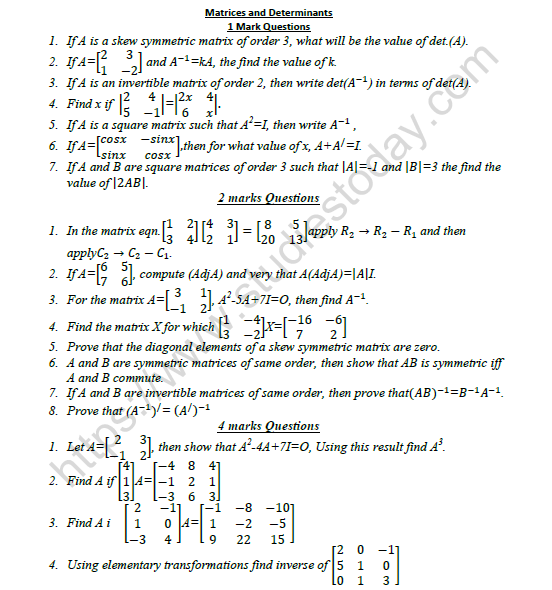
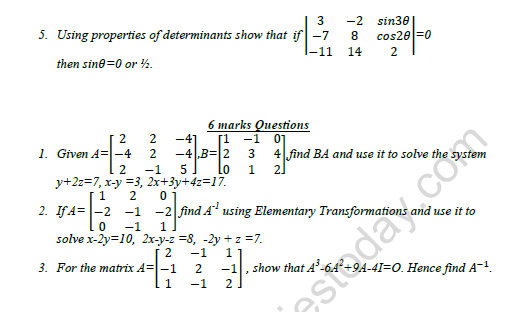
Please click on below link to download CBSE Class 12 Mathematics Matrices And Determinants Worksheet Set C
Free study material for Mathematics
Practice Worksheet and Study Resources for Class 12 Mathematics Chapter 03 Matrices
CBSE Practice Material: Class 12 Mathematics Chapter 03 Matrices
Access structured practice worksheets for Chapter 03 Matrices designed in alignment with the latest CBSE curriculum for Class 12 Mathematics. These printable problem sets help students build accuracy and prepare effectively for school tests.
NCERT-Aligned Questions and Solutions
Cross-reference your completed exercises with comprehensive NCERT solutions for Class 12 Mathematics to ensure absolute clarity across all sub-topics in this chapter.
Next Steps in Your Exam Preparation
Wrap up your chapter revision by testing your knowledge against standard question formats. Everything on our platform is provided free of charge.
FAQs
You can download the teacher-verified PDF for CBSE Class 12 Mathematics Matrices And Determinants Worksheet Set 03 from StudiesToday.com. These practice sheets for Class 12 Mathematics are designed as per the latest CBSE academic session.
Yes, our CBSE Class 12 Mathematics Matrices And Determinants Worksheet Set 03 includes a variety of questions like Case-based studies, Assertion-Reasoning, and MCQs as per the 50% competency-based weightage in the latest curriculum for Class 12.
Yes, we have provided detailed solutions for CBSE Class 12 Mathematics Matrices And Determinants Worksheet Set 03 to help Class 12 and follow the official CBSE marking scheme.
Daily practice with these Mathematics worksheets helps in identifying understanding gaps. It also improves question solving speed and ensures that Class 12 students get more marks in CBSE exams.
All our Class 12 Mathematics practice test papers and worksheets are available for free download in mobile-friendly PDF format. You can access CBSE Class 12 Mathematics Matrices And Determinants Worksheet Set 03 without any registration.