

Official NCERT Solutions for Class 7 Science: Chapter 11 Transportation in Animals and Plants
Explore reliable textbook solutions for Chapter 11 Transportation in Animals and Plants tailored for Class 7 learners. Utilizing these Science answers ensures thorough preparation and strengthens foundational knowledge before final NCERT evaluations.
Chapter-wise Solutions for Science: Chapter 11 Transportation in Animals and Plants
Navigate directly to the solved Science textbook exercises using the digital viewer below. Each solution includes detailed step-by-step explanations, allowing students to instantly cross-check their work and identify areas requiring further revision.
NCERT Solutions for Class 7 Science for chapter 11 Transportation in Animals and Plants
Question.1 Match the structures given in Column I with functions given in Column II.
|
Column I |
Column II |
|
Stomata |
Absorption of water |
|
Xylem |
Transpiration |
|
Root hairs |
Transport of food |
|
Phloem |
Transport of water |
|
Synthesis of carbohydrates |
Answer. 1 The correctly matched contents of Column I with Column II are as follows:
|
Column I |
Column II |
|
Stomata |
Transpiration |
|
Xylem |
Transport of water |
|
Root hairs |
Absorption of water |
|
Phloem |
Transport of food |
Question.2 Fill in the blanks:
(i) The blood from the heart is transported to all parts of the body by the _____
(ii) Haemoglobin is present in cells______
(iii) Arteries and veins are joined by a network of_______
(iv) The rhythmic expansion and contraction of the heart is called_________
(v) The main excretory product in human beings is________
(vi) Sweat contains water and ________
(vii) Kidneys eliminate the waste materials in the liquid form called________
(viii) Water reaches great heights in the trees because of suction pull caused by________
Answer. 2
(i) Arteries
(ii) Red blood cells
(iii) Capillaries
(iv) Heartbeat
(v) Urea
(vi) Salts
(vii) Urine
(viii) Transpiration
Question.3 Choose the correct option:
(a) In plants, water is transported through
(i) xylem (ii) phloem (iii) stomata (iv) root hair
(b) Water absorption through roots can be increased by keeping the plants
(i) in the shade (ii) in dim light (iii) under the fan (iv) covered with a polythene bag
Answer. 3
(a) In plants, water is transported through (i) xylem
(b) Water absorption through roots can be increased by keeping the plants (iii) under the fan
Question.4 Why is transport of materials necessary in a plant or in an animal? Explain.
Answer.4 The transport of materials is necessary in all organisms because it allows exchange of gases, supply of nutrients and removal of waste materials. All plants and animals have well developed transport systems to ensure continuous supply of oxygen, water and food to all parts of the body. Also, the toxic waste materials generated due to various activities is removed from the body by means of transport system only.
Question.5 What will happen if there are no platelets in the blood?
Answer. 5 In the absence of platelets, clot formation will not take place that will result in severe blood loss in case of injury. When a blood vessel is injured, platelets form blood clot that covers the wound protecting it from disease causing microorganisms and preventing blood loss.
Question.6 What are stomata? Give two functions of stomata.
Answer. 6 Stomata are small porespresent on the surface of the leaves forming an opening for exchange of materials. Two important functions of stomata are as follows:
1. Stomata allow exchange of gases, that is, intake of carbon dioxide and release of oxygen through it.
2. Stomata regulate rate of evaporation of water from the leaf surface which is called transpiratio
Question.7 Does transpiration serve any useful function in the plants? Explain.
Answer.7 Transpiration is the loss of water molecules from stomata that causes a suction pull on the water column in xylem. Due to this suction pressure, water is transported to a great height in large trees through the xylem.
Question.8 What are the components of blood?
Answer.8 There are four major components of blood:
1. Plasma
2. Red blood cells
3. White blood cells
4. Platelets
Question.9 Why is blood needed by all the parts of a body?
Answer.9 Blood is the only means of supplying oxygen and nutrients derived from digested food to all parts of the body and removing waste products from them. As blood is the sole means of transport of materials, it is needed by all parts of the body.
Question.10 What makes the blood look red?
Answer.10 Blood appears red because of the presence of a red-coloured pigment in red blood cells called haemoglobin. This pigment binds with oxygen and carries it to all parts of body.
Question.11 Describe the function of the heart.
Answer.11 Heart is a muscular organ that pumps blood to each and every organ of the body. It helps in pumping the blood to lungs for oxygenation. Pumping action of heart keeps blood circulating in the vessels through which various important substances like respiratory gases and nutrients are transported. Heart consists of two atria and two ventricles which contract and relax rhythmically to give rise to the pumping action.
Question.12 Why is it necessary to excrete waste products?
Answer. 12 Waste products need to be excreted because these are toxic in nature and their circulation or presence in body cause damage to various organs of the body.
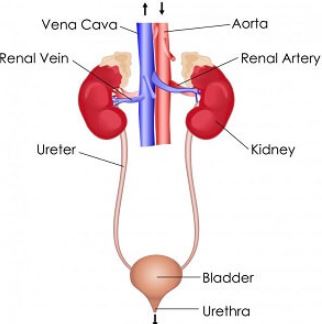
Question.13 Draw a diagram of the human excretory system and label the various parts.
Answer.13 A well-labelled diagram of human excretory system is as follows:
Free study material for Science
NCERT Solutions for Class 7 Science Chapter 11 Transportation in Animals and Plants
Textbook Solutions for Class 7 Science Chapter 11 Transportation in Animals and Plants
Explore reliable textbook solutions for Chapter 11 Transportation in Animals and Plants tailored for Class 7 learners. Utilizing these complete exercise answers ensures your preparation aligns exactly with official NCERT standards for Science.
Mastering Theoretical and Practical Questions
Each solution includes detailed reasoning to foster genuine comprehension of Chapter 11 Transportation in Animals and Plants concepts. Reviewing these step-by-step breakdowns allows learners to master both analytical and descriptive questions expected in school evaluations.
Effective Self-Study and Homework Assistance
Consistent practice with these solution guides cultivates faster problem-solving habits and clearer logical structuring. For a complete preparation experience, pair these textbook answers with our dedicated revision notes and sample papers for Class 7 Science.
FAQs
The complete and updated NCERT Solutions Class 7 Science Chapter 11 Transportation in Animals and Plants is available for free on StudiesToday.com. These solutions for Class 7 Science are as per latest NCERT curriculum.
Yes, our experts have revised the NCERT Solutions Class 7 Science Chapter 11 Transportation in Animals and Plants as per 2026 exam pattern. All textbook exercises have been solved and have added explanation about how the Science concepts are applied in case-study and assertion-reasoning questions.
Toppers recommend using NCERT language because NCERT marking schemes are strictly based on textbook definitions. Our NCERT Solutions Class 7 Science Chapter 11 Transportation in Animals and Plants will help students to get full marks in the theory paper.
Yes, we provide bilingual support for Class 7 Science. You can access NCERT Solutions Class 7 Science Chapter 11 Transportation in Animals and Plants in both English and Hindi medium.
Yes, you can download the entire NCERT Solutions Class 7 Science Chapter 11 Transportation in Animals and Plants in printable PDF format for offline study on any device.