

Step-by-Step Textbook Solutions for Class 7 Science Chapter 03 Fibre to Fabric
Explore reliable textbook solutions for Chapter 03 Fibre to Fabric tailored for Class 7 learners. Utilizing these Science answers ensures thorough preparation and strengthens foundational knowledge before final NCERT evaluations.
Download Chapter 03 Fibre to Fabric Textbook Solutions PDF
View or download the dedicated Chapter 03 Fibre to Fabric solution resource below. Engaging with these textbook answers under focused study conditions ensures continuous academic progress and mastery of the 2026-27 curriculum for Science.
NCERT Solutions for Class 7 Science for chapter 3 Fibre to Fabric
Question.1
You must be familiar with the following nursery rhymes:
(i) ‘Baa baa black sheep, have you any wool.’
(ii) ‘Mary had a little lamb, whose fleece was white as snow.’
Answer the following:
(a) Which parts of the black sheep have wool? (b) What is meant by the white fleece of the lamb?
Answer.
(a) Wool is obtained from fleece (hair) of sheep.
(b) White fleece refers to white thick hairy coat of lamb.
Question.2
The silkworm is (a) a caterpillar, (b) a larva.
Choose the correct option.
(i) a
(ii) b
(iii) both a and b
(iv) neither a nor b
Answer.
The correct option is (iii) both a and b.
Question.3
Which of the following does not yield wool?
(i) Yak
(ii) Camel
(iii) Goat
(iv) Woolly dog
Answer.
(iv) Woolly dog
Question.4
What is meant by the following terms?
(i) Rearing
(ii) Shearing
(iii) Sericulture
Answer.
(i) Rearing: Bringing up and looking after farm animals are known as rearing.
(ii) Shearing: The process of removing the fleece of sheep along with a thin layer of skin is called shearing.
(iii) Sericulture: Rearing (raising) of silkworms for producing silk is known as sericulture.
Question.5 - Given below is a sequence of steps in the processing of wool. Which are the missing missing steps? Add them.
Shearing, ____________. sorting ________
Answer.
Shearing, scouring, sorting, drying, carding
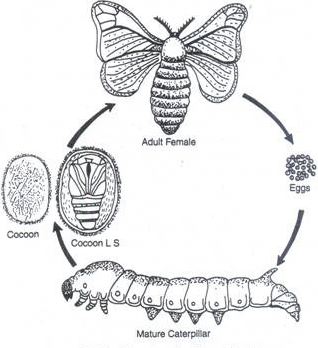
Question.6 Make sketches of the two stages in the life history of the silk moth which are directly related to the production of silk.
Answer.
Question.7 - Out of the following, which are the two terms related to silk production?
Sericulture, floriculture, moriculture, apiculture and silviculture.
Hint: (i) Silk production involves cultivation of mulberry leaves and rearing silkworms.
(ii) Scientific name of mulberry is Morus alba.
Answer.
Out of the given, terms related to silk production are sericulture and moriculture.
Note:
Sericulture: Rearing of silkworms for the production of silk is known as sericulture.
Moriculture: Science of mulberry plant cultivation is known as moriculture.
Question.8
Match the words of column I with those given in Column II.
Column I Column II
1. Scouring (a) Yields silk fibres
2. Mulberry leaves (b) Wool yielding animal
3. Yak (c) Food of silk worm
4. Cocoon (d) Reeling
(e) Cleaning sheared skin
Answer.
Column I Column II
1. Scouring (e) Cleaning sheared skin
2. Mulberry leaves (c) Food of silk worm
3. Yak (b) Wool yielding animal
4. Cocoon (a) Yields silk fibres
Question.9
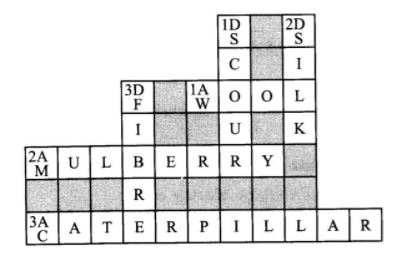
Given below is a crossword puzzle based on this lesson. Use hints to fill in the blank spaces with letters that complete the words.
Down
(D) 1 : Thorough washing
2 : Animal fibre
3 : Long thread like structure
Across
(A) 1 : Keeps warm
2 : Its leaves are eaten by silkworms
3 : Hatches from egg of moth
Answer
Free study material for Science
Science Class 7 Curriculum Solutions: Chapter 03 Fibre to Fabric
Textbook Solutions for Class 7 Science Chapter 03 Fibre to Fabric
Access structured NCERT textbook solutions for Chapter 03 Fibre to Fabric. Designed in alignment with the latest academic curriculum for Class 7 Science, these answers cover all end-of-chapter exercises to support daily learning and homework completion.
Mastering Theoretical and Practical Questions
Beyond providing final answers, these guides offer step-by-step breakdowns for complex queries in the Class 7 Science module. This approach helps students balance theoretical depth with practical problem-solving skills required for NCERT exams.
Effective Self-Study and Homework Assistance
Frequent review of these structured answers builds strong analytical capabilities and response efficiency. Maximize your academic readiness by combining these textbook solutions with our curated study materials and mock evaluations for Class 7 Science.
FAQs
The complete and updated NCERT Solutions Class 7 Science Chapter 3 Fibre to Fabric is available for free on StudiesToday.com. These solutions for Class 7 Science are as per latest NCERT curriculum.
Yes, our experts have revised the NCERT Solutions Class 7 Science Chapter 3 Fibre to Fabric as per 2026 exam pattern. All textbook exercises have been solved and have added explanation about how the Science concepts are applied in case-study and assertion-reasoning questions.
Toppers recommend using NCERT language because NCERT marking schemes are strictly based on textbook definitions. Our NCERT Solutions Class 7 Science Chapter 3 Fibre to Fabric will help students to get full marks in the theory paper.
Yes, we provide bilingual support for Class 7 Science. You can access NCERT Solutions Class 7 Science Chapter 3 Fibre to Fabric in both English and Hindi medium.
Yes, you can download the entire NCERT Solutions Class 7 Science Chapter 3 Fibre to Fabric in printable PDF format for offline study on any device.