

NCERT Solutions for Class 7 Science: Chapter 16 Water A Precious Resource
Explore reliable textbook solutions for Chapter 16 Water A Precious Resource tailored for Class 7 learners. Utilizing these Science answers ensures thorough preparation and strengthens foundational knowledge before final NCERT evaluations.
Practice Class 7 Science Solutions: Chapter 16 Water A Precious Resource
Access the complete solution PDF for Class 7 Science below. Regular practice with these targeted textbook answers builds familiarity with standard question patterns and helps secure higher marks in final school evaluations.
NCERT Solutions for Class 7 Science for chapter 16 Water A Precious Resource
Exercises
1. Mark ‘T’ if the statement is true and ‘F’ if it is false:
(a) The freshwater stored in the ground is much more than that present in the rivers and lakes of the world. (T/F)
(b) Water shortage is a problem faced only by people living in rural areas. (T/F)
(c) Water from rivers is the only source for irrigation in the fields. (T/F)
(d) Rain is the ultimate source of water. (T/F)
Answer
(a) T
(b) F
(c) F
(d) T
2. Explain how groundwater is recharged?
Answer
The rainwater and water from other sources such as rivers and ponds seeps through the soil and fills the empty spaces and cracks deep below the ground. The process of seeping of water into the ground is called infiltration. The groundwater thus gets recharged by this process.
3. There are ten tubewells in a lane of fifty houses. What could be the long term impact on the water table?
Answer
This will lead to exploitation of water resource present underground if people of all the fifty houses in the lane use the ten tubewells regularly. In long term, the water level will go below and thus the depletion of tubewells.
4. You have been asked to maintain a garden. How will you minimise the use of water?
Answer
For minimising the use of water in maintenance of garden, i will use the technique of drip irrigation. In this method, required amount water is supplied directly to the roots of the plants using narrow pipes thus preventing the loss of water.
5. Explain the factors responsible for the depletion of water table.
Answer
Factors responsible for the depletion of water level:
(i) Increase in the demand of water due to overpopulation.
(ii) Deforestation leads to less rainfall which affect the recharge of river and pounds.
(iii) Increase the number of industries as they use a lot of water for their purpose.
(iv) Insignificant uses in agriculture activities as in many parts of the world people uses old techniques which waste a lot of water.
(v) Lack awareness in people is also a main reason behind the depletion of water level as they waste water without any uses.
6. Fill in the blanks with the appropriate answers:
(a) People obtain groundwater through________ and ________ .
(b) Three forms of water are ________, ________ and ________.
(c) The water bearing layer of the earth is ________.
(d) The process of water seepage into the ground is called ________.
Answer
(a) People obtain groundwater through tube wells and hand pumps.
(b) Three forms of water are ice, water and vapour.
(c) The water bearing layer of the earth is aquifer.
(d) The process of water seepage into the ground is called infiltration.
7. Which one of the following is not responsbile for water shortage?
(i) Rapid growth of industries
(ii) Increasing population
(iii) Heavy rainfall
(iv) Mismanagement of water resources
Answer
(iii) Heavy rainfall
8. Choose the correct option. The total water
(i) in the lakes and rivers of the world remains constant.
(ii) under the ground remains constant.
(iii) in the seas and oceans of the world remains constant.
(iv) of the world remains constant.
Answer
(iv) of the world remains constant.
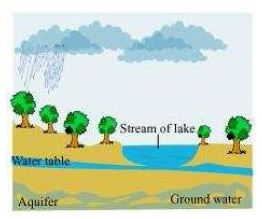
9. Make a sketch showing groundwater and water table. Label it.
Free study material for Science
Step-by-Step Textbook Answers: Class 7 Science Chapter 16 Water A Precious Resource
Textbook Solutions for Class 7 Science Chapter 16 Water A Precious Resource
Access structured NCERT textbook solutions for Chapter 16 Water A Precious Resource. Designed in alignment with the latest academic curriculum for Class 7 Science, these answers cover all end-of-chapter exercises to support daily learning and homework completion.
Mastering Theoretical and Practical Questions
Beyond providing final answers, these guides offer step-by-step breakdowns for complex queries in the Class 7 Science module. This approach helps students balance theoretical depth with practical problem-solving skills required for NCERT exams.
Effective Self-Study and Homework Assistance
Frequent review of these structured answers builds strong analytical capabilities and response efficiency. Maximize your academic readiness by combining these textbook solutions with our curated study materials and mock evaluations for Class 7 Science.
FAQs
The complete and updated NCERT Solutions Class 7 Science Chapter 16 Water A Precious Resource is available for free on StudiesToday.com. These solutions for Class 7 Science are as per latest NCERT curriculum.
Yes, our experts have revised the NCERT Solutions Class 7 Science Chapter 16 Water A Precious Resource as per 2026 exam pattern. All textbook exercises have been solved and have added explanation about how the Science concepts are applied in case-study and assertion-reasoning questions.
Toppers recommend using NCERT language because NCERT marking schemes are strictly based on textbook definitions. Our NCERT Solutions Class 7 Science Chapter 16 Water A Precious Resource will help students to get full marks in the theory paper.
Yes, we provide bilingual support for Class 7 Science. You can access NCERT Solutions Class 7 Science Chapter 16 Water A Precious Resource in both English and Hindi medium.
Yes, you can download the entire NCERT Solutions Class 7 Science Chapter 16 Water A Precious Resource in printable PDF format for offline study on any device.