

Download NCERT Solutions for Class 11 Mathematics Chapter 07 Binomial Theorem
Explore reliable textbook solutions for Chapter 07 Binomial Theorem tailored for Class 11 learners. Utilizing these Mathematics answers ensures thorough preparation and strengthens foundational knowledge before final NCERT evaluations.
Access NCERT Solutions and Answers
Access the complete solution PDF for Class 11 Mathematics below. Regular practice with these targeted textbook answers builds familiarity with standard question patterns and helps secure higher marks in final school evaluations.
Exercise 8.1
1. Expand the expression (1– 2x)5
Answer :
By using Binomial Theorem, the expression (1-2x) can be expanded as
(1 -2x)5
= 5C0 (1)5 – 5C1 (1)4 (2x) + 5C2 (1)3 (2x)2 - 5C3 (1)2 (2x)3 + 5C4 (1)1(2x)4 + 5C5 (2x)5
= 1 – 5(2x) + 10(4x2 ) – 10(8x3 )+ 5(16x4 ) – (32x5 )
= 1 – 10x + 40x2 – 80x3 + 80x4 – 32x5
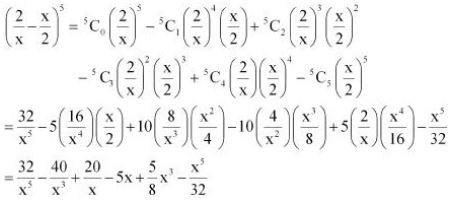
2. Expand the expression (2/x - x/2)5
Answer :
By using Binomial Theorem, the expression (2/x - x/2)5 can be expanded as
3. Expand the expression (2x – 3)6 .
Answer :
By using Binomial theorem, the expression (2x - 3)6 can be expanded as
(2x - 3)6
= 6C0 (2x)6 – 6C1 (2x)5 (3) + 6C2 (2x)4 (3)2 – 6C3 (2x)3 (3)3 + 6C4 (2x)2 (3)4 – 6C5 (2x) (3)5 + 6C6 (3)6
= 64x6 – 6(32x5 )(3) + 15(16x4 )(9) – 20(8x3 )(27) + 15(4x2) (81) – 6(2x)(243) + 729
= 64x6 – 576x5 + 2160x4 – 4320x3 + 4860x2 – 2916x + 729
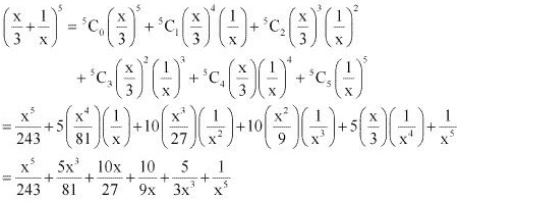
4. Expand the expression (x/3 + 1/x)5
Answer :
By using Binomial Theorem, the expression (x/3 + 1/x)5 can be expanded as
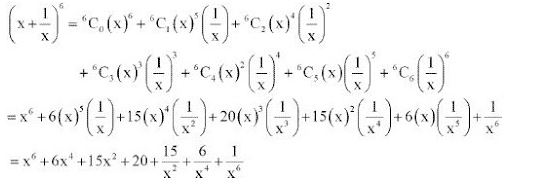
5. Expand (x + 1/x)6
Answer :
By using Binomial Theorem, the expression(x + 1/x)6 can be expanded as
6. Using Binomial Theorem, evaluate (96)3
Answer :
96 can be expressed as the sum or difference of two numbers whose powers are easier to calculate and then, binomial theorem can be applied.
It can be written that, 96 = 100 - 4
∴ (96)3 = (100 - 4)3
= 3C0 (100)3 - 3C1 (100)2 (4) + 3C2 (100)(4)2 - 3C3 (4)3
= (100)3 - 3(100)2 (4) + 3(100)(4)2 - (4)3
= 1000000 - 120000 + 4800 - 64
= 884736
7. Using Binomial Theorem, evaluate (102)5
Answer :
102 can be expressed as the sum or difference of two numbers whose powers are easier to calculate and then, Binomial Theorem can be applied.
It can be written that, 102 = 100 + 2
∴ (102)5 = (100 + 2)5
= 5C0(100)5 - 5C1(100)4 (2) + 5C2(100)3 (2)2 - 5C3(100)2 (2)3 + 5C4(100)(2)4 + 5C5(2)5
= (100)5 + 5(100)4 (2) + 10(100)3 (2)2 + 10(100)2 (2)3 + 5(100)(2)4 +(2)5
= 10000000000 + 1000000000 + 40000000 + 800000 + 8000 + 32
= 11040808032
8. Using Binomial Theorem, evaluate (101)4
Answer :
101 can be expressed as the sum or difference of two numbers whose powers are easier to calculate and then, Binomial Theorem can be applied.
It can be written that, 101 = 100 + 1
∴ (101)4 = (100 + 1)4
= 4C0(100)4 - 4C1(100)3 (1) + 4C2(100)2 (1)2 - 4C3(100)(1)3 + 4C4(1)4
= (100)4 + 4(100)3 + 6(100)2 + 4(100) + (1)4
= 100000000 +4000000 + 60000 + 400 + 1
= 104060401
9. Using Binomial Theorem, evaluate (99)5
Answer :
99 can be written as the sum or difference of two numbers whose powers are easier to calculate and then, Binomial Theorem can be applied.
It can be written that, 99 = 100 – 1
∴ (99)5 = (100 - 1)5
= 5C0 (100)5 - 5C1 (100)4 (1) + 5C2 (100)3 (1)2 - 5C3 (100)2 (1)3 + 5C4 (100)(1)4 + 5C5 (1)5
= (100)5 - 5(100)4 + 10(100)3 - 10(100)2 + 5(100) - 1
= 10000000000 - 500000000 + 10000000 - 100000 + 500 - 1
= 10010000500 - 500100001
= 9509900499
10. Using Binomial Theorem, indicate which number is larger (1.1)10000 or 1000.
Answer :
By splitting 1.1 and then applying Binomial Theorem, the first few terms of (1.1)10000 can be obtained as
(1.1)10000 = (1 + 0.1)10000
= 10000C0 - 10000C1 (1.1) + Other positive terms
= 1 + 10000 × 1.1 + Other positive terms
= 1 + 11000 + Other positive terms
> 1000
Hence, (1.1)10000 > 1000
11. Find (a + b)4 - (a - b)4. Hence, evaluate (√3 + √2)4 - (√3 - √2)4
Answer :
Using Binomial Theorem, the expressions, (a + b)4 and (a - b)4 , can be expanded as
(a + b)4 = 4C0a4 + 4C1a3b + 4C2a2b2 + 4C3ab3 + 4C4b4
(a - b)4 = 4C0a4 - 4C1a3b + 4C2a2b2 - 4C3ab3 + 4C4b4
∴ (a + b)4 - (a - b)4 = 4C0a4 + 4C1a3b + 4C2a2b2 + 4C3ab3 + 4C4b4 - [4C0a4 - 4C1a3b + 4C2a2b2 - 4C3ab3 + 4C4b4]
= 2(4C1a3b + 4C3ab3) = 2(4a3b + 4ab3)
= 8ab (a2 + b2 )
By putting a = √3 and b = √2 , we obtain
(√3 + √2)4 - (√3 - √2)4 = 8(√3)(√2) {(√3)2 + (√2)2 }
= 8(√6) (3 + 2) = 40√6
12. Find (x + 1)6 + (x -1)6. Hence or otherwise evaluate (√2 + 1)6 + (√2 - 1)6
Answer :
Using Binomial Theorem, the expressions, (x + 1)6 and (x - 1)6 , can be expanded as
(x + 1)6 = 6C0 x6 + 6C1 x5 + 6C2 x4 + 6C3 x3 + 6C4 x2 + 6C5 x + 6C6
(x - 1)6 = 6C0 x6 - 6C1 x5 + 6C2 x4 - 6C3 x3 + 6C4 x2 - 6C5 x + 6C6
∴ (x + 1)6 + (x -1)6 = 2[6C0 x6 + 6C1 x5 + 6C2 x4 + 6C4 x2 + 6C6]
= 2[x6 + 15x4 + 15x2 + 1]
By putting x = √2, we obtain
(√2 + 1)6 + (√2 - 1)6 = 2[(√2)6 + 15(√2)4 + 15(√2)2 + 1 ]
= 2(8 + 15 × 4 + 15 × 2 + 1)
= 2(8 + 60 + 30 + 1)
= 2(99) = 198
13. Show that 9n+1 – 8n – 9 is divisible by 64, whenever n is a positive integer.
Answer :
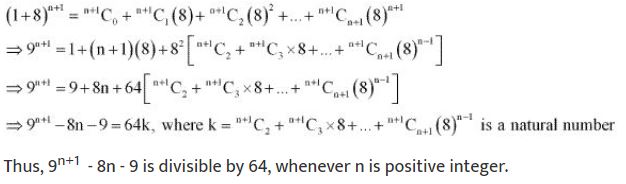
In order to show that 9n+1 - 8n - 9 is divisible by 64, it has to be proved that,
9n+1 - 8n - 9 = 64k, where k is some natural number.
By Binomial Theorem,
(1 + a)m = mC0 + mC1 a + mC2 a2 + .... + mCm am
For a = 8 and m = n + 1, we obtain
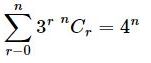
14. Prove that
Answer :
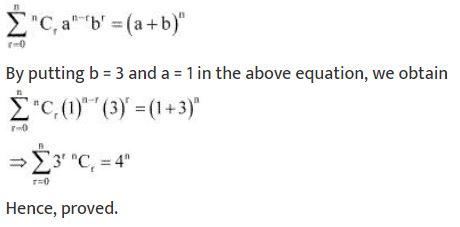
By Binomial Theorem,
Exercise 8.2
1. Find the coefficient of x5 in (x + 3)8
Answer :
It is known that (r + 1)th term, (Tr+1), in the binomial expansion of (a + b)n is given by Tr+1 = nCr an-rbr.
Assuming that x5 occurs in the (r + 1)th term of the expansion (x + 3)8 , we obtain
Tr+1 = 8Cr x8-r 3r.
Comparing the indices of x in x5 and in Tr+1, we obtain
r = 3
Thus, the coefficient of x5 is 8Cr (3)3 = (8!/3!5!) × 33 = (8.7.6.5!/3.2.5!).33 = 1512
2. Find the coefficient of a5 b7 in (a - 2b)12 .
Answer :
It is known that (r + 1)th term, (Tr+1), in the binomial expansion of (a + b)n is given by Tr+1 = nCr an-r br .
Assuming that a5 b7 occurs in the (r + 1)th term of the expansion (a - 2b)12 , we obtain

Comparing the indices of a and b in a5 b7 and in Tr+1 , we obtain
r = 7
Thus, the coefficient of a5 b7 is 12C7 (-2)7 = (-12!/7!5!) .27 = (12.11.10.9.8.7!/5.4.3.2.7!) 27 = -(792)(128) = -101376
3. Write the general term in the expansion of (x2 - y)6
Answer :
It is known that the general term Tr+1{which is the (r+1)th term} in the binomial expansion of (a + b)n is given by Tr+1 = nCr an-r br .
Thus, the general term in the expansion of (x2 - y6) is
Tr+1 = 6Cr (x2 )6-r (-y)r . (-1)r 6Cr x12-2r yr
Question4. Write the general term in the expansion of (x2 – yx)12, x ≠ 0
Answer :
General form of the expansion Tr+1 is
{ which is the (r+1)th term } in the binomial expansion of (a+b)n is given by Tr+1=nCran−rbr.
Thus, the general term in the expansion of (x2−yx)12
is Tr+1 = 12Cr(x2)12−t(−yx)r
=(−1)r12Cr−x24−2r−yr
=(−1)r−2Crx24−r⋅yr
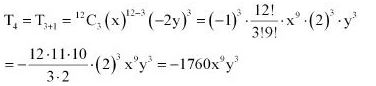
5. Find the 4th term in the expansion of (x – 2y)12 .
Answer :
It is known that (r + 1)th term, Tr+1, in the binomial expansion of (a + b)n is given by Tr+1 = nCr an-r br .
Thus, the 4th term in the expansion of (x - 2y)12 is
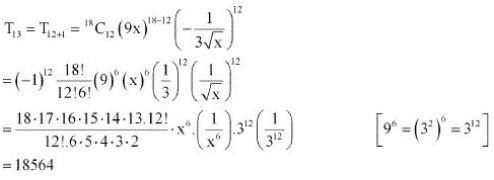
6. Find the 13th term in the expansion of (9x - 1/3√x)18 , x ≠ 0.
Answer :
It is known that (r + 1)th term, (Tr+1 ), in the binomial expansion of (a + b)n is given by Tr+1 = nCr an-r br.
Thus, 13th term in the expansion of (9x - 1/3√x)18 is
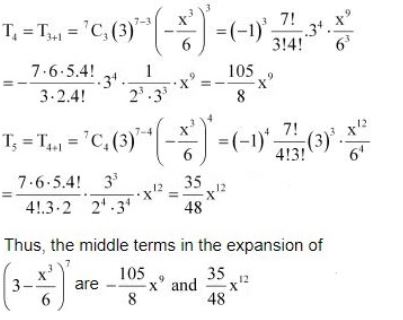
7. Find the middle terms in the expansions of (3 - x3 /6)7 .
Answer :
It is known that in the expansion of (a + b)n, if n is odd, then there are two middle terms, namely, [(n+1)/2]8 term and [(n+1)/2 + 1)th term.
Therefore, the middle terms in the expansion of [3 - x3 /6]7 are [(7+1)/2]th = 4th term and [(7+1)/2 + 1)th = 5th term
8. Find the middle terms in the expansions of (x/3 + 9y)10
Answer :
It is known that in the expansion (a + b)n , if n is even , then the middle term is (n/2 + 1)th term.
Therefore, the middle term in the expansion of (x/3 + 9y)10 is (10/2 + 1)th = 6th term
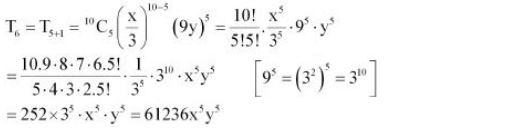
Thus, the middle term in the expansion of (x/3 + 9y)10 is 61236 x5 y5.
9. In the expansion of (1 + a)m + n, prove that coefficients of am and an are equal.
Answer :
It is known that (r + 1)th term, (Tr+1), in the binomial expansion of (a + b)n is given by Tr+1 = nCr an-r br .
Assuming that am occurs in the (r + 1)th term of the expansion (1 + a)m + n, we obtain
Tr+1 = m+nCr (1)m+n-r (a)r . = m+nCr ar
Comparing the indices of a in am and in Tr+1, we obtain
r = m
Therefore, the coefficient of am i

10. The coefficients of the (r – 1)th, rth and (r + 1)th terms in the expansion of (x + 1)n are in the ratio 1:3:5. Find n and r.
Answer :
It is known that (k +1)th term, (Tk+1 ) in the binomial expansion of (a + b)n is given by Tk+1 = nCk an-k bk .
Therefore, (r – 1)th term in the expansion of (x + 1)n is Tr-1 = nCr-2 (x)n-(r-2) (1)(r- 2) = nCr-2 Xn-r+2
rth term in the expansion of (x + 1)n is Tr = nCr-1 (x)n-(r-1) (1)(r-1) = nCr-1 xn-r+1
(r +1)th term in the expansion of (x +1)n is Tr+1 = nCr (X)n-r (1)r = nCr Xn-r
Therefore, the coefficients of the (r -1)th , rth and (r + 1)th terms in the expansion of (x + 1)n are nCr-2 , nCr-1 and nCr respectively. Since these coefficients are in the ratio 1 : 3 : 5, we obtain
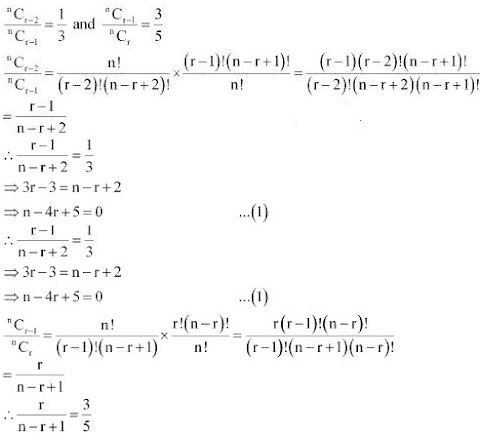
Multiplying (1) by 3 and subtracting it from (2), we obtain
4r – 12 = 0
⇒ r = 3
Putting the value of r in (1), we obtain
n – 12 + 5 = 0
⇒ n = 7
Thus, n = 7 and r = 3
11. Prove that the coefficient of xn in the expansion of (1 + x)2n is twice the coefficient of xn in the expansion of (1 + x)2n–1 .
Answer :
It is known that (r + 1)th term, (Tr+1), in the binomial expansion of (a + b)n is given by Tr+1 = nCr an-r br ..
Assuming that xn occurs in the (r + 1)th term of the expansion of (1 + x)2n, we obtain

Comparing the indices of x in xn and in Tr+1 , we obtain
r = n
Therefore, the coefficient of xn in the expansion of (1 + x)2n is

Therefore, the coefficient of xn in the expansion of (1 + x)2n is twice the coefficient of xn in the expansion of (1 + x)2n–1.
Hence, proved.
12. Find a positive value of m for which the coefficient of x2 in the expansion (1 + x)m is 6
Answer :
It is known that (r + 1)th term, (Tr+1), in the binomial expansion of (a + b)n is given by .
Tr+1 = nCr an-r br .
Assuming that x2 occurs in the (r + 1)th term of the expansion (1 +x)m, we obtain
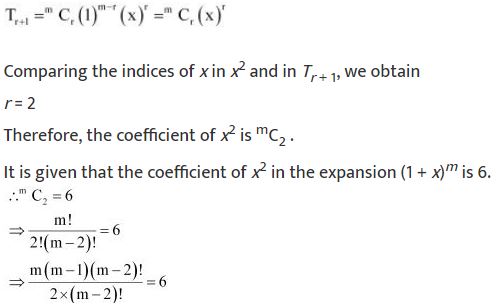
⇒ m(m - 1) = 12
⇒ m2 - m - 12 = 0
⇒ m2 - 4m + 3m - 12 = 0
⇒ m(m - 4) + 3(m -4) = 0
⇒ (m - 4)(m + 3) = 0
⇒ (m - 4) = 0 or (m +3) = 0
⇒ m = 4 or m = -3
Thus, the positive value of m, for which the coefficient of x2 in the expansion
(1 + x)m is 6, is 4.
Miscellaneous Solutions
1. Find a, b and n in the expansion of (a + b)n if the first three terms of the expansion are 729, 7290 and 30375, respectively.
Answer :
It is known that (r + 1)th term, (Tr+1), in the binomial expansion of (a + b)n is given by
Tr+1 = nCr an-r br .
The first three terms of the expansion are given as 729, 7290, and 30375 respectively.
Therefore, we obtain
T1 = nC0 an-0 b0 = an = 729 ...(1)
T2 = nC1 an-1 b1 = nan-1 b = 7290 ...(2)
T3 = nC2 an-2 b2 = [n(n-1)/2] an-2 b2 = 30375 ...(3)
Dividing (2) by (1), we obtain
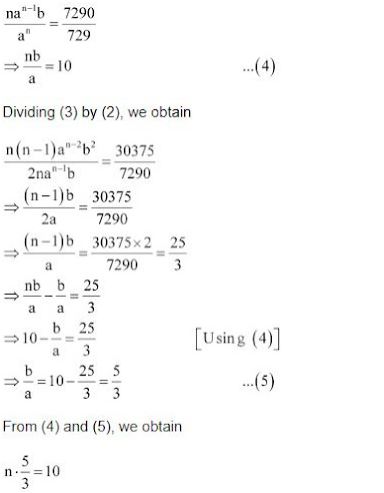
⇒ n = 6
Substituting n = 6 in equation (1), we obtain
a6 = 729
⇒ a = 6√729 = 3
From (5), we obtain
b/3 = 5/3 ⇒ 5
Thus, a = 3 , b = 5 , and n = 6.
2. Find a if the coefficients of x2 and x3 in the expansion of (3 + ax)9 are equal.
Answer :
It is known that (r + 1)th term, (Tr+1), in the binomial expansion of (a + b)n is given by Tr+1 = nCr an-r br ..
Assuming that x2 occurs in the (r + 1)th term in the expansion of (3 + ax)9, we obtain
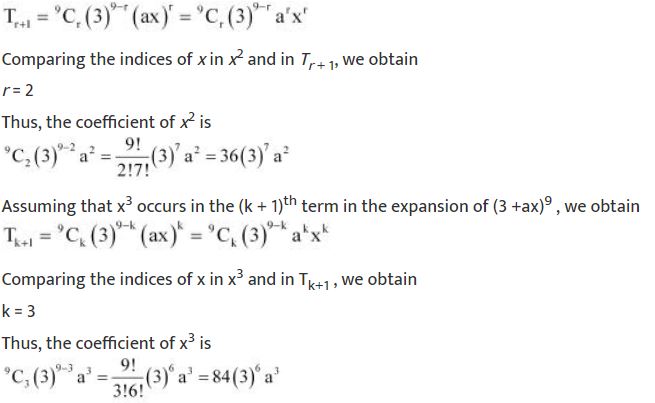
It is given that the coefficients of x2 and x3 are the same.
84(3)6 a3 = 36(3)7 a2
⇒ 84a = 36× 3
⇒ a = (36× 3)/84 = 104/84
⇒ a = 9/7
Thus, the required value of a is 9/7.
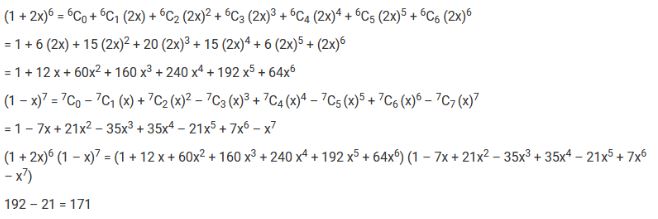
3. Find the coefficient of x5 in the product (1 + 2x)6 (1 – x)7 using binomial theorem.
Answer :
Question4. If a and b are distinct integers, prove that a – b is a factor of an – bn, whenever n is a positive integer.
[Hint: write an = (a – b + b)n and expand]
Answer :
n order to prove that (a – b) is a factor of (an – bn), it has to be proved that
an – bn = k (a – b) where k is some natural number.
a can be written as a = a – b + b
an = (a – b + b)n = [(a – b) + b]n
= nC0 (a – b)n + nC1 (a – b)n-1 b + …… + n C n bn
an – bn = (a – b) [(a –b)n-1 + nC1 (a – b)n-1 b + …… + n C n bn]
an – bn = (a – b) k
Where k = [(a –b)n-1 + nC1 (a – b)n-1 b + …… + n C n bn] is a natural number
Question5. Evaluate: (√3 + √2)6 - (√3 - √2)6
Answer :

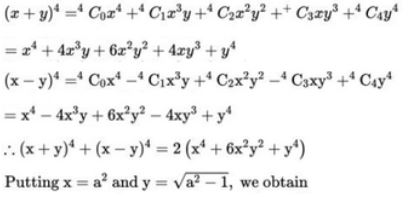
6. Find the value of [a2 + √(a2 - 1)]4 + [a2 - √(a2 - 1)]4
Answer :
Firstly, the expression (x + y)4 + (x – y)4 is simplified by using Binomial Theorem.
This can be done as
7. Find an approximation of (0.99)5 using the first three terms of its expansion.
Answer :
0.99 = 1 - 0.01
∴ (0.99)5 = (1 - 0.01)5
= 5C0 (1)5 - 5C1 (1)4 (0.01) + 5C2 (1)3 (0.01)2 (Approximately)
= 1 - 5(0.01) + 10(0.01)2
1 - 0.05 + 0.001
= 1.001 - 0.05
= 0.951
Thus, the value of (0.99)5 is approximately 0.951.
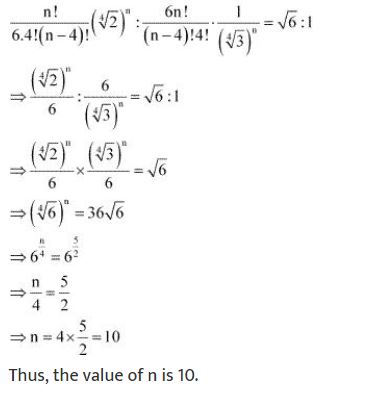
8. Find n, if the ratio of the fifth term from the beginning to the fifth term from the end in the expansion of (4√2 + 1/4√3 )n is √6 : 1
Answer :
(a + b)n = nC0an + nC1an-1b + nC2an-2b2 + ... + nCn-1 abn-1 + nCnbn,
Fifth term from the beginning = nC4 an-4 b4
Fifth term from the end = nCn-4 a4 bn-4
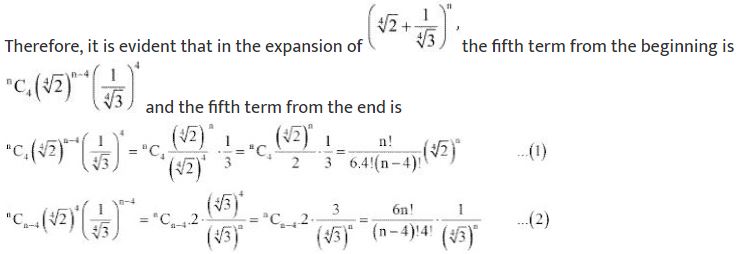
It is given that the ratio of the fifth term from the beginning to the fifth term from the end is √6 : 1. Therefore, from (1) and (2), we obtain
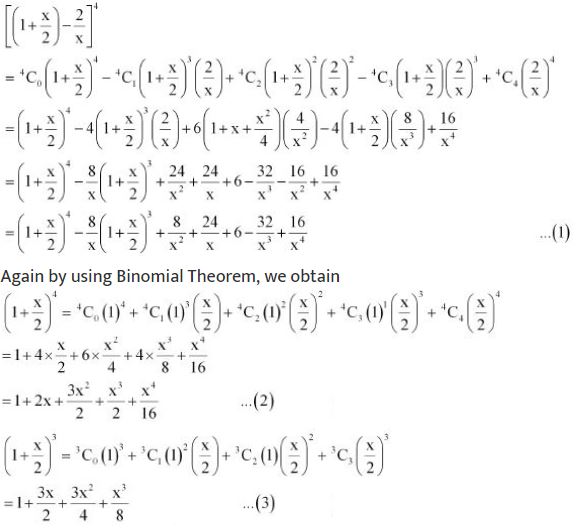
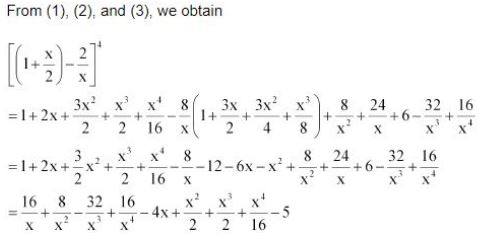
9. Expand using Binomial Theorem (1 + x/2 - 2/x)4, x ≠ 0
Answer :
Using Binomial Theorem, the given expression (1 + x/2 - 2/x)4 can be expanded as
Question10. Find the expansion of (3x2 – 2ax + 3a2)3using binomial theorem.
Answer :
Here
= We know that (a + b)3 = a3 + 3a2b + 3ab2 + b3
Putting a = 3x2 & b = -a (2x-3a), we get
[3x2 + (-a (2x-3a))]3
= (3x2)3+3(3x2)2(-a (2x-3a)) + 3(3x2) (-a (2x-3a))2 + (-a (2x-3a))3
= 27x6 – 27ax4 (2x-3a) + 9a2x2 (2x-3a)2 – a3(2x-3a)3
= 27x6 – 54ax5 + 81a2x4 + 9a2x2 (4x2-12ax+9a2) – a3 [(2x)3 – (3a)3 – 3(2x)2(3a) + 3(2x)(3a)2]
= 27x6 – 54ax5 + 81a2x4 + 36a2x4 – 108a3x3 + 81a4x2 – 8a3x3 + 27a6 + 36a4x2 – 54a5x
= 27x6 – 54ax5+ 117a2x4 – 116a3x3 + 117a4x2 – 54a5x + 27a6
Thus, (3x2 – 2ax + 3a2)3
= 27x6 – 54ax5+ 117a2x4 – 116a3x3 + 117a4x2 – 54a5x + 27a6
Free study material for Mathematics
NCERT Solutions for Class 11 Mathematics Chapter 07 Binomial Theorem
Official NCERT Solutions for Chapter 07 Binomial Theorem
Explore reliable textbook solutions for Chapter 07 Binomial Theorem tailored for Class 11 learners. Utilizing these complete exercise answers ensures your preparation aligns exactly with official NCERT standards for Mathematics.
Step-by-Step Explanations for Chapter 07 Binomial Theorem
Each solution includes detailed reasoning to foster genuine comprehension of Chapter 07 Binomial Theorem concepts. Reviewing these step-by-step breakdowns allows learners to master both analytical and descriptive questions expected in school evaluations.
Next Steps in Your Mathematics Revision
Consistent practice with these solution guides cultivates faster problem-solving habits and clearer logical structuring. For a complete preparation experience, pair these textbook answers with our dedicated revision notes and sample papers for Class 11 Mathematics.
FAQs
The complete and updated NCERT Solutions Class 11 Mathematics Chapter 8 Binomial Theorem is available for free on StudiesToday.com. These solutions for Class 11 Mathematics are as per latest NCERT curriculum.
Yes, our experts have revised the NCERT Solutions Class 11 Mathematics Chapter 8 Binomial Theorem as per 2026 exam pattern. All textbook exercises have been solved and have added explanation about how the Mathematics concepts are applied in case-study and assertion-reasoning questions.
Toppers recommend using NCERT language because NCERT marking schemes are strictly based on textbook definitions. Our NCERT Solutions Class 11 Mathematics Chapter 8 Binomial Theorem will help students to get full marks in the theory paper.
Yes, we provide bilingual support for Class 11 Mathematics. You can access NCERT Solutions Class 11 Mathematics Chapter 8 Binomial Theorem in both English and Hindi medium.
Yes, you can download the entire NCERT Solutions Class 11 Mathematics Chapter 8 Binomial Theorem in printable PDF format for offline study on any device.