

Official NCERT Solutions for Class 11 Mathematics: Chapter 11 Introduction to Three Dimensional Geometry
Review structured textbook solutions for Class 11 Mathematics Chapter 11 Introduction to Three Dimensional Geometry. Built according to NCERT guidelines for the 2026-27 academic year, these downloadable answers support daily revision and problem-solving accuracy.
Chapter-wise Solutions for Mathematics: Chapter 11 Introduction to Three Dimensional Geometry
Navigate directly to the solved Mathematics textbook exercises using the digital viewer below. Each solution includes detailed step-by-step explanations, allowing students to instantly cross-check their work and identify areas requiring further revision.
Exercise 12.1
Question 1: A point is on the x-axis. What are its y-coordinates and z-coordinates?
Answer : If a point is on the x-axis, then its y-coordinates and z-coordinates are zero.
Question 2: A point is in the XZ-plane. What can you say about its y-coordinate?
Answer : If a point is in the XZ plane, then its y-coordinate is zero.
Question 3: Name the octants in which the following points lie:
(1, 2, 3), (4, –2, 3), (4, –2, –5), (4, 2, –5), (–4, 2, –5), (–4, 2, 5), (–3, –1, 6), (2, –4, –7)
Answer : The x-coordinate, y-coordinate, and z-coordinate of point (1, 2, 3) are all positive. Therefore, this point lies in octant I.
The x-coordinate, y-coordinate, and z-coordinate of point (4, –2, 3) are positive, negative, and positive respectively. Therefore, this point lies in octant IV.
The x-coordinate, y-coordinate, and z-coordinate of point (4, –2, –5) are positive, negative, and negative respectively. Therefore, this point lies in octant VIII.
The x-coordinate, y-coordinate, and z-coordinate of point (4, 2, –5) are positive, positive, and negative respectively. Therefore, this point lies in octant V.
The x-coordinate, y-coordinate, and z-coordinate of point (–4, 2, –5) are negative, positive, and negative respectively. Therefore, this point lies in octant VI.
The x-coordinate, y-coordinate, and z-coordinate of point (–4, 2, 5) are negative, positive, and positive respectively. Therefore, this point lies in octant II.
The x-coordinate, y-coordinate, and z-coordinate of point (–3, –1, 6) are negative, negative, and positive respectively. Therefore, this point lies in octant III.
The x-coordinate, y-coordinate, and z-coordinate of point (2, –4, –7) are positive, negative, and negative respectively. Therefore, this point lies in octant VIII.
4. Fill in the blanks:
(i) The x-axis and y-axis taken together determine a plane known as______.
(ii) The coordinates of points in the XY-plane are of the form ______.
(iii) Coordinate planes divide the space into ______ octants.
Answer :
(i) The x-axis and y-axis taken together determine a plane known as XY-plane.
(ii) The coordinates of points in the XY-plane are of the form (x, y, 0) .
(iii) Coordinate planes divide the space into eight octants.
Exercise 12.2
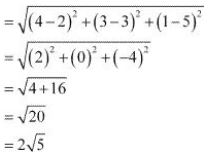
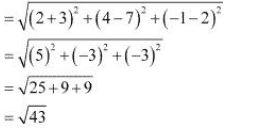
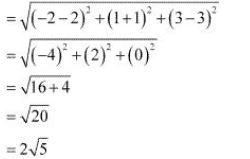
1. Find the distance between the following pairs of points:
(i) (2, 3, 5) and (4, 3, 1)
(ii) (–3, 7, 2) and (2, 4, –1)
(iii) (–1, 3, –4) and (1, –3, 4)
(iv) (2, –1, 3) and (–2, 1, 3)
Answer :
The distance between points P(x1, y1, z1) and P(x2, y2, z2) is given by

(i) Distance between points (2, 3, 5) and (4, 3, 1)
(ii) Distance between points (-3, 7, 2) and (2, 4, -1)
(iv) Distance between points (2, -1, 3) and (-2, 1, 3)
2. Show that the points (–2, 3, 5), (1, 2, 3) and (7, 0, –1) are collinear.
Answer :
Let points (–2, 3, 5), (1, 2, 3), and (7, 0, –1) be denoted by P, Q, and R respectively.
Points P, Q, and R are collinear if they lie on a line.
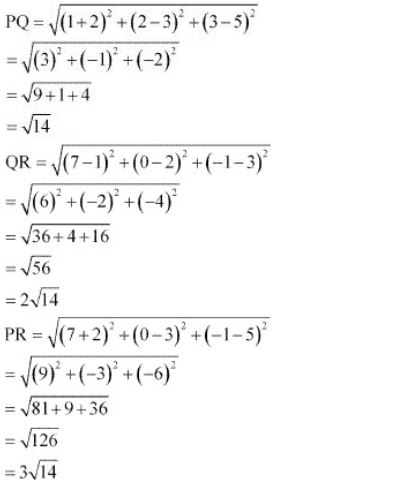
Here, PQ + QR = √14 + 2√14 = 3√14 = PR
Hence, points P(-2, 3, 5), Q(1, 2, 3), and R(7, 0, -1) are collinear.
3. Verify the following:
(i) (0, 7, –10), (1, 6, –6) and (4, 9, –6) are the vertices of an isosceles triangle.
(ii) (0, 7, 10), (–1, 6, 6) and (–4, 9, 6) are the vertices of a right angled triangle.
(iii) (–1, 2, 1), (1, –2, 5), (4, –7, 8) and (2, –3, 4) are the vertices of a parallelogram.
Answer :
(i) Let points (0, 7, -10), (1, 6, -6), and (4, 9, -6) be denoted by A, B, and C respectively.
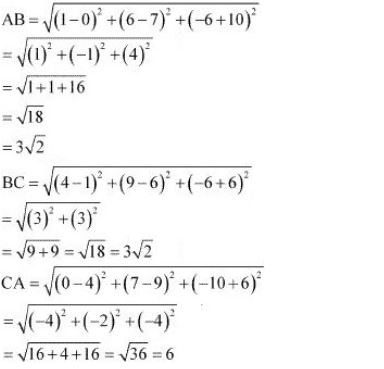
Here, AB = BC ≠ CA
Thus, the given points are the vertices of an isosceles triangle.
(ii) Let (0, 7, 10), (–1, 6, 6), and (–4, 9, 6) be denoted by A, B, and C respectively.
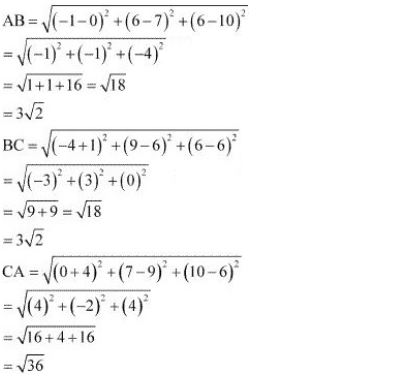
Now, AB2 + BC2 = (3√2)2 + (3√2)2 = 18 + 18 = 36 = AC2.
Therefore, by Pythagoras theorem, ABC is a right triangle.
Hence, the given points are the vertices of a right - angled triangle.
(iii) Let (-1, 2, 1), (1, -2, 5), (4, -7, 8), and (2, -3, 4) be denoted by A, B, C, and D respectively.
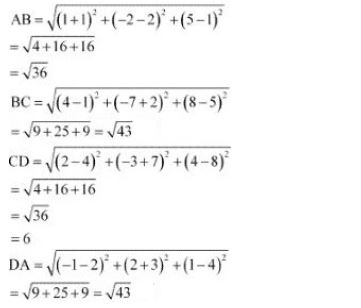
Here, AB = CD = 6, BC = AD = √43
Hence, the opposite sides of quadrilateral ABCD, whose vertices are taken in order, are equal.
Therefore, ABCD is a parallelogram.
Hence, the given points are the vertices of a parallelogram.
4. Find the equation of the set of points which are equidistant from the points (1, 2, 3) and (3, 2, –1).
Answer :
Let P (x, y, z) be the point that is equidistant from points A(1, 2, 3) and B(3, 2, –1).
Accordingly, PA = PB
⇒ PA2 = PB2
⇒ (x - 1)2 + (y - 2)2 + (z - 3)2 = (x -3)2 + (y - 2)2 + (z + 1)2
⇒ x2 - 2x + 1 + y2 - 4y + 4 +z2 - 6z + 9 = x2 - 6x + 9 + y2 - 4y + 4 + z2 + 2z + 1
⇒ -2x - 4y - 6z + 14 = -6x - 4y + 2z + 14
⇒ -2x - 6z + 6x - 2z = 0
⇒ 4x - 8z = 0
⇒ x - 2z = 0
Thus, the required equation is x - 2z = 0.
5. Find the equation of the set of points P, the sum of whose distances from A (4, 0, 0) and B (–4, 0, 0) is equal to 10.
Solution
Let the coordinates of P be (x, y, z).
The coordinates of points A and B are (4, 0, 0) and (–4, 0, 0) respectively.
It is given that PA + PB = 10.
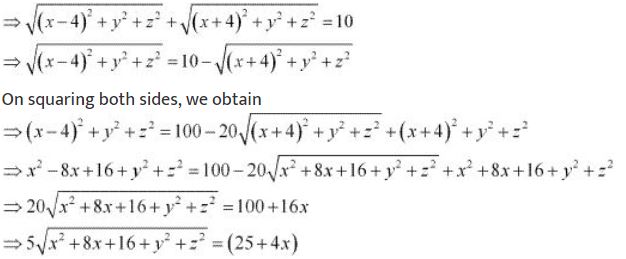
On squaring both sides again, we obtain
25 (x2 + 8x + 16 + y2 + z2) = 625 + 16x2 + 200x
⇒ 25x2 + 200x + 400 + 25y2 + 25z2 = 625 + 16x2 + 200x
⇒ 9x2 + 25y2 + 25z2 – 225 = 0
Thus, the required equation is 9x2 + 25y2 + 25z2 – 225 = 0.
Exercise 12.3
1. Find the coordinates of the point which divides the line segment joining the points (–2, 3, 5) and (1, –4, 6) in the ratio (i) 2:3 internally, (ii) 2:3 externally.
Answer :
(i) The coordinates of point R that divides the line segment joining points P (x1, y1, z1) and Q (x2, y2, z2) internally in the ratio m: n are
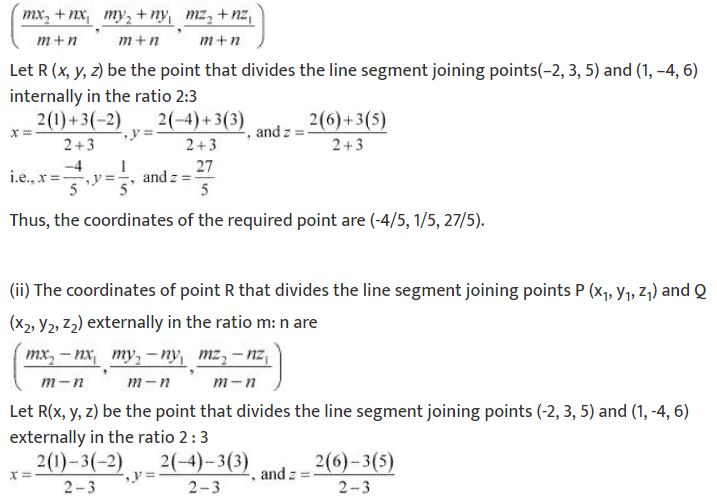
i.e., x = -8, y = 17, and z = 3
Thus, the coordinates of the required point are (-8, 17, 3).
2. Given that P (3, 2, –4), Q (5, 4, –6) and R (9, 8, –10) are collinear. Find the ratio in which Q divides PR.
Answer :
Let point Q (5, 4, –6) divide the line segment joining points P (3, 2, –4) and R (9, 8, –10) in the ratio k:1.
Therefore, by section formula,
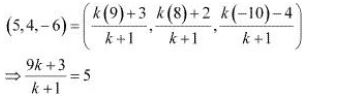
⇒ 9k + 3 = 5k + 5
⇒ 4k = 2
⇒ k = 2/4 = 1/2
Thus, point Q divides PR in the ratio 1 : 2.
3. Find the ratio in which the YZ-plane divides the line segment formed by joining the points (–2, 4, 7) and (3, –5, 8).
Solution
Let the YZ planedivide the line segment joining points (–2, 4, 7) and (3, –5, 8) in the ratio k:1.
Hence, by section formula, the coordinates of point of intersection are given by
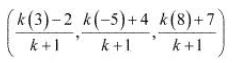
On the YZ plane, the x - coordinate of any point is zero.
(3k - 2)/(k + 1) = 0
⇒ 3k -2 = 0
⇒ k = 2/3
Thus, the YZ plane divides the line segment formed by joining the given points in the ratio 2 : 3.
4. Using section formula, show that the points A (2, –3, 4), B (–1, 2, 1) and C(0, 1/3, 2) are collinear.
Answer :
The given points are A (2, –3, 4), B (–1, 2, 1), and C(0, 1/3, 2). .
Let P be a point that divides AB in the ratio k:1.
Hence, by section formula, the coordinates of P are given by
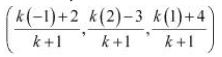
Now, we find the value of k at which point P coincides with point C.
By taking (-k + 2)/(k + 1) = 0 , we obtain k = 2.
For k = 2, the coordinates of point P are (0, 1/3, 2).
i.e, C(0, 1/3, 2) is a point that divides AB externally in the ratio 2 : 1 and is the same as point P .
Hence, points A, B, and C are collinear.
5. Find the coordinates of the points which trisect the line segment joining the points P (4, 2, –6) and Q (10, –16, 6).
Answer :
Let A and B be the points that trisect the line segment joining points P (4, 2, –6) and Q (10, –16, 6)
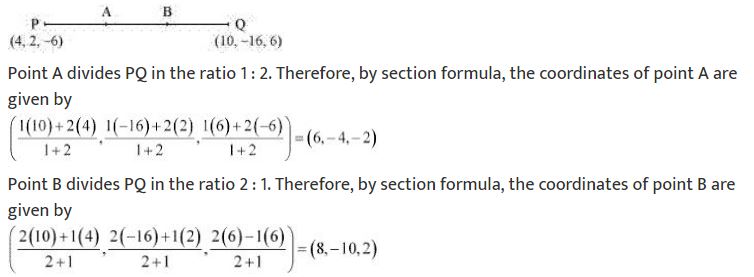
Thus, (6, -4, -2) and (8, -10, 2) are the points that trisect the line segment joining points P(4, 2, -6) and Q(10, -16, 6).
Miscellaneous Exercise
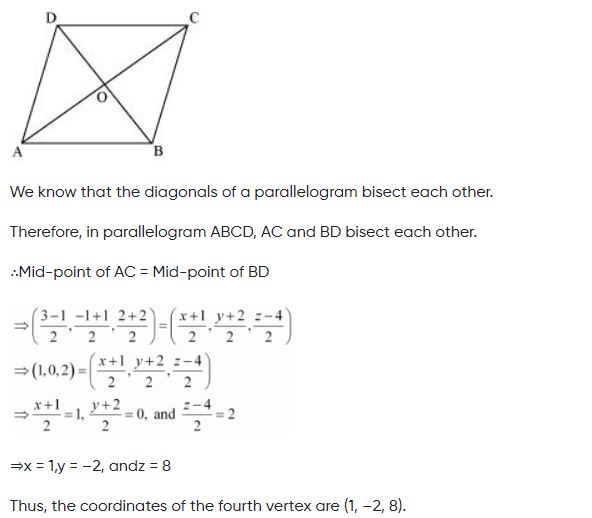
1. Three vertices of a parallelogram ABCD are A (3, –1, 2), B (1, 2, –4) andC (–1, 1, 2). Find the coordinates of the fourth vertex.
Answer :
The three vertices of a parallelogram ABCD are given as A (3, –1, 2), B (1, 2, –4), and C (–1, 1, 2). Let the coordinates of the fourth vertex be D (x,y,z).
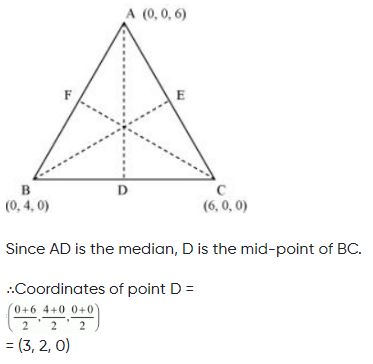
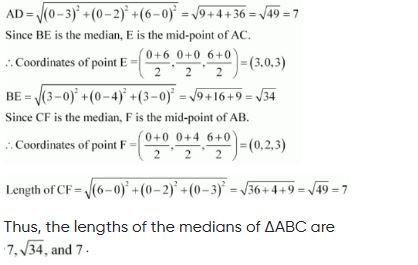
2. Find the lengths of the medians of the triangle with vertices A (0, 0, 6), B (0, 4, 0) and (6, 0, 0).
Answer :
Let AD, BE, and CF be the medians of the given triangle ABC.
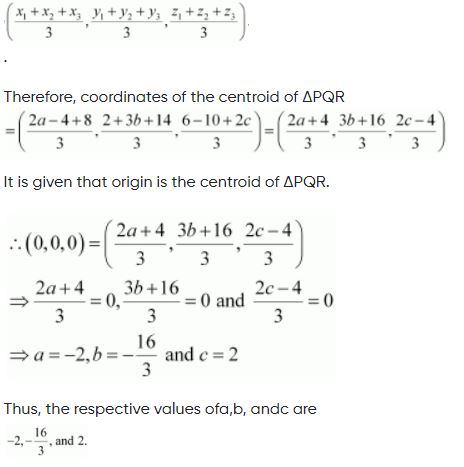
3. If the origin is the centroid of the triangle PQR with vertices P (2a, 2, 6), Q (–4, 3b, –10) and R (8, 14, 2c), then find the values ofa,b andc.
Answer :
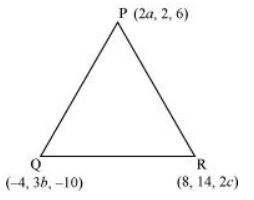
It is known that the coordinates of the centroid of the triangle, whose vertices are (x1,y1,z1), (x2,y2,z2) and (x3,y3,z3), are
4. Find the coordinates of a point ony-axis which are at a distance of 5√2 from the point P (3, –2, 5).
Answer :
If a point is on the y-axis, then x-coordinate and the z-coordinate of the point are zero.
Let A (0, b, 0) be the point on the y-axis at a distance of AP = 5√2
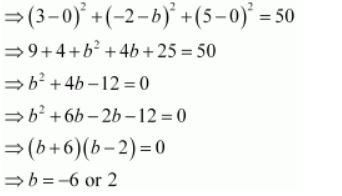
Thus, the coordinates of the required points are (0, 2, 0) and (0, –6, 0).
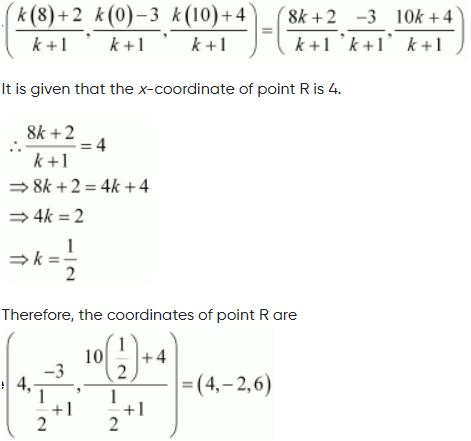
5. A point R withx-coordinate 4 lies on the line segment joining the pointsP (2, –3, 4) and Q (8, 0, 10). Find the coordinates of the point R.
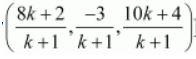
[Hint suppose R divides PQ in the ratio k: 1. The coordinates of the point R are given by
Answer :
The coordinates of points P and Q are given as P (2, –3, 4) and Q (8, 0, 10).
Let R divide line segment PQ in the ratio k:1.
Hence, by section formula, the coordinates of point R are given by
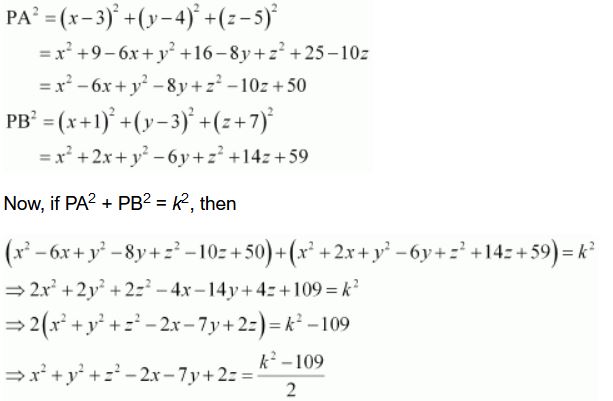
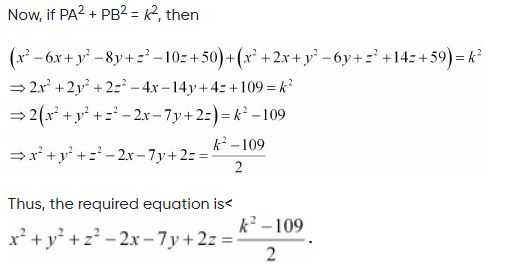
6. If A and B be the points (3, 4, 5) and (–1, 3, –7), respectively, find the equation of the set of points P such that PA2 + PB2 =k2, wherek is a constant.
Answer :
The coordinates of points A and B are given as (3, 4, 5) and (–1, 3, –7) respectively.
Let the coordinates of point P be (x, y, z).
On using distance formula, we obtain
Free study material for Mathematics
Mathematics Class 11 Curriculum Solutions: Chapter 11 Introduction to Three Dimensional Geometry
Textbook Solutions for Class 11 Mathematics Chapter 11 Introduction to Three Dimensional Geometry
Review comprehensive exercise answers for Class 11 Mathematics Chapter 11 Introduction to Three Dimensional Geometry. Fully updated to match current NCERT syllabus guidelines, these textbook solutions help students verify their work and maintain accurate study notes.
Mastering Theoretical and Practical Questions
Each solution includes detailed reasoning to foster genuine comprehension of Chapter 11 Introduction to Three Dimensional Geometry concepts. Reviewing these step-by-step breakdowns allows learners to master both analytical and descriptive questions expected in school evaluations.
Effective Self-Study and Homework Assistance
These resources act as an effective roadmap for daily homework tasks and independent study. Supplement your review of Chapter 11 Introduction to Three Dimensional Geometry with official sample papers and interactive practice tests available on our platform free of charge.
FAQs
The complete and updated NCERT Solutions Class 11 Mathematics Chapter 12 Introduction to Three Dimensional Geometry is available for free on StudiesToday.com. These solutions for Class 11 Mathematics are as per latest NCERT curriculum.
Yes, our experts have revised the NCERT Solutions Class 11 Mathematics Chapter 12 Introduction to Three Dimensional Geometry as per 2026 exam pattern. All textbook exercises have been solved and have added explanation about how the Mathematics concepts are applied in case-study and assertion-reasoning questions.
Toppers recommend using NCERT language because NCERT marking schemes are strictly based on textbook definitions. Our NCERT Solutions Class 11 Mathematics Chapter 12 Introduction to Three Dimensional Geometry will help students to get full marks in the theory paper.
Yes, we provide bilingual support for Class 11 Mathematics. You can access NCERT Solutions Class 11 Mathematics Chapter 12 Introduction to Three Dimensional Geometry in both English and Hindi medium.
Yes, you can download the entire NCERT Solutions Class 11 Mathematics Chapter 12 Introduction to Three Dimensional Geometry in printable PDF format for offline study on any device.