

Download NCERT Solutions for Class 11 Chemistry Chapter 05 States of Matter
Access comprehensive textbook solutions for Chapter 05 States of Matter using the official curriculum guides for Class 11 Chemistry. Designed to align with the 2026-27 NCERT standards, these detailed answers help students reinforce core academic concepts.
Access NCERT Solutions and Answers
Navigate directly to the solved Chemistry textbook exercises using the digital viewer below. Each solution includes detailed step-by-step explanations, allowing students to instantly cross-check their work and identify areas requiring further revision.
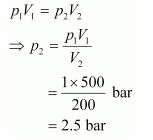
Question. What will be the minimum pressure required to compress 500 dm3 of air at 1 bar to 200 dm3 at 30°C?
Answer : Given,
Initial pressure, P1 = 1 bar
Initial volume, V1 = 500 dm3
Final volume, V2 = 200 dm3
Since the temperature remains constant, the final pressure (P2) can be calculated using Boyle's law.
According to Boyle's law,
Question. A container with a capacity of 120 mL contains some amount of gas at 35∘ C and 1.2 bar pressure. The gas is transferred to another container of volume 180 mL at 35∘C. Calculate what will be the pressure of the gas?
Answer : Initial pressure, P1 = 1.2 bar
Initial volume, V1 = 120 mL
Final volume, V2 = 180 mL
As the temperature remains same, final pressure (P2) can be calculated with the help of Boyle’s law.
According to the Boyle’s law,
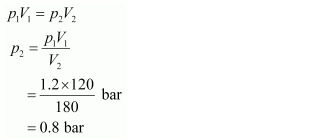
Therefore, the min pressure required is 0.8 bar.
Question. Using the equation of state pV = nRT; show that at a given temperature density of a gas is proportional to gas pressurep.
Answer : The equation of state is given by,
pV = nRT ……….. (i)
Where,
p → Pressure of gas
V → Volume of gas
n→ Number of moles of gas
R → Gas constant
T → Temperature of gas
From equation (i) we have,
n/v = P/RT
Replacing n with m/M, we have
m/MV = P/PT.........(ii)
Where,
m → Mass of gas
M → Molar mass of gas
But, m/v= d (d = density of gas)
Thus, from equation (ii), we have
d/M = P/RT
⇒ d = (M/RT)p
Molar mass (M) of a gas is always constant and therefore, at constant temperature (T), M/RT constant.
d = (constant)p
⇒ d ∝ p
Hence, at a given temperature, the density (d) of gas is proportional to its pressure (p).
Question. At 0°C, the density of a certain oxide of a gas at 2 bar is same as that of dinitrogen at 5 bar. What is the molecular mass of the oxide?
Answer : Density (d) of the substance at temperature (T) can be given by the expression,
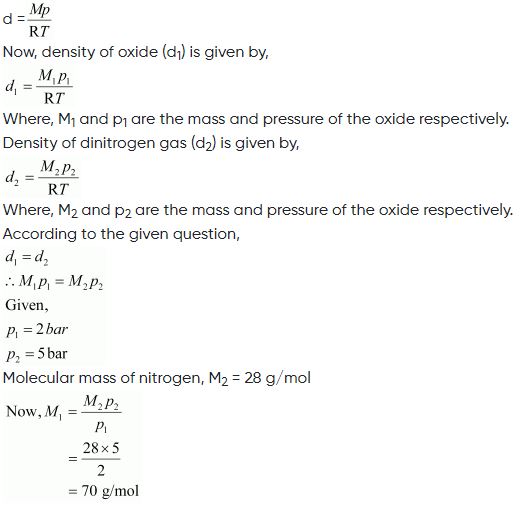
Hence, the molecular mass of the oxide is 70 g/mol.
Question. Pressure of 1 g of an ideal gas A at 27 °C is found to be 2 bar. When 2 g of another ideal gas B is introduced in the same flask at same temperature the pressure becomes 3 bar. Find a relationship between their molecular masses.
Answer : For ideal gas A, the ideal gas equation is given by,
PAV = nART.........(i)
Where, pA and nA represent the pressure and number of moles of gas A.
For ideal gas B, the ideal gas equation is given by,
PBV = nART.........(ii)
Where, pB and nB represent the pressure and number of moles of gas B.
[V and T are constants for gases A and B]
From equation (i), we have
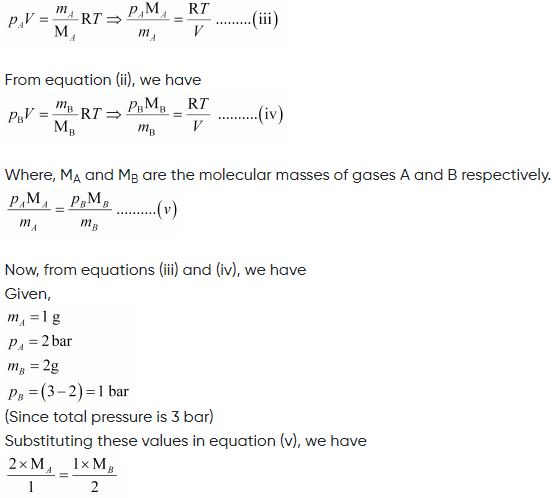
⇒ 4MA = MB
Thus, a relationship between the molecular masses of A and B is given by.
4MA = MB
Question. The drain cleaner, Drainex contains small bits of aluminum which react with caustic soda to produce dihydrogen. What volume of dihydrogen at 20 °C and one bar will be released when 0.15g of aluminum reacts?
Answer : The reaction of aluminium with caustic soda can be represented as:
At STP (273.15 K and 1 atm), 54 g (2 × 27 g) of Al gives 3 × 22400 mL of H2..
0.15 g Al gives i.e., 186.67 mL of H2.
At STP,
Let the volume of dihydrogen be at p2 = 0.987 atm (since 1 bar = 0.987 atm) and T2 = 20°C = (273.15 + 20) K = 293.15 K..
Therefore, 203 mL of dihydrogen will be released.
Question. What will be the pressure exerted by a mixture of 3.2 g of methane and 4.4 g of carbon dioxide contained in a 9 dm3 flask at 27 °C ?
Answer : It is known that,
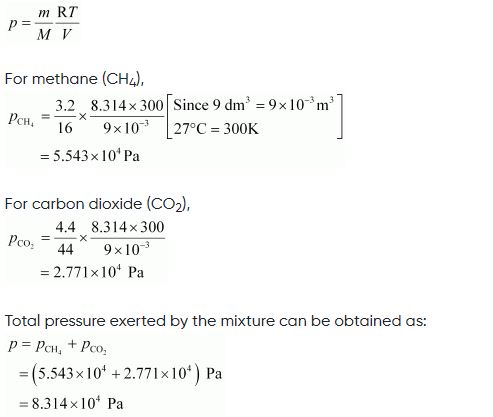
Hence, the total pressure exerted by the mixture is 8.314 × 10⁴ Pa.
Question. What will be the pressure of the gaseous mixture when 0.5 L of H2 at 0.8 bar and 2.0 L of dioxygen at 0.7 bar are introduced in a 1L vessel at 27°C?
Answer : Let the partial pressure of H2 in the vessel be.
Now,
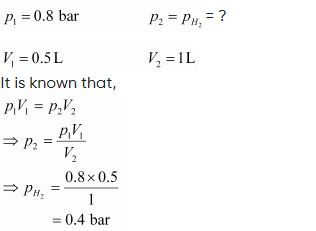
Now, let the partial pressure of O2 in the vessel be.
p1V1 = p2 V2'
⇒ p2 = p1 V1 / V2
⇒ pO2 = 0.7 × 2 .0 /1 = 1.4 bar
Total pressure of the gas mixture in the vessel can be obtained as:
Ptotal = PH2 + Po2
= 0.4 + 1.4
= 1.8 bar
Hence, the total pressure of the gaseous mixture in the vessel is.
Question. Density of a gas is found to be 5.46 g /dm3 at 27 °C at 2 bar pressure. What will be its density at STP?
Answer : Given,
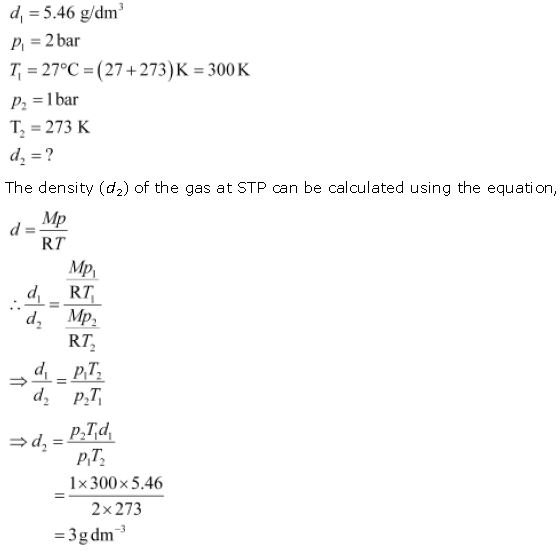
Hence, the density of the gas at STP will be 3 g dm–3.
Question. 34.05 mL of phosphorus vapour weighs 0.0625 g at 546 °C and 0.1 bar pressure. What is the molar mass of phosphorus?
Answer : Given,
p = 0.1 bar
V = 34.05 mL = 34.05 × 10⁻³ L = 34.05 × 10⁻³ dm3
R = 0.083 bar dm3 K–1 mol–1
T = 546°C = (546 + 273) K = 819 K
The number of moles (n) can be calculated using the ideal gas equation as:
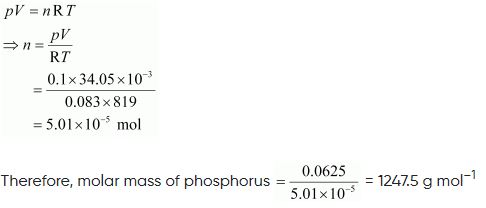
Hence, the molar mass of phosphorus is 1247.5 g mol–1.
Question. A student forgot to add the reaction mixture to the round bottomed flask at 27 °C but instead he/she placed the flask on the flame. After a lapse of time, he realized his mistake, and using a pyrometer he found the temperature of the flask was 477 °C. What fraction of air would have been expelled out?
Answer : Let the volume of the round bottomed flask be V.
Then, the volume of air inside the flask at 27° C is V.
Now,
V1 = V
T1 = 27°C = 300 K
V2 =?
T2 = 477° C = 750 K
According to Charles’s law,
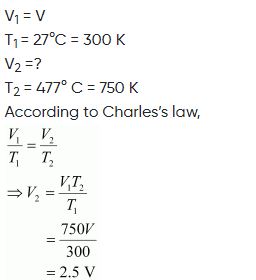
Therefore, volume of air expelled out = 2.5 V – V = 1.5 V
Hence, fraction of air expelled out
= 1.5 V/2.5 V = 3/5
Question. Calculate the temperature of 4.0 mol of a gas occupying 5 dm3 at 3.32 bar.(R = 0.083 bar dm3 K–1 mol–1).
Answer : Given,
n = 4.0 mol
V = 5 dm3
p = 3.32 bar
R = 0.083 bar dm3 K–1 mol–1
The temperature (T) can be calculated using the ideal gas equation as:
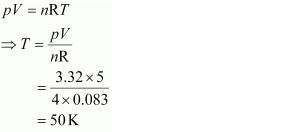
Hence, the required temperature is 50 K.
Question. Calculate the total number of electrons present in 1.4 g of dinitrogen gas.
Answer : Molar mass of dinitrogen (N2) = 28 g mol–1
Thus, 1.4 g of
N2 = 1.4/28 = 0.05mol
= 0.05 * 6.02 * 1023 number of molecules
= 3.01 * 1023 number of molecules
Now, 1 molecule of contains 14 electrons.
Therefore, 3.01 × 10²³ molecules of N2 contains = 1.4 × 3.01 × 1023
= 4.214 × 10²³ electrons
Question. How much time would it take to distribute one Avogadro number of wheat grains, if 1010 grains are distributed each second?
Answer : Avogadro number = 6.02 × 10²³
Thus, time required
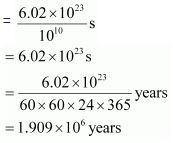
Hence, the time taken would be.1.909 x 106 years
Question. Calculate the total pressure in a mixture of 8 g of dioxygen and 4 g of dihydrogen confined in a vessel of 1 dm3 at 27°C. R = 0.083 bar dm3 K–1 mol–1.
Answer : Given,
Mass of dioxygen (O2) = 8 g
Thus, number of moles of O2
= 8/32 = 0.25 mole
Mass of dihydrogen (H2) = 4 g
Thus, number of moles of
H2 = 4/2 = 2 mole
Therefore, total number of moles in the mixture = 0.25 + 2 = 2.25 mole
Given,
V = 1 dm3
n = 2.25 mol
R = 0.083 bar dm3 K–1 mol–1
T = 27°C = 300 K
Total pressure (p) can be calculated as:
pV = nRT
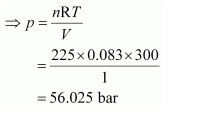
Hence, the total pressure of the mixture is 56.025 bar.
Question. Pay load is defined as the difference between the mass of displaced air and the mass of the balloon. Calculate the pay load when a balloon of radius 10 m, mass 100 kg is filled with helium at 1.66 bar at 27°C. (Density of air = 1.2 kg m–3 and R = 0.083 bar dm3 K–1 mol–1).
Answer : Given,
Radius of the balloon, r = 10 m
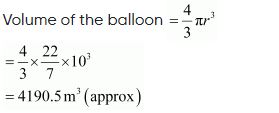
Thus, the volume of the displaced air is 4190.5 m3.
Given,
Density of air = 1.2 kg m–3
Then, mass of displaced air = 4190.5 × 1.2 kg
= 5028.6 kg
Now, mass of helium (m) inside the balloon is given by,
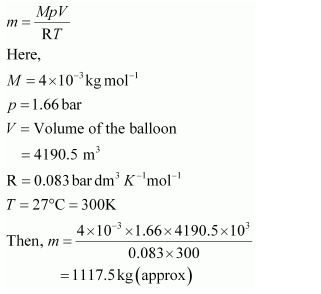
Now, total mass of the balloon filled with helium = (100 + 1117.5) kg
= 1217.5 kg
Hence, pay load = (5028.6 – 1217.5) kg
= 3811.1 kg
Hence, the pay load of the balloon is 3811.1 kg.
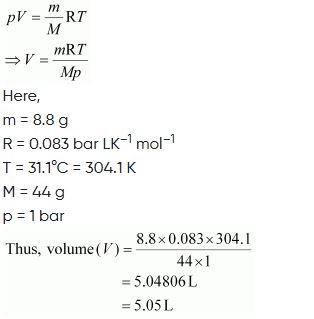
Question. Calculate the volume occupied by 8.8 g of CO2 at 31.1°C and 1 bar pressure. R = 0.083 bar L K–1 mol–1.
Answer : It is known that,
Question. 2.9 g of a gas at 95 °C occupied the same volume as 0.184 g of dihydrogen at 17 °C, at the same pressure. What is the molar mass of the gas?
Answer : Volume (V) occupied by dihydrogen is given by,
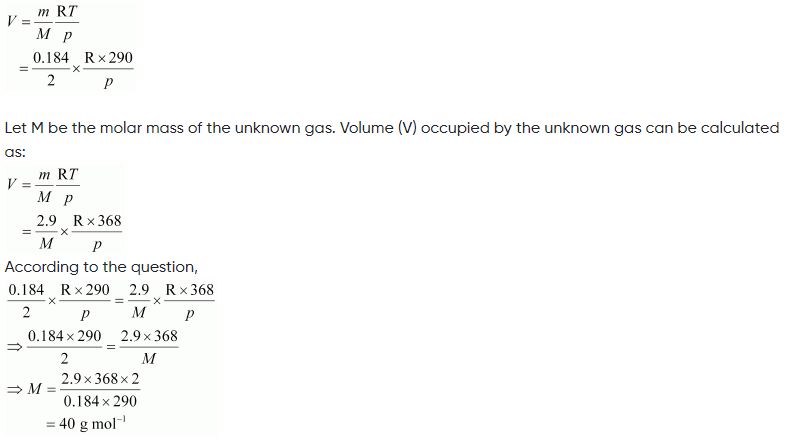
Hence, the molar mass of the gas is 40 g mol–1.
Question. A mixture of dihydrogen and dioxygen at one bar pressure contains 20% by weight of dihydrogen. Calculate the partial pressure of dihydrogen.
Answer : Let the weight of dihydrogen be 20 g and the weight of dioxygen be 80 g.
Then, the number of moles of dihydrogen,
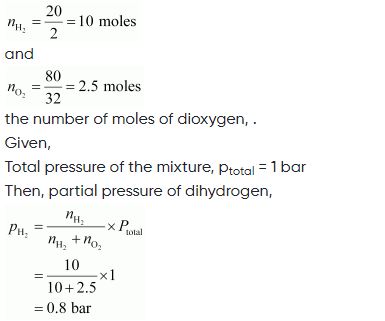
Hence, the partial pressure of dihydrogen is.
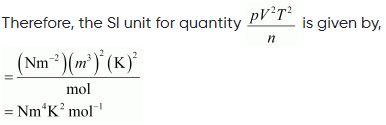
Question. What would be the SI unit for the quantity pV2T 2/n?
Answer : The SI unit for pressure, p is Nm–2.
The SI unit for volume, V is m3.
The SI unit for temperature, T is K.
The SI unit for the number of moles, n is mol.
Question. In terms of Charles’ law explain why –273°C is the lowest possible temperature.
Answer : Charles’ law states that at constant pressure, the volume of a fixed mass of gas is directly proportional to its absolute temperature.
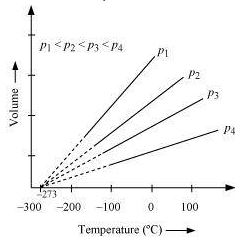
It was found that for all gases (at any given pressure), the plots of volume vs. temperature (in °C) is a straight line. If this line is extended to zero volume, then it intersects the temperature-axis at – 273°C. In other words, the volume of any gas at –273°C is zero. This is because all gases get liquefied before reaching a temperature of – 273°C. Hence, it can be concluded that – 273°C is the lowest possible temperature.
Question. Critical temperature for carbon dioxide and methane are 31.1 °C and –81.9 °C respectively. Which of these has stronger intermolecular forces and why?
Answer : Higher is the critical temperature of a gas, easier is its liquefaction. This means that the intermolecular forces of attraction between the molecules of a gas are directly proportional to its critical temperature. Hence, intermolecular forces of attraction are stronger in the case of CO2.
Question. Explain the physical significance of Van der Waals parameters.
Answer : Physical significance of ‘a’:
‘a’ is a measure of the magnitude of intermolecular attractive forces within a gas.
Physical significance of ‘b’:
‘b’ is a measure of the volume of a gas molecule.
Free study material for Chemistry
Chemistry Class 11 Curriculum Solutions: Chapter 05 States of Matter
Textbook Solutions for Class 11 Chemistry Chapter 05 States of Matter
Review comprehensive exercise answers for Class 11 Chemistry Chapter 05 States of Matter. Fully updated to match current NCERT syllabus guidelines, these textbook solutions help students verify their work and maintain accurate study notes.
Mastering Theoretical and Practical Questions
Clear, methodical explanations accompany every challenging problem within the Class 11 Chemistry text. Engaging with these detailed answers lays a solid foundation for advanced learning and improves foundational clarity for upcoming assessments.
Effective Self-Study and Homework Assistance
Consistent practice with these solution guides cultivates faster problem-solving habits and clearer logical structuring. For a complete preparation experience, pair these textbook answers with our dedicated revision notes and sample papers for Class 11 Chemistry.
FAQs
The complete and updated NCERT Solutions Class 11 Chemistry Chapter 5 States of Matter is available for free on StudiesToday.com. These solutions for Class 11 Chemistry are as per latest NCERT curriculum.
Yes, our experts have revised the NCERT Solutions Class 11 Chemistry Chapter 5 States of Matter as per 2026 exam pattern. All textbook exercises have been solved and have added explanation about how the Chemistry concepts are applied in case-study and assertion-reasoning questions.
Toppers recommend using NCERT language because NCERT marking schemes are strictly based on textbook definitions. Our NCERT Solutions Class 11 Chemistry Chapter 5 States of Matter will help students to get full marks in the theory paper.
Yes, we provide bilingual support for Class 11 Chemistry. You can access NCERT Solutions Class 11 Chemistry Chapter 5 States of Matter in both English and Hindi medium.
Yes, you can download the entire NCERT Solutions Class 11 Chemistry Chapter 5 States of Matter in printable PDF format for offline study on any device.