

NCERT Solutions for Class 11 Chemistry: Chapter 10 The s Block Elements
Explore reliable textbook solutions for Chapter 10 The s Block Elements tailored for Class 11 learners. Utilizing these Chemistry answers ensures thorough preparation and strengthens foundational knowledge before final NCERT evaluations.
Practice Class 11 Chemistry Solutions: Chapter 10 The s Block Elements
Access the complete solution PDF for Class 11 Chemistry below. Regular practice with these targeted textbook answers builds familiarity with standard question patterns and helps secure higher marks in final school evaluations.
1. What are the common physical and chemical features of alkali metals?
Answer:
Physical properties:
(1) The alkali metal is soft and so we can cut them easily. We can able to cut the sodium metal even by using the knife.
(2) Generally the alkali metal is lightly coloured and mostly they appear as silvery white.
(3) Its atomic size is larger and so their density is low. The density of the alkali metal increases down in the group from Li to Cs except K which has low density than sodium.
(4) Alkali metal is weak in its metallic bonding and so they are having low boiling and melting points.
(5) The salts present in alkali metals exposes colour to flames because, heat of the flame excites electron which is located on the outer orbital to higher energy level. In this excited state of electron getting reversed back to the ground level, the emission of excess energy in the form of radiation falls in visible region.
(6) Metals like K and Cs loses electrons when they get irradiated with light and also displays photoelectric effect.
Chemical properties:
(1) Alkali metal reacts with water and forms oxides and hydroxides. So, the reaction will be more spontaneous while moving down the group.
(2) Alkali metal reacts with water and forms dihydrogens and hydroxides.
General reaction :
2M + 2H20 → 2M+ + 2OH– + H2
(3) Dihydrogen reacts with alkali metals and forms metal hydrides. The hydrides from this have higher melting points and they are solids which are ionic.
2M + H2 → 2M+ H–
(4) Alkali metals directly reacts with halogens and forms ionic halides except Li.
2M + CL2 → 2MCI (M = Li ,K, Rb, Cs)
It has the ability to easily distort the cloud of the electron which is around the –ve halide ion because, lithium ion is smaller in size . Hence, Lithium halide is naturally covalent.
(5) Alkali metals are very stronger reducing agents. This increases as we move down the group except lithium. Due to its high hydration energy it results in strong reducing agent among all alkali metals.
(6) To result in blue coloured solution(deep blue) which are naturally conducting, they get dissolved in liquid ammonia.
M +(x + y) NH3 → [ M ( NH3 )x ]+ + [ M ( NH3)y ]–
2. Discuss the general characteristics and gradation in properties of alkaline earth metals.
Answer:
General characteristics:
(i)(Noble gas) ns2 is the electronic configuration of alkaline earth metal.
(ii) To occupy the nearest inert gas configuration, these metals lose two of their electrons; and so its oxidation state is +2.
(iii) The ionic radii and atomic radii is smaller than alkali metals. When they moved down towards the group, there is an increase in ionic radii and atomic radii due to decrease in effective nuclear charge.
(iv) The ionization enthalpy is low because the alkaline earth metals are larger in size. The first ionization enthalpy is higher than metals of group 1.
(v) They appear in lustrous and silvery white. They are soft as alkali metals.
(vi)Factors that cause alkaline earth metals to contain high boiling point and melting point :
(*) Atoms of alkali metals are larger than that of alkaline earth metals.
(*) The strong metallic bonds are formed by two valence electrons.
(vii) Ca- brick red, Sr- crimson red, Ba-apple green results in colours to flames.
Electrons are bounded strongly to get excited in Be and Mg. Therefore, they do not expose any colours to the flame.
The alkali metals are more reactive than alkaline earth metals.
Chemical properties:
(i) Reaction with water air and: Due to the formation of oxide layer on their surface, beryllium and Mg are most inert to water and air.
(a) Beo and Be3 N2 is formed when powdered Be is burnt in air.
(b) For the formation of MgO and Mg3 N2, Mg is burnt in air with dazzling sparkle. since, Mg is more electropositive.
(c) The formation of respective nitrides and oxides is by instant reaction of Sr,Ca, and Ba with air.
(d) Ca,Sr, and Ba can able to react vigorously even with water which is cold.
(ii) when they react with halogens, halides is formed at high temperature.
M +X2 → MX2 (X = F, CL, Br, I)
(iii) Except Be, all the alkaline earth metals react with hydrogen to form hydrides.
(iv) alkaline earth metals instantly react with acids to form salts with the liberation of hydrogen gas.
M +2HCL→ MCL2 + H2(X)
3. Why are alkali metals not found in nature?
Answer:
Sodium, cesium, lithium, francium, potassium, rubidium all together comprises of alkali metals. they consist of only one electron on its valence shell, which gets loosed easily due to their low ionizing energies. Alkali metals are not found naturally in their elemental state and also they are highly reactive.
4. Mention the oxidation state of Na in Na2O2.
Answer:
Let the oxidation state of Na be y.
In case of peroxides, the oxidation state of oxygen is -1.
Therefore,
2(y) + 2(-1) = 0
2y – 2 = 0
2y = 2
Y = +1
Therefore, the oxidation state of Na is +1.
5. Why Na reacts lesser than potassium?
Answer: In alkali metals, on moving down the group, the atomic size increases and the effective
nuclear charge decreases. Because of these factors, the outermost electron in potassium
can be lost easily as compared to sodium. Hence, potassium is more reactive than
sodium.
Question 10.6:
Compare the alkali metals and alkaline earth metals with respect to (i) ionization
enthalpy (ii) basicity of oxides and (iii) solubility of hydroxides.
| Alkali metals | Alkaline earth metals | ||
| (i) | Ionization enthalpy: These have lowest ionization enthalpies in respective periods. This is because of their large atomic sizes. Also, they lose their only valence electron easily as they attain stable noble gas configuration after losing it. |
(ii) | Ionization enthalpy: Alkaline earth metals have smaller atomic size and higher effective nuclear charge as compared to alkali metals. This causes their first ionization enthalpies to be higher than that of alkali metals. However, their second ionization enthalpy is less than the corresponding alkali metals. This is because alkali metals, after losing one electron, acquires noble gas configuration, which is very stable. |
| (ii) | Basicity of oxides: The oxides of alkali metals are very basic in nature. This happens due to the highly electropositive nature of alkali metals, which makes these oxides highly ionic. Hence, they readily dissociate in water to give hydroxide ions. |
(ii) | Basicity of oxides: The oxides of alkaline earth metals are quite basic but not as basic as those of alkali metals. This is because alkaline earth metals are less electropositive than alkali metals. |
| (iii) | Solubility of hydroxides: The hydroxides of alkali metals are more soluble than those of alkaline earth metals. |
(iii) | Solubility of hydroxides: The hydroxides of alkaline earth metals are less soluble than those of alkali metals. This is due to the high lattice energies of alkaline earth metals. Their higher charge densities (as compared to alkali metals) account for higher lattice energies. |
Question 10.7: In what ways lithium shows similarities to magnesium in its chemical behaviour?
Answer Similarities between lithium and magnesium are as follows.
(i) Both Li and Mg react slowly with cold water.
(ii) The oxides of both Li and Mg are much less soluble in water and their hydroxides decompose at high temperature.
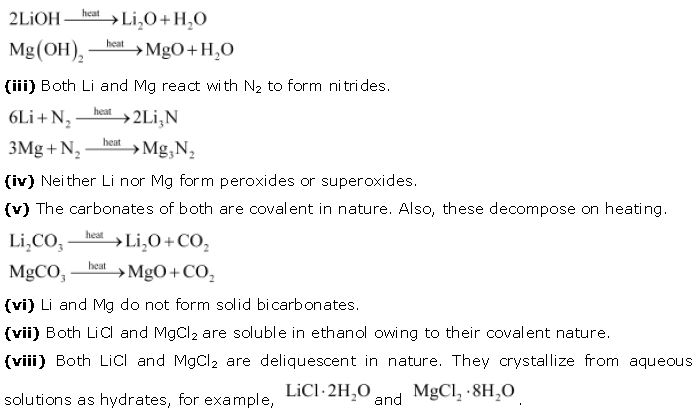
Question 10.8: Explain why alkali and alkaline earth metals cannot be obtained by chemical reduction methods?
Answer In the process of chemical reduction, oxides of metals are reduced using a stronger reducing agent. Alkali metals and alkaline earth metals are among the strongest reducing agents and the reducing agents that are stronger than them are not available.
Therefore, they cannot be obtained by chemical reduction of their oxides.
Question 10.9: Why are potassium and cesium, rather than lithium used in photoelectric cells?
Answer All the three, lithium, potassium, and cesium, are alkali metals. Still, K and Cs are used in the photoelectric cell and not Li.
This is because as compared to Cs and K, Li is smaller in size and therefore, requires high energy to lose an electron. While on the other hand, K and Cs have low ionization energy. Hence, they can easily lose electrons. This property of K and Cs is utilized in photoelectric cells.
Question 10.10: When an alkali metal dissolves in liquid ammonia the solution can acquire different colours. Explain the reasons for this type of colour change.
Answer When an alkali metal is dissolved in liquid ammonia, it results in the formation of a deep blue coloured solution.

The ammoniated electrons absorb energy corresponding to red region of visible light.
Therefore, the transmitted light is blue in colour.
At a higher concentration (3 M), clusters of metal ions are formed. This causes the solution to attain a copper–bronze colour and a characteristic metallic lustre.
Question 10.11: Beryllium and magnesium do not give colour to flame whereas other alkaline earth metals do so. Why?
Answer When an alkaline earth metal is heated, the valence electrons get excited to a higher energy level. When this excited electron comes back to its lower energy level, it radiates energy, which belongs to the visible region. Hence, the colour is observed. In Be and Mg, the electrons are strongly bound. The energy required to excite these electrons is very high. Therefore, when the electron reverts back to its original position, the energy released does not fall in the visible region. Hence, no colour in the flame is seen.
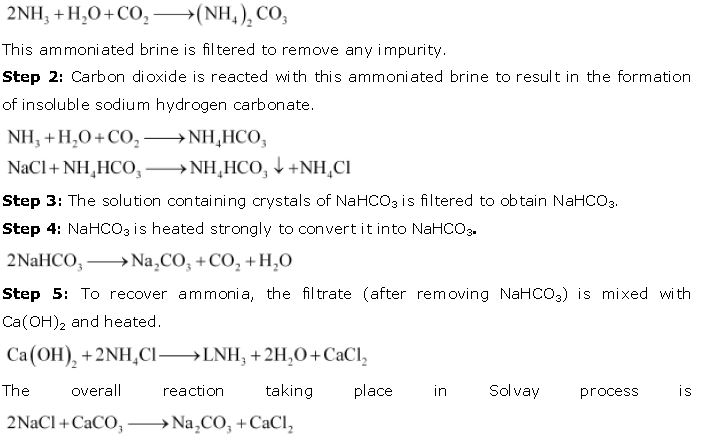
Question 10.12: Discuss the various reactions that occur in the Solvay process.
Answer Solvay process is used to prepare sodium carbonate.
When carbon dioxide gas is bubbled through a brine solution saturated with ammonia,
sodium hydrogen carbonate is formed. This sodium hydrogen carbonate is then converted to sodium carbonate.
Step 1: Brine solution is saturated with ammonia.
Question 10.13: Potassium carbonate cannot be prepared by Solvay process. Why?
Answer Solvay process cannot be used to prepare potassium carbonate. This is because unlike sodium bicarbonate, potassium bicarbonate is fairly soluble in water and does not precipitate out.
Question 10.14: Why is Li2CO3 decomposed at a lower temperature whereas Na2CO3 at higher temperature?
Answer As we move down the alkali metal group, the electropositive character increases. This causes an increase in the stability of alkali carbonates. However, lithium carbonate is not so stable to heat. This is because lithium carbonate is covalent. Lithium ion, being very small in size, polarizes a large carbonate ion, leading to the formation of more stable lithium oxide.

Therefore, lithium carbonate decomposes at a low temperature while a stable sodium carbonate decomposes at a high temperature.
Question 10.15: Compare the solubility and thermal stability of the following compounds of the alkali metals with those of the alkaline earth metals. (a) Nitrates (b) Carbonates (c) Sulphates.
Answer
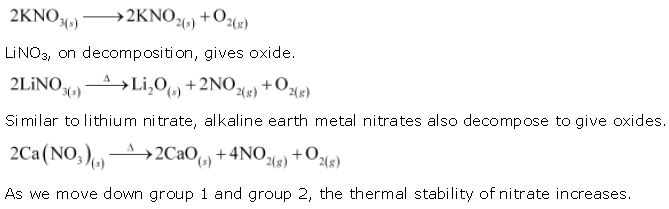
(i) Nitrates
Thermal stability
Nitrates of alkali metals, except LiNO3, decompose on strong heating to form nitrites.
Solubility
Nitrates of both group 1 and group 2 metals are soluble in water.
(ii) Carbonates
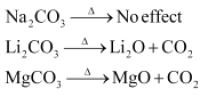
Thermal stability
The carbonates of alkali metals are stable towards heat. However, carbonate of lithium, when heated, decomposes to form lithium oxide. The carbonates of alkaline earth metals also decompose on heating to form oxide and carbon dioxide.
Solubility
Carbonates of alkali metals are soluble in water with the exception of Li2CO3. Also, the solubility increases as we move down the group.
Carbonates of alkaline earth metals are insoluble in water.
(iii) Sulphates
Thermal stability
Sulphates of both group 1 and group 2 metals are stable towards heat.
Solubility
Sulphates of alkali metals are soluble in water. However, sulphates of alkaline earth metals show varied trends.
BeSO4 Fairly soluble
MgSO4 Soluble
CaSO4 Sparingly soluble
SrSO4 Insoluble
BaSO4 Insoluble
In other words, while moving down the alkaline earth metals, the solubility of their sulphates decreases.
Question 10.16: Starting with sodium chloride how would you proceed to prepare (i) sodium metal (ii) sodium hydroxide (iii) sodium peroxide (iv) sodium carbonate?
Answer (a) Sodium can be extracted from sodium chloride by Downs process This process involves the electrolysis of fused NaCl (40%) and CaCl2 (60 %) at a
temperature of 1123 K in Downs cell.
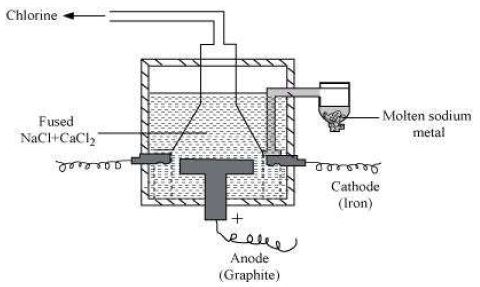
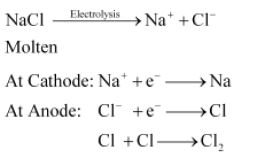
Steel is the cathode and a block of graphite acts as the anode. Metallic Na and Ca are formed at cathode. Molten sodium is taken out of the cell and collected over kerosene.
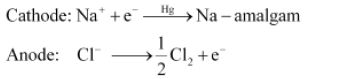
(ii) Sodium hydroxide can be prepared by the electrolysis of sodium chloride. This is called Castner–Kellner process. In this process, the brine solution is electrolysed using a carbon anode and a mercury cathode. The sodium metal, which is discharged at cathode, combines with mercury to form an amalgam.
(iii) Sodium peroxide
First, NaCl is electrolysed to result in the formation of Na metal (Downs process).
This sodium metal is then heated on aluminium trays in air (free of CO2) to form its peroxide.

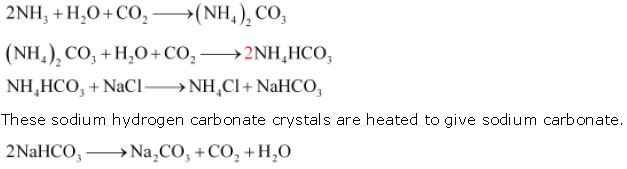
(iv) Sodium carbonate is prepared by Solvay process. Sodium hydrogen carbonate is precipitated in a reaction of sodium chloride and ammonium hydrogen carbonate.
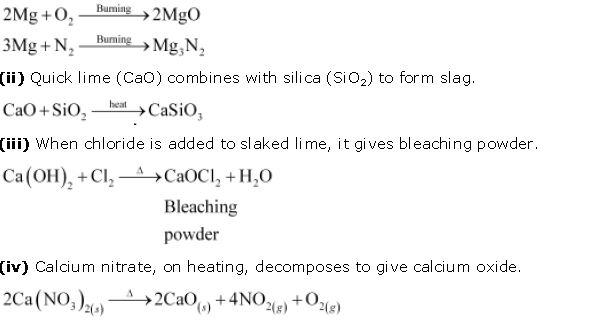
Question 10.17: What happens when (i) magnesium is burnt in air (ii) quick lime is heated with silica (iii) chlorine reacts with slaked lime (iv) calcium nitrate is heated ?
Answer (i) Magnesium burns in air with a dazzling light to form MgO and Mg3N2.
Question 10.18: Describe two important uses of each of the following: (i) caustic soda (ii) sodium carbonate (iii) quicklime.
Answer (i) Uses of caustic soda
(a) It is used in soap industry.
(b) It is used as a reagent in laboratory.
(ii) Uses of sodium carbonate
(a) It is generally used in glass and soap industry.
(b) It is used as a water softener.
(iii) Uses of quick lime
(a) It is used as a starting material for obtaining slaked lime.
(b) It is used in the manufacture of glass and cement.
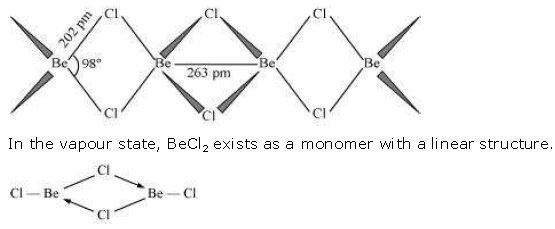
Question 10.19: Draw the structure of (i) BeCl2 (vapour) (ii) BeCl2 (solid).
Answer (a) Structure of BeCl2 (solid)
BeCl2 exists as a polymer in condensed (solid) phase
Question 10.20: The hydroxides and carbonates of sodium and potassium are easily soluble in water while the corresponding salts of magnesium and calcium are sparingly soluble in water. Explain.
Answer The atomic size of sodium and potassium is larger than that of magnesium and calcium.
Thus, the lattice energies of carbonates and hydroxides formed by calcium and magnesium are much more than those of sodium and potassium. Hence, carbonates and hydroxides of sodium and potassium dissolve readily in water whereas those of calcium and magnesium are only sparingly soluble.
Question 10.21: Describe the importance of the following: (i) limestone (ii) cement (iii) plaster of paris.
Answer (i) Chemically, limestone is CaCO3.
Importance of limestone
(a) It is used in the preparation of lime and cement.
(b) It is used as a flux during the smelting of iron ores.
(ii) Chemically, cement is a mixture of calcium silicate and calcium aluminate.
Importance of cement
(a) It is used in plastering and in construction of bridges.
(b) It is used in concrete.
(iii) Chemically, plaster of Paris is 2CaSO4.H2O.
Importance of plaster of Paris
(a) It is used in surgical bandages.
(b) It is also used for making casts and moulds.
Question 10.22: Why are lithium salts commonly hydrated and those of the other alkali metal ions usually anhydrous?
Answer Lithium is the smallest in size among the alkali metals. Hence, Li+ ion can polarize water molecules more easily than other alkali metals. As a result, water molecules get attached to lithium salts as water of crystallization. Hence, lithium salts such as trihydrated lithium chloride (LiCl.3H2O) are commonly hydrated. As the size of the ions increases, their polarizing power decreases. Hence, other alkali metal ions usually form anhydrous salts.
Question 10.23: Why is LiF almost insoluble in water whereas LiCl soluble not only in water but also in acetone?
Answer LiF is insoluble in water. On the contrary, LiCl is soluble not only in water, but also in acetone. This is mainly because of the greater ionic character of LiF as compared to LiCl.
The solubility of a compound in water depends on the balance between lattice energy and hydration energy. Since fluoride ion is much smaller in size than chloride ion, the lattice energy of LiF is greater than that of LiCl. Also, there is not much difference between the hydration energies of fluoride ion and chloride ion. Thus, the net energy change during the dissolution of LiCl in water is more exothermic than that during the dissolution of LiF in water. Hence, low lattice energy and greater covalent character are the factors making LiCl soluble not only in water, but also in acetone.
Question 10.24: Explain the significance of sodium, potassium, magnesium and calcium in biological fluids.
Answer Importance of sodium, potassium, magnesium, and calcium in biological fluids:
(i) Sodium (Na):
Sodium ions are found primarily in the blood plasma. They are also found in the interstitial fluids surrounding the cells.
(a) Sodium ions help in the transmission of nerve signals.
(b) They help in regulating the flow of water across the cell membranes.
(c) They also help in transporting sugars and amino acids into the cells.
(ii) Potassium (K):
Potassium ions are found in the highest quantity within the cell fluids.
(a) K ions help in activating many enzymes.
(b) They also participate in oxidising glucose to produce ATP.
(c) They also help in transmitting nerve signals.
(iii) Magnesium (Mg) and calcium (Ca):
Magnesium and calcium are referred to as macro-minerals. This term indicates their higher abundance in the human body system.
(a) Mg helps in relaxing nerves and muscles.
(b) Mg helps in building and strengthening bones.
(c) Mg maintains normal blood circulation in the human body system.
(d) Ca helps in the coagulation of blood
(e) Ca also helps in maintaining homeostasis.
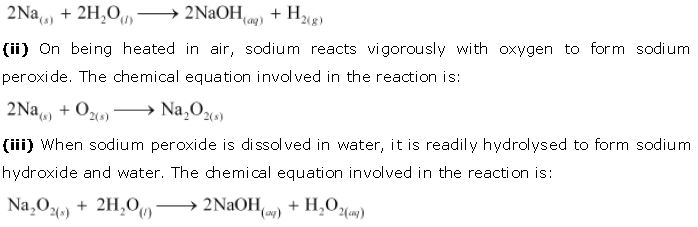
Question 10.25: What happens when
(i) sodium metal is dropped in water ?
(ii) sodium metal is heated in free supply of air ?
(iii) sodium peroxide dissolves in water ?
Answer (i) When Na metal is dropped in water, it reacts violently to form sodium hydroxide and hydrogen gas. The chemical equation involved in the reaction is:
Question 10.26: Comment on each of the following observations:
(a) The mobilities of the alkali metal ions in aqueous solution are Li+ < Na+ < K+ < Rb+ < Cs+
(b) Lithium is the only alkali metal to form a nitride directly

Answer (a) On moving down the alkali group, the ionic and atomic sizes of the metals increase.
The given alkali metal ions can be arranged in the increasing order of their ionic sizes as:
Li+ < Na+ < K+ < Rb+ < Cs+
Smaller the size of an ion, the more highly is it hydrated. Since Li+ is the smallest, it gets heavily hydrated in an aqueous solution. On the other hand, Cs+ is the largest and so it is the least hydrated. The given alkali metal ions can be arranged in the decreasing order of their hydrations as:
Li+ > Na+ > K+ > Rb+ > Cs+
Greater the mass of a hydrated ion, the lower is its ionic mobility. Therefore, hydrated
Li+ is the least mobile and hydrated Cs+ is the most mobile. Thus, the given alkali metal ions can be arranged in the increasing order of their mobilities as:
Li+ < Na+ < K+ < Rb+ < Cs+
(b) Unlike the other elements of group 1, Li reacts directly with nitrogen to form lithium nitride. This is because Li+ is very small in size and so its size is the most compatible with the N3– ion. Hence, the lattice energy released is very high. This energy also overcomes the high amount of energy required for the formation of the N3– ion.
(c) Electrode potential (E°) of any M2+/M electrode depends upon three factors:
(i) Ionisation enthalpy
(ii) Enthalpy of hydration
(iii) Enthalpy of vaporisation
The combined effect of these factors is approximately the same for Ca, Sr, and Ba.
Hence, their electrode potentials are nearly constant.'
Question 10.27: State as to why
(a) a solution of Na2CO3 is alkaline ?
(b) alkali metals are prepared by electrolysis of their fused chlorides ?
(c) sodium is found to be more useful than potassium ?
Answer (a) When sodium carbonate is added to water, it hydrolyses to give sodium bicarbonate and sodium hydroxide (a strong base). As a result, the solution becomes alkaline.

(b) It is not possible to prepare alkali metals by the chemical reduction of their oxides as they themselves are very strong reducing agents. They cannot be prepared by displacement reactions either (wherein one element is displaced by another). This is because these elements are highly electropositive. Neither can electrolysis of aqueous solutions be used to extract these elements. This is because the liberated metals react with water.
Question 10.30: Which of the alkali metal is having least melting point?
(a) Na (b) K (c) Rb (d) Cs
Answer Atomic size increases as we move down the alkali group. As a result, the binding energies of their atoms in the crystal lattice decrease. Also, the strength of metallic bonds decreases on moving down a group in the periodic table. This causes a decrease in the melting point. Among the given metals, Cs is the largest and has the least melting point.
Question 10.31: Which one of the following alkali metals gives hydrated salts?
(a) Li (b) Na (c) K (d) Cs
Answer Smaller the size of an ion, the more highly is it hydrated. Among the given alkali metals, Li is the smallest in size. Also, it has the highest charge density and highest polarising
power. Hence, it attracts water molecules more strongly than the other alkali metals. As a result, it forms hydrated salts such as LiCl.2 H2O. The other alkali metals are larger than Li and have weaker charge densities.
Hence, they usually do not form hydrated salts.
Question 10.32: Which one of the alkaline earth metal carbonates is thermally the most stable?
(a) MgCO3 (b) CaCO3 (c) SrCO3 (d) BaCO3
Answer Thermal stability increases with the increase in the size of the cation present in the carbonate. The increasing order of the cationic size of the given alkaline earth metals is
Mg < Ca < Sr < Ba
Hence, the increasing order of the thermal stability of the given alkaline earth metal carbonates is
MgCO3 < CaCO3 < SrCO3 < BaCO3
Free study material for Chemistry
Step-by-Step Textbook Answers: Class 11 Chemistry Chapter 10 The s Block Elements
Textbook Solutions for Class 11 Chemistry Chapter 10 The s Block Elements
Access structured NCERT textbook solutions for Chapter 10 The s Block Elements. Designed in alignment with the latest academic curriculum for Class 11 Chemistry, these answers cover all end-of-chapter exercises to support daily learning and homework completion.
Mastering Theoretical and Practical Questions
Each solution includes detailed reasoning to foster genuine comprehension of Chapter 10 The s Block Elements concepts. Reviewing these step-by-step breakdowns allows learners to master both analytical and descriptive questions expected in school evaluations.
Effective Self-Study and Homework Assistance
These resources act as an effective roadmap for daily homework tasks and independent study. Supplement your review of Chapter 10 The s Block Elements with official sample papers and interactive practice tests available on our platform free of charge.
FAQs
The complete and updated NCERT Solutions Class 11 Chemistry Chapter 10 The s Block Elements is available for free on StudiesToday.com. These solutions for Class 11 Chemistry are as per latest NCERT curriculum.
Yes, our experts have revised the NCERT Solutions Class 11 Chemistry Chapter 10 The s Block Elements as per 2026 exam pattern. All textbook exercises have been solved and have added explanation about how the Chemistry concepts are applied in case-study and assertion-reasoning questions.
Toppers recommend using NCERT language because NCERT marking schemes are strictly based on textbook definitions. Our NCERT Solutions Class 11 Chemistry Chapter 10 The s Block Elements will help students to get full marks in the theory paper.
Yes, we provide bilingual support for Class 11 Chemistry. You can access NCERT Solutions Class 11 Chemistry Chapter 10 The s Block Elements in both English and Hindi medium.
Yes, you can download the entire NCERT Solutions Class 11 Chemistry Chapter 10 The s Block Elements in printable PDF format for offline study on any device.