

Step-by-Step Textbook Solutions for Class 11 Chemistry Chapter 05 Thermodynamics
Explore reliable textbook solutions for Chapter 05 Thermodynamics tailored for Class 11 learners. Utilizing these Chemistry answers ensures thorough preparation and strengthens foundational knowledge before final NCERT evaluations.
Download Chapter 05 Thermodynamics Textbook Solutions PDF
View or download the dedicated Chapter 05 Thermodynamics solution resource below. Engaging with these textbook answers under focused study conditions ensures continuous academic progress and mastery of the 2026-27 curriculum for Chemistry.
Question. Choose the correct answer. A thermodynamic state function is a quantity
(i) used to determine heat changes
(ii) whose value is independent of path
(iii) used to determine pressure volume work
(iv) whose value depends on temperature only
Answer : A thermodynamic state function is a quantity Whose value is independent of a path. Functions like p, V, T etc. depend only on the state of a system and not on the path.
Hence, alternative (ii) is correct.
Question. For the process to occur under adiabatic conditions, the correct condition is:
(i) ∆T = 0
(ii) ∆p = 0
(iii) q = 0
(iv) w = 0
Answer : A system is said to be under adiabatic conditions if there is no exchange Of heat between the system and its surroundings. Hence, under adiabatic conditions, q = 0.
Therefore, alternative (iii) is correct,
Question. The enthalpies of all elements in their standard states are:
(i) unity
(ii) zero
(iii) < 0
(iv) different for each element
Answer : The enthalpy of all elements in their standard state is zero. Therefore, alternative (ii) is correct
Question. ΔU⊖ of combustion of methane is −X kJ mol−1. The value of ΔH⊖ is
(i)=ΔU⊖
(ii) >ΔU⊖
(iii) <=ΔU⊖
(iv) = 0
Answer : SinceΔHθ=ΔUθ+ΔngRT and ΔUθ=−Xkmol−1
ΔHθ=(−X)+ΔngRT
⇒△Hθ<ΔUθ
Therefore, alternative (iii) is correct.
Question. The enthalpy of combustion of methane, graphite and dihydrogen at 298 K are, –890.3kJmol−1−393.5kJmol−1, and −285.8kJmol−1
respectively. Enthalpy of formation of CH4 will be
(i)−74.8kJmol−1
(ii) −52.27kJmol−1
(iii) +74.8kJmol−1
(iv) +52.26kJmol−1
Answer : According to the question,
(i) CH4(g)+2O2(g)⟶CO2(z)+2H2O(g)ΔH=−890.3kJmol−1
(ii) C(x)+O2(y)⟶CO2(g)ΔH=−393.5kJmol−1
(iii) 2H2(g)+O2(z)⟶2H2O(g)
ΔH=−285.8kJmol−1
Thus, the desired equation is the one that represents the formation of CH4(g) i.e..,
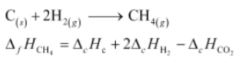
= [-395.5 + 2(-285.8) - (-890.3)] kJ Mol-1
= -74.8 kJ Mol-1
∴ Enthalpy of formation of CH4(g)=−74.8kJmol−1 Hence, alternative (i) is correct.
Question. A reaction, A + B → C + D + q is found to have a positive entropy change. The reaction will be
(i) possible at high temperature
(ii) possible only at low temperature
(iii) not possible at any temperature
(iv) possible at any temperature
Answer : For a reaction to be spontaneous, ΔG should be negative.
ΔG = ΔH – TΔS
According to the question, for the given reaction,
ΔS = positive
ΔH = negative (since heat is evolved)
⇒ ΔG = negative
Therefore, the reaction is spontaneous at any temperature.
Hence, alternative (iv) is correct.
Question. In a process, 701 J of heat is absorbed by a system and 394 J of work is done by the system. What is the change in internal energy for the process?
Answer : According to the first law of thermodynamics,
ΔU = q + W (i)
Where,
ΔU = change in internal energy for a process
q = heat
W = work
Given,
q = + 701 J (Since heat is absorbed)
W = –394 J (Since work is done by the system)
Substituting the values in expression (i), we get
ΔU = 701 J + (–394 J)
ΔU = 307 J
Hence, the change in internal energy for the given process is 307 J.
Question. The reaction of cyanamide,NH2CN(s) with dioxygen was carried out in a bomb calorimeter, and ∆U was found to be –742.7kJmol−1 at 298 K. Calculate enthalpy change for the reaction at 298 K.
NH2CN(g) + 3/2O2(g)→N2(g)+CO2(g)+H2O(l)
Answer : Enthalpy change for a reaction (ΔH) is given by the expression,
ΔH = ΔU + ΔngRT
Where,
ΔU = change in internal energy
Δng = change in number of moles
For the given reaction,
Δng = ∑ng (products) – ∑ng (reactants)
= (2 – 1.5) moles
Δng = 0.5 moles
And,
ΔU = –742.7 kJ mol–1
T = 298 K
R = 8.314 × 10⁻³ kJ mol–1 K–1
Substituting the values in the expression of ΔH:
ΔH = (–742.7 kJ mol–1) + (0.5 mol) (298 K) (8.314 × 10⁻³ kJ mol–1 K–1)
= –742.7 + 1.2
ΔH = –741.5 kJ mol–1
Question. Calculate the number of kJ of heat necessary to raise the temperature of 60.0 g of aluminium from 35°C to 55°C. Molar heat capacity of Al is 24 Jmol−1K−1.
Answer : From the expression of heat (q) q=m⋅ c. ΔT
Where,
c= molar heat capacity
m= mass of substance
ΔT= change in temperature
Substituting the values in the expression of q:
q=(60/27mol)(24Jmol−1K−1)(20K)
q=1066.7J
q=1.07k
Question. Calculate the enthalpy change on freezing of 1.0 mol of water at10.0°C to ice at
–10.0°C.ΔfusH=6.03kJmol−1 at 0∘C
Cp[H2O(I)]=75.3Jmol−1K−1
Cρ[H2O(s)]=36.8Jmol−1K−1
Answer : Total enthalpy change involved in the transformation is the of the following changes:
(a) Energy change involved in the transformation of 1 mol of water at 10∘ C to 1 mol of water at 0 C.
(b) Energy change involved in the transformation of 1 mol of water at 0∘ to 1 mol of ice at 0∘C
(c) Energy change involved in the transformation of 1 mol of ice at0∘C to 1 mol of ice at−10∘C.
ΔH= Cp[ H2OCl]ΔT+ ΔH fivering + Cρ[H2O(s)]ΔT
=(75.3] mol−1K−1)(0−10)K + (−6.03 × 10³Jmol−1)+(36.8] mol−1 K−1 )(−10 −0)K
=−7533 mol−1 − 6030Jmol −1− 368Jmol−1
=−7151J mol−1
=−7.151kJmol−1
Hence, the enthalpy change involved in the transformation is−7.151kJmol−1.
Question. Enthalpy of combustion of carbon to CO2 is –393.5−7.151kJmol−1 . Calculate the heat released upon formation of 35.2 g ofCO2 from carbon and dioxygen gas.
Answer : Formation of CO2 from carbon and dioxygen gas can be represented as:
C(s) + O2(g)⟶CO2(g)
ΔfH=−393.5kJmol−1
(1 mole =44g) Heat released on formation of 44gCO2=−393.5kJmol−1
∴ Heat released on formation of 35.2gCO2
=−314.8kJmol−1
Question. Enthalpies of formation of CO(g), CO2(g), N2O(g) and N2O4(g) are −110,−393,81 and 9.7kJmol−1 respectively.
Find the value of ∆H for the reaction:
N2O4(g)+3CO(g)→N2O(g+3CO2(g]
Answer : ΔrH for a reaction is defined as the difference between ΔH value of products and ΔH value of reactants.
Δ,H=∑Δ,H( products )−∑ΔfH( reactants )
For the given reaction,
N2O4(g) + 3CO(g)⟶ N2O(g) + 3CO2(g)
ΔrH=[ {ΔfH(N2O)+3ΔJH(CO2)}−{ΔfH (N2O4) + 3ΔjH(CO)} ]
Substituting the values ofΔH for N2O,CO2,N2O4 , and CO
From the question, we get:
ΔrH=[ { 81kJmol−1 + 3(−393)kJmol−1} − {9.7kJmol −1+3(−110) kJmol−1}]
ΔrH=−7777kJmol−1
Hence, the value ofΔrH
for the reaction is −777.7 kJmol−1.
Question. Given
N2(g) + 3H2(g) ⟶ 2NH3(y);
ΔrHθ=−92.4kJmol−1
What is the standard enthalpy of formation ofNH3 gas?
Answer : Standard of formation of a compound is the charge in enthalpy that takes place during the formation of 1 mole Of a substance in its standard form from its constituent elements in their standard state.
Re-writing the given equation for 1 mole of NH3(g).
1/2N2(g)+3/2H2(g)⟶NH3(g)
∴ Standard enthalpy of formation of NH3(g)
=1/2 ΔrHθ = 1/2(−92.4 kJmol−1 )= −46.2kJmol−1
Question. Calculate the standard enthalpy of formation ofCH3OH(l) from the following data:
CH3OH(l)+3/2O2(g]→CO2(g)+2H2O(l): Δ,H∘=−726kJmol−1
C(graphite) +O2(g)→CO2(g]: ΔeH=−393kJmol−1
H2(g)+1/2O2(g)→H2O(1); Δ,H=−286kJmol−1
Answer : The reaction that takes place during the formation ofCH3OH(l) can be written as:
C(s) + 2H2O(g) + 1/2O2(G), ⟶ CH3OH(η)(1)
The reaction (I) can be obtained from the given reactions by following the algebraic calculations as:
Equation (ii) + 2 × equation (iii) – equation (i)
ΔfHθ [CH3OH(l)] = ΔcHθ + 2ΔfHθ [H2O(l)] – ΔrHθ
= (–393 kJ mol–1) + 2(–286 kJ mol–1) – (–726 kJ mol–1)
= (–393 – 572 + 726) kJ mol–1
ΔfHθ [CH3 OH(l)] = –239 kJ mol–1
Question. Calculate the enthalpy change for the process CCl4(g)→C(g)+4Cl(g) and calculated bond enthalpy of C−Cl in CCl4(g)
ΔvapHθ (CC|4) = 30.5kJmol−1 ΔfHθ(CCl4) =−135.5kJmol−1
ΔaHθ(C) = 715.0kJmol−1, where ΔaHθ is enthalpy of atomisation
Δ2Hθ(Cl2) = 242kJmol−1
Answer : The chemical equations implying to the given values of enthalpies” are:
(1) CCl4(l) à CCl4(g) ; ΔvapHΘ = 30.5 kJmol−1
(2) C(s) à C(g) ΔaHΘ = 715 kJmol−1
(3) Cl2(g) à 2Cl(g) ; ΔaHΘ = 242 kJmol−1
(4) C(g) + 4Cl(g) à CCl4(g); ΔfHΘ
= -135.5 kJmol−1 ΔH for the process CCl4(g) à C(g) + 4Cl(g) can be measured as:
ΔH=ΔaHΘ(C) + 2ΔaHΘ(Cl2) – ΔvapHΘ–ΔfH
= (715kJmol−1) + 2(kJmol−1) – (30.5kJmol−1) – (-135.5kJmol−1)
Therefore, H= 1304kJmol−1
The value of bond enthalpy for C-Cl in CCl4(g)
= 1304/4kJmol−1
= 326 kJmol−1
Question. For an isolated system, ∆U = 0, what will be ∆S ?
Answer : ΔS will be positive i.e., greater than zero
Since ΔU = 0, ΔS will be positive and the reaction will be spontaneous.
Question. For the reaction at 298 K,
2A + B → C
∆H = 400kJmol−1
and ∆S = 0.2kJmol−1
At what temperature will the reaction become spontaneous considering ∆H and ∆S to be constant over the temperature range.
Answer : From the expression
ΔG= ΔH−TΔS
Assuming the reaction at equilibrium,δ
T for the reaction would be:
T=(ΔH−ΔG)1/ΔS=ΔH/ΔS(ΔG=0 at equilibrium)
=400kJmol−1 0.2 kJK−1 mol−1 T=2000K
For the reaction to be spontaneous,ΔG must be negative. Hence, for the given reaction to be spontaneous, T should be greater than 2000 K.
Question. For the reaction,2Cl(g)→Cl2(g) , what are the signs of ∆H and ∆S ?
Answer : ∆H and ∆S are negative
The given reaction represents the formation of chlorine molecule from chlorine atoms. Here, bond formation is taking place. Therefore, energy Is being released. Hence ∆H is negative.
Also, two moles of atoms have more randomness than one mole of a molecule. Since spontaneity is decreased, ∆S is negative for the given reaction.
Question. For the reaction
2A(g)+B(g)→2D(g)ΔUe=−10.5kJ and ΔS∘=−44.1JK−1
Calculate ΔG⊖ for the reaction, and predict whether the reaction may occur spontaneously
Answer : For the given reaction,
2A(g)+B(g)→2D(g)Δηg=2−(3)=−1 mole
Substituting the value of ΔUθ
in the expression of ΔH:
ΔHθ=ΔUθ+ΔngRT
= (−10.5kJ)−(−1)(8.314×10⁻³ kJK−1 mol−1) (298K) = −10.5kJ−2.48kJΔH⊖=−12.98kJ
Substituting the values ofΔH⊖ and ΔS⊖ in the expression of ΔG⊖
ΔGθ= △Hθ−TΔSθ
=−12.98kJ − ( 298K) (−44.1JK−1) = −12.98kJ + 13.14 kJ ΔG⊖ =+0.16kJ
SinceΔGθ for the reaction is positive, the reaction will not occur spontaneously.
Question. The equilibrium constant for a reaction is 10. What will be the value of ∆G⊖ ? R = 8.314JK−1 mol−1
T = 300 K.
Answer : From the expression, ΔGθ= −2.303 RT logk eq
ΔGθ for the reaction,
=(2.303) (8.314JK−1mol−1) (300K) log10=−5744.14Jmol−1
=−5.744kkmol−1
Question. Comment on the thermodynamic stability of NO(g) , given
12N2(g)+12O2(g)→NO(g);
ΔrH⊖= 90kJmol−1NO(g) + 12O2(g)→NO2(g):
ΔrHe= −74kJmol−1
Answer : The positive value of ΔrH indicates that heat is absorbed during the formation of NO(g), j. This means that NO(g) has higher than the reactants(N2 and O2) .
Hence, NO(g) is unstable. The negative value ofΔrH
H indicates that heat is evolved during the formation ofNO2(g) from NO(g) and O2(g)
. The product,NO2(g) is stabilized with minimum energy.
Hence, unstableNO(g) changes to unstableNO2(g).
Question. Calculate the entropy change in surroundings when 1.00 mol ofH2O(l) is formed under standard conditions.ΔHθ=−286kJ mol−1
Answer : It is given that 286 kJmol−1 of heat is evolved the formation of 1 mol ofH2O(l).
Thus, an equal amount of heat will be absorbed by the surroundings.
qsurr= +286 kJmol−1
Entropy change(ΔSsurr) for the surroundings = qsurr / 7
=286kJmol−1/ 298k
∴ΔSsurt =959.73 Jmol−1K−1
Free study material for Chemistry
Free NCERT Textbook Explanations: Class 11 Chemistry Chapter 05 Thermodynamics
Chapter Exercise Answers for Class 11 Chemistry
Review comprehensive exercise answers for Class 11 Chemistry Chapter 05 Thermodynamics. Fully updated to match current NCERT syllabus guidelines, these textbook solutions help students verify their work and maintain accurate study notes.
Detailed Answer Guides for Chapter 05 Thermodynamics
Beyond providing final answers, these guides offer step-by-step breakdowns for complex queries in the Class 11 Chemistry module. This approach helps students balance theoretical depth with practical problem-solving skills required for NCERT exams.
Complete Preparation Kit for Class 11 Exams
Consistent practice with these solution guides cultivates faster problem-solving habits and clearer logical structuring. For a complete preparation experience, pair these textbook answers with our dedicated revision notes and sample papers for Class 11 Chemistry.
FAQs
The complete and updated NCERT Solutions Class 11 Chemistry Chapter 6 Thermodynamics is available for free on StudiesToday.com. These solutions for Class 11 Chemistry are as per latest NCERT curriculum.
Yes, our experts have revised the NCERT Solutions Class 11 Chemistry Chapter 6 Thermodynamics as per 2026 exam pattern. All textbook exercises have been solved and have added explanation about how the Chemistry concepts are applied in case-study and assertion-reasoning questions.
Toppers recommend using NCERT language because NCERT marking schemes are strictly based on textbook definitions. Our NCERT Solutions Class 11 Chemistry Chapter 6 Thermodynamics will help students to get full marks in the theory paper.
Yes, we provide bilingual support for Class 11 Chemistry. You can access NCERT Solutions Class 11 Chemistry Chapter 6 Thermodynamics in both English and Hindi medium.
Yes, you can download the entire NCERT Solutions Class 11 Chemistry Chapter 6 Thermodynamics in printable PDF format for offline study on any device.