

Mathematics Objective Questions and Answers: IMO Olympiad
Access targeted multiple-choice questions for IMO Olympiad designed to align with the latest CBSE academic syllabus for Class 8 Mathematics. These objective practice sets help students evaluate their conceptual understanding and improve exam readiness.
Download IMO Olympiad MCQs with Answers
Access the complete set of multiple-choice questions for IMO Olympiad below. This focused format allows students to isolate specific topics for thorough review and uninterrupted practice alongside official CBSE textbooks.
Multiple Choice Questions
Rules
I. If an odd number is followed by a two-digit even number then they are to be added.
II. If an odd number is followed by a two-digit odd number then the second number is to be subtracted from the first number.
III. If an even number is followed by a number which is a perfect square of a number then the second number is to be divided by the first number.
IV. If an even number is followed by a two-digit even number then the first number is to be multiplied by the second number.
8 16 16 14
13 11 12 144
What is the difference between the resultant of the first set of numbers and the second set of numbers?
(a) 106
(b) 118
(c) 210
(d) 222
Show Answer & Explanation
Answer: (a) 106
Explanation:
- Row 1: 16 is a perfect square, so 16 ÷ 8 = 2; then 16 ÷ 2 = 8; then 8 × 14 = 112.
- Row 2: 13 − 11 = 2; 2 × 12 = 24; then 144 ÷ 24 = 6.
- The difference is 112 − 6 = 106.
- So the answer is (a) 106.
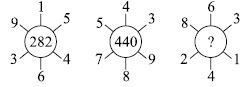
(a) 262
(b) 226
(c) 136
(d) 206
Show Answer & Explanation
Answer: (d) 206
Explanation:
- Find the rule that links the six outer numbers of a circle to the number inside it.
- Apply the same rule to the third circle to get the missing number.
- So the answer is (d) 206.

(a) Figure (A)
(b) Figure (B)
(c) Figure (C)
(d) Figure (D)
Show Answer & Explanation
Answer: (b) Figure (B)
Explanation:
- Fold the sheet along the dotted line so that the left part falls on the right part.
- The patterns of both halves then appear together on one side.
- So the answer is (b).
Four players P, Q, R and S are holding 4 cards each.
Each of them has an Ace, a King, a Queen and a Jack. All of them have all the suits (spade, heart, club and diamond).
I. P has Ace of spade and Queen of diamond.
II. Q has Ace of club and King of diamond.
III. R has Queen of club and King of spade.
IV. S has jack of club.
Ace of diamond is with
(a) P
(b) R
(c) Q
(d) S
Show Answer & Explanation
Answer: (d) S
Explanation:
- S holds the Jack of club, so the Ace, King and Queen of S are of spade, heart and diamond.
- The Kings of diamond and spade are with Q and R, and S cannot hold the King of club (its club is the Jack), so S has the King of heart.
- The Ace and Queen of S are then spade and diamond, and the Ace of spade is with P, so S has the Ace of diamond.
- So the answer is (d) S.

(a) 8
(b) 10
(c) 12
(d) 14
Show Answer & Explanation
Answer: (c) 12
Explanation:
- Count each straight line of the figure once, however many segments it is cut into.
- The figure needs 12 straight lines.
- So the answer is (c) 12.
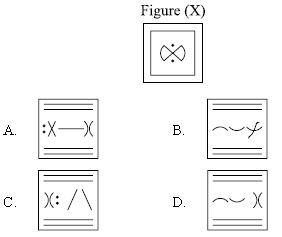
(a) Figure (A)
(b) Figure (B)
(c) Figure (C)
(d) Figure (D)
Show Answer & Explanation
Answer: (c) Figure (C)
Explanation:
- Look at the parts that make up the key figure (X).
- The correct option is the one whose parts fit together to form exactly Fig. (X).
- So the answer is (c).
(a) North
(b) East
(c) North-east
(d) South-west
Show Answer & Explanation
Answer: (c) North-east
Explanation:
- The post office is east of the school, and the market is the same distance north of the post office.
- The market is therefore as far north of the school as the post office is east of it.
- Equal distances east and north make the direction North-east.
- So the answer is (c) North-east.
(a) North
(b) North-west
(c) South-east
(d) North-east
Show Answer & Explanation
Answer: (d) North-east
Explanation:
- At 4.30 the minute hand is on 6, so 6 is East, 3 is North, 12 is West and 9 is South.
- At 4.30 the hour hand is halfway between 4 and 5.
- This is halfway between 3 (North) and 6 (East), which is North-east.
- So the answer is (d) North-east.

(a) Figure (A)
(b) Figure (B)
(c) Figure (C)
(d) Figure (D)
Show Answer & Explanation
Answer: (a) Figure (A)
Explanation:
- Study how the shaded and unshaded parts move from one problem figure to the next.
- Continue the same movement for the sixth figure.
- So the answer is (a).

(a) Figure (A)
(b) Figure (B)
(c) Figure (C)
(d) Figure (D)
Show Answer & Explanation
Answer: (b) Figure (B)
Explanation:
- Compare the figures in the rows and columns of the matrix.
- The missing figure must follow the same pattern.
- So the answer is (b).
(a) 92156873
(b) 92157683
(c) 92516783
(d) 92156837
Show Answer & Explanation
Answer: (a) 92156873
Explanation:
- The first four letters V O C A reversed are A C O V.
- The next four letters L I S T reversed are T S I L.
- Substituting gives 9 2 1 5 6 8 7 3.
- So the answer is (a) 92156873.
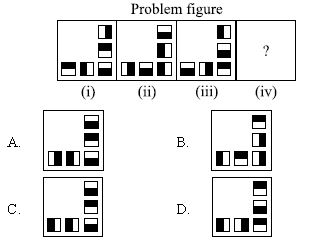
(a) Figure (A)
(b) Figure (B)
(c) Figure (C)
(d) Figure (D)
Show Answer & Explanation
Answer: (b) Figure (B)
Explanation:
- Find how figure (ii) is formed from figure (i).
- Apply the same change to figure (iii) to get figure (iv).
- So the answer is (b).
| Position | Top | Left face | Right face |
|---|---|---|---|
| X | 5 | 4 | 1 |
| Y | 4 | 6 | 3 |
| Z | 2 | 6 | 5 |
(a) More than 5
(b) 5
(c) Less than 5
(d) Cannot be determined
Show Answer & Explanation
Answer: (a) More than 5
Explanation:
- In position Y the top face is 4.
- Faces 5, 1, 6 and 3 are all next to 4 (seen in X and Y), so the face opposite 4 is 2.
- Top + bottom = 4 + 2 = 6, which is more than 5.
- So the answer is (a) More than 5.
(a) 3 + 2 > 4 × 9 + 3 < 2
(b) 3 > 2 > 4 × 18 + 3 < 1
(c) 3 > 2 < 4 × 8 + 4 < 2
(d) 3 + 2 < 4 × 9 + 3 < 3
Show Answer & Explanation
Answer: (d) 3 + 2 < 4 × 9 + 3 < 3
Explanation:
- Replace the symbols: > is +, < is −, + is ÷, − is =, = is 'less than' and × is 'greater than'.
- Statements (a), (b) and (c) work out as 5.5 > 1, 9 > 5 and 1 > 0, which are all true.
- Statement (d) becomes 3 ÷ 2 − 4 greater than 9 ÷ 3 − 3, that is −2.5 > 0, which is false.
- So the answer is (d).
(a) Son
(b) Brother
(c) Cousin
(d) Nephew
Show Answer & Explanation
Answer: (b) Brother
Explanation:
- Deepanshu's father's wife is his mother, and her daughter is his sister.
- The sister's two brothers are Deepanshu and the boy playing football.
- So the boy is Deepanshu's brother.
- So the answer is (b) Brother.

(a) 1
(b) 2
(c) 3
(d) 4
Show Answer & Explanation
Answer: (d) 4
Explanation:
- Follow how the arrows are added and moved from box to box.
- One numbered box breaks the pattern of the series.
- So the answer is (d) 4.
A person is asked to put in a basket one apple when ordered 'One', one guava when ordered 'Two', one orange when ordered 'Three' and is asked to take out from the basket one apple and one guava when ordered 'Four' and 'Five' respectively.
4 4 5 4 5 3 4 5 3 1 4 5 3 1 2 4 5 4 5 3 4 5 3
If 8 of each type of fruits are already in the basket then, how many apples will be there in the basket at the end of the above order sequence?
(a) 1
(b) 2
(c) 3
(d) 4
Show Answer & Explanation
Answer: (b) 2
Explanation:
- Only the orders 'One' (add an apple) and 'Four' (remove an apple) change the apples.
- The sequence has two 'One' and eight 'Four' orders.
- Apples left = 8 + 2 − 8 = 2.
- So the answer is (b) 2.
The sum of the incomes of A and B is more than that of C and D taken together. The sum of the incomes of A and C is the same as that of B and D taken together. Moreover, A earns half as much as the sum of the incomes of B and D. If A's income be Rs. 80,000 per annum and the difference between the incomes of B and D be the same as A's income, B's income is _____.
(a) Rs. 40,000
(b) Rs. 60,000
(c) Rs. 80,000
(d) Rs. 1,20,000
Show Answer & Explanation
Answer: (d) Rs. 1,20,000
Explanation:
- A earns half of B + D, so B + D = Rs. 1,60,000.
- The difference of B and D is Rs. 80,000, so the incomes are Rs. 1,20,000 and Rs. 40,000.
- A + C = B + D gives C = Rs. 80,000, and A + B > C + D means B > D.
- So B = Rs. 1,20,000, and the answer is (d).

(a) Figure (A)
(b) Figure (B)
(c) Figure (C)
(d) Figure (D)
Show Answer & Explanation
Answer: (c) Figure (C)
Explanation:
- Football and cricket overlap (6 play both), and cricket and hockey overlap (4 play both).
- Football or cricket covers 18 + 17 − 6 = 29 students; 46 − 5 = 41 play outdoor games, so 12 more play only hockey, and hockey does not overlap football.
- Carrom has its own separate circle.
- So the answer is (c).

(a) 17
(b) 18
(c) 19
(d) None of these
Show Answer & Explanation
Answer: (d) None of these
Explanation:
- Count the faces of all the cubes that make the solid, including top, front and side faces.
- The count does not match 17, 18 or 19.
- So the answer is (d) None of these.
(a) −1
(b) 1
(c) −2
(d) 2
Show Answer & Explanation
Answer: (a) −1
Explanation:
- The first fraction is \(\dfrac{-2^{n}}{2^{n-1}}\) = −2.
- \(\sqrt[q]{a^{q^2-pq}} = a^{q-p}\), so the brace is \(a^{(p-q)-(q-p)-2(p-q)} = a^{0} = 1\), and 1 to the power n is 1.
- The total is −2 + 1 = −1.
- So the answer is (a) −1.
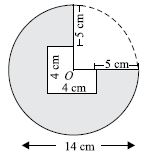
(a) 28.45 sq. cm
(b) 113.6 sq. cm
(c) 59.8 sq. cm
(d) 103.5 sq. cm
Show Answer & Explanation
Answer: (d) 103.5 sq. cm
Explanation:
- The circle has radius 7 cm, so its area is 22/7 × 7 × 7 = 154 sq. cm.
- The shaded area is the circle minus the white parts shown in the figure.
- So the answer is (d) 103.5 sq. cm.
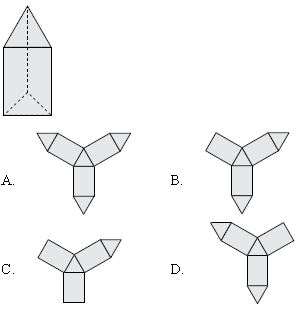
(a) Figure (A)
(b) Figure (B)
(c) Figure (C)
(d) Figure (D)
Show Answer & Explanation
Answer: (c) Figure (C)
Explanation:
- The solid is a prism with two triangular ends and rectangular side faces.
- A possible net must fold into this prism with the faces meeting correctly.
- So the answer is (c).
(a) 360°
(b) 540°
(c) 420°
(d) 120°
Show Answer & Explanation
Answer: (a) 360°
Explanation:
- The angles of the three triangles ABO, DCO and FEO add up to 3 × 180° = 540°.
- The angles at O are ∠AOB, ∠COD and ∠EOF, and ∠EOF equals the vertically opposite ∠BOC.
- So ∠AOB + ∠BOC + ∠COD = 180° along the line AOD.
- Hence a + b + c + d + e + f = 540° − 180° = 360°, so the answer is (a).
(a) \(\sqrt{2}\)
(b) \(\dfrac{12+8\sqrt{2}}{5}\)
(c) \(\dfrac{12-8\sqrt{2}}{5}\)
(d) \(\dfrac{16\sqrt{2}+24}{5}\)
Show Answer & Explanation
Answer: (a) \(\sqrt{2}\)
Explanation:
- \(x = 4\sqrt{2}(\sqrt{2}-1) = 8-4\sqrt{2}\).
- Then \(\dfrac{x+2}{x-2}=\dfrac{10-4\sqrt{2}}{6-4\sqrt{2}}\) and \(\dfrac{x+2\sqrt{2}}{x-2\sqrt{2}}=\dfrac{8-2\sqrt{2}}{8-6\sqrt{2}}\).
- Adding these and multiplying by \(\dfrac{1}{\sqrt{2}}\) gives \(\sqrt{2}\) (about 1.4142).
- So the answer is (a) \(\sqrt{2}\).
(a) 72\(\frac{1}{2}\)°
(b) 135°
(c) 105°
(d) 67\(\frac{1}{2}\)°
Show Answer & Explanation
Answer: (b) 135°
Explanation:
- Third friend's share = 24 − 7 − 8 = 9 parts out of 24.
- Central angle = 9/24 × 360° = 135°.
- So the answer is (b) 135°.
(a) 240°
(b) 90°
(c) 105°
(d) 60°
Show Answer & Explanation
Answer: (a) 240°
Explanation:
- Triangle LSR is equilateral, so z = 60° and ∠SRL = 60°; the diagonal SQ makes ∠RSQ = 45°.
- In the triangle formed by S, R and the crossing point of RL and SQ, y = 180° − 45° − 60° = 75°.
- x = 180° − 75° = 105°.
- x + y + z = 105° + 75° + 60° = 240°, so the answer is (a).
(a) 1
(b) 0
(c) 1/36
(d) 4/36
Show Answer & Explanation
Answer: (a) 1
Explanation:
- The faces carry six odd numbers, so every throw gives an odd number.
- Odd + odd is always even.
- So the sum is always even and the probability is 1.
- So the answer is (a) 1.
(a) 1 cm = 36 m
(b) 1 cm = 26 m
(c) 1 cm = 33 m
(d) 1 cm = 6 m
Show Answer & Explanation
Answer: (d) 1 cm = 6 m
Explanation:
- Area of the map on the page = 2/5 × 25 × 30 = 300 sq. cm.
- So 300 sq. cm stands for 10800 sq. m, that is 36 sq. m for 1 sq. cm.
- Then 1 cm stands for √36 = 6 m.
- So the answer is (d) 1 cm = 6 m.
(a) R paid more than Q by Rs. 40
(b) R paid more than Q by Rs. 30
(c) Q paid more than R by Rs. 40
(d) Q paid more than R by Rs. 30
Show Answer & Explanation
Answer: (d) Q paid more than R by Rs. 30
Explanation:
- Q's simple interest = 26000 × 2 × 2 ÷ 100 = Rs. 1040.
- R's compound interest = 25000 × (1.02² − 1) = Rs. 1010.
- Q paid 1040 − 1010 = Rs. 30 more.
- So the answer is (d) Q paid more than R by Rs. 30.
(a) 175
(b) 165
(c) 185
(d) 200
Show Answer & Explanation
Answer: (a) 175
Explanation:
- Let P = 6k, Q = 5k, R = 4k, so 77k2 = 192500 and k2 = 2500, k = 50.
- P = 300, Q = 250 and R = 200.
- (300 + 250 − 200) ÷ 2 = 175.
- So the answer is (a) 175.
(a) \(-\dfrac{63}{1024}\)
(b) \(-\dfrac{63}{2048}\)
(c) \(-\dfrac{9}{2048}\)
(d) \(\dfrac{9}{1024}\)
Show Answer & Explanation
Answer: (c) \(-\dfrac{9}{2048}\)
Explanation:
- a = 1/4 − 1/8 = 1/8, b = 1/8 − 1/16 = 1/16 and c = 1/16 − 1/4 = −3/16.
- 3abc = 3 × 1/8 × 1/16 × (−3/16) = −9/2048.
- So the answer is (c) −9/2048.
(a) ±(10/3)
(b) 0
(c) 1
(d) −1
Show Answer & Explanation
Answer: (a) ±(10/3)
Explanation:
- Let t = \(\sqrt[3]{x}\). Cubing both sides gives 3(t − 1/t) = 8, so t − 1/t = 8/3.
- (t + 1/t)2 = (t − 1/t)2 + 4 = 64/9 + 4 = 100/9.
- So t + 1/t = ±10/3.
- So the answer is (a) ±(10/3).
(a) 22 m
(b) 11 m
(c) 33 m
(d) 44 m
Show Answer & Explanation
Answer: (d) 44 m
Explanation:
- With π = 22/7: (2/3) × (22/7) × r3 = 468512/21, so 44r3/21 = 468512/21.
- r3 = 468512 ÷ 44 = 10648, so r = 22 m.
- Diameter = 2 × 22 = 44 m.
- So the answer is (d) 44 m.
(a) (ax − by)(ax + by)
(b) (ax + by)(bx + ay)
(c) (ax − ay + bx + by)(ax − ay + bx + by)
(d) (ax + ay + bx + by)(ax − ay + bx + by)
Show Answer & Explanation
Answer: (c) (ax − ay + bx + by)(ax − ay + bx + by)
Explanation:
- The expression has the form p2 + 2pq + q2 with p = (x − y)a and q = (x + y)b.
- So it equals (p + q)2 = ((x − y)a + (x + y)b)2.
- (x − y)a + (x + y)b = ax − ay + bx + by.
- So the answer is (c) (ax − ay + bx + by)(ax − ay + bx + by).
(a) 10000, 35000
(b) 25000, 20000
(c) 15000, 30000
(d) 5000, 40000
Show Answer & Explanation
Answer: (b) 25000, 20000
Explanation:
- Let the first part be x. Interest = 0.40x + 0.495(45000 − x) = 19900.
- 22275 − 0.095x = 19900, so x = 25000.
- The other part is 45000 − 25000 = 20000.
- So the answer is (b) 25000, 20000.
(a) Rs. 15600
(b) Rs. 18625
(c) Rs. 17650
(d) Rs. 18750
Show Answer & Explanation
Answer: (d) Rs. 18750
Explanation:
- The difference is 30 − 7 = 23 parts = Rs. 14375, so 1 part = Rs. 625.
- Officer's salary = 30 × 625 = Rs. 18750.
- So the answer is (d) Rs. 18750.
(a) Rs. 5000
(b) Rs. 4000
(c) Rs. 4250
(d) Rs. 5250
Show Answer & Explanation
Answer: (b) Rs. 4000
Explanation:
- Selling price = 85% of 5000 = Rs. 4250.
- This is 106.25% of the cost price.
- Cost price = 4250 ÷ 1.0625 = Rs. 4000.
- So the answer is (b) Rs. 4000.
(a) 1 : 5 : 7
(b) 2 : 10 : 10
(c) 1 : 5 : 6
(d) 2 : 8 : 9
Show Answer & Explanation
Answer: (c) 1 : 5 : 6
Explanation:
- Let Sarthak be s years, so his mother is 5s and his father is 6s.
- After 15 years: 6s + 30 = 4/3 × (6s + 15) = 8s + 20, so s = 5.
- The ages are 5, 25 and 30, in the ratio 1 : 5 : 6.
- So the answer is (c) 1 : 5 : 6.
(a) 11
(b) 22
(c) 33
(d) None of these
Show Answer & Explanation
Answer: (a) 11
Explanation:
- The remaining work is 15 days of work for 22 men.
- To finish it in 10 days the men needed are 22 × 15 ÷ 10 = 33.
- More men = 33 − 22 = 11.
- So the answer is (a) 11.
(a) 30
(b) 40
(c) 50
(d) 25
Show Answer & Explanation
Answer: (a) 30
Explanation:
- Let the fraction of females be f: 9200(1 − f) + 8200f = 8900.
- 9200 − 1000f = 8900, so f = 0.3.
- So 30% of the employees are female.
- So the answer is (a) 30.
(a) 20, 20, 10
(b) 10, 10, 5
(c) 15, 15, 30
(d) 15, 15, 10
Show Answer & Explanation
Answer: (b) 10, 10, 5
Explanation:
- Let the numbers of questions be 2k, 2k and k.
- Marks: 3 × 2k + 4 × 2k + 6 × k = 20k = 100, so k = 5.
- The numbers are 10, 10 and 5.
- So the answer is (b) 10, 10, 5.
(a) 6000
(b) 5000
(c) 7000
(d) 8000
Show Answer & Explanation
Answer: (d) 8000
Explanation:
- Volume of the barrel = 22/7 × 1.5 × 1.5 × 14 = 99 cc.
- 99 ml writes 3600 words, so 1 ml writes 3600/99 words.
- 220 ml writes 220 × 3600 ÷ 99 = 8000 words.
- So the answer is (d) 8000.
(a) Rs. 3000
(b) Rs. 6000
(c) Rs. 9000
(d) Rs. 12000
Show Answer & Explanation
Answer: (b) Rs. 6000
Explanation:
- The amounts are in the ratio (1 × 3) : (30 × 1) = 3 : 30.
- The first class part is 3/33 of the total.
- 3/33 × 66000 = Rs. 6000.
- So the answer is (b) Rs. 6000.
(a) 34900
(b) 35100
(c) 35900
(d) 36100
Show Answer & Explanation
Answer: (b) 35100
Explanation:
- 12 hectares 3201 m2 = 120000 + 3201 = 123201 m2.
- The side is √123201 = 351 m.
- 351 m = 35100 cm.
- So the answer is (b) 35100.
(a) 1/16, 1/144, 5/144, 3/144
(b) 1/16, 5/144, 1/144, 3/144
(c) 1/16, 3/144, 1/144, 5/144
(d) None of these
Show Answer & Explanation
Answer: (b) 1/16, 5/144, 1/144, 3/144
Explanation:
- Adding the three equations gives 2(1/s + 1/m + 1/f) = 1/24 + 1/18 + 1/36 = 1/8, so the total is 1/16.
- 1/s = 1/16 − 1/36 = 5/144 and 1/m = 1/16 − 1/18 = 1/144.
- 1/f = 1/16 − 1/24 = 3/144.
- So the answer is (b) 1/16, 5/144, 1/144, 3/144.
Statement 1 : \(\left[\sqrt[9]{\left(\dfrac{2}{3}\right)^{5}}\right]^{\sqrt{x-5}} = \left(\dfrac{2}{3}\right)^{0}\), then x = 5
Statement 2 : \(\left[\sqrt[n]{\left(\dfrac{a}{b}\right)^{m}}\right]^{p} = \left(\dfrac{a}{b}\right)^{\frac{\sqrt{mp}}{\sqrt{n}}}\)
(a) Statement 1 is true and statement 2 is false
(b) Statement 1 and 2 are true
(c) Statement 1 and 2 are false
(d) Statement 1 is false and statement 2 is true
Show Answer & Explanation
Answer: (a) Statement 1 is true and statement 2 is false
Explanation:
- Statement 1: the left side is \((2/3)^{5\sqrt{x-5}/9}\), which equals \((2/3)^0\) only when \(\sqrt{x-5}=0\), so x = 5 and the statement is true.
- Statement 2: the left side is \((a/b)^{mp/n}\), which is not \((a/b)^{\sqrt{mp}/\sqrt{n}}\) in general (for m = 4, n = 1, p = 1 the powers are 4 and 2).
- So statement 1 is true and statement 2 is false.
- So the answer is (a).
(a) 4, 6 and 2, 7
(b) 2, 3 and 7, 3
(c) 8, 2 and 7, 3
(d) 5, 4 and 3, 7
Show Answer & Explanation
Answer: (c) 8, 2 and 7, 3
Explanation:
- 23 = 8 and 83 = 512, so cubes of numbers ending in 2 and 8 end in 8 and 2.
- 33 = 27 and 73 = 343, so cubes of numbers ending in 3 and 7 end in 7 and 3.
- So the answer is (c) 8, 2 and 7, 3.
(a) x > y = z
(b) x < y = z
(c) x = y = z
(d) Cannot be determined
Show Answer & Explanation
Answer: (c) x = y = z
Explanation:
- PT ∥ QR and m ∥ l, so x and z are corresponding angles and x = z.
- QR cuts the parallel lines l and n, so z and y are corresponding angles and z = y.
- So x = y = z.
- So the answer is (c) x = y = z.
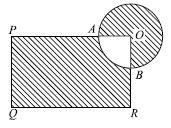
Find the area of the shaded region if PA = 8 cm and BR = 4 cm (Use π = 3.14)
(a) 132.68 cm2
(b) 121.12 cm2
(c) 108.56 cm2
(d) None of these
Show Answer & Explanation
Answer: (b) 121.12 cm2
Explanation:
- PA = 8 cm is 2/3 of PO, so PO = 12 cm and AO = 4 cm; BR = 4 cm gives OR = 8 cm.
- Rectangle = 12 × 8 = 96 cm2; the circle is 3.14 × 16 = 50.24 cm2; the white quarter circle is 12.56 cm2.
- Shaded = 96 − 12.56 + (50.24 − 12.56) = 121.12 cm2, so the answer is (b).
- So the answer is (b) 121.12 cm2.
Free study material for Mathematics
Practice MCQs for Class 8 Mathematics IMO Olympiad
Chapter MCQs with Answers for Class 8 Mathematics
Explore reliable practice questions for IMO Olympiad tailored for Class 8 Mathematics learners. Use these multiple-choice formats to evaluate preparedness and strengthen problem-solving skills.
Expert Practice Material for Class 8 Mathematics
Each question includes structured solution keys mapped directly to standard CBSE textbooks, helping students evaluate their reasoning and correct mistakes early in their revision.
Complete Your Chapter Revision
Follow up your worksheet practice by attempting the interactive online Mathematics MCQ test for this chapter to evaluate your execution speed. All platform resources are free to access.
FAQs
You can get most exhaustive CBSE Class 8 Mathematics IMO Olympiad MCQs with Answers Set 14 for free on StudiesToday.com. These MCQs for Class 8 Mathematics are updated for the 2026-27 academic session as per CBSE examination standards.
Yes, our CBSE Class 8 Mathematics IMO Olympiad MCQs with Answers Set 14 include the latest type of questions, such as Assertion-Reasoning and Case-based MCQs. 50% of the CBSE paper is now competency-based.
By solving our CBSE Class 8 Mathematics IMO Olympiad MCQs with Answers Set 14, Class 8 students can improve their accuracy and speed which is important as objective questions provide a chance to secure 100% marks in the Mathematics.
Yes, Mathematics MCQs for Class 8 have answer key and brief explanations to help students understand logic behind the correct option as its important for 2026 competency-focused CBSE exams.
Yes, you can also access online interactive tests for CBSE Class 8 Mathematics IMO Olympiad MCQs with Answers Set 14 on StudiesToday.com as they provide instant answers and score to help you track your progress in Mathematics.