

Multiple Choice Questions (MCQs) for Class 8 Mathematics: Chapter 06 Squares and Square Roots
Access targeted multiple-choice questions for Chapter 06 Squares and Square Roots designed to align with the latest CBSE academic syllabus for Class 8 Mathematics. These objective practice sets help students evaluate their conceptual understanding and improve exam readiness.
Practice Chapter 06 Squares and Square Roots MCQs for Class 8 Mathematics
Navigate directly to the 50 objective questions for Chapter 06 Squares and Square Roots using the digital viewer below. Each practice set includes verified answer keys, allowing students to instantly cross-check their work and identify areas requiring further revision.
Question: The square root of 441/961 is
a) 21/31
b) 21/39
c) 37/21
d) 11/13
Answer: 21/31
Question: If M is a square number, then the next immediate square number is
a) M + 2 √M +1
b) M2 + 2M
c) M + 5
d) none of these
Answer: M + 2 √M +1
Question: The square root of 71 × 72 × 73 × 74 + 1 is
a) 5255
b) 9625
c) 9375
d) 5625
Answer: 5255
Question: If a square number ends in 6, the preceding figure is
a) an odd number
b) a composite number
c) an even number
d) a prime number
Answer: an odd number
Question: The Value of √(-1) √(-1) is
a) – 1
b) ± 2
c) + 1
d) none
Answer: – 1
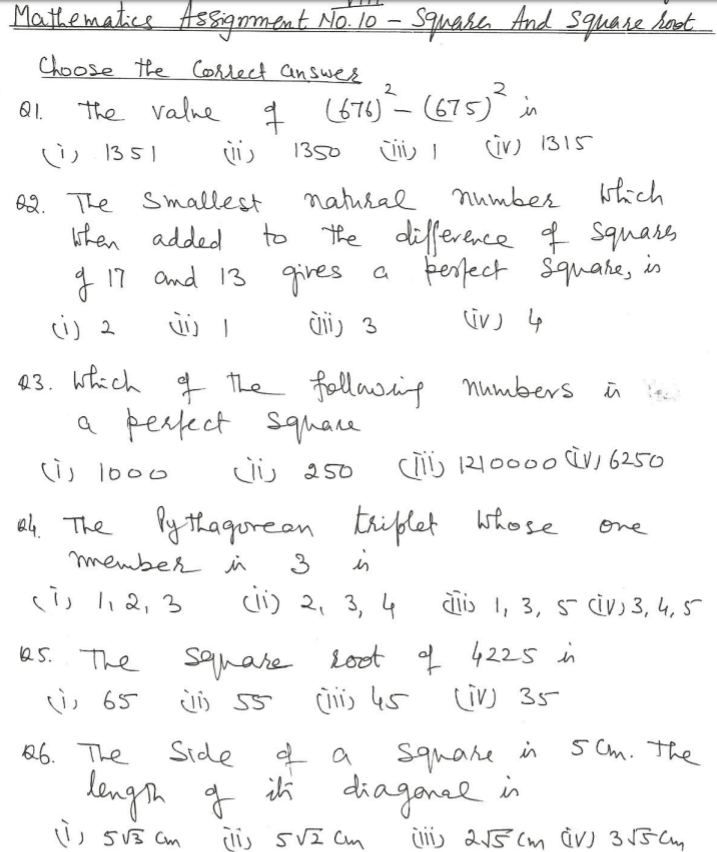
Question: The value of (501)2 – (500)2 is
a) 1001
b) 1
c) 101
d) none of these
Answer: 1001
Question: Which of the following is a Pythagorean triplet?
a) (6, 8, 10)
b) (5, 12, 18)
c) (3, 4, 7)
d) none of these
Answer: (6, 8, 10)
Question: The value of 1 + 3 + 5 + 7 + 9 + ..... + 25 is
a) 169
b) 625
c) 196
d) 225
Answer: 169
Question: The smaller number by which 396 must be multiplied so that the product becomes a perfect square is
a) 11
b) 2
c) 5
d) 3
Answer: 11
Question: The value of √99 X √396 is
a) 198
b) none of these
c) 208
d) 254
Answer: 198
Question: Square root of 0.081/0.0064 X 0.484/6.25 X 2.5/21.1 is
a) 0.45
b) 0.95
c) 0.75
d) 0.75
Answer: 0.45
Question: The value of 1+√0.01 / 1−√0.01 is close to
a) 1.6
b) 0.6
c) 1.1
d) 1.7
Answer: 1.6
Question: A number added to its square gives 56. The number is
a) 7
b) 9
c) 12
d) 8
Answer: 7
Question: The least number which must be subtracted from 6156 to make its perfect square is
a) 72
b) 82
c) 52
d) 62
Answer: 72
Question: A four digit perfect square number whose first two digits and last two digits taken separately are also perfect square numbers is
a) 1681
b) 3664
c) 1636
d) 6481
Answer: 1681
Question. The square root of 441/961 is
(A) 21/39
(B) 37/21
(C) 21/31
(D) 11/13
Answer: C
Question. If M is a square number, then the next immediate square number is
(A) M + 5
(B) M + 2√M + 1
(C) M2 + 2M
(D) none of these
Answer: B
Question. √1/16 + 1/9 =
(A) 7/12
(B) 25/144
(C) 5/12
(D) none
Answer: C
Question. If √1+27/169 = 1+x/13 then x =
(A) 1
(B) 14
(C) cannot be determined
(D) none of these
Answer: A
Question. The square root of 71 × 72 × 73 × 74 + 1 is
(A) 9375
(B) 9625
(C) 5625
(D) 5255
Answer: D
Question. If a square number ends in 6, the preceding figure is
(A) an even number
(B) an odd number
(C) a prime number
(D) a composite number
Answer: B
Question. The value of √(-1)√(-1) is
(A) – 1
(B) + 1
(C) ± 2
(D) none
Answer: A
Question. The value of (501)2 – (500)2 is
(A) 1
(B) 101
(C) 1001
(D) none of these
Answer: C
Question. Which of the following is a Pythagorean triplet?
(A) (6, 8, 10)
(B) (3, 4, 7)
(C) (5, 12, 18)
(D) none of these
Answer: A
Question. The value of 1 + 3 + 5 + 7 + 9 + ..... + 25 is
(A) 196
(B) 625
(C) 225
(D) 169
Answer: D
Question. The smaller number by which 396 must be multiplied so that the product becomes a perfect square is
(A) 5
(B) 11
(C) 3
(D) 2
Answer: B
Question. The value of √99 × √396 is
(A) 208
(B) 198
(C) 254
(D) none of these
Answer: B
Question. Square root of 0.081/0.0064 x 0.484/6.25 x 2.5/21.1 is
(A) 0.45
(B) 0.75
(C) 0.95
(D) 0.75
Answer: A
Question. √1+ √1+ √1+ .........
(A) equals 1
(B) lies between 0 and 1
(C) lies between 1 and 2
(D) is grater than 2
Answer: C
Question. The value of 1+√0.01/1-√0.1 is close to
(A) 0.6
(B) 1.1
(C) 1.6
(D) 1.7
Answer: C
Question. If x * y =√x2 + y2 , the value of (1 * 2√2) (1 * – 2√2) is
(A) – 7
(B) 0
(C) 2
(D) 9
Answer: D
Question. Evaluate √41- √21- √19 - √9
(A) 3
(B) 6
(C) 5
(D) 6.4
Answer: B
Question. A number added to its square gives 56. The number is
(A) 12
(B) 9
(C) 8
(D) 7
Answer: D
Question. The least number which must be subtracted from 6156 to make its perfect square is
(A) 62
(B) 72
(C) 52
(D) 82
Answer: B
Question. A four digit perfect square number whose first two digits and last two digits taken separately are also perfect square numbers is
(A) 1681
(B) 1636
(C) 3664
(D) 6481
Answer: A
Question. The square of a natural number subtracted from its cube is 48. The number is
(A) 6
(B) 5
(C) 4
(D) 8
Answer: C
Question. The smallest natural number which when added to the difference of squares of 17 and 13 gives a perfect square is
(A) 1
(B) 5
(C) 11
(D) 24
Answer: A
Question. If √16/49 = x/49 then x =
(A) 4
(B) 7
(C) 16
(D) 28
Answer: D
Question. The square root of a perfect square containing ‘n’ digits has ________ digits.
(A) n+1/2
(B) n/2
(C) A or B
(D) none
Answer: C
Question. The area of a square field is 80,244/729 sq. m. The length of each side of the field is
(A) 8.96 m
(B) 10.26 m
(C) 13.54 m
(D) none
Answer: A
Question. The square root of 1764 is
(A) 32
(B) 42
(C) 48
(D) 38
Answer: B
Question. The square root of 53361 is
(A) 231
(B) 211
(C) 261
(D) 249
Answer: A
Question. The least perfect square which is divisible by 2, 4 and 6 is
(A) 36
(B) 64
(C) 16
(D) 18
Answer: A
Question. The square root of 390625 is
(A) 645
(B) 225
(C) 735
(D) 625
Answer: D
Question. The least perfect square exactly divisible by each of the numbers 6, 9, 15 and 20 is
(A) 3600
(B) 900
(C) 400
(D) 225
Answer: B
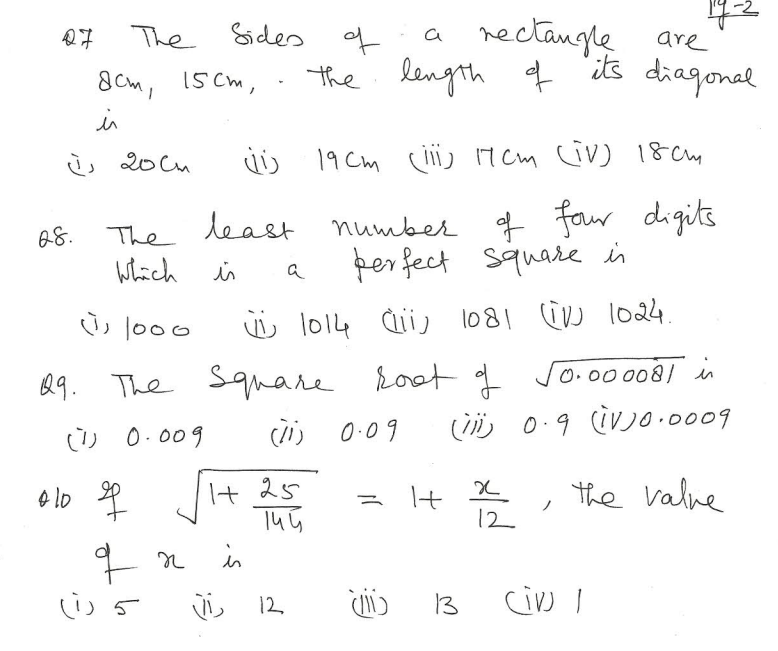
Question. The sides of a rectangular field are 80 m and 18 m respectively. The length of the diagonal is
(A) 84 m
(B) 98 m
(C) 82 m
(D) 86 m
Answer: C
Question. The least number of 4 digits which is a perfect square is
(A) 1000
(B) 1004
(C) 1016
(D) 1024
Answer: D
Question. The least number which must be subtracted from 2509 to make it a perfect square is
(A) 6
(B) 9
(C) 12
(D) 14
Answer: B
Question. The value of √0.9 is (approx)
(A) 0.3
(B) 0.6
(C) 0.9
(D) 0.4
Answer: C
Question. 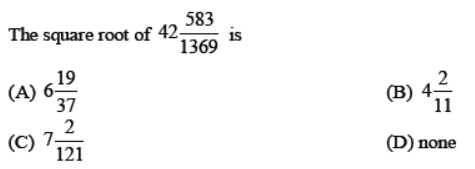
Answer: A
Question. Which of the following numbers, where in some of the digits have been suppressed by symbols, can possibly be the perfect square of a 3 digit odd number?
(A) 65 × × × 1
(B) 9 × × 1
(C) 10 × × × 4
(D) 9 × × × × × 5
Answer: A
Question. The least number which must be added to 196201 to make it a perfect square is
(A) 42
(B) 44
(C) 48
(D) 50
Answer: B
Question. The least number which must be subtracted from 2509 to make it a perfect square, is
(A) 6
(B) 9
(C) 12
(D) 14
Answer: B
Question. The least number of numbers to be deleted from the set {1, 2, 3,....13, 14, 15} so that the product of the remaining numbers is a perfect square is
(A) 1
(B) 2
(C) 3
(D) 4
Answer: C
Question. A gardener has 1000 plants. The minimum number of plants he needs more to plant these in such a way that the number of rows and the number of columns remain same is
(A) 100
(B) 24
(C) 89
(D) 156
Answer: B
Question. If the diagonal of a square is doubled, the area of the square becomes
(A) 2 times
(B) 3 times
(C) 4 times
(D) 6 times
Answer: C
Question. The students of class 8 of a school donated Rs. 2401 in all, for Prime Minister’s National Relief Fund. Each student donated as many rupees as the number of students in the class. The number of students in the class, is
(A) 47
(B) 48
(C) 49
(D) 50
Answer: C
Question. The smallest number by which 252 must be multiplied so that the product is a perfect square is
(A) 7
(B) 6
(C) 5
(D) 12
Answer: A
Question. The value of √900 + √0.09 + √0.000009 is
(A) 30.003
(B) 30.330
(C) 30.303
(D) 30.333
Answer: C
Question. If √2√2√2√2√2 = x , then x is
(A) 0
(B) 1
(C) 2
(D) 231/32
Answer: D
Question. The number must be subtracted from 16161 to get a perfect square is
(A) 31
(B) 32
(C) 33
(D) 34
Answer: B
Question. √284 + √52 + √144
(A) 14
(B) 16
(C) 16.6
(D) 18.8
Answer: B
Question. The smallest square number which is divisible by each of the number 6, 9 and 15, is
(A) 100
(B) 400
(C) 900
(D) 1024
Answer: C
Question. The smallest number by which 180 must be multiplied so that it becomes a perfect square is
(A) 6
(B) 9
(C) 3
(D) 5
Answer: D
Question. The lest square number, which is exactly divisible by each one of the numbers 12, 15, 18 is
(A) 3844
(B) 3364
(C) 3721
(D) 3600
Answer: D
Question. The square root of 7 correct upto two places of decimal is
(A) 2.64
(B) 2.65
(C) 2.66
(D) 2.67
Answer: B
Question. Between which two consecutive whole numbers does √95 lie?
(A) 7 and 8
(B) 8 and 9
(C) 9 and 10
(D) 10 and 11
Answer: C
Question. If √(12+√12+√12+......) = x , then the value of x is
(A) 3
(B) 4
(C) 6
(D) greater than 6
Answer: B
Question. If √3 = 1.732 and √2 = 1.414, then the value of 1/√3+√2 is
(A) 0.064
(B) 0.308
(C) 0.318
(D) 2.146
Answer: C
Question. Largest perfect square number of three digits divisible by 10, 15 and 25 is
(A) 625
(B) 999
(C) 900
(D) 1024
Answer: C
Question. The least square number exactly divisible by each one of the numbers 8, 12, 15, 20 is
(A) 3652
(B) 3600
(C) 4900
(D) 1500
Answer: B
Question. The greatest six-digit number, which is a perfect square is
(A) 998001
(B) 995001
(C) 997001
(D) 996001
Answer: A
Question. A decimal fraction is multiplied by itself. If the product is 176.252176. The fraction is
(A) 13276
(B) 13.267
(C) 13.287
(D) 13278
Answer: A
Question. If √2401 = √7x , then the value of x is
(A) 3
(B) 4
(C) 5
(D) 6
Answer: B
Question. The smallest number by which 9408 must be divided so that the quotient is a perfect square, is
(A) 2
(B) 3
(C) 5
(D) 7
Answer: B
Question. The square root of the quotient which is a perfect square obtained when 9408 is divided by smallest number is
(A) 56
(B) 168
(C) 54
(D) 55
Answer: A
Question. If √2 + √x = √3 , then x =
(A) 1
(B) √7
(C) 7
(D) 49
Answer: D
Question. If √.05x5x a =.5x.05x √b , then a/b = ?
(A) 0.0025
(B) 0.025
(C) 0.25
(D) 2.5
Answer: B
Question. If √0.01+ √0.0064 = x , then the value of x is
(A) 0.3
(B) 0.03
(C) √0.18
(D) none of these
Answer: A
Question. The value of x, for which ax2 – c = 0 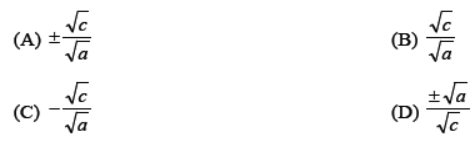
Answer: A
Question. If value of √15625 =125, then the value of √156.25 + √1.5625 is
(A) 137.5
(B) 1.375
(C) 13.75
(D) 0.1375
Answer: C
Question. Consider the following statements
1. √(√5-2)2 = √5-2
2. √(√6-√7)2 = √7-√6. Of these statements
(A) 1 alone is correct
(B) 2 alone is correct
(C) both 1 and 2 are false
(D) both 1 and 2 are correct
Answer: D
Question. Square numbers can only have......at the end
(A) Odd number of zeros
(B) Even number of zeros
(C) Both (A) and (B)
(D) none of these
Answer: B
Question. The least perfect square number divisible by 3, 4, 5, 6, 8 is
(A) 900
(B) 1200
(C) 2500
(D) 3600
Answer: D
Question. The value of √99 x √396 is
(A) 208
(B) 198
(C) 254
(D) 205
Answer: B
Question. If x = √3018 +√36 +√169 , the value of x is
(A) 55
(B) 44
(C) 63
(D) 42
Answer: A
Question. If √0.9x0.09x x = 0.9x0.09x √z , then the value of
(A) 0.081
(B) 0.810
(C) 081
(D) 8.09
Answer: A
Question. If √169/x = 1.30 then the value of x is
(A) 100
(B) 1000
(C) 10
(D) 1000
Answer: A
Question. The value of √7+2√10 is
(A) √6 + v1
(B) √4 + √3
(C) √5 + √2
(D) 2 + √5
Answer: C
Question. 
Answer: B
Question. A number is 64 times the square of its reciprocal. The number is
(A) 10
(B) 4
(C) 2
(D) 16
Answer: B
Question. The smallest perfect square number exactly divisible by 4, 5, 6, 15, 18 is
(A) 800
(B) 225
(C) 361
(D) 900
Answer: D
Question. A gardener plants 17956 trees in such a way that there are as many rows as there are trees in a row.
The number of trees in a row are
(A) 136
(B) 164
(C) 134
(D) 166
Answer: C
Put a tick mark(√) on the correct answer :
Question. If a number has ‘1’ or ‘9’ in the unit’s place, then its square roor ends in which of the following numbers.
(i) 1 (ii) 4
(iii) 5
(iv) 6
Question. There are how many non-perfect squares between 100 & 121 ?
(i) 10
(ii) 15
(iii) 20
(iv) 25
Question. What will be the unit’s digit of 526982
(i) zero
(ii) 4
(iii) 5
(iv) 6
Question. The sum of first ‘n’ odd natural numbers is given by
(i) 2n
(ii) n2
(iii) (n + 1)
(iv) n2 + 1
Question. Which of the following numbers is not a perfect square ?
(i) 62500
(ii) 57600
(iii) 90000
(iv) 63147
Question. Which of the following Pythagorean triplet has the smallest member ‘8’
(i) 8,11,14
(ii) 8,10,12
(iii) 8,9,10
(iv) 8,15 ,17
Question. Which of the following is the square root of 7056 ?
(i) 86
(ii) 3 4
(iii) 54
(iv) 84
Question. Which of the following numbers by which 9408 must be divided so that the quotient is a Perfect square?
(i) 4
(ii) 3
(iii) 5
(iv) 6.
Question. Which of the following square number is divisible by each of the numbers 6 , 9 7 15 ?
(i) 400
(ii) 500
(iii) 600
(iv) 900
Question. Which of the following numbers must be subtracted from 5607to get a perfect square ?
(i) 121
(ii) 131
(iii) 141
(iv) 151
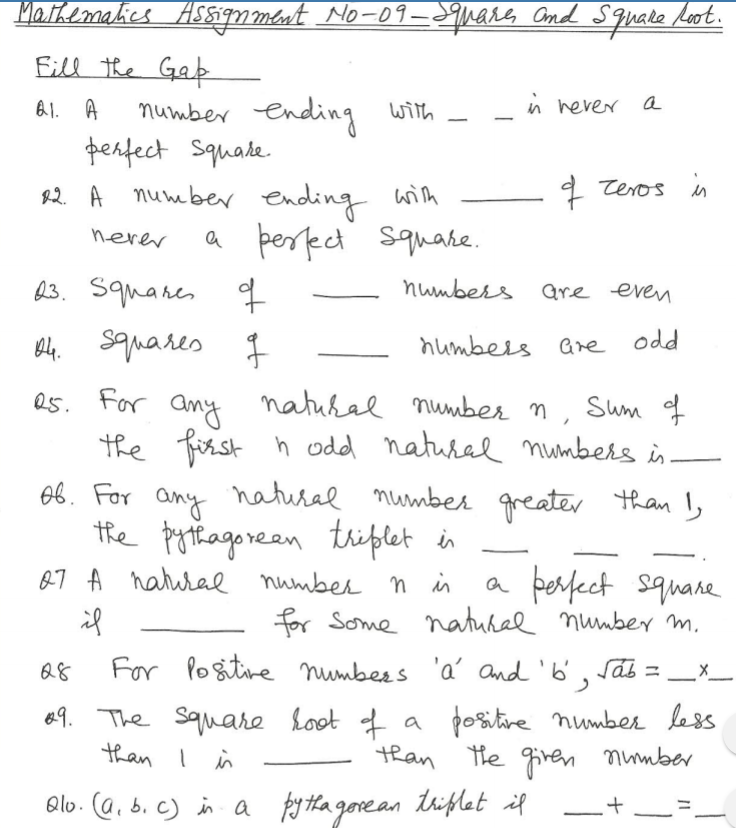
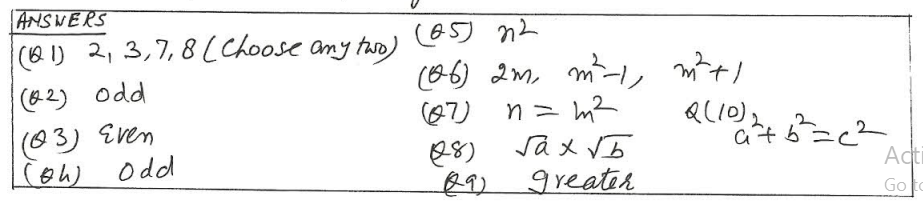
1. The square of a number is that number raised to the power 2.
2. A natural number is called a perfect square if it is the square of some natural number.
3. Properties of Squares
(a) A number ending in 2, 3, 7 (or) 8 is never a perfect square.
(B) A number ending in an odd number of zeros is never a perfect square.
(C) Squares of even numbers are given
(D) Squares of odd numbers are odd.
(e) For every natural number ‘n’, we have (n + 1)2 – n2 = (n + 1) + n e.g., – 92 – 82 = 9 + 8 = 17.
(f) A triplet (a, b, c) of three natural numbers a, b and c is called a Pythagorean triplet if a2 + b2 = c2.
4. The square root of a number x is that number which when multiplied by itself gives x as the product.
We denote the square root of x by √x.
5. For any positive numbers ‘a’ and ‘b’ we have
(i) √ab = √a × √b
(ii) √a/b = √a/√b.
Free study material for Mathematics
Download Chapter MCQs: Class 8 Mathematics Chapter 06 Squares and Square Roots
Class 8 Mathematics Chapter 06 Squares and Square Roots Objective Test Questions
Test your conceptual understanding of Chapter 06 Squares and Square Roots with these targeted multiple-choice questions. Designed in alignment with the latest CBSE curriculum for Class 8 Mathematics, these problem sets build accuracy and prepare students for objective exams.
NCERT-Aligned Objective Questions and Solutions
Cross-reference your completed choices with comprehensive NCERT solutions for Class 8 Mathematics to ensure absolute clarity across all sub-topics in this chapter.
Next Steps in Your Exam Preparation
Wrap up your chapter revision by testing your knowledge against standard question formats. Everything on our platform is provided free of charge.
FAQs
You can get most exhaustive CBSE Class 8 Mathematics Squares and Square Roots MCQs Set 01 for free on StudiesToday.com. These MCQs for Class 8 Mathematics are updated for the 2026-27 academic session as per CBSE examination standards.
Yes, our CBSE Class 8 Mathematics Squares and Square Roots MCQs Set 01 include the latest type of questions, such as Assertion-Reasoning and Case-based MCQs. 50% of the CBSE paper is now competency-based.
By solving our CBSE Class 8 Mathematics Squares and Square Roots MCQs Set 01, Class 8 students can improve their accuracy and speed which is important as objective questions provide a chance to secure 100% marks in the Mathematics.
Yes, Mathematics MCQs for Class 8 have answer key and brief explanations to help students understand logic behind the correct option as its important for 2026 competency-focused CBSE exams.
Yes, you can also access online interactive tests for CBSE Class 8 Mathematics Squares and Square Roots MCQs Set 01 on StudiesToday.com as they provide instant answers and score to help you track your progress in Mathematics.