

Refer to CBSE Class 6 Maths Whole Numbers HOTs. We have provided exhaustive High Order Thinking Skills (HOTS) questions and answers for Class 6 Mathematics Chapter 02 Whole Numbers. Designed for the 2026-27 exam session, these expert-curated analytical questions help students master important concepts and stay aligned with the latest CBSE, NCERT, and KVS curriculum.
High Order Thinking Skills: Class 6 Mathematics Chapter 02 Whole Numbers
Working through Class 6 Mathematics HOTS Questions helps you master complex topics in Mathematics. Rely on the clear explanations given below to sharpen your analytical skills and prepare well for your Class 6 evaluations.
HOTS Questions and Answers for Class 6 Mathematics Chapter 02 Whole Numbers
HOTS
1. On dividing 8000 by a certain whole number, the quotient is 65 and the remainder is 5. Find the whole number.
Answer: 123
2. Find the greatest 4-digit number which is exactly divisible by 357.
Answer: 9996
3. Find the smallest 5-digit number which is exactly divisible by 279.
Answer: 10044
4. The sum of the numbers in each row, each column and both diagonals in the following magic square is the same. The numbers 1, 2, 3, 4 and 5 have been left out. Write them in their correct places. 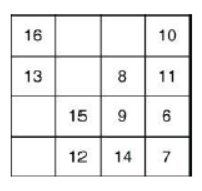
Answer: 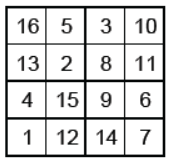
5. The height of a slippery pole is 20m and an insect is trying to climb the pole. The insect climbs 5m in one minute and then slips down by 4m. In how much time will the insect reach the top?
Answer: 16 minutes
6. A, B, C, D, and E are letter that stand for the digits 0 to 4 but not in that order. The table given below shows the result of adding A, B and C with each other. What are the values of A, B, C, D and E. 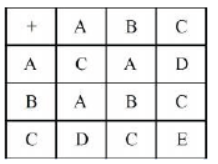
Answer: A=1, B=0, C=2, D=3, E=4
7. If I multiplied by I equals ME and ME multiplied by ME equals SHE, find the whole number SHE.
Answer: 256
CHALLENGES
1. What is the largest natural number which leaves the same remainder as its quotient when divided by 13?
2. What is the smallest natural number greater than 19 and which leaves the same number as remainder when divided by 17 and 19?
3. Find the largest number which when divided by 15 gives a quotient and a remainder such that their sum is 15.
4. What is the smallest natural number which leaves the remainder 3 when divided by 5 and remainder 5 when divided by 7?
5. A magic square is a square array of numbers in which the row sum, the column sum and the diagonal sum are all equal, this equal number is called a magic sum. Suppose a 4 × 4 magic square is formed using the numbers from 1 to 16. Can you find its magic sum without constructing one?
6. Can you find the magic sum of 5 × 5 magic square, if the numbers from 1 to 25 are used?
7. Exploration: Suppose in a 4 × 4 magic square, you replace each number by its successor. Is the new array a magic square? Suppose you add 10 to each number. Do you still get a magic square? What is the conclusion you can draw?
8. Define a new multiplication on whole numbers as follows: a*b = a+b+(a·b).
For example 3 * 5 = 3 + 5 + (3 · 5) = 23. Answer the following:
a. Is a * b = b * a?
b. Is a * (b * c) = (a * b) * c?
c. What is a ? 0?
d. Is a * (b + c) = a * b + a * c?
e. Can you find a whole number b such that a * b = 10a + b(= a̅b̅) for all whole numbers a?
9. How many numbers from 10000 to 100000 are divisible by 234?
10. How many numbers from 0 to 1000 are divisible by 3 but not by 7?
11. Give an example to show that if two numbers divide a third number, then the product of those two numbers need not divide the third number.
12. Show by example that a number may divide the square of a second number but need not divide the second number itself.
13. Four number game: You can play a game as follows: Take any four numbers, say 1, 5, 3, 2; put them in the corners of a square. At each step take the positive difference between the corner numbers and put it at the midpoint of that side. If you join these midpoints, you get a square and each corner has a number there. Now again repeat this process. This is shown in the following diagram. 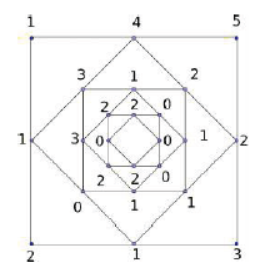
If you further continue, you get 2, 2, 2, 2 and the next step you get 0, 0, 0, 0. We may write the whole process as follows: 
Starting from (1, 5, 2, 3) you reach (0,0,0,0) in 7 steps. We call this the length of (1, 5, 2, 3).
a. Find the length of (1, 2, 3, 4).
b. Find the length of (1,3, 6, 10).
c. Find the length of (1, 3, 8, 17).
d. Find the length of (3, 6, 9, 12). Is this the same as that of (1,2,3,4)?
SUMMARY
1. 0 is a whole number but not a natural number.
2. 0 is the smallest whole number.
3. There is no largest whole number.
4. The successor of a whole number is one more than the given number.
5. The predecessor of a whole number (except zero) is one less than the given number.
6. Of the two given different whole numbers, the one which lies to the right on the number line is greater than the other.
7. There is no whole number between two consecutive whole numbers.
8. There is atleast one whole number between two non-consecutive whole numbers.
9. Addition properties of whole numbers
Closure property- If a and b are any whole numbers, then a+b is also a whole number.
Commutative property- If a and b are any whole numbers, then a+b = b+a.
Associative property- If a, b and c are any whole numbers, then (a+b) + c = a+ (b+c).
Additive identity - If a is any whole number, then a + 0 = a = 0 + a
Cancellation law - If a, b and c are any whole numbers, then a + c = b + c ⇒ a = b.
10. Multiplication properties of whole numbers
Closure property - If a and b are any whole numbers, then a×b is also a whole number.
Commutative property - If a and b are any whole numbers, then a × b = b × a.
Associative property - If a, b and c are any whole numbers, then (a x b) × c = a × (b×c).
Distributive property - If a, b and c are any whole numbers, then a × (b+c) = a × b + a × c.
Multiplicative identity - If a is any whole number, then a × 1 = a = 1 × a.
Multiplication by zero - If a is any whole number, then a × 0 = 0 = 0 × a.
Cancellation law - If a and b are any whole numbers and c is a non-zero whole number, then a × c = b × c ⇒ a = b
11. If a, b ( ≠ 0) and c are whole numbers such that b × c = a then a ÷ b = c.
12. Division by zero is not defined.
13. Properties of division of whole numbers
If a is any whole number, then a ÷ 1 = a.
If a is any non-zero whole number, then a ÷ a= 1.
If a is any non-zero whole number, then 0 ÷ a = 0.
14. Division algorithm
If a is any whole number and b is another smaller non-zero whole number then there exist unique whole numbers q and r such that a = (b × q) + r where 0 ≤ r < b.
ERRORANALYSIS
1. While representing whole numbers on a number line students don’t take equal distance between two consecutive numbers.
2. Students generally forget that subtraction and division are not commutative and hence make mistakes in writing the order of numbers. Emphasis should be laid to explain that a–b ≠ b–a and a÷b ≠ b÷a.
ACTIVITY
Objective: To test the commutative property of all four operations on whole numbers.
Requirements: A4 paper sheet, die, ruler, pencil and pen
Steps:
1. Draw a table on the sheet and write any random numbers as shown in the table below : 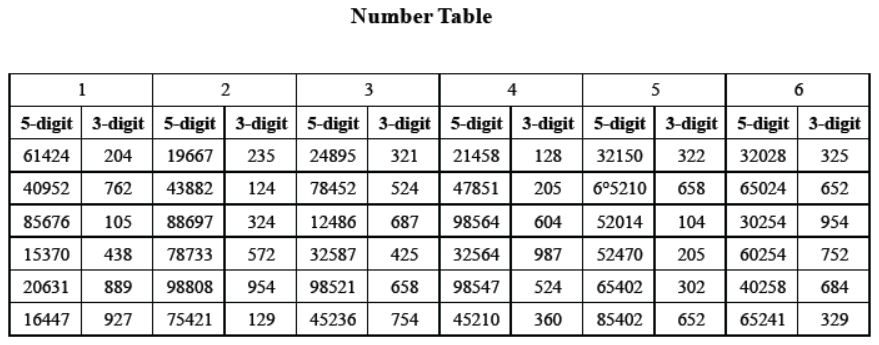
2. Throw a die. Check the number on the face of the die and select the numbers from the column (with the same number on the die) of the table. For example, if '3' comes on the face of the die, then select any number from the column '3' of the table.
3. Select 5-digit and 3-digit numbers each and complete 'Number Table' as below. 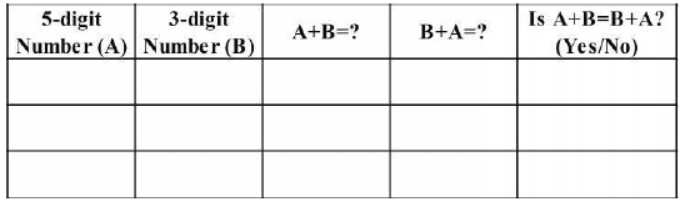
4. Make similar ‘Number Table’ for subtraction, multiplication and division.
Answer the following questions.
a. What did you observe while doing the activity?
b. Is commutative property true for all four operations (addition, subtraction, multiplication and division)
Free study material for Mathematics
Advanced HOTS Questions with Solutions: Class 6 Mathematics Chapter 02 Whole Numbers
Challenging Questions for Class 6 Mathematics Chapter 02 Whole Numbers
Download high-level analytical questions for Chapter 02 Whole Numbers. Designed in alignment with the latest CBSE syllabus for Class 6 Mathematics, these problem sets test deep conceptual understanding and prepare students for complex exam questions.
Verified Solutions for Better Concept Clarity
Pair these practice sets with our comprehensive NCERT solutions for Class 6 Mathematics to clear up doubts. Checking your working against our detailed explanations guarantees absolute mastery over this chapter.
Additional Revision and Practice Tests
Looking for more practice? Explore our complete library of Class 6 Mathematics worksheets, chapter notes, and online mock tests. Everything is provided free of charge to support your academic goals.
FAQs
You can download the teacher-verified PDF for CBSE Class 6 Maths Whole Numbers HOTs from StudiesToday.com. These questions have been prepared for Class 6 Mathematics to help students learn high-level application and analytical skills required for the 2026-27 exams.
In the 2026 pattern, 50% of the marks are for competency-based questions. Our CBSE Class 6 Maths Whole Numbers HOTs are to apply basic theory to real-world to help Class 6 students to solve case studies and assertion-reasoning questions in Mathematics.
Unlike direct questions that test memory, CBSE Class 6 Maths Whole Numbers HOTs require out-of-the-box thinking as Class 6 Mathematics HOTS questions focus on understanding data and identifying logical errors.
After reading all conceots in Mathematics, practice CBSE Class 6 Maths Whole Numbers HOTs by breaking down the problem into smaller logical steps.
Yes, we provide detailed, step-by-step solutions for CBSE Class 6 Maths Whole Numbers HOTs. These solutions highlight the analytical reasoning and logical steps to help students prepare as per CBSE marking scheme.