

Here is CBSE Class 6 Maths Mensuration HOTs for your advanced practice. Find detailed High Order Thinking Skills (HOTS) questions and solutions for Class 6 Mathematics Chapter 10 Mensuration. Built for the 2026-27 exam session, these expert-tested questions sharpen your problem-solving skills according to standard CBSE, NCERT, and KVS rules.
Analytical Questions: Chapter 10 Mensuration (Class 6 Mathematics)
Working through Class 6 Mathematics HOTS Questions helps you master complex topics in Mathematics. Rely on the clear explanations given below to sharpen your analytical skills and prepare well for your Class 6 evaluations.
HOTS Questions and Answers for Class 6 Mathematics Chapter 10 Mensuration
HOTS
1. The perimeter of a rectangle is 36 cm. What will be the length and breadth (in natural numbers) of that rectangle whose area is a. maximum? b. minimum?
Answer: a. 10 cm, 8 cm b. 17 cm, 1 cm
2. Find the length of the lane 5m wide which can be covered by 50000 bricks of size 22cm by 15cm.
Answer: 330 m
3. A rope of length 60cm is cut into two pieces. One piece is used to form a rectangle of length 12cm and width 6cm. The other piece is bent into a regular hexagon. What is the length of each side of the hexagon?
Answer: 4 cm
4. What happens to the area of a rectangle if its length is halved and its breadth is doubled?
Answer: remains the same
5. If the length of a rectangle is increaased by one-third and its width is decreased by one-third, then find the percentage decrease in its area.
Answer: 11(1)/9 %
6. The breadth of a rectangular hall is 3/4 of its length. If the area of the hall is 300 sq m, what is the difference between the length and the breadth of the hall?
Answer: 5 m
CHALLENGES
1. The perimeter of a rectangular field is 200 m and its breadth is 40 m. What is its area?
2. The length of a rectangle is 2 cm more than its breadth. If its perimeter is 48 cm, find its area.
3. A rectangular carpet has an area 120 sq m and its perimeter is 46m. What are its length and breadth, given that they are natural numbers.
4. The cost of cultivating a square field at the rate of ₹ 160 per acre is ₹ 1440. What is the cost of putting a fence around it at the rate of ₹ 1 per metre?
5. Around a rectangular garden of length 200 m and width 100 m, a road of 2 m wide is laid. Find the cost of construction of the road at the rate of ₹ 400 per sq m.
6. A hall 40 m long and 15 m broad is to be paved with stones , each measuring 6 dm by 5 dm (1 dm = 10 cm). How many stones are required?
7. The area of a rectangular field is 52000 sq m. This rectangular area is drawn on a map to the scale 1 cm to 100 m. The length is shown as 3.25 cm on the map. What is the actual breadth of the field?
8. The length of a rectangle is twice its breadth. If its length is decreased by 5 cm and breadth is increased by 5 cm, find the area of the rectangle.
9. The length of a rectangle is increased by 60%. By what percent should its breadth be decreased to maintain the same area?
10. The length of a rectangle is doubled and its breadth is halved. What is the percentage change in its area?
11. A person runs along the boundary of a rectangular park at the rate of 12 km/hr and completes one full round in 15 minutes. If the length of the park is 4 times its breadth, find the area of the park.
12. A rectangular lawn 60 m long and 40 m broad has two roads each 5 m wide running in the middle of the lawn, one parallel to its length and the other parallel to its breadth. Find the cost of gravelling it at ₹ 2 per sq m.
13. If the side of a square is increased by 4 cm, its area increases by 60 sq. cm. Find the side of the square.
14. The perimeter of a rectangle and a square is equal to 80 cm. The difference in their areas is 100 sq. cm. Find the dimensions of the rectangle.
15. The length and breadth of a square are increased by 40% and 30%, respectively. What is the percentage increase in the area of the rectangle?
SUMMARY
1. Total length of the boundary of a closed figure is called its perimeter. 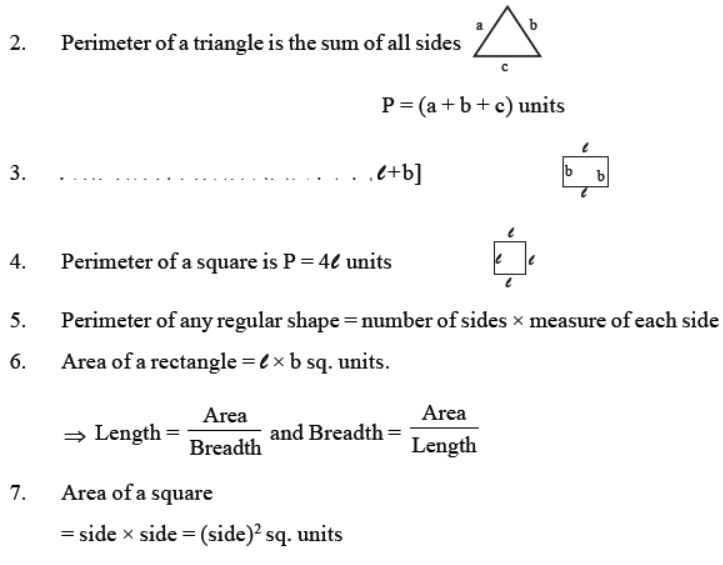
ERRORANALYSIS
1. Students apply wrong formula while calculating length or breadth from the given perimeter.
2. Students forget to write units in the answer.
3. Students should be encouraged to draw figures wherever necessary.
4. Students make mistakes in conversion of units.
ACTIVITY I
Estimating the area of Irregular Figures
Estimate the area of the closed irregular figure, given below : 
In the above closed irregular figure:
Number of completely covered squares = _______________
Number of more than half covered squares = _______________
Number of exactly half covered squares = _______________
Estimated area of the given closed figure = _______________
ACTIVITY II
Forming Rectangles of given area and to find their perimeter.
1. On a squared paper (1 unit x 1 unit), make as many rectangles as you can such that the area of the rectangle is 16 sq. m. (Consider only natural number lengths).
Proceed as under :
Since 16 = 1 × 16, 16 = 2 × 8 or 16 = 4 × 4 and the area of a rectangle = length × breadth, therefore, the only possible lengths of two adjacent sides of rectangles are:
1 unit and 16 units; 2 units and 8 units; 4 units and 4 units. The rectangles are shown in the figure: 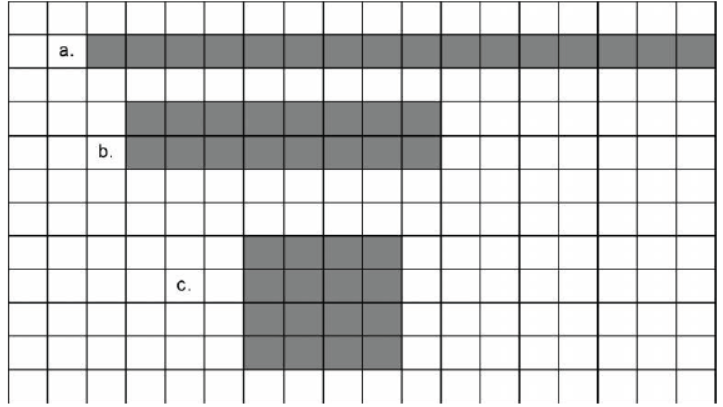
Find perimeters of the rectangles formed -
Perimeter of rectangle (a) = _______________ units
Perimeter of rectangle (b) = _______________ units
Perimeter of rectangle (c) = _______________ units
Perimeter of rectangle _____ is greatest and perimeter of rectangle _____ is least.
2. On a squared paper, draw as many rectangles as you can such that the area of the rectangle is 24 sq. units (consider only natural number lengths) and find their perimeter.
Free study material for Mathematics
CBSE Class 6 Mathematics Chapter 10 Mensuration HOTS Questions and Answers
Challenging Questions for Class 6 Mathematics Chapter 10 Mensuration
Explore rigorous problem-solving exercises for Class 6 Mathematics Chapter 10 Mensuration. These questions focus on advanced applications of core formulas, ensuring complete readiness for school tests and academic evaluations.
NCERT-Aligned Solutions and Explanations
Each question in this set is mapped directly to the official NCERT book for Class 6. Review the detailed answer keys provided below each problem to verify your solution steps and correct mistakes early.
Next Steps for Class 6 Mathematics Preparation
Looking for more practice? Explore our complete library of Class 6 Mathematics worksheets, chapter notes, and online mock tests. Everything is provided free of charge to support your academic goals.
FAQs
You can download the teacher-verified PDF for CBSE Class 6 Maths Mensuration HOTs from StudiesToday.com. These questions have been prepared for Class 6 Mathematics to help students learn high-level application and analytical skills required for the 2026-27 exams.
In the 2026 pattern, 50% of the marks are for competency-based questions. Our CBSE Class 6 Maths Mensuration HOTs are to apply basic theory to real-world to help Class 6 students to solve case studies and assertion-reasoning questions in Mathematics.
Unlike direct questions that test memory, CBSE Class 6 Maths Mensuration HOTs require out-of-the-box thinking as Class 6 Mathematics HOTS questions focus on understanding data and identifying logical errors.
After reading all conceots in Mathematics, practice CBSE Class 6 Maths Mensuration HOTs by breaking down the problem into smaller logical steps.
Yes, we provide detailed, step-by-step solutions for CBSE Class 6 Maths Mensuration HOTs. These solutions highlight the analytical reasoning and logical steps to help students prepare as per CBSE marking scheme.