

Refer to CBSE Class 6 Maths Decimals HOTs. We have provided exhaustive High Order Thinking Skills (HOTS) questions and answers for Class 6 Mathematics Chapter 08 Decimals. Designed for the 2026-27 exam session, these expert-curated analytical questions help students master important concepts and stay aligned with the latest CBSE, NCERT, and KVS curriculum.
Analytical Questions: Chapter 08 Decimals (Class 6 Mathematics)
Every Class 6 Mathematics student should practice these HOTS Questions to tackle difficult exam problems. Use the provided solutions to improve your critical thinking and boost your overall performance in Class 6.
Get Chapter 08 Decimals HOTS PDF for Class 6 Mathematics
HOTS
1. Who am I?
a. I am a fraction which is equivalent to 2/3 . My denominator is 9.
b. I am a fraction whose numerator is 12. I am equivalent to 3/4 .
c. I am a fraction whose denominator is 6. I am equivalent to 12/18 .
d. I am a fraction equivalent to 16/24 . I am in the lowest terms of this fraction.
Answer: a. 6/9 b. 12/16 c. 4/6 d. 2/3
2. Write the fractions in the appropriate place in the boxes. 
Answer: 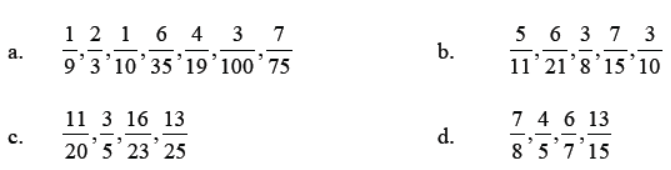
3. Fill up the blank boxes of the magic square such that the sum of the numbers taken vertically, horizontally, and diagonally remains the same. 
Answer: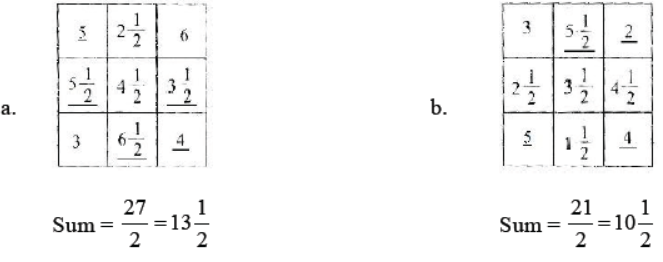
4. Given below are some estimated answers for every question. In each case, state whether the real answer is greater or less than the estimated answer. Do not work them out. Only observe the numbers and tick the right answer. The first one is done for you. 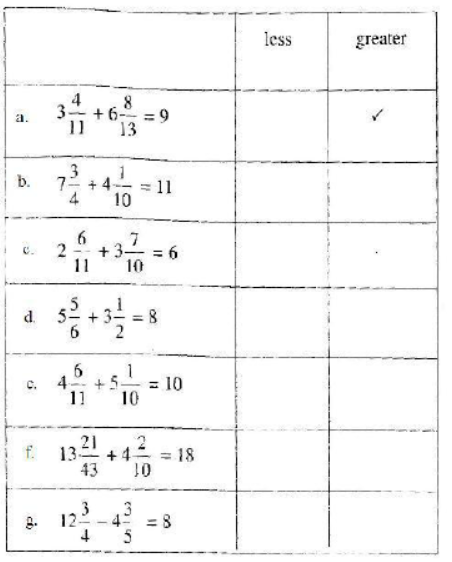
Answer: 
5. Find the magic sum of the given magic square. Subtract 2.34 from each number in the magic square and enter the answer in the appropriate column in the given blank box. What will be the magic sum of the new magic square? 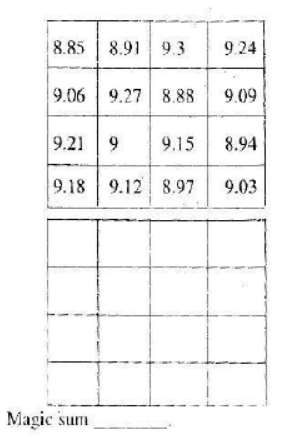
Answer: Magic sum = 36.3 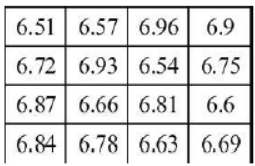
Magic sum = 26.94
CHALLANGES
1. What you shoud put in the place of ?
16.7 + 12.38–? = 10.09.
2. Complete the multiplication:
3 × 0.3 × 0.03 × 0.003 × 30 =
3. Find the missing number:
0.011 × – – – = 0.777777.
4. If 1/3.718 = 0.2869, what is 1/0.0003718 ?
5. Find 0.98 × 0.09 – 0.98 × 1.52 + 0.76 × 0.76.
6. Find the value of 0.004 x 0.0008/0.02
7. Calculate 4.7 × 13.23 + 9.4 × 9.43 + 4.7 × 77.34.
8. Write the following fractions in ascending order after converting them to decimals:
4/5 , 6/10 , 3/8 , 16/25 .
9. Which of the following fractions can be converted into decimal numbers?
a. 77/40 b. 975/26 c. 1394/38
d. 1/27 x 53 e. 2019/22 x 53 x 41
10. Find (0.5)2 – (0.4)2.
11. Simplify:
0.625 x 0.0729 x 28.9/0.0081 x 0.025 x 1.7
12. What is (0.3)3 – 0.027?
13. Simplify:
6.5 x 4.7 + 6.5 x 5.3/1.3 x 7.9 - 1.3 x 6.9
14. What is the largest decimal number you can write using all the digits from 0 to 9, each exactly once?
15. What is the smallest decimal number you can write using all the digits from 0 to 9, each exactly once?
SUMMARY
1. The places of the digits to the left of units digit are tens, hundreds, thousands..., while the places of the digits to the right of units digit are tenths, hundredths, thousandths.... To separate these, we place a point (small dot) on the right of units digit. This point is called decimal point and the numbers are called decimal numbers or decimals.
2. The place values of the digits that are on the left of ones digit in order are multiplied by 10, 100, 1000 and so on while the place values of the digits that are on the right of ones digit in order are divided by 10, 100, 1000 ad so on.
3. To understand tenths - divide an object into 10 equal parts, then one part is one-tenth of whole.
Thus, one tenth = 1/10 , it is written as 0.1.
4. To understand hundredths - divide an object into 100 equal parts, then one part is one-hundredth of whole.
Thus, one hundredth = 1/100 , it is written as 0.01.
5. Every decimal number can be represented by a point on a number line.
6. Addition of zero (s) at the end of a decimal number does not change its value.
7. The decimal numbers having equal number of decimal places are called like decimal numbers.
8. Fractions with denominator 10, 100, 1000, .....are called decimal fractions.
9. Every decimal fraction can be converted into a decimal number.
10. A decimal number (having a finite number of decimal places) can be converted into a fraction.
11. Comparison of two decimal numbers:
• The number having greater whole number part is greater.
• If the whole number parts are equal, then compare the tenths digits. The number having greater tenths digit is greater. If the tenths digits are equal, then compare the hundredths digits and so on.
12. To add or subtract decimal numbers:
Write the decimal numbers one below the other in such a way that the decimal point of one number lies directly below the decimal point of the other number. Then add or subtract the numbers in the usual way.
13. Decimal numbers are useful in real life problems concerning money, length/distance and mass/ weight.
ERRORANALYSIS
1. Conceptual error -
• Using wrong symbols
• The decimal point placement while adding or subtracting numbers with a decimal point
2. Computational error -
• While adding or subtracting they miss out the carry over part
3. Careless error -
• Copying wrong
• Writing a wrong number
• Dropping a negative sign
ACTIVITY I
Fill in the empty squares with numbers that will make the equation true 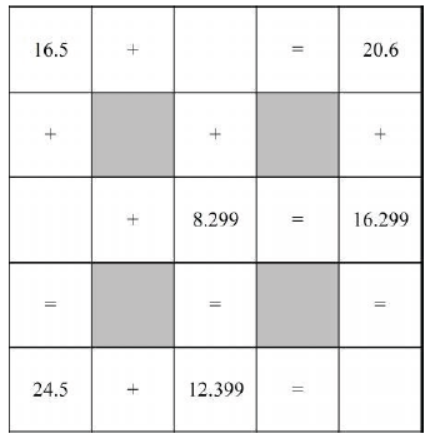
ACTIVITY II
Multiplying Decimals with Models
Multiply decimals by shading in the model. Shade the first number with blue. Shade the second number with green. Your answer is the overlapping colors.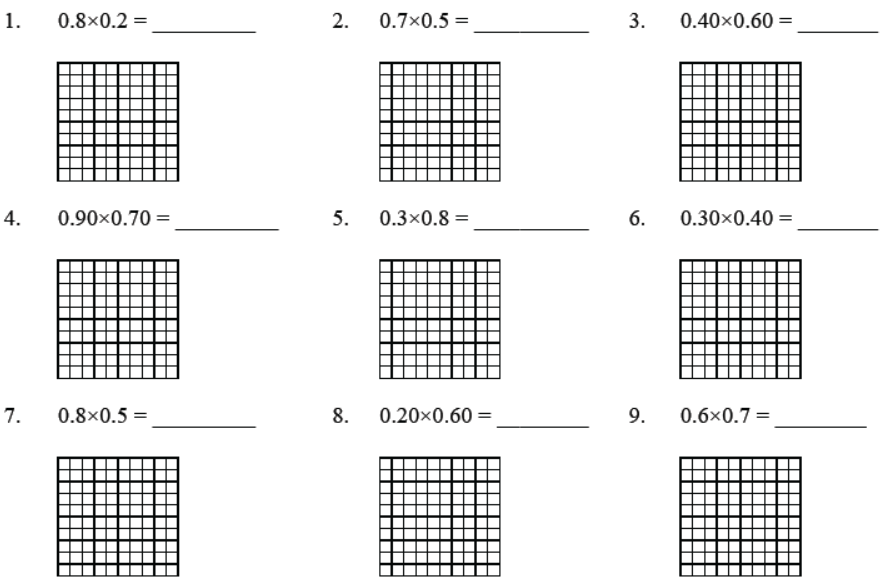
ACTIVITY III
Comparison of Decimals
Material required : Pencil, eraser, sketch pen.
Preparation : Students work individually for this.
Steps:
1. Move from the starting point to the finishing point by marking arrows from a smaller decimal to a bigger decimal.
2. Mark an arrow from 0.001 to 0.007 (as there are no other options at this stage). Now, there are two options at 0.007—one leads to 0.02 and the other to 0.001. Since 0.02 is
bigger than 0.007 here, take the arrow to 0.02 (0.001 is smaller than 0.007). Similarly keep moving towards a bigger decimal till you reach the finishing point. 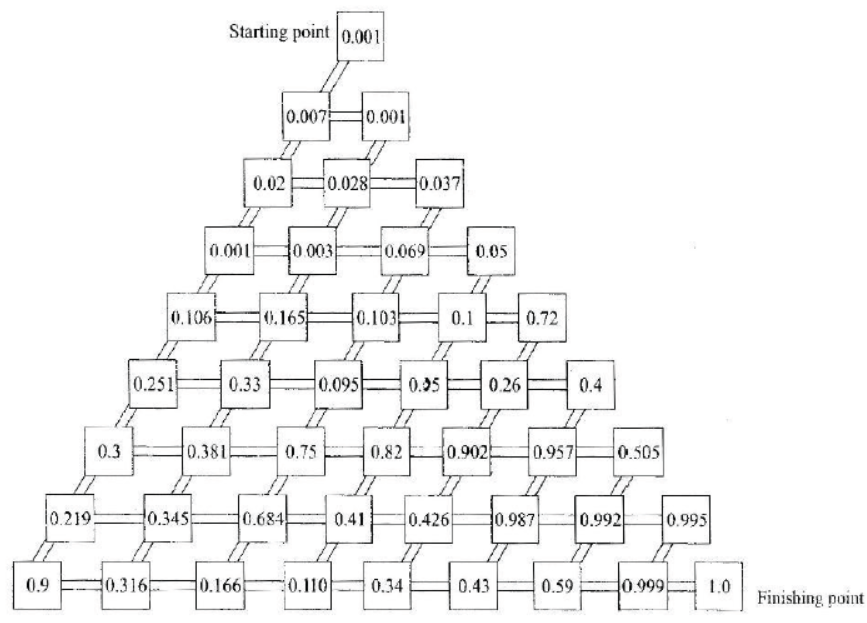
Free study material for Mathematics
Download Class 6 Mathematics Chapter 08 Decimals HOTS Practice Questions
Challenging Questions for Class 6 Mathematics Chapter 08 Decimals
Master core concepts in Chapter 08 Decimals with these targeted Higher Order Thinking Skills (HOTS) problems. Built for Class 6 Mathematics students following the CBSE curriculum, these exercises challenge analytical thinking and improve problem-solving speed.
How to Use These Class 6 Mathematics HOTS
Pair these practice sets with our comprehensive NCERT solutions for Class 6 Mathematics to clear up doubts. Checking your working against our detailed explanations guarantees absolute mastery over this chapter.
More Study Resources for Class 6 Mathematics
To reinforce your revision after completing these HOTS, try our online Mathematics MCQ test for Class 6. All learning materials on our platform are completely free and updated for the current academic session.
FAQs
You can download the teacher-verified PDF for CBSE Class 6 Maths Decimals HOTs from StudiesToday.com. These questions have been prepared for Class 6 Mathematics to help students learn high-level application and analytical skills required for the 2026-27 exams.
In the 2026 pattern, 50% of the marks are for competency-based questions. Our CBSE Class 6 Maths Decimals HOTs are to apply basic theory to real-world to help Class 6 students to solve case studies and assertion-reasoning questions in Mathematics.
Unlike direct questions that test memory, CBSE Class 6 Maths Decimals HOTs require out-of-the-box thinking as Class 6 Mathematics HOTS questions focus on understanding data and identifying logical errors.
After reading all conceots in Mathematics, practice CBSE Class 6 Maths Decimals HOTs by breaking down the problem into smaller logical steps.
Yes, we provide detailed, step-by-step solutions for CBSE Class 6 Maths Decimals HOTs. These solutions highlight the analytical reasoning and logical steps to help students prepare as per CBSE marking scheme.