

Check out CBSE Class 6 Maths Fractions HOTs right here. Get complete High Order Thinking Skills (HOTS) questions and answers for Class 6 Mathematics Chapter 07 Fractions. Created for the 2026-27 exam session, these analytical practice problems help learners master core ideas while following guidelines from CBSE, NCERT, and KVS.
Chapter 07 Fractions Class 6 Mathematics HOTS with Solutions
Practicing Class 6 Mathematics HOTS Questions is important for scoring high in Mathematics. Use the detailed answers provided below to improve your problem-solving speed and Class 6 exam readiness.
HOTS Questions and Answers for Class 6 Mathematics Chapter 07 Fractions
HOTS
1. Sunny was given 1/3 of a sum of money and Ankur was given 1/3 of what was left. What is Ankur’ss share as a fraction of Sunny’s share?
Answer: 2/3
2. Use the numbers 11, 9, 7 to form the smallest and the largest mixed numbers. Then find their sum giving your answer as a mixed number.
Answer: 19(59)/99
3. Add 
Answer: 5
4. 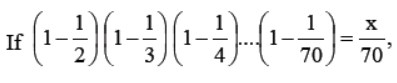
then what is the value of x?
Answer: 1
5. How much more is 1/2 of 2/3 than 3/4 of 1/3 ?
Answer: 1/12
CHALLENGES
1. In the expression 1*/* 4 = 1/4 , * stands for the same digit. Find it.
2. In the expression 1*/*4 = 1/* , * stands for the same digit. Find it.
3. Consider the fractions:
1/2019 , 2/2018, 3/2017 ,..., 2018/2 , 2019/1
a. How many proper fractions are there?
b. How many improper fractions are there?
c. How many of these fractions are integers?
d. How many fractions are simple?
4. Find the sum : 1- 1/2 + 1/3 - 1/4 + 1/5 - 1/6 .
5. Find the sum : 1+ 1/2 + 1/4 + 1/8 + 1/16 + 1/32 + 1/64 .
6. Find the sum : 8/1 - 7/2 + 6/3 - 5/4 + 4/5 - 3/6 + 2/7 - 1/8 .
7. Find four fractions such that with suitable addition and subtraction of some of these fractions, you can get all fractions k/40 for k = 1, 2, 3, . . . , 40.
9. Arrange the following fractions in ascending order:
3/5 , 4/7 , 2/3 , 5/8 , 3/4 , 9/7 , 1/9 .
10. Consider the following sequence of fractions:
2/1 , 5/2 , 10/3 , 17/4 , 26/5 ,.......
What are the next two fractions? (Hint: Write as mixed fractions.)
SUMMARY
1. A fraction is a number which represents a part of whole. The whole may be a single object or a group of objects.
2. The numbers such as 2/3 , 7/12 , 29/10 are called fractions. The number above the division line is called the numerator and the number below the division line is called the denominator of a fraction.
3. Types of fractions :
• Proper fraction — whose numerator is greater than zero but less than its denominator.
• Improper fraction — whose numerator is equal to or greater than its denominator.
• Mixed fraction (or mixed number) — it consists of two parts, a whole number and a proper fraction.
• Every mixed fraction can be written as an improper fraction and every improper fraction can be written as a mixed fraction.
• Like fractions — have same denominator.
• Unlike fractions — have different denominators.
• Equivalent fractions —have equal value.
4. The value of a fraction does not change if the numerator and the denominator are multiplied or divided by the same (non-zero) number.
5. To check the equivalence of fractions 
If ad = bc, then the given fractions are equivalent otherwise not equivalent.
6. A fraction is in irreducible (or simplest) form if its numerator and denominator have no factor (except 1).
7. To compare two (or more) fractions:
• In like fractions, the fraction with greater numerator is greater.
• In fractions with same numerator, the fraction with smaller denominator is greater.
• General method of.comparing fractions
a. Convert all fractions into equivalent like fractions.
b. Then the fraction having greater numerator is greater.
8. To add/subtract two (or more) fractions:
• In like fractions, we simply add or subtract the numerators and write the result above the denominator.
• In unlike fractions, proceed as under:
a. Convert the mixed fractions (if any) to improper fractions.
b. Convert all the fractions into equivalent like fractions.
c. Combine the numerators of all these like fractions with their proper sign '+ or -’ and place it over the common denominator to obtain a single fraction.
d. Reduce the single fraction obtained in step (c) to irreducible form and convert it to mixed fraction (if need be).
9. To multiply two fractions:
a. Convert the mixed fractions (if any) to improper.fractions.
b. Multiply the numerators together and the denominators together. Place the product of the numerators over the product of the denominators and reduce the result to irreducible form.
10. To divide one fraction by another fraction:
a. Convert the mixed fractions (if any) to improper fractions.
b. Multiply the dividend by the reciprocal of the divisor and reduce the result to irreducible form.
ERRORANALYSIS
1. While adding and subtracting fractions, students add the numerators and denominators.
eg. 3/9 + 2/9 = 3+2/9+9 = 5/18 which is wrong.
Correct method :
3+2/9 = 5/9
2. Write the fraction of shaded portion.
eg. 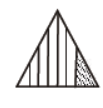
Wrong method: 1/5.
Correct method :
We cannot write fraction for this as it is not divided into equal parts.
ACTIVITY I
Fraction Wall
Objective : To create a fraction wall.
Material required : Coloured pencils
Procedure : A fraction wall has been created as an example. Two blank walls are provided for you to fill in the missing fractions. 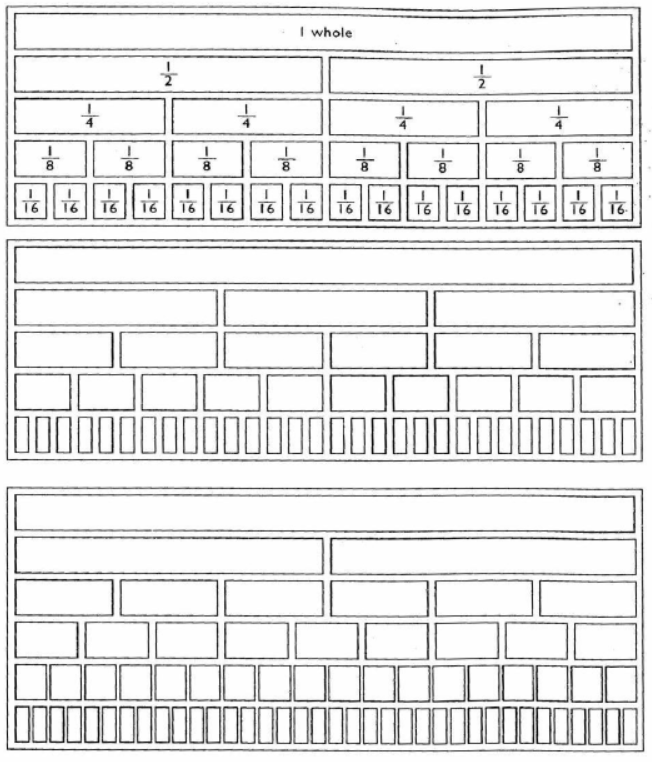
ACTIVITY II
Objective : To find the sum of two fractional numbers.
Material Required : Chart paper, scissors, pencil, ruler, colour pens.
Procedure:
Let us add 2/3 + 1/4 What is the LCM of 3 and 4 ? 12
Step 1 : Cut three strips of size (12 cm x 2 cm), from the chart paper.
Step 2 : a. Divide the first strip into 3 equal parts, each part representing the fraction 1/3 . 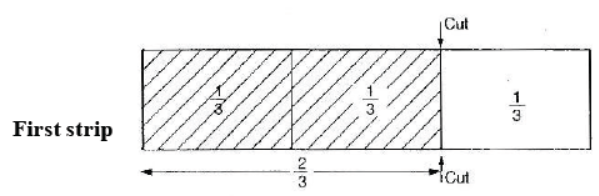
b. Divide the second strip into 4 equal parts, each part representing the fraction 1/4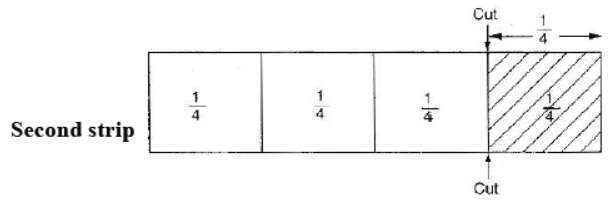
c. Divide the third strip into 12 equal parts, each part representing the fraction 1/12 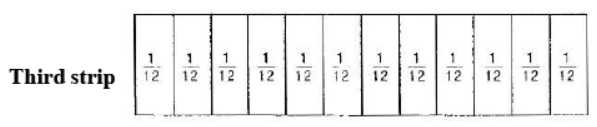
Step 3 : a. From the first strip cut two equal parts representing the fraction 2/3 .
b. From the second strip cut one equal part representing the fraction 1/4 .
Place them side by side. Place the third strip exactly below these. 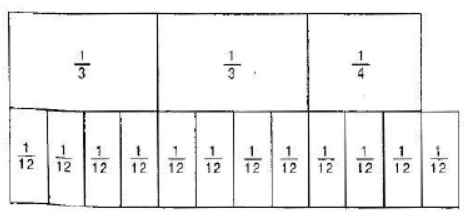
Count at the number of 1/12 corresponding to the sum 2/3 + 1/4 . They are 11.
∴ 2/3 + 1/4 = 11/12
Free study material for Mathematics
CBSE Class 6 Mathematics Chapter 07 Fractions HOTS Questions and Answers
About Chapter 07 Fractions HOTS for Class 6 Mathematics
Strengthen your preparation for Class 6 Mathematics examinations with specialized Chapter 07 Fractions HOTS worksheets. These structured problems are curated to match official CBSE guidelines and help tackle difficult board-level questions.
How to Use These Class 6 Mathematics HOTS
Each question in this set is mapped directly to the official NCERT book for Class 6. Review the detailed answer keys provided below each problem to verify your solution steps and correct mistakes early.
More Study Resources for Class 6 Mathematics
Wrap up your chapter revision by testing your speed with our interactive Mathematics quizzes. Access all curriculum-aligned study resources online without any restrictions.
FAQs
You can download the teacher-verified PDF for CBSE Class 6 Maths Fractions HOTs from StudiesToday.com. These questions have been prepared for Class 6 Mathematics to help students learn high-level application and analytical skills required for the 2026-27 exams.
In the 2026 pattern, 50% of the marks are for competency-based questions. Our CBSE Class 6 Maths Fractions HOTs are to apply basic theory to real-world to help Class 6 students to solve case studies and assertion-reasoning questions in Mathematics.
Unlike direct questions that test memory, CBSE Class 6 Maths Fractions HOTs require out-of-the-box thinking as Class 6 Mathematics HOTS questions focus on understanding data and identifying logical errors.
After reading all conceots in Mathematics, practice CBSE Class 6 Maths Fractions HOTs by breaking down the problem into smaller logical steps.
Yes, we provide detailed, step-by-step solutions for CBSE Class 6 Maths Fractions HOTs. These solutions highlight the analytical reasoning and logical steps to help students prepare as per CBSE marking scheme.