

Here is CBSE Class 6 Maths Data Handling HOTs for your advanced practice. Find detailed High Order Thinking Skills (HOTS) questions and solutions for Class 6 Mathematics Chapter 09 Data Handling. Built for the 2026-27 exam session, these expert-tested questions sharpen your problem-solving skills according to standard CBSE, NCERT, and KVS rules.
High Order Thinking Skills: Class 6 Mathematics Chapter 09 Data Handling
Working through Class 6 Mathematics HOTS Questions helps you master complex topics in Mathematics. Rely on the clear explanations given below to sharpen your analytical skills and prepare well for your Class 6 evaluations.
Class 6 Mathematics Chapter 09 Data Handling Advanced HOTS Questions
HOTS
Preference of people in playing different games over the years is given in the bar graph. Read the graph and answer the questions that follow. 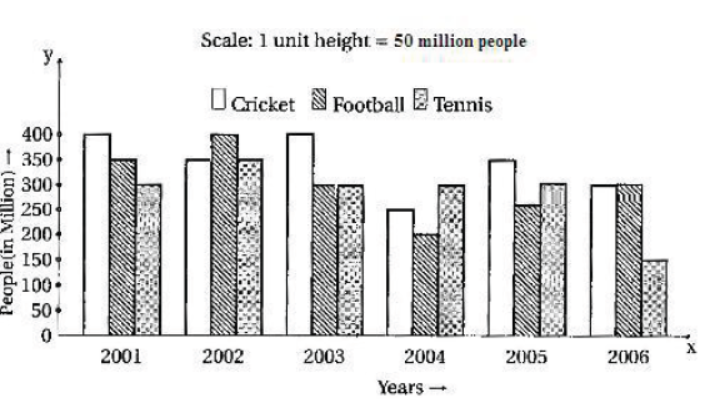
1. In the year 2006, the people preferring to play tennis is what percent of the people preferring to play cricket, football and tennis together in that year?
Answer: 20%
2. From 2001 to 2006, find the total number of people who preferred to play football.
Answer: 1800 million
3. The number of people preferring to play tennis in 2006 is how many million fewer than the number of people preferring to play tennis in 2005?
Answer: 150 million
4. What is the ratio of the number of people preferring to play cricket to the number of people preferring to play tennis in the year 2003?
Answer: 4 : 3
5. How many people (in million) have preferred to play cricket in all the years together?
Answer: 2050 million
SUMMARY
1. The collection of facts in the form of numerical values is called the data.
2. Each numerical figure in a data is called an observation.
3. The number of times a particular observation occurs in a data is called the frequency of that observation.
4. A table showing the frequency of various observations is called the frequency distribution table.
5. A representation that shows numerical information by using pictures or symbols is called a pictograph.
6. A bar graph is a pictorial representation of data in which bars of equal width are erected vertically or horizontally with equal spacing between them. The height or length of a bar represents the corresponding value of the data.
ERRORANALYSIS
1. Tally marks are incorrectly drawn by students.
2. Scale is not mentioned in a bar graph and a pictograph.
3. Labelling of axis is not done.
4. Equal spacing between bars is not maintained.
5. Bars are not of uniform width.
ACTIVITY I
To collect the data from the students regarding time spent (more than 2 hours) watching TV and to present the data in the form of a bar graph by paper cutting and pasting.
Material required : Coloured and white papers, sketch pens, a pair of scissors, a pencil and glue
Procedure
Step 1 : Record the number of hours spent during a day by each student in the class watching TV in Table 1.
Step 2 : List the students who spent more than 2 hours a day watching TV in Table 2 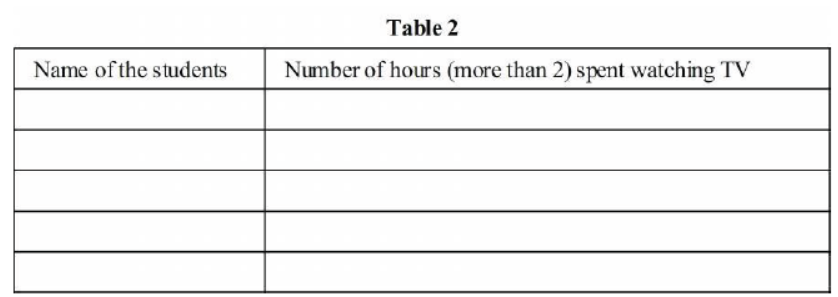
Step 3 : To make a bar graph of the data in Table 2, draw two lines (one horizontal and one vertical as shown in Fig. (a) 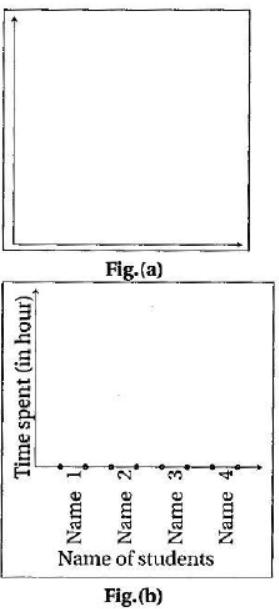
Step 4 : Write the names of the students in Table 2 along the horizontal line at equal distances and time spent (in hours) along the vertical line. [Fig. (b)]
Step 5 : Now make strips of uniform width of different colours, for each student, of length according to time (in hours) spent by him/her in watching TV (see Table 2)
Step 6 : Paste these strips in Fig. (b) accordingly against the names of the students.
Observations:
a. The number of students who spent 2 to 3 hours watching TV in a day =......
b. The name(s) of student(s) who spent more than 6 hours a day watching TV are.....
c. The name(s) of the student (s) who spent maximum time watching TV are .......
d. The name(s) of the student(s) who spent exactly 2 hours a day watching TV is/are ..........
ACTIVITY II
We know a die is a cube where 6 faces are marked with numbers or dots from 1 to 6, one number on each face. Recall, we use a die while playing Ludo or Snake and ladder.
Throw a die 20 times and write the result of each throw in the following table: 
On the basis of the above data, answer the following questions:
a. How many times has 6 occurred?
b. How many times has a number more than 3 occurred?
c. How many times has a number less than 4 occurred?
Free study material for Mathematics
Higher Order Thinking Skills (HOTS) for Class 6 Mathematics Chapter 09 Data Handling
Challenging Questions for Class 6 Mathematics Chapter 09 Data Handling
Explore rigorous problem-solving exercises for Class 6 Mathematics Chapter 09 Data Handling. These questions focus on advanced applications of core formulas, ensuring complete readiness for school tests and academic evaluations.
Verified Solutions for Better Concept Clarity
Each question in this set is mapped directly to the official NCERT book for Class 6. Review the detailed answer keys provided below each problem to verify your solution steps and correct mistakes early.
Additional Revision and Practice Tests
Wrap up your chapter revision by testing your speed with our interactive Mathematics quizzes. Access all curriculum-aligned study resources online without any restrictions.
FAQs
You can download the teacher-verified PDF for CBSE Class 6 Maths Data Handling HOTs from StudiesToday.com. These questions have been prepared for Class 6 Mathematics to help students learn high-level application and analytical skills required for the 2026-27 exams.
In the 2026 pattern, 50% of the marks are for competency-based questions. Our CBSE Class 6 Maths Data Handling HOTs are to apply basic theory to real-world to help Class 6 students to solve case studies and assertion-reasoning questions in Mathematics.
Unlike direct questions that test memory, CBSE Class 6 Maths Data Handling HOTs require out-of-the-box thinking as Class 6 Mathematics HOTS questions focus on understanding data and identifying logical errors.
After reading all conceots in Mathematics, practice CBSE Class 6 Maths Data Handling HOTs by breaking down the problem into smaller logical steps.
Yes, we provide detailed, step-by-step solutions for CBSE Class 6 Maths Data Handling HOTs. These solutions highlight the analytical reasoning and logical steps to help students prepare as per CBSE marking scheme.