

Official NCERT Book for Class 11 Mathematics: Chapter 11 Introduction to Three Dimensional Geometry
Access the official NCERT textbook for Class 11 Mathematics, updated for the 2026-27 academic session. This digital resource provides the foundational knowledge required for exam success and conceptual clarity.
Chapter-wise Study Material: Chapter 11 Introduction to Three Dimensional Geometry
Access the complete PDF for Chapter 11 Introduction to Three Dimensional Geometry below. This focused excerpt allows students to isolate specific topics for thorough review. Cross-reference your textbook exercises with our detailed NCERT Solutions for Class 11 Mathematics.
Question. The distance of the point (4, 3, 5) from the y-axis is:
a. √34
b. 5
c. √41
d. √15
Answer : C
Question. If centroid of tetrahedron OABC, where A, B, C are given by (a, 2, 3), (1, b, 2) and (2, 1, c) respectively be (1, 2, – 1), then distance of P(a, b, c) from origin is equal to:
a. √107
b. √14
c. √107 /14
d. None of these
Answer : A
Question. A line which makes angle 60° with y-axis and z-axis, then the angle which it makes with x-axis is:
a. 45°
b. 60°
c. 75°
d. 30°
Answer : A
Question. A line passes through the points (6, –7, –1) and (2,–3, 1). The direction cosines of line, so directed that the angle made by it with the positive direction of x-axis is acute, are: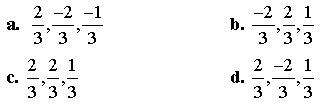
Answer : A
Question. If the x-co-ordinate of a point P on the join of Q (2, 2, 1) and R (5, 1, –2) is 4, then its z-co-ordinate is:
a. 2
b. 1
c. –1
d. –2
Answer : C
Question. If the direction cosines of a line are (1/c, 1/c, 1/c), then:
a. c > 0
b. c = ± √3
c. 0 < c < 1
d. c > 2
Answer : B
Question. If the direction ratio of two lines are given by 3lm− 4ln +mn = 0 and l + 2m+ 3n = 0 , then the angle between the lines is:
a. π/2
b. π/3
c. π/4
d. π/6
Answer : A
Question. If a line makes angles α, β, γ, δ with four diagonals of a cube, then the value of sin2 α + sin2 β + sin2 γ + sin2 δ is:
a. 4/3
b. 1
c. 8/3
d. 7/3
Answer : C
Question. The vector equation of line through the point A(3, 4, –7) and B(1, –1, 6) is
a. r = (3i + 4j− 7k) +λ (i − j+ 6k)
b. r = (i − j+ 6k) +λ (3i + 4j− 7k)
c. r = (3i + 4j− 7k) +λ (−2i −5j+13k)
d. r = (i − j+ 6k) +λ (4i + 3j−k)
Answer : C
Question. If r is a vector of magnitude 21 and has d.r.’s 2, –3, 6. Then r is equal to:
a. 6i − 9j+18k
b. 6i + 9j+18k
c. 6i − 9j−18k
d. 6i + 9j−18k
Answer : A
Question. The projection of a line on co-ordinate axes are 2, 3, 6. Then the length of the line is:
a. 7
b. 5
c. 1
d.11
Answer : B
Question. The angle between two lines x + 1 / 2 = y + 1 / 2 = z - 4 / -1 and x - 4 / 1 = x + 4 / 2 = z + 1 / 2 is
a. cos−1(1/9)
b. cos−1(1/9)
c. cos−1(1/9)
d. cos−1(1/9)
Answer : D
Question. The point of intersection of the lines, x - 5 / 3 = y - 7 / -1 = z + 2 / 1 = x + 3 / -36 = y - 3 / 2 = z - 6 / 4 is:
a. 21, 5/3, 10/3
b. ( 2,10, 4)
c. (−3, 3, 6)
d. (5, 7, − 2)
Answer : A
Question. The cartesian equations of a line are 6x − 2 . = 3y +1 = 2z − 2 The vector equation of the line is:
a. r = (1/3 1 - 1/3 j+k ) + λ (I + 2j + 3k)
b. r = (3i −3j+ k) +λ (i + 2j+ 3k)
c. r = (i + j+ k) +λ (i + 2j+ 3k)
d. None of these
Answer : A
Question. The angle between the lines whose direction cosines are proportional to (1, 2, 1) and (2, –3, 6) is:
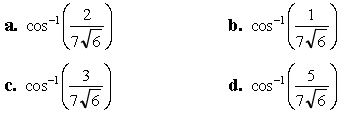
Answer : A
Question. The angle between the lines whose direction cosines satisfy the equations l + m + n = 0 , 0 l2 + m2 − n2 = is given by:
a. 2π/3
b. π/6
c. 5π/6
d. π/3
Answer : D
Question. The xy-plane divides the line joining the points (–1, 3, 4) and (2, –5, 6)
a. Internally in the ratio 2:3
b. Internally in the ratio 3:2
c. Externally in the ratio 2:3
d. Externally in the ratio 3:2
Answer : C
Question. The angle between the pair of lines with direction ratios (1, 1, 2) and ( √3 − 1,− √3 − 1,4) is:
a. 30°
b. 45°
c. 60°
d. 90°
Answer : C
Question. If direction ratios of two lines are 5, −12,13 and −3, 4, 5 then the angle between them is:
a. cos−1(1/ 65)
b. cos−1 (2 / 65)
c. cos−1 (3/ 65)
d. π / 2
Answer : A
Question. The equation of the plane, which makes with co-ordinate axes a triangle with its centroid (α, β, γ), is:
a. α x +β y +γ z = 3
b. x/α + y/β + z/γ = 1
c. α x +β y +γ z = 1
d. x/α + y/β + z/γ = 3
Answer : D
Question. Angle between two planes x +2y+2z=3 and −5x + 3y + 4z = 9 is:
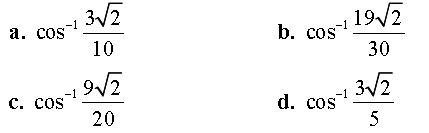
Answer : A
Question. The shortest distance between the lines r = (i + j− k) +λ (3i − j) and r = (4i − k) +μ (2i + 3k) is:a. 6
b. 0
c. 2
d. 4
Answer : B
Question. If the straight lines x =1+ s, y = 3 − λs, z = 1+ λs and x = t/2 x = y = 1 + c, z = 2 -t with parameters s and t trespectively, are co-planar, then λ equals:
a. 0
b.–1
c. –1/2
d. –2
Answer : D
Question. The ratio in which the plane x − 2y + 3z = 17 divides the line joining the point (–2, 4, 7) and (3, –5, 8) is:
a. 10 : 3
b. 3 : 1
c. 3 : 10
d. 10 : 1
Answer : C
Question. Distance between two parallel planes 2x + y + 2z = 8 and 4x + 2y + 4z + 5 = 0 is:
a. 9/2
b. 5/2
c. 7/2
d. 3/2
Answer : C
Integer
Question. A variable plane is at a constant distance p form the origin and meets the axes in A, B and C. If the locus of the centroid of the tetrahedron OABC is x–2 + y–2 + z–2 =λp–2 then the value of 160λ must be
Answer : 2560
Question. The lines x + 4 / 3 = y + 6 / 5 = z - 1 /-2 and 3x – 2y + z + 5 = 0 =
2x + 3y + 4z–k
are coplanar for k is equal to
Answer : 2
Question. The shortest distance between the z-axis and the lines x + y + 2z − 3 = 0, 2x + 3y + 4z − 4 = 0must be
Answer : 2
Question. If the volume of tetrahedron formed by planes whose equations are y + z = 0, z + x = 0, x + y = 0 and x + y + z = 1 is λ cubic unit then the value of 729λ must be
Answer : 486
Question. If the angle of intersection of the sphere x2 + y2 + 2z − 2x −4 y − 6z +10 = 0 with the sphere, the extremities of whose diameter are (1, 2, –3) and (5,0,1) is cos–1(λ), thenthe value of 9999|λ| must be
Answer : 6666
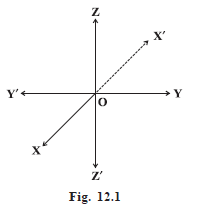
12.1.1 Coordinate axes and coordinate planes Let X′OX, Y′OY, Z′OZ be three mutually perpendicular lines that pass through a point O such that X′OX and Y′OY lies in the plane of the paper and line Z′OZ is perpendicular to the plane of paper. These three lines are called rectangular axes ( lines X′OX, Y′OY and Z′OZ are called x-axis, y-axis and z-axis). We call this coordinate system a three-dimensional space, or simply space.
The three axes taken together in pairs determine xy, yz, zx-plane, i.e., three coordinate planes. Each plane divide the space in two parts and the three coordinate planes together divide the space into eight regions (parts) called octant, namely (i) OXYZ (ii) OX′YZ (iii) OXY′Z (iv) OXYZ′ (v) OXY′Z′ (vi) OX′YZ′ (vii) OX′Y′Z (viii) OX′Y′Z′.
(Fig.12.1).
Let P be any point in the space, not in a coordinate plane, and through P pass planes parallel to the coordinate planes yz, zx and xy meeting the coordinate axes in the points A, B, C respectively. Three planes are
(i) ADPF || yz-plane (ii) BDPE || xz-plane (iii) CFPE || xy-plane
These planes determine a rectangular parallelopiped which has three pairs of rectangular faces (A D P F, O B E C),(B D P E, C F A O) and (A O B D, FPEC) (Fig 12.2) 12.1.2 Coordinate of a point in space An arbitrary point P in three-dimensional space is assigned coordinates (x0, y0, z0) provided that
Please refer to attached file for NCERT Class 11 Maths Introduction To Three Dimensional Geometry Questions
Free study material for Mathematics
Official NCERT Textbook PDF: Class 11 Mathematics Chapter 11 Introduction to Three Dimensional Geometry
Chapter Textbook PDF for Class 11 Mathematics
Download the certified NCERT Textbook for Class 11 Mathematics Chapter 11 Introduction to Three Dimensional Geometry. Educational authorities and instructors recommend this e-textbook as the foundational reference for all terminal tests and school assessments.
Digital E-Book Collection for Class 11 Mathematics
Access a full archive of NCERT books in English Medium tailored for Class 11 courses. Units like Chapter 11 Introduction to Three Dimensional Geometry deliver in-depth concepts and thorough review questions at the section close.
Complete Your Chapter Preparation
Elevate your study routine by reviewing our comprehensive NCERT Solutions and revision notes available on our platform free of charge.
FAQs
You can download the latest, teacher-verified PDF for NCERT Book Class 11 Maths Introduction To Three Dimensional Geometry Questions PDF Download for free on StudiesToday.com. These digital editions are updated as per 2026-27 session and are optimized for mobile reading.
Yes, our collection of Class 11 Mathematics NCERT books follow the 2026 rationalization guidelines. All deleted chapters have been removed and has latest content for you to study.
Downloading chapter-wise PDFs for Class 11 Mathematics allows for faster access, saves storage space, and makes it easier to focus in 2026 on specific topics during revision.
NCERT books are the main source for NCERT exams. By reading NCERT Book Class 11 Maths Introduction To Three Dimensional Geometry Questions PDF Download line-by-line and practicing its questions, students build strong understanding to get full marks in Mathematics.