

Official NCERT Book for Class 11 Chemistry: Lab Manual Chemical Equilibrium Ionic Equilibrium
Explore the complete NCERT textbook for Class 11 Chemistry. Tailored for the 2026-27 curriculum, this resource breaks down complex topics to help students prepare effectively for school examinations.
Chapter-wise Study Material: Lab Manual Chemical Equilibrium Ionic Equilibrium
Access the complete PDF for Lab Manual Chemical Equilibrium Ionic Equilibrium below. This focused excerpt allows students to isolate specific topics for thorough review. Cross-reference your textbook exercises with our detailed NCERT Solutions for Class 11 Chemistry.
Question. At 298 K, the solubility product of PbCl2 is 1.0 x 10⁻⁶.
What will be the solubility of PbCl2 in moles/litre
a. 3 6.3 10× −
b. 3 1.0 10× −
c. 3 3.0 10× −
d. 14 4.6 10× −
Answer : A
Question. The solubility of BaSO4 in water is 2.33×10⁻³ gm/litre. Its solubility product will be (molecular weight of BaSO4 = 233)
a. 1 x 10⁻⁵
b. 1 x 10⁻¹⁰
c. 1 x 10⁻¹⁵
d. 1 x 10⁻²⁰
Answer : B
Question. Assuming complete dissociation, which of the following aqueous solutions will have the same pH value?
a. 100ml of 0.01 M HCl
b. 100ml of 0.01 M H2SO4
c. 50 ml of 0.01 M HCl
d. Mixture of 50 ml of 0.02 M H2SO4 and 50 ml of 0.02 M
NaOH
Answer : A. D
Question. Solubility product of a sulphide MS is 3 x 10⁻²⁵ and that of another sulphide NS is 4 x 10−40 In ammoniacal solution
a. Only NS gets precipitated
b. Only MS gets precipitated
c. No sulphide precipitates
d. Both sulphides precipitate
Answer : D
Question. Which one of the following is most soluble?
a. CuS (Ksp = 8 x 10−37)
b. MnS (Ksp = 7 x 10⁻¹⁶)
c. Bi2S2 (Ksp = 1 x 10−70)
d. Ag2S (Ksp = 6 x 10−51)
Answer : B
Question. The solubility product of a salt having general formula MX2, in water is: 4 10−12 The concentration of M2+ ions in the aqueous solution of the salt is
a. 2.0 x 10 M−6
b. 1.0 x 10 M−4
c. 1.6 x 10 M−4
d. 4.0 x 10 M−10
Answer : B
Question. The addition of HCl will not suppress the ionization of
a. Acetic acid
b. Benzoic acid
c. H2S
d. Sulphuric acid
Answer : D
Question. Why pure NaCl is precipitated when HCl gas is passed in a saturated solution of NaCl:
a. Impurities dissolves in HCl
b. The value of [Na+] and[Cl−] becomes smaller than sp Ksp of NaCl
c. The value of [Na+] and [Cl−] becomes greater than sp Ksp of NaCl
d. HCl dissolves in the water
Answer : C
Question. If the solubility product Ksp of a sparingly soluble salt MX2 at 25°C is 1.0×10⁻¹¹, the solubility of the salt in mole litre–1 at this temperature will be
a. 2.46×10¹⁴
b. 1.36x10⁻⁴
c. 2.60x10⁻⁷
d. 1.20x10⁻¹⁰
Answer : B
Question. An acid-base indicator has the acid form of the indicator is red and the form is blue. Then:
a. pH is 4.04 when indicator is 75% red
b. pH is 5.00 when indicator is 75% blue.
c. pH is 5.00 when indicator is 75% red.
d. pH is 4.05 when indicator is 75% blue.
Answer : A, B
Question. The colour of an electrolyte solution depends on:
a. The nature of the anion
b. The nature of the cation
c. The nature of both the ions
d. The nature of the solvent
Answer : C
Question. The compound whose 0.1M solution is basic is:
a. Ammonium acetate
b. Calcium carbonate
c. Ammonium sulphate
d. Sodium acetate
Answer : D
Question. Assuming complete dissociation, which of the following aqueous solutions will have the same pH value:
a. 100ml of 0.01 M HCl
b. 100ml of 0.01 M H2SO4
c. 50ml of 0.01 M HCl
d. Mixture of 50ml of 0.02 M H2SO4 and 50ml of 0.02 M NaOH
Answer : A, D
Question. Which of the following will not function as a buffer solution?
a. NaCl and NaOH
b. NaOH and NH4OH
c. CH3COONH4 and HCl
d. Borax and boric acid
Answer : A, B, C
Question. The following reaction is known to occur in the body CO2 + H2O ⇌ H2CO3 ⇌ H+ + HCO3− If CO2 escapes from the system:
a. pH will decrease
b. Hydrogen ion concentration will decrease
c. H2CO3 concentration will be unaltered
d. The forward reaction will be promoted
Answer : B
Question. Correct statement is:
a. NH4 Cl gives alkaline solution in water
b. NH3 COONa gives acidic solution in water
c. NH3 COOH is a weak acid
d. NH4 OH is a strong base
Answer : C
Question. At 90oC pure water has 6 [H3O+] = 10-6 M, the value of Kw at this temperature will be:
a. 6 10−
b. 12 10−
c. 14 10−
d. 8 10−
Answer : B
Question. Ksp value of Al(OH)3 and Zn(OH)2 are 8.5×10⁻²³ and 1.8×10⁻¹⁴ respectively. If NH4 OH is added in a solution of Al3+ and Zn2+, which will precipitate earlier:
a. Al (OH)3
b. Zn (OH)2
c. Both together
d. None
Answer : A
Question. The Ksp of Mg(OH)2 is 1×10–12, 0.01 M Mg (OH2) will precipitate at the limiting pH:
a. 3
b. 9
c. 5
d. 8
Answer : B
Assertion and Reason
Note: Read the Assertion (A) and Reason (R) carefully to mark the correct option out of the options given below:
a. If both assertion and reason are true and the reason is the correct explanation of the assertion.
b. If both assertion and reason are true but reason is not the correct explanation of the assertion.
c. If assertion is true but reason is false.
d. If the assertion and reason both are false.
e. If assertion is false but reason is true.
Question. Assertion: CHCl3 is more acidic than CHF3.
Reason: The conjugate base of CHCl3 is more stable than CHF3.
Answer : A
Question. Assertion: Ionic reactions are not instantaneous.
Reason: Oppositely charged ions exert strong forces.
Answer : C
Question. Assertion: A solution of FeCl3 in water produce brown precipitate on standing.
Reason: Hydrolysis of FeCl3takes place in water
Answer : A
Question. Assertion: BaCO3 is more soluble in NHO3 than in plain water.
Reason: Carbonate is a weak base and reacts with the H+ from the strong acid, casuing the barium salt to dissociate.
Answer : A
Question. Assertion: The amino acid glycine predominantly exists in the form of ⊕NH3CH2COO⊙ .
Reason: The conjugate acid of glycine is NH2CH2COO⊙ .
Answer : C
Question. Assertion: pH of hydrochloric acid solution is less than that of acetic acid solution of the same concentration.
Reason: In equimolar solutions, the number of titrable protons present in hydrochloric acid is less than that persent in acetic acid.
Answer : C
Question. Assertion: A ionic product is used from any types of electrolytes whereas solubility product is applicable only to sparingly soluble salts.
Reason: Ionic product is defined at any stage of the raction whereas solubility product is only appicable to the saturation stage.
Answer : B
Question. Assertion: Addition of silver ions to a mixture of aqueous sodium chloride and sodium bromide solution will first precipitate AgBr rather than AgCl.
Reason: Ksp of AgCl < Ksp of AgBr.
Answer : C
Question. Assertion: The pH of an aqueous solution of CH3COOH remains unchanged on the addition of CH3COONa.
Reason: The ionization of CH3COOH is suppressed by the addition of CH3COONa.
Answer : D
Comprehension Based
Paragraph –I
In qualitative analysis, cations of group II as group II as well as group IV both are precipitated in the form of sulphides. Due to low value of Ksp of group II sulphides, group reagent is H2S in the presence of dil. HCl and due to high value of Ksp of group IV sulphides, group reagent is H2S in the presence of NH4OH and NH4Cl. In solution containing 0.1M each of Sn2+, Cd2+, andNi2+ ions, H2S gas is passed. Ksp of SnS = 8×10–29, Ksp of CdS = 15 10–28, Ksp of NiS = 3×10–21, K1 of H2S=1×10⁻⁷, K2 of H2S = 1×10–14
Question. If H2S is passed into the above mixture in the presence of HCl, which ion will be precipitated first?
a. SnS
b. CdS
c. NiS
d. SnS and CdS
Answer : C
Question. At what value of pH, NiS will start to precipitate?
a. 12.76
b. 7
c. 1.24
d. 4
Answer : C
Question. Which of the following sulphides is more soluble in pure water?
a. Cds
b. NiS
c. SnS
d. Equal solubility for all
Answer : A
Question. If 0.1 M HCl is mixed in the solution containing only 0.1 MCd2+ ions and saturated with H2S, then [Cd2+] remaining in the solution after CdS stops to precipitate is:
a. 10–8
b. 8.2 × 10⁻⁹
c. 5.6 × 10⁻⁶
d. 5.6 × 10⁻¹⁰
Answer : A
Paragraph –II
Acid rain takes place due to combination of acidic oxides with water and it is an environmental concern all over the world. Assuming rain water is uncontaminated with HNO3 or H2CO3 and is in equilibrium with 1.25×10⁻⁴ atm CO2. The Henry’s law constant (KH) is 1.25×10⁶ torr. Ka1 of H2CO3 = 4.3×10⁻⁷. Given KfCuCl⊕ 1.0(Kf = is formation constant of CuCl⊕)
Question. What is the pH of natural rain water?
a. 5.64
b. 7.00
c. 5.87
d. 7.40
Answer : C
Question. If content is the atmosphere is 0.64 ppm by volume, pH of rain water is (assume 100% ionization of acid rain as monobasic acid).
a. 4.0
b. 5.0
c. 6.0
d. 7.0
Answer : B
Paragraph –III
In acid-base titration reacts rapidly to neutralize each other. Equivalence point is point at which the acid and the base (or oxidising agent and reducing agent) have been added in equivalent quantities. The end point is the point at which the titration stops. Since the purpose of the indicator is to stop the titration close to the point at which the acid and base were added in equivalent quantities, it is important that the equivalent point and the end point be as close as possible. The indicator must change colour at a pH close to that of a solution of the salt of the acid and base. Significantly, the pH changes most rapidly neat the equivalence point. The exact shape of a titration curve depends on Ka and Kb of acid base.
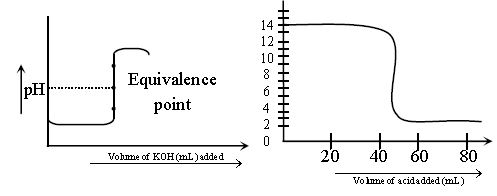
Question. The following curve represents titration curve of HCl against KOH. The pH at equivalent point is. Examine the titration curve below and answer the question:
a. 3
b. 6
c. 7
d. 8
Answer : C
Question. The curve represents the titration of?
a. CsOH by HBr
b. HCl by NaOH
c. HCl by KOH
d. NH3 by HNO3
Answer : A
Question. The suitable indicator for the titration is?
a. Methyl orange
b. Bromothymol
c. Methyl red
d. All of these
Answer : D
Question. The pH at equivalence point is?
a. 2
b. 3
c. 7
d. 11
Answer : C
Question. Which of the following curves indicates the titration of a weak diprotic acid by KOH by equivalent strength?
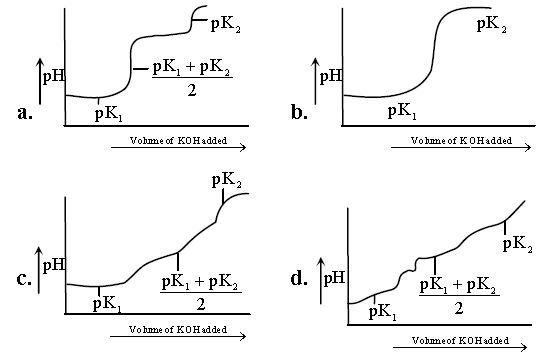
Answer : A
Integer
Question. How many of the conbinations of reactants in (8) above will react until more than 98% of the limiting quantity is used up?
Answer : 8
Question. The dissociation constant of a substituted benzoic acid at 25°C is 1.1 × 10⁻¹. Find the pH of a 0.01 M solution of its sodium salt.
Answer : 8
Question. Among the following, find the total number of compounds whose aqueous solution turns red litmus paper blue KCN, K2SO4, (NH4)2, C2O4, NaCl, Zn(NO3)2, FeCl2, K2CO3, NH4NO2, LiCN.
Answer : 3
Question. Find the total number of diprotic acids among the following.
H3PO4, H2SO4, H3 PO3, H2CO3, H2S2O7, H3BO3, H3PO2, H2CrO4, H2SO3
Answer : 6
Question. In 1 L saturated solution of AgCl(Ksp of AgCl) =1.6×10⁻¹⁰), 0.1 mol of CuCl (Ksp CuCl = 1.0×10⁻⁶) is added. The resultant concentration of Ag+ in the solution is 1.6 ×10–x. Calculate the value of x.
Answer : 7
Question. Match the statement of Column I with those in Column II:
| Column I | Column II |
| (A) HSO4⊙ | 1. Lewis acid |
| (B) BF3 | 2. Lewis base |
| (C) NH3 | 3. Bronsted acid |
| (D) OH | 4. Bronsted base |
a. A→3,4, B→1, C→2,4, D→2,4
b. A→3,4, B→1, C→2,4, D→2,2
c. A→4,4, B→2, C→1,4, D→2,4
d. A→2,4, B→1, C→2,4, D→2,3
Answer : A
Question. Match the statement of Column I with those in Column II:
| Column I | Column II |
| (A) Hydrolysis of ethyl acetate in basic solution | 1. Second-order reaction |
| (B) Hydrolysis of ethyl acetate in acidic solution | 2. First-order reaction. |
| (C) The limits of pH values of a buffer solution. | 3. pKa ≠ 1 |
| (D) The buffer capacity of a solution is maximum when the concentration of salt to the acid is | 4. Equal |
a. A→1, B→2, C→3, D→1,4,2
b. A→1, B→2, C→2, D→1,4,3
c. A→1, B→1, C→2, D→1,3,2
d. A→1, B→2, C→1, D→1,4,4
Answer : A
CHEMICAL EQUILIBRIUM (IONIC EQUILIBRIUM IN SOLUTION)
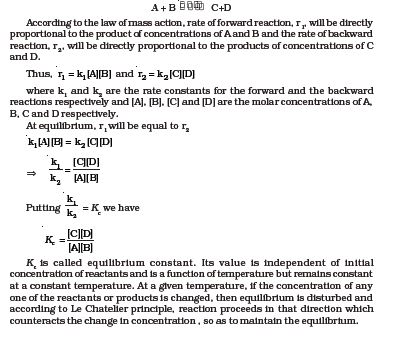
CHEMICAL Reactions can be classified into two categories; namely reversible and irreversible reactions. Reversible reactions take place in the same reaction vessel and can proceed in the forward and backward direction simultaneously under the same conditions of temperature and pressure. Further in the case of reversible reactions a state is reached, when the rate of the forward reaction becomes equal to the rate of the reverse reaction and it appears as though the reaction has come to a stand still. This state is referred to as the state of dynamic equilibrium. Consider the following simple reversible reaction at the given temperature, T.
Click on the below link to download NCERT Class 11 Chemistry Lab Manual Chemical Equilibrium Ionic Equilibrium
Free study material for Chemistry
Lab Manual Chemical Equilibrium Ionic Equilibrium Digital Textbook & Resources for Class 11 Chemistry
Class 11 Chemistry Lab Manual Chemical Equilibrium Ionic Equilibrium Official E-Book
Secure your copy of the NCERT Textbook for Class 11 Chemistry Lab Manual Chemical Equilibrium Ionic Equilibrium. Widely adopted across educational institutions, final question papers map directly to the framework outlined in this chapter.
English Medium NCERT Textbooks for Class 11
Browse our comprehensive suite of NCERT books in English Medium designed for Class 11 students, offering clear conceptual breakdowns and concluding practice problems.
Additional Study Resources for Class 11 Chemistry
Elevate your study routine by reviewing our comprehensive NCERT Solutions and revision notes available on our platform free of charge.
FAQs
You can download the latest, teacher-verified PDF for NCERT Book Class 11 Chemistry Lab Manual Chemical Equilibrium Ionic Equilibrium PDF Download for free on StudiesToday.com. These digital editions are updated as per 2026-27 session and are optimized for mobile reading.
Yes, our collection of Class 11 Chemistry NCERT books follow the 2026 rationalization guidelines. All deleted chapters have been removed and has latest content for you to study.
Downloading chapter-wise PDFs for Class 11 Chemistry allows for faster access, saves storage space, and makes it easier to focus in 2026 on specific topics during revision.
NCERT books are the main source for NCERT exams. By reading NCERT Book Class 11 Chemistry Lab Manual Chemical Equilibrium Ionic Equilibrium PDF Download line-by-line and practicing its questions, students build strong understanding to get full marks in Chemistry.