

Official Class 10 Mathematics Revision Material: CBSE Class 10 Mathematics Surface Area And Volume Notes Set 03
Access comprehensive revision notes for Chapter 12 Surface Areas and Volumes using the CBSE Class 10 Mathematics Surface Area And Volume Notes Set 03. Designed to align with the 2026-27 academic syllabus for Class 10 Mathematics, these concept summaries help students streamline their exam preparation and review complex topics efficiently.
Chapter-wise Concept Summaries: Chapter 12 Surface Areas and Volumes
View or download the dedicated Chapter 12 Surface Areas and Volumes revision resource below. Engaging with these structured concept notes daily ensures continuous academic progress and mastery of the 2026-27 curriculum for Mathematics.
CBSE Class 10 Mathematics Surface area and volumes notes Learning the important concepts is very important for every student to get better marks in examinations. The concepts should be clear which will help in faster learning. The attached concepts made as per NCERT and CBSE pattern will help the student to understand the chapter and score better marks in the examinations.
SURFACE AREAS AND VOLUMES
Contents
1) Cube
2) Cuboid
3) Cylinder
4) Cone
5) Sphere
6) Hemisphere
7) Frustum
Concept
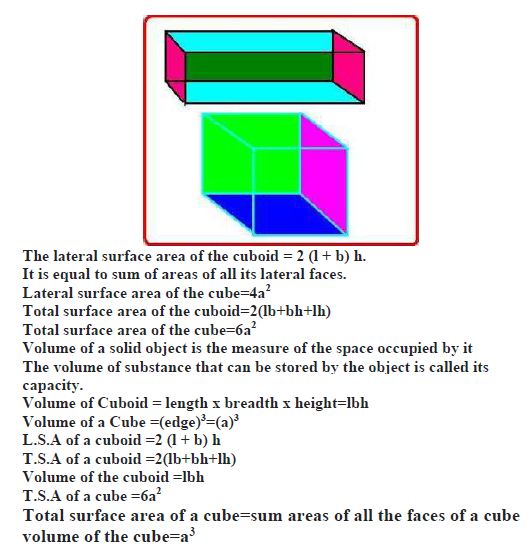
A cuboid is a solid bounded by six faces that arerectangular in shape.
A cuboid whose length, breadth and height are equal is called a cube.
Any two faces other than the opposite faces are called adjacent faces.
Any two adjacent faces meet in a line segment, which is called an edge of the cuboid.
The point of concurrency of any three edges of a cuboid is called a vertex of thecuboid.
A cuboid has 8 vertices and 12 edges. Any face of a cuboid may be called the base of the cuboid. In that case, the four adjacent faces of the base are called thelateral faces of the cuboid.
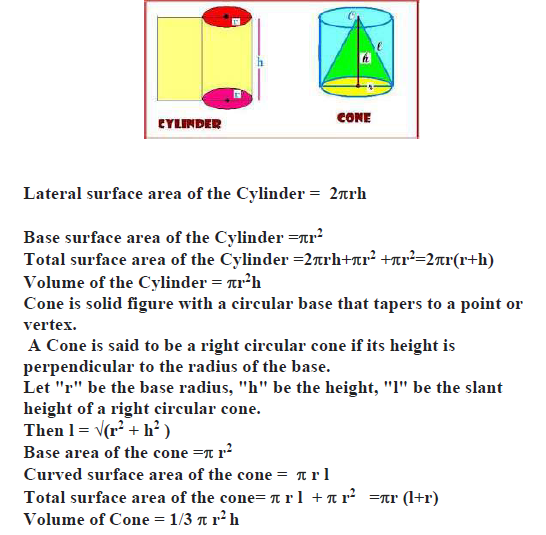
A cylinder can be defined as a solid figure that is bound by a curved surface and two flat surfaces. The flat surfaces are made up of two congruent circles that are parallel to each other.
These flat surfaces are called thebases of the cylinder.
The radius of the circular bases is the radius of the cylinder.
The perpendicular line that passes through the centers of the two circular bases is the height of the cylinder or axis of the cylinder.
A cylinder is said to be right circular cylinder if axis is perpendicular to the radius of the cylinder.
The curved surface joining the two basses of a right circular cylinder is called its lateral surface area. For a right circular cylinder of radius r and height h
A sphere is a three dimensional figure, made up of points that are equidistant from a given point.
It does not have an edge or a vertex.
The surface of a sphere is uniform and smooth.
The centre of a sphere is a point, which is equidistant from all the points on a sphere.
The distance between the centre and any point on the surface of the sphere is called the radius of a sphere.
Generally the radius is denoted by the letter r.
A line segment through the centre of the sphere, and with the end points on the sphere is called a diameter of the sphere.
Frustum of a cone: Frustum is a latin word meaning,”piece cut off” & its plural is ‘frusta’.
For a given cone,cut it with a plane parallel to its base and remove the cone that is formed on one side of that plane,the part that is left over on the other side of the plane is called a frustum of the cone.
X Maths Surface Areas and Volumes Important Concepts
1. Every cube is a cuboid but every cuboid is not a cube.
2. In a cube, the lengths of all edges are the same.
3. Area of the four walls of the hall is the lateral surface area of cube or cuboid4. The outer surface of a cuboid is made up of six rectangles or six rectangular regions, called the faces of the cuboid
5. In case of a room, lateral surface area means the area of the four walls of the room, whereas total surface area means the area of four walls plus the area of the floor and the ceiling.
6. Face diagonal of a cube or cuboid will always be shorter than the body diagonal.
7. The total surface area of any object will be greater than its lateral surface area.
8. The unit of measurement of both volume and capacity is cubic unit such as cubic feet, cubic cm. cubic m etc.
9. When an object of certain volume is recast into a cylinder, the volume of the cylinder formed will always be equal to the volume of the original object.
10. The solids having the same curved surface do not necessarily occupy the same volume.
11. When an object is dropped into a liquid, the volume of the displaced liquid is equal to the volume of the object that is dipped.
12. Volume of a Cone is one third of the volume of a cylinder of same height and radius of base
13. Volume of a hemisphere be exactly half of the corresponding sphere.
14. All the solids having a given volume, the sphere is the one with the smallest surface area; of all solids having a given surface area, the sphere is the one having the greatest volume
Formulae
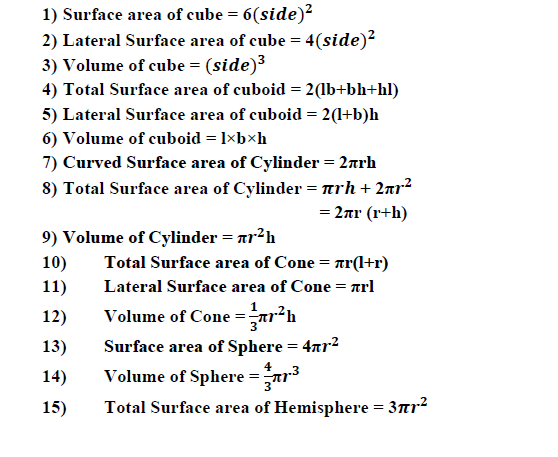
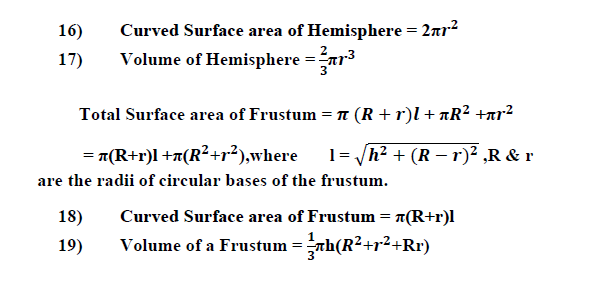
Please click the link below to download pdf file for CBSE Class 10 Mathematics Surface area and volumes notes.
Free study material for Mathematics
Revision Notes and Key Concepts for Class 10 Mathematics Chapter 12 Surface Areas and Volumes
Quick Revision Notes: Chapter 12 Surface Areas and Volumes (CBSE)
Explore reliable chapter overviews for Chapter 12 Surface Areas and Volumes tailored for Class 10 learners. Use these structured points to grasp difficult themes and ensure solid preparation for upcoming assessments.
Expert Study Material for Class 10 Mathematics
Cross-reference your comprehension with comprehensive NCERT solutions for Class 10 to ensure absolute clarity across all sub-topics in this chapter.
Complete Your Chapter Revision
Wrap up your chapter revision by testing your knowledge against standard question formats. Everything on our platform is provided free of charge.
FAQs
You can download the teacher prepared revision notes for CBSE Class 10 Mathematics Surface Area And Volume Notes Set 03 from StudiesToday.com. These notes are designed as per 2026-27 academic session to help Class 10 students get the best study material for Mathematics.
Yes, our CBSE Class 10 Mathematics Surface Area And Volume Notes Set 03 include 50% competency-based questions with focus on core logic, keyword definitions, and the practical application of Mathematics principles which is important for getting more marks in 2026 CBSE exams.
Yes, our CBSE Class 10 Mathematics Surface Area And Volume Notes Set 03 provide a detailed, topic wise breakdown of the chapter. Fundamental definitions, complex numerical formulas and all topics of CBSE syllabus in Class 10 is covered.
These notes for Mathematics are organized into bullet points and easy-to-read charts. By using CBSE Class 10 Mathematics Surface Area And Volume Notes Set 03, Class 10 students fast revise formulas, key definitions before the exams.
No, all study resources on StudiesToday, including CBSE Class 10 Mathematics Surface Area And Volume Notes Set 03, are available for immediate free download. Class 10 Mathematics study material is available in PDF and can be downloaded on mobile.