

Revision Notes for Class 6 Science: Chapter 09 The Living Organisms and Their Surroundings
Explore reliable concept summaries and revision materials through the CBSE Class 6 Science Living Organisms And Their Surroundings Notes. Tailored for Class 6 learners, utilizing these notes for Science Chapter 09 The Living Organisms and Their Surroundings ensures thorough preparation and strengthens core academic definitions before final evaluations.
Review Chapter 09 The Living Organisms and Their Surroundings for Class 6 Science
Access the complete concept summary PDF for Chapter 09 The Living Organisms and Their Surroundings below. Regular review of these targeted notes builds familiarity with complex Class 6 Science themes and helps secure higher marks in final school evaluations.
CBSE Class 6 Science - Living Organisms and their Surroundings Learning the important concepts is very important for every student to get better marks in examinations. The concepts should be clear which will help in faster learning. The attached concepts made as per NCERT and CBSE pattern will help the student to understand the chapter and score better marks in the examinations.
Topics in the chapter
- Habitat
- Adaptations
- Types of habitat
- Acclimatisation
- Components of a habitat
What is Habitat?
- The surrounding where an organism lives, where it can find food, shelter and a favourable condition for breeding is known as its habitat.
Adaptations
- The ability of living organisms to adjust themselves to the surroundings is called as adaptation.
- Adaptations are the changes in structure or behaviour of an organism that will allow the organism to survive in that habitat.
Types of habitat
- There are two types of habitat:
i. Terrestrial habitat
ii. Aquatic habitat
Terrestrial habitat
- It refers to the land where all plants and animals survive.
- Animals and plants which live on land are called as terrestrial animals and terrestrial plants.
- Terrestrial habitat is further classified into:
(i) Forests
(ii) Grasslands
(iii) Deserts
(iv) Mountains
(v) Polar Regions
(i) Forest
- These are large areas covered with trees and plants.
- Organisms living in the forest depend upon abiotic factors like air, availability of water, temperature, sunlight etc.
- Three types of forests are tropical forests, temperate forests and boreal forests.
(ii) Grasslands
- These are mainly covered by long and thick grasses.
- Temperature ranges between - 20℃ and 30℃.
- Annual rainfall they receive varies between 50cm and 90cm.
(iii) Deserts
- These are the areas that receive scanty rainfall.
- These are dry with sand covering the whole region.
- Deserts are mostly hot regions but some of them are even too cold regions.
(iv) Mountains
- These regions are rocky and dry.
- Sometimes water occurs as flowing streams.
- Plants present on hills are xerophytes. These are conical and evergreen.
(v) Polar region
- These regions are covered with high snowy peaks.
- Animals found here are adapted by having thick furry coat on the skin.
Aquatic habitat
- It refers to the region covered with water where plants and animals survive.
(a) Freshwater habitat: These are the water bodies filled with fresh water. These include rivers, lakes, ponds, streams etc.
(b) Marine habitat: Ocean and seas are termed to be marine habitat.
These are full with life. Different varieties of organisms exist in marine habitat.
(c) Coastal habitat: This is the region represented by the place where land meets the sea.
Acclimatisation:
- The ability of an organism to make small adjustments or changes in the body in a short period of time to adjust itself to the surrounding atmosphere is called acclimatisation.
- There are two types of components of a habitat:
(i) Biotic components
(ii) Abiotic components
Biotic components
- It include all the livings organisms in a habitat, i.e. plants, animals and microorganisms.
Abiotic components
- It includes all the non-living things in a habitat, i.e. air, soil, water, sunlight and temperature.
- The favourable conditions for survival of living organisms are provided by abiotic components.
Abiotic components
(i) Air
- Air is essential for all the living organisms on earth.
- Plants and animals take in oxygen from the air during respiration.
- Air is required by organisms to cool their body.
(ii) Soil
- Soil is the topmost layer of the earth.
- Soil is rich in minerals and microorganisms which help in different ways for plant growth.
(iii) Water
- Water forms a medium for many metabolic reactions taking place inside the body.
(iv) Sunlight
- Sun is the ultimate source of energy for all the living organisms on earth.
- Plants depend on sunlight for synthesising their food by the process of photosynthesis.
(v) Temperature
- Temperature at a place depends on the sunlight available at the particular place.
- Temperature also influences the humidity of that particular place.
Q1. Define habitat, adaptation, xerophytes and hydrophytes.
Ans. The definitions are as follows:-
a) Habitat- Habitat is the place where an organism lives.
b) Adaptation- Adaptation refers to the presence of specific features or certain habits which enable a plant or animal to live in its surroundings.
c) Xerophytes-Plants which live in dry conditions
d) Hydrophytes-Plants which live in water.
Q2. Leaves of pine tree are needle- like. Why?
Ans. Leaves of pine tree are n
eedle like because this helps the rain water and snow to slide off easily.
Q3. Stem in desert plants is coloured with a thick waxy layer. Why?
Ans. Stem in desert plants is covered with a thin waxy layer so as to reduce the loss of water.
Q4. Classify the following as biotic and abiotic components.
Ans. a) Bacteria- Biotic
b) Humidity- Abiotic
c) Light- Abiotic
f) Dog- Biotic
g) Polar Bear- Biotic
h) Air- Abiotic
d) Precipitation- Abiotic
e) Soil- Abiotic
i) Temperature- Abiotic
j) Water- Abiotic
Q5. Why frogs are called amphibians of animal kingdom?
Ans. Frogs are called amphibians of animal kingdom because they live both in water as well as on land.
Q6. Why rats and snakes stay in deep burrows in land?
Ans. Rats and snakes stay in deep burrows in land so as to stay away from heat.
Q7. Mention two ways in which animals cope up with low temperature?
Ans. The two ways in which animals cope up with low temperature are:
- Thick skin or fur to protect them from cold.
- Yaks have long hair to keep them warm.
Q8. Mention two stimuli that plants respond to.
Ans. The two stimuli are:
- Stem grows towards light.
- Some plants like touch me not close their leaves when we touch it.
Q9. Select the animals which can live in water as well as on land:-
Ans. a) Frog- Yes
b) Duck- No
c) Crocodile- No
d) Human fish- No
e) Monkey- No
Q10. Why lions have eyes in front of their face?
Ans. Lions have eyes in front of their face because this allows it to have a correct idea about the location of its prey.
Q11.How do desert plants control the loss of water? Give three adaptive features.
Ans. The three adaptive features are:-
• Leaves are reduced to spine like structure.
• Leaves have a thin waxy coating.
• Roots are deep and extensive.
Q12. Write True/ False
a) Animals grow throughout their life.
b) All living beings response to stimuli.
Ans. a) True
b) True
Q13. Differentiate between:-
a) Breathing and Respiration
b) Living and Non- Living things.
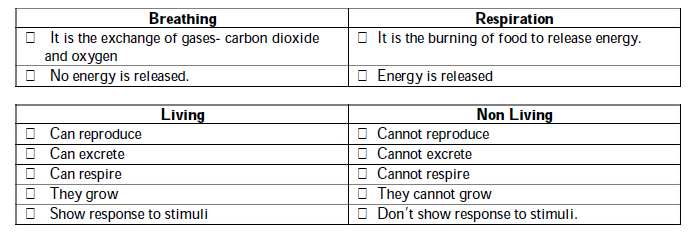
Q14. Define excretion.
Ans. Process of getting rid of the wastes by the living organism is called excretion.
Q15. Give three adaptive features of animals living in water.
Ans. The three features are:-
• Streamlined body.
• Presence of scales.
• Gills for respiration.
Q16. Give three adaptive features of hydrophytes.
Ans. The three features are:-
• Roots are poorly developed.
• Stems are long and hollow.
• Leaves are narrow and thin ribbon- like.
Q17. Give four examples of terrestrial habitat.
1. Forests
2. Grasslands
3. Deserts.
4. Mountain regions.
Q18. How do plants respire?
Ans. Plants respire with the help of stomata.They are the tiny pores present on leaf surface.
Q19)Mention some adaptations of animals living in the mountain regions.
Ans-animals in mountain region have thick skin or fur to protect them from cold.
YAKS- have long hair to keep them warm.
SNOW LEOPARD- has thick fur on its body including feet and toes which protect them from cold when it walks on the snow.
MOUNTAIN GOAT- has strong hones for running up the rocky slopes of the mountains.
Q20)How deer is adapted to live in forests and grassland?
Ans-1)Deer has strong teeth for chewing hard plant stems of the forest.
2)it has long ears to hear movements of predators.
3)the eyes on the side of its head allow it to look in all directions for danger.
4) the speed of the deer helps to run away from predators.
Q21)How do dolphins and whales breathe,as they don’t have gills?why they come on surface time to time?
Ans- they breathe in air through nostrils or blowholes that are located on the upper parts of their heads. They can stay inside the water for a long time without breathing,they come out to the surface from time to time , to breathe in air.
Q22)What is stimuli and response?give example.
Ans- changes in our surroundings that makes us respond to them , are called stimuli.
Reaction in return of stimuli is termed as response.
Example-wild animals run away when bright light is flashed towards them.
Bright light is a stimuli and running of animals is response.
Q23)Which part of the following organisms do respiration:
1)frog- skin and lung
2)earthworm- moist skin
3)plants- stomata
4)human being-lung
5)fish- gill
6)dolphins-lungs
Please click the link below to download CBSE Class 6 Science - Living Organisms and their Surroundings
Free study material for Science
Revision Notes and Key Concepts for Class 6 Science Chapter 09 The Living Organisms and Their Surroundings
Download Chapter Summary: Class 6 Science Chapter 09 The Living Organisms and Their Surroundings
Explore reliable chapter overviews for Chapter 09 The Living Organisms and Their Surroundings tailored for Class 6 learners. Use these structured points to grasp difficult themes and ensure solid preparation for upcoming assessments.
Concept Clarification for Chapter 09 The Living Organisms and Their Surroundings
Each chapter summary is structured around standard CBSE textbooks, allowing students to check their understanding and clarify complex ideas early in their revision.
Additional Study Resources for Class 6 Science
Explore our broader library of printable assignments, chapter notes, and mock tests designed to support continuous revision and secure higher marks in CBSE assessments.
FAQs
You can download the teacher prepared revision notes for CBSE Class 6 Science Living Organisms And Their Surroundings Notes from StudiesToday.com. These notes are designed as per 2026-27 academic session to help Class 6 students get the best study material for Science.
Yes, our CBSE Class 6 Science Living Organisms And Their Surroundings Notes include 50% competency-based questions with focus on core logic, keyword definitions, and the practical application of Science principles which is important for getting more marks in 2026 CBSE exams.
Yes, our CBSE Class 6 Science Living Organisms And Their Surroundings Notes provide a detailed, topic wise breakdown of the chapter. Fundamental definitions, complex numerical formulas and all topics of CBSE syllabus in Class 6 is covered.
These notes for Science are organized into bullet points and easy-to-read charts. By using CBSE Class 6 Science Living Organisms And Their Surroundings Notes, Class 6 students fast revise formulas, key definitions before the exams.
No, all study resources on StudiesToday, including CBSE Class 6 Science Living Organisms And Their Surroundings Notes, are available for immediate free download. Class 6 Science study material is available in PDF and can be downloaded on mobile.