

Revision Notes for Class 6 Science: Chapter 08 Body Movements
Review targeted revision notes for Class 6 Science with the CBSE Class 6 Science Body Movements Notes. Built according to official educational guidelines for the 2026-27 academic year, these downloadable summaries for Chapter 08 Body Movements support daily study and last-minute exam readiness.
Review Chapter 08 Body Movements for Class 6 Science
Navigate directly to the revision notes for Chapter 08 Body Movements using the digital viewer below. Each summary is structured to highlight high-weightage sections, allowing students to instantly access critical definitions and focus on core exam topics.
CBSE Class 6 Science - Body Movements. Learning the important concepts is very important for every student to get better marks in examinations. The concepts should be clear which will help in faster learning. The attached concepts made as per NCERT and CBSE pattern will help the student to understand the chapter and score better marks in the examinations.
Topics in the chapter
- What is locomotion?
- Parts of human skeleton
- Types of joints in human body
- Bones and their various shape and functions
- Cartilage
- Muscles
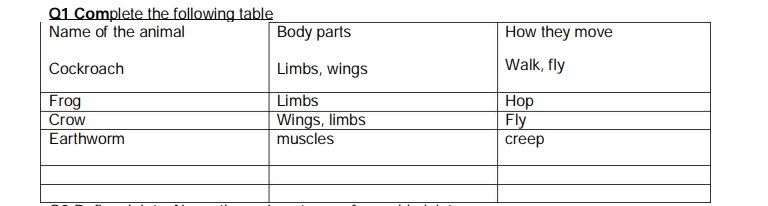
- Gait of animals:- earthworm, snail, cockroach, birds, fishes and snakes.
What is Locomotion?
- Locomotion is movement of the entire body from one place to another.
- Locomotion forms a framework that gives shape and support to the body.
- The human body consists of 206 bones.
- Bones protect internal organs.
Parts of Human Skeleton
- The bones present in our body form a framework this frame work is called Skeleton.
- The human skeleton has two parts:
(i) The axial skeleton system: It includes the skull, vertebral column and the chest bones or the rib-cage.
(ii) Appendicular skeleton system: It includes hip girdles and shoulder and the limbs.
Types of joints in Human Body
Different types of Joints
(i) Ball and socket joints
(ii) Pivotal joints
(iii) Hinge joints
(iv) Fixed joints
(i) Ball and socket joints
- It is a type of joint in which ball shape surface of one bone fitted into the hollow space of another bone known as socket.
(ii) Pivotal Joints
- Pivotal joints allow for flexibility, extension, rotation and twisting.
(iii) Hinge Joint
- It is found between two or more than two bones where we need back and forth movement.
(iv) Fixed Joint
- It does not move in any direction. Bones
- Skeletal structure is composed of hard material which is made up of calcium called bone Various shape and functions of bones
- The number of small bones on the back side these small bones combine called as backbone, which is helpful in bending front and back.
- Bones which joins the chest and the backbone is called ribs
- If you will touch just below your stomach area you will find the presence of pelvic bone.
- The skull is the most hard and tough bone of our body which protects our brain from any mechanical injuries.
Cartilage
- It is softer and more flexible than bone. Cartilage is found between the joints of knee and hips.
Muscles
- Muscles are attached to the bones and it is responsible for the movement of human body.
- There is change in the length of muscle due to contraction and relaxation.
Gait(Locomotion) of Animals
Locomotion of Earthworm
- Earth worms commonly found in soil, it do not have bones. Their body is segmented, forms rings all over.
Locomotion of Snail
- Snails commonly found on land or in soil.
- It possesses wavy movement with muscular contraction.
- Snail has hard shell on its back but it is not made up of bone and not helpful in locomotion.
Locomotion of Cockroach:
- Cockroach is an insect and is a terrestrial animal mostly a common household pet.
- The body is divided into three parts—head, thorax, and abdomen.
- 3 pair of legs is present in thoracic part which moves by the muscles present near its limbs (legs).
- The body is covered with the outer hard exoskeleton.
- It uses breast muscles for the movement of wings due to which they can fly.
Birds
- Birds were egg laying animal with feathers, wings and beak.
- Fore limbs of birds were modified into wings due to which these can fly.
- Hind limbs are legs due to which they can jump, walk or swim as can be seen in ducks.
- The skeleton of birds is hollow to reduce weight and the breastbone muscle use to move the wings up and down.
Fishes
- Fishes found in oceans, rivers, lakes, aquarium etc.
- Fishes has well-arranged skeleton covered with strong muscles.
- This movement is helped by the fins present on tail and also the fins presents on body helps to balance the body while swimming.
Snakes
- Snakes live on ground, water, on trees. These were legless reptile.
- During its movement snakes creates curves in many loops which pushes them to the forward direction, they moves very fast but not in straight-line the motion created by snakes is called serpentine motion.
Q2 Define Joints. Name the various types of movable joints
Ans. A joint is a place where two or more bones meet. Various types of movable joints are-
1 ball and socket joint
2.Pivotal joint
3 .Hinge joint
Q3 Bones are hard and cannot be bent? How do we bend our limbs at the elbow and knees?
Ans. We can bend our limbs at the elbow and knees because of presence of hinge joint .
Q4 What are fixed joints ? Give its example.
Ans. Fixed joints do not allow any movement. eg. bones of our skull.
Q5 What is a ball and socket joint? Give its example.
Ans. In this type of joint ball of one bone is fitted in the socket of another bone .eg hip joint
Q6 How are we able to move our head up and down and sideways?
Ans. Pivotal joint
Q7 Name the joint that allows movement in one plane only?
Ans. Hinge joint
Q8 Define pivotal joint.
A In this joint rounded surface of one bone fits into the ring formed by the other.
Q9 What is the significance of human skeleton? (2 points)
Ans. 1 It provides support to the body and give specific shape to it
2 It helps to protect delicate organs.
Q10 What is a rib cage?
Ans. Chest bone and backbone together form a box called ribcage
Q11 What are the important organs protected by ribcage?
Ans. Heart and lungs
Q12 How many bones are present in our shoulder?
Ans. Two
Q13 Differentiate between bone and cartilage?
Ans. Bone is hard and inflexible and cartilage is soft and flexible
Q14 What is the main function of a muscle and how does it work?
Ans. Muscles help in movement by contraction and relaxation. Muscles move bones by contracting and thus pulling them but they cannot push back. That is why muscles work in pairs. One muscle pulls the bone away from the joint and another pulls it back.
Q15 Why do we say that earthworm are friends of farmers?
Ans. Earthworm decomposes organic waste and makes the soil more airy.
Q16 How does earthworm fix its body parts to the ground?
Ans. Bristles help to get a good grip on the surface of the ground.
Q17 What area the special features that help a bird to fly?
Ans. Birds have following featuresa)
a) Wings to fly.
b) streamlined body which reduces air resistance.
C) hollow bones which make them light in weight
Q18 What are the different body parts used by cockroach for its movements?
Ans. It has 3 pair of legs and 2 pairs of wings which helps it to fly and climb.
Q19 What is the significance of streamlined body in fishes?
Ans. This reduces water resistance and make it easy for fish to swim.
Q20 What is the importance of fins in fish?
Ans. It helps them to swim.
Please click the link below to download CBSE Class 6 Science - Body Movements
Free study material for Science
Revision Notes and Key Concepts for Class 6 Science Chapter 08 Body Movements
Download Chapter Summary: Class 6 Science Chapter 08 Body Movements
Explore reliable chapter overviews for Chapter 08 Body Movements tailored for Class 6 learners. Use these structured points to grasp difficult themes and ensure solid preparation for upcoming assessments.
Concept Clarification for Chapter 08 Body Movements
Built using the official NCERT book for Class 6 Science, these notes provide reliable academic guidance. Pair your summary review with our recommended NCERT solutions to master optimal problem-solving approaches.
Additional Study Resources for Class 6 Science
Follow up your revision by attempting the interactive online Science MCQ test and practice worksheets for this chapter to verify your mastery. All platform resources are free to access.
FAQs
You can download the teacher prepared revision notes for CBSE Class 6 Science Body Movements Notes from StudiesToday.com. These notes are designed as per 2026-27 academic session to help Class 6 students get the best study material for Science.
Yes, our CBSE Class 6 Science Body Movements Notes include 50% competency-based questions with focus on core logic, keyword definitions, and the practical application of Science principles which is important for getting more marks in 2026 CBSE exams.
Yes, our CBSE Class 6 Science Body Movements Notes provide a detailed, topic wise breakdown of the chapter. Fundamental definitions, complex numerical formulas and all topics of CBSE syllabus in Class 6 is covered.
These notes for Science are organized into bullet points and easy-to-read charts. By using CBSE Class 6 Science Body Movements Notes, Class 6 students fast revise formulas, key definitions before the exams.
No, all study resources on StudiesToday, including CBSE Class 6 Science Body Movements Notes, are available for immediate free download. Class 6 Science study material is available in PDF and can be downloaded on mobile.