

Download Class 6 Science Concept Summaries: CBSE Class 6 Science Components Of Food Notes
Explore reliable concept summaries and revision materials through the CBSE Class 6 Science Components Of Food Notes. Tailored for Class 6 learners, utilizing these notes for Science Chapter 02 Components of Food ensures thorough preparation and strengthens core academic definitions before final evaluations.
Access Chapter 02 Components of Food Notes and Study Material
View or download the dedicated Chapter 02 Components of Food revision resource below. Engaging with these structured concept notes daily ensures continuous academic progress and mastery of the 2026-27 curriculum for Science.
CBSE Class 6 Science - Components of Food Learning the important concepts is very important for every student to get better marks in examinations. The concepts should be clear which will help in faster learning. The attached concepts made as per NCERT and CBSE pattern will help the student to understand the chapter and score better marks in the examinations.
Topics in the chapter
- What are nutrients?
- Carbohydrates
- Proteins
- Vitamins
- Minerals
- Fats
- Roughage
- Fibres
- Balance Diet
- Diseases caused due to the deficiency of various nutrients
What are Nutrients?
- The food that we eat consists of different nutrients or components.
- The components of food which are needed by our body is known as nutrient.
- There are six main components present in food:
Carbohydrates, fats, proteins,vitamins, minerals and fibers.
- These components fulfill the different needs of the body.
Carbohydrates
- Carbohydrates are the compound which is made up of three elements:-
Carbon, Hydrogen and Oxygen
- Carbohydrate provides energy to our body, which keeps it going throughout the day.
- The main carbohydrates found in our food are in the form of sugars and starch. If food contains starch we can easily test it.
- The sources of carbohydrates include cereals such as wheat, maize, rice, jawar, bajra, potatoes, bread etc.
- We can test the presence of carbohydrates by iodine test.
Test for carbohydrates:
Step 1: Take the food item in the test tube and add 2-3 drops of dilute iodine solution to it.
Step 2: After some time if the colour changes to blue-black, it indicates the presence of starch in the food item.
Proteins
- Proteins are the complex compounds made up of carbon, hydrogen, oxygen, nitrogen and sulphur.
- The sources of proteins are: cheese, egg, soya bean, pulses, meat etc.
- Protein is known as bodybuilding food.
Test for proteins:
Step 1: Take food item in the test tube and Add 10 drops of water to it and mix well.
Step 2: Now add 2 drops of copper sulphate and ten drops of caustic soda (sodium hydroxide) solution.
Step 3: Mix it well and keep it undisturbed for some time.
Step 3: After some time you observe the development of violet color in the test tube, it indicates the presence or the proteins.
Fat
- Fat also provides energy to our body. Fat gives more energy as compared to carbohydrates.
- Some sources of fat are oil, ghee, egg yolk, milk, butter etc.
Test for fats:
Step 1: Take some food item in a paper and wrap it.
Step 2: Then try to crush it taking care that the paper is not torn.
Step 3: After that take out the food item and allow the paper to be dried for some time.
Step 4: If you can find the oil spots on the paper it indicates the presence of fats in the food item.
Vitamins
- Vitamins are a group of organic compound which is essential in small amounts for maintaining normal health and development.
- Vitamins help in protecting our body against diseases. It helps in keeping our eyes, bones, teeth and gums healthy.
- There are two types of vitamins some are fat soluble and some are water soluble.
- Vitamins are of different types: -
vitamin A, vitamin C, vitamin D,
vitamin E, and vitamin K.
- There are some other vitamins known as vitamin B complex which contain vitamin B1, vitamin B2, vitamin B3, vitamin B5, vitamin B6, vitamin B7, vitamin B9 and vitamin B12.
Minerals
- Minerals perform important functions such as formation of bones, teeth and blood cell and also maintain the normal heartbeat.
Roughage
- Roughage is also called dietary fibers.
- It consist of indigestible plant carbohydrates called cellulose.
- The source of Roughage is fresh fruits, whole grains and pulses.
Balance diet
- Our diet should have all the required nutrients in right proportions this should also contain some water and dietary fibers this kind of diet is called as Balanced diet.
- Balance diet is important for growth and maintenance of good health,
- It can be very harmful for us to eat too much of fat rich foods and we may end up suffering from a condition called obesity.
Deficiency Diseases
- Diseases that occur due to lack of nutrients over a long period are called as deficiency diseases.
- If we do not take a particular nutrient over a long period of time,we suffer from its deficiency.
-Lack of iodine quantity in our body causes Goiter.
-Lack of calcium cause the deficiency bone and tooth decay
-Vitamin A deficiency cause loss of vision
-Vitamin D deficiency cause Rickets
-Lack of iron causes Anemia.
Q1)What are nutrients?
Ans1-nutrients are the substances that an organism needs for growth, repair and maintenenance of its body.
Q2) Name the various nutrients needed by human body.
Ans2- carbohydrates, fats, proteins, vitamins, and minerals.
Q3) Apart from these nutrients, what are the other components of food?
Ans3- Roughage and water.
Q4)What are energy giving foods? Give 2 examples.
Ans4-carbohydrates and fats on digestion releases energy. Example-sugarcane, potato, Rice, sweet potato, wheat, maize, banana, papaya etc.
Q5)Which chemical reagent will we use to test the following food items: bread, pea nuts, soyabean, paneer, banana, boiled rice, pulse, potato.
Ans5-
1. Bread ,banana, boiled rice ,potato Contain starch: Iodine solution is need
2. Soyabean, paneer Are rich in protein:can be tested using caustic soda and copper sulphate.
3. Pea nuts Rich in fats: only a paper is needed
Q6)What are body building food? Give example.
Ans6-protein are body building food. These are necessary for the growth and repair of body that is why growing children, pregnant women and people recovering from illness need more protein in their diet.
Q7)Name 2 sources of plant proteins and animal proteins.
Ans7-a) plant protein-beans, pulses, cereals
b) animals protein-meat ,fish, eggs
Q8)What is the function of fats in our body? Name any three sources of fats?
Ans8-Fats give more energy than carbohydrates, however it is difficult for the body to digest fats and excess of fat get stored in body. Milk, ghee, butter, cream, meat.
Q9)What are vitamins?
Ans9-vitamins are essential nutrients required in small quantities for normal growth,good vision, healthy teeth, gums, bones, and overall good health.
Q10)Name 4 important vitamins required for overall good health.
Ans10-vitamin A, vitamin B, vitamin C, vitamin D.
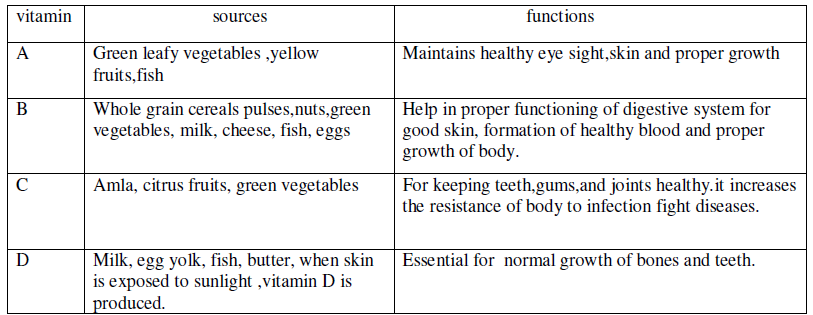
Q11)Mention the source and functions of the following vitamins.
Q12)Why do we need to include minerals in our food?
Ans12-minerals are the nutrients which are required by our body for its proper functioning normal growth and good health.
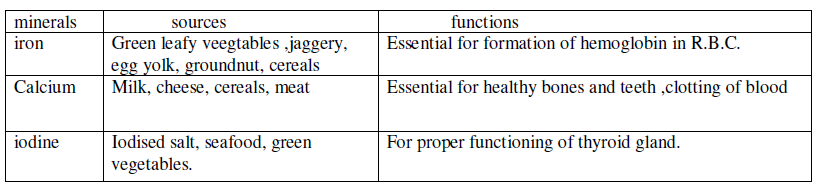
Q13)Mention the sources and functions of following minerals
Ans13
Q14) Define roughage.
Ans14-The fibrous indigestible material present in our food .
Q15)Why is roughage considered to be an important component of our food?name 3 important sources of roughage.
Ans15-i)roughage adds bulk to the food ,prevents constipation.
ii)it can absorb a great amount of water and helps retain water in our body.
SOURCES - unpeeled fruits (like apple,pear), porridge(dalia),salads
Q16)What is meant by dehydration? How is it caused?
Ans16 -excessive loss of water from the tissues of our body is called dehydration.it occurs when water intake is less than water loss from the body.
Q17)What is a balanced diet?
Ans17 -The diet that contains adequate amount of all the essential nutrients, roughage and water sufficient for The normal growth and development of the body.
Q18)State two beneficial effects of cooking food.
Ans18 -i)cooking improves the taste of food material.
ii)cooking makes the food digestible.
iii)cooking kills the harmful micro-organisms.
Q19)Name two cooking practices that lead to the loss of nutrients in food materials.
Ans19- If cooking is done in excess of water and the water is thrown away after cooking, many water soluble vitamins and minerals are lost.
If cooking is done at high temperature, many proteins and vitamins are destroyed. For example vitamin C.
Q20)What is obesity? What are the causes of obesity?
Ans20 - overeating of fat rich food leads to an overweight condition called obesity. Due to lack of physical activity, fats get accumulated in the body and causes obesity.
Q21)Mention some of the methods for maintaining good health.
Ans21 -1) always take fresh and clean food.
2.) Avoid food that is too oily or spicy.
3.) Avoid junk food.
4.) Eat lots of fruits and green vegetables.
5.) Drink plenty of water.
6.) Do regular physical exercises.
Q22) Who needs more proteins in his or her diet in relation to body weight: a growing child or grown up man? Why?
Ans22 - A growing child needs more proteins than a grown up man because child needs proteins for development bone, muscles of his body.
Please click the link below to download CBSE Class 6 Science - Components of Food
Free study material for Science
Download CBSE Revision Notes: Class 6 Science Chapter 02 Components of Food
Download Chapter Summary: Class 6 Science Chapter 02 Components of Food
Explore reliable chapter overviews for Chapter 02 Components of Food tailored for Class 6 learners. Use these structured points to grasp difficult themes and ensure solid preparation for upcoming assessments.
Concept Clarification for Chapter 02 Components of Food
Cross-reference your comprehension with comprehensive NCERT solutions for Class 6 to ensure absolute clarity across all sub-topics in this chapter.
Additional Study Resources for Class 6 Science
Wrap up your chapter revision by testing your knowledge against standard question formats. Everything on our platform is provided free of charge.
FAQs
You can download the teacher prepared revision notes for CBSE Class 6 Science Components Of Food Notes from StudiesToday.com. These notes are designed as per 2026-27 academic session to help Class 6 students get the best study material for Science.
Yes, our CBSE Class 6 Science Components Of Food Notes include 50% competency-based questions with focus on core logic, keyword definitions, and the practical application of Science principles which is important for getting more marks in 2026 CBSE exams.
Yes, our CBSE Class 6 Science Components Of Food Notes provide a detailed, topic wise breakdown of the chapter. Fundamental definitions, complex numerical formulas and all topics of CBSE syllabus in Class 6 is covered.
These notes for Science are organized into bullet points and easy-to-read charts. By using CBSE Class 6 Science Components Of Food Notes, Class 6 students fast revise formulas, key definitions before the exams.
No, all study resources on StudiesToday, including CBSE Class 6 Science Components Of Food Notes, are available for immediate free download. Class 6 Science study material is available in PDF and can be downloaded on mobile.