

School Assignments for Class 11 Chemistry: Chapter 05 Thermodynamics
Explore structured practice materials through the CBSE Class 11 Chemistry Thermodynamics Assignment. Tailored for Class 11 learners, utilizing these Chemistry assignments ensures thorough preparation and strengthens foundational knowledge before final CBSE evaluations.
Practice Class 11 Chemistry Assignments: Chapter 05 Thermodynamics
Access the complete assignment PDF for Class 11 Chemistry below. Regular practice with these targeted academic tasks builds familiarity with standard question patterns and helps secure higher marks in final school evaluations.
Question. The internal energy change when a system goes from state A to B is 40 kJ/mol. If the system goes from A to B by a reversible path and returns to state A by an irreversible path what would be the net change in internal energy ?
(a) > 40 kJ
(b) < 40 kJ
(c) Zero
(d) 40 kJ
Answer : C
Question. A gas absorbs 200 J heat and undergoes simultaneous expansion against a constant external pressure of 105 Pa. The volume changes from 4L to 5L. The change in internal energy is
(a) 300 J
(b) 100 J
(c) –300 J
(d) – 100 J
Answer : B
Question. When 110 g of manganese (At. mass = 55) dissolves in dilute HNO3 at 27°C under atmospheric pressure, the work done in the process is :
(a) 2494.2 J
(b) – 2494.2 J
(c) – 4988.4 J
(d) 4988.4 J
Answer : C
Question. Workdone for the conversion of 0.5 mole of water at 100ºC to steam at 1 atm pressure is (heat of vaporisation of water at 100ºC is 40670 J mol–1)
(a) –1.54 kJ
(b) 1.54 kJ
(c) 1.25 kJ
(d) –1.35 kJ
Answer : A
Question. The amount of work done by 2 mole of an ideal gas at 298 K in reversible isothermal expansion from 10 litre to 20 litre will be
(a) 3.4 kJ
(b) –3.4 kJ
(c) 4.0 kJ
(d) –4.0 kJ
Answer : B
Question. The enthalpy changes for the following processes are listed below :
Cl2(g) → 2Cl(g), 242.3 kJ mol–1
I2(g) → 2I(g), 151.0 kJ mol–1
ICl(g) → I(g) + Cl(g), 211.3 kJ mol–1
I2(s) → I2(g), 62.76 kJ mol–1
Given that the standard states for iodine and chlorine are I2(s) and Cl2(g), the standard enthalpy of formation for ICl(g) is :
(a) +16.8 kJ mol–1
(b) +244.8 kJmol–1
(c) –14.6 kJ mol–1
(d) –16.8 kJ mol–1
Answer : A
Question. The quantity of heat (in J) required to raise the temperature of 1.0 kg of ethanol from 293.45 K to the boiling point and then change to liquid to vapour at that temperature is closest to [Given, boiling point of ethanol 351.45 K. Specific heat capacity of liquid ethanol 2.44 J g–1 k–1. Latent heat of vaporisation of ethanol 855 J g–1]
(a) 142 × 102
(b) 9.97 × 10²
(c) 142 × 105
(d) 9.97 × 10⁵
Answer : D
Question. Oxidising power of chlorine in aqueous solution can be determined by the parameters indicated below:
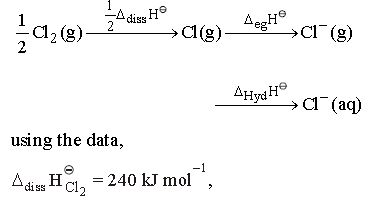
Δeg H Cl = –349 kJ mol–1
Δhyd HCl– = –381 kJ mol–1, will be
(a) + 152 kJ mol–1
(b) – 850 kJ mol–1
(c) – 610 kJmol–1
(d) + 120 kJ mol–1
Answer : C
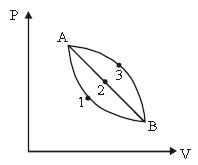
Question. A gas expands reversibly from state A to state B by three paths 1, 2 and 3 as shown in the figure. If w1, w2 and w3 respectively be the work done by the gas along three paths then
(a) w1 > w2 > w3
(b) w1 < w2 < w3
(c) w1 = w2 = w3
(d) w2 < w3 < w1
Answer : B
Question. 10 mole of an ideal gas expand isothermally and reversibly from a pressure of 10 atm to 1atm at 300 K. What is the largest mass which can lifted through a height of 100 meter?
(a) 31842 kg
(b) 58.55 kg
(c) 342.58 kg
(d) 6051 kg
Answer : B
Question. Given that C + O2 → CO2 : ΔHº = - x kJ
2CO + O2 → 2CO2 : ΔHº = - y kJ
the enthalpy of formation of carbon monoxide will be
(a) 2x - y/2
(b) y-2x/2
(c) 2x – y
(d) y – 2x
Answer : B
Question. One mole of CH3COOH undergoes dimerization in vapour phase at 127°C as:
2CH COOH (g) ⇔ (CH COOH)2 (g) if dimer formation is due to two H-bonds involved in dimer, each of 33 kJ stength and the degree of dimerisation of acetic acid 98.2%. The change in standard entropy during dimerization is
(a) –104 JK–1 mol–1
(b) –120 JK–1 mol–1
(c) 135 JK–1 mol–1
(d) 108 JK–1mol–1
Answer : A
Question. Given that the molar combustion enthalpy of benzene, cyclohexane, and hydrogen are x, y, and z, respectively, the molar enthalpy of hydrogenation of benzene to cyclohexane is
(a) x - y + z
(b) x - y + 3z
(c) y - x + z
(d) y - x + 3z
Answer : B
Question. For vaporization of water at 1 atmospheric pressure, the values of ΔH and ΔS are 40.63 kJmol–1 and 108.8 JK–1 mol–1, respectively. The temperature when Gibbs energy change (ΔG) for this transformation will be zero, is:
(a) 293.4 K
(b) 273.4 K
(c) 393.4 K
(d) 373.4 K.
Answer : D
Question. The specific heat of a monoatomic gas at constant pressure is 248.2 J kg–1 K–1 and at constant volume it is 149.0 J kg–1 K–1. The mean molar mass of the gas is
(a) 83.8 g mol–1
(b) 84.0 g mol–1
(c) 82 g mol–1
(d) 80 g mol–1
Answer : A
Question. For a spontaneous process
(a) enthalpy change of the system must be negative.
(b) entropy change of the system must be positive.
(c) entropy change of the surrounding must be positive.
(d) entropy change of the system plus surrounding must be positive.
Answer : D
Question. At the sublimation temperature, for the process CO2(s) ⇔ CO2(g)
(a) ΔH, ΔS and ΔG are all positive
(b) ΔH > 0, ΔS > 0 and ΔG < 0
(c) ΔH < 0, ΔS > 0 and ΔG < 0
(d) ΔH > 0, ΔS > 0 and ΔG = 0
Answer : D
Question. The factor of ΔG values is important in metallurgy. The ΔG values for the following
reactions at 800ºC are given as :
S2 (s)+ 2O2 (g) → 2SO2 (g) ; ΔG = – 544 kJ
2Zn(s)+ S2 (s) → 2ZnS(s) ; ΔG = – 293 kJ
2Zn(s)+ O2 (g) → 2ZnO(s) ; ΔG = – 480 kJ
Then ΔG for the reaction :
2ZnS(s) + 3O2 (g) → 2ZnO(s) + 2SO2 (g) will be :
(a) –357 kJ
(b) –731 kJ
(c) –773 kJ
(d) –229 kJ
Answer : B
Question. The values of standard enthalpy of formation of SF6(g), S(g)and F(g) are : – 1100, 275 and 80 kJ mol–1 respectively. The average S–F bond energy in SF6 will be
(a) 309 kJ
(b) 315 kJ
(c) 320 kJ
(d) 300 kJ
Answer : A
Question. Given the following entropy values (in J K–1 mol–1) at 298 K and 1 atm :H2(g) : 130.6, Cl2(g) : 223.0, HCl(g) : 186.7.The entropy change (in J K–1 mol–1) for the reaction H2 (g) + Cl 2 (g) → 2HCl (g) is
(a) +540.3
(b) +727.0
(c) –166.9
(d) +19.8
Answer : D
Numeric Value Answer
Question. For a dimerization reaction, 2A(g) → A2 (g), at 298 K,ΔUΘ = -20 kJ mol–1, ΔSΘ = -30 K–1 mol–1, then the ΔGΘ will be ___________ J.
Answer : –13538
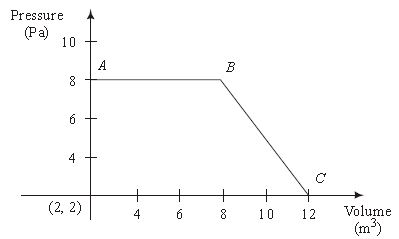
Question. The magnitude of work done by a gas that undergoes a reversible expansion along the path ABC shown in the figure is _______
Answer : 48.00
Question. At constant volume, 4 mol of an ideal gas when heated from 300 K to 500 K changes its internal energy by 5000 J. The molar heat capacity at constant volume is ______.
Answer : 6.25
Question. A perfect gas undergoes a reversible adiabatic expansion from (300 K, 200 atm) to (90 K, 10 atm). The atomicity of gas will be
Answer : 1
Question. A mixture of ferric oxide, Fe2O3, and aluminium, Al, is used in solid fuel rockets. The fuel value per cc of the mixture is
Heats of formation and densities are as follows :
Hf (Al2O3) = 399 kcal/mol;
Hf (Fe2O3) = 199 kcal/mol;
Density of Fe2O3 = 5.2 g/cc;
Density of Al = 2.7 g/cc.
Answer : 4
Question. x g sample of NH4NO3 is decomposed in a Bomb calorimeter. The temperature of calorimeter
increase by 4°C. The heat capacity of the system is 125 kJ/°C. The value of x is (Given molar heat of decomposition of NH4NO3 at constant volume is 400 kJ mol–1)
Answer : 1
Question. A heat engine is operating between 500K to 400K. If the engine absorbs 100 J heat, the impossible amount of heat rejected by the engine is 20TJ, then the value of T is ________
Answer : 4
Question. One mole of a real gas undergoes a change of state A to B with a change in internal energy
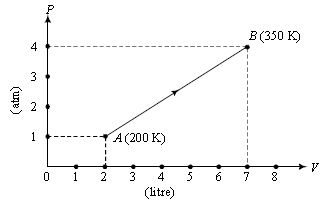
ΔE = 50 L – atm. What is the value of change in enthalpy in L – atm?
Answer : 76
Question. A 20g piece of iron (specific heat capacity = 0.5 J/g °C) at 200°C is immersed in 100g water of 27°C. What will be the temperature (°C) of this system at thermal equilibrium?
Answer : 31
Question. Nitroglycerine (MW = 227.1) detonated according to the following equations, 2C3H5(NO3)3(l) → 3N2(g) + 1/2 O2(g) + 6CO2(g) + 5H2O(g)
The standard molar enthalpies of formation,
ΔH0f for all the compounds are given below.
ΔH°f [C3H5(NO3)3] = – 364 kJ/mol
ΔH°f [CO2(g)] = – 393.5 kJ/mol
ΔH°f [H2O(g)] = – 241.8 kJ/mol
ΔH°f [N2(g)] = 0 kJ/mol
ΔH°f [O2(g)] = 0 kJ/mol
The enthalpy change when 10 g of nitroglycerine is detonated as
Answer : 62.5
1. Thermodynamics: Science which deals with study of different forms of energy and quantitative relationship.
2. System & Surroundings: The part of universe for study is called system and remaining portion is surroundings.
3. State of system & state function: State of system is described in terms of T, P, V etc. The property which depends only on state of system not upon path is called state function eg. P, V, T, E, H, S etc.
4. Extensive & Intensive Properties: Properties which depends on quantity of matter called extensive prop. eg. mass, volume, heat capacity, enthalpy, entropy etc. The properties which do not depends on matter present depends upon nature of substance called Intensive properties. eg. T,P, density, refractive index, viscosity, bp, pH, mole fraction etc.
5. Internal energy: The total energy with a system.
i.e. U = Ee + En + Ec + Ep + Ek + ------
U = U2 – U1 or UP – UR & U is state function and extensive properly. If U1 > U2 energy is released.
6. Heat (q): It I a form of energy which is exchanged between system and surrounding due to difference of temperature. Unit is Joule (J) or Calorie (1Calorie = 4.18 J).
7. First Law of Thermodynamics: It is law of conservation energy. Energy can neither be created not destroyed, it may be converted from one from into another.
Mathematically U = q + w, w = –p. V (work of expansion)
U = q – p. V or q = U + p. V, q,w are not state function.
But U is state function.
8. Enthalpy (H): At constant volume V = 0, qv = U So H = U + p. V, qp = H2 H1 = H H = U + P. V.
9. Relationship between qp, qv i.e. H& U It is H = U+ ng.RT or qp = qv + ng.RT
10. Exothermic and Endothermic reactions: H = –Ve for exothermic and H
= +Ve for endothermic reaction i.e. evolution and absorption of heat.
Eg C+O2 → CO2 + 393.5 KJ, H = –393.5 KJ (exothermic)
N2 + O2 → 2NO – 180.7 KJ, H = 180.7 KJ (Endothermic)
11. Enthalpy of reaction ( rH): The amount of heat evolved or absorbed when the reaction is completed.
12. Standard Enthalpy of reaction ( rH0) at 1 bar pressure and specific temp.
ONE MARK QUESTIONS
1. Dissolution of ammonium chloride in water is endothermic yet it is a spontaneous process. Explain
2. When will heat change at constant volume and heat change at constant pressure be equal?
3. Discuss the role of temperature in determining the spontaneity of a process.
4. Give two examples of state functions.
5. Predict the change in internal energy for an isolated system at constant volume.
TWO MARK QUESTIONS
1. Derive the relationship between Cp and Cv
2. State
i. Hess’s law of constant heat summation
ii. Second law of thermodynamics
3. Derive the relation ΔH = ΔU + ΔngRT
4. What will be the sign of entropy change for the following changes?
a) In an isolated system, two identical gases are allowed to mix under identical conditions.
b) I2(g) → I2(s)
c) H2(g) + I2(g) → 2HI(g)
d) Dissolution of sugar in water contained in a thermos flask.
5 ΔH and ΔS for the reaction Ag2O ⇌ 2Ag + ½ O2 are 30.56 KJ/mole and 60 J/K respectively. Calculate the temperature at which the free energy change for this reaction will be zero. Predict whether the forward reaction will be favoured above/below this T.
6 Calculate the Kc at 298 K for the reaction H2 + I2 ⇌ 2HI, if ΔGof (HI) = 1.3kJ/mole
7 Differentiate between
a) heat of formation and heat of reaction
b) heat of hydration and heat of solution
8 Calculate heat change at constant pressure if heat change at constant volume for the reaction NH2CN(g) + 3/2 O2(g) → N2(g) + CO2(g) + H2O(l) at 298K is -742 kJ/mole
9 What would be the work done when the pressure of 2 moles of an ideal gas is changed from 2 bar to 5 bar isothermally and reversibly at 25oC ?
THREE MARK QUESTIONS
1 Define
(i) Molar heat capacity (ii) Enthalpy of a reaction (iii) Residual entropy
2 Comment on the following statements
(i) An exothermic reaction is always thermodynamically spontaneous.
(ii) The entropy of a substance increases when going from liquid state to vapour state at any temperature.
(iii) A reaction with ΔG0 >0 always has an equilibrium constant greater than one
3 (i) For the equilibrium PCl5 ⇌ PCl3 + Cl2 at 25 0C, K = 1.8 x 10⁻⁷. Calculate ΔGo of reaction
(ii) For the reaction 2NO (g) + O2(g) ⇌ 2NO2(g), calculate the ΔG at 600 K if enthalpy and entropy changes are –110kJ/mole and 150 J/Kmole
4 For the synthesis of NH3 ,N2(g) + 3H2(g)⇌ 2NH3(g), calculate Kp at 300K if ΔHof of
5 NH3 as -46.2 kJ/mole and ΔSo for the reaction is 198.3 J/Kmole.
(i) The ΔHvap of water at 100oC is 41kJ/mole. Calculate the internal energy change.
(ii) What is the work done on a gas when 10 lt of the gas is compressed to 4.5 lt under a constant pressure of 103kPa?
6 Calculate the ΔH0f of benzene if ΔHcomb of benzene, carbon and hydrogen are 3267, 393 and 286 kJ/mole respectively.
7 The mean bond enthalpies of N≡N and H-H are 946 and 436 kJ/mole respectively. If heat of formation of ammonia is -46kJ/mole, calculate the mean BE of N-H bonds in ammonia.
8 (i) Calculate the entropy change in surroundings when 36 g of water is formed under standard conditions. ΔH0f of water = -286kJ/mole
(ii) Calculate the work done when 2.5 moles of an ideal gas at 300K is isothermally and reversibly compressed from a volume of 5m3 to a volume of 2 m3
Free study material for Chemistry
Download Practice Assignments: Class 11 Chemistry Chapter 05 Thermodynamics
Chapter Practice Questions for Class 11 Chemistry
Explore reliable practice questions for Chapter 05 Thermodynamics tailored for Class 11 learners. Use these structured worksheets to evaluate preparedness and strengthen core problem-solving skills.
Why Practice Class 11 Chemistry Assignments?
- Curriculum Standards: Assignments match modern CBSE sample formats to ensure relevant preparation.
- Thorough Revision: Detailed problem sets reinforce core concepts and eliminate conceptual weak spots.
- Execution Speed: Timed practice with assignment sets sharpens overall response timing.
Steps to Complete Chapter 05 Thermodynamics Assignments Successfully
- Textbook Review: Always study the core NCERT book for Class 11 Chemistry prior to beginning the assignment.
- Independent Attempt: Solve Chapter 05 Thermodynamics questions on your own initially before cross-checking with expert solutions.
- Error Tracking: Record challenging concepts in a dedicated notebook and practice online MCQ tests for revision.
FAQs
You can download free PDF assignments for Class 11 Chemistry Chapter 05 Thermodynamics from StudiesToday.com. These practice sheets have been updated for the 2026-27 session covering all concepts from latest NCERT textbook.
Yes, our teachers have given solutions for all questions in the Class 11 Chemistry Chapter 05 Thermodynamics assignments. This will help you to understand step-by-step methodology to get full marks in school tests and exams.
Yes. These assignments are designed as per the latest CBSE syllabus for 2026. We have included huge variety of question formats such as MCQs, Case-study based questions and important diagram-based problems found in Chapter 05 Thermodynamics.
Practicing topicw wise assignments will help Class 11 students understand every sub-topic of Chapter 05 Thermodynamics. Daily practice will improve speed, accuracy and answering competency-based questions.
Yes, all printable assignments for Class 11 Chemistry Chapter 05 Thermodynamics are available for free download in mobile-friendly PDF format.