

School Assignments for Class 11 Chemistry: Salt Analysis
Explore structured practice materials through the CBSE Class 11 Chemistry Salt Analysis Assignment. Tailored for Class 11 learners, utilizing these Chemistry assignments ensures thorough preparation and strengthens foundational knowledge before final CBSE evaluations.
Practice Class 11 Chemistry Assignments: Salt Analysis
Navigate directly to the solved Chemistry assignments using the digital viewer below. Each practice set includes detailed step-by-step solutions, allowing students to instantly cross-check their work and identify areas requiring further revision.
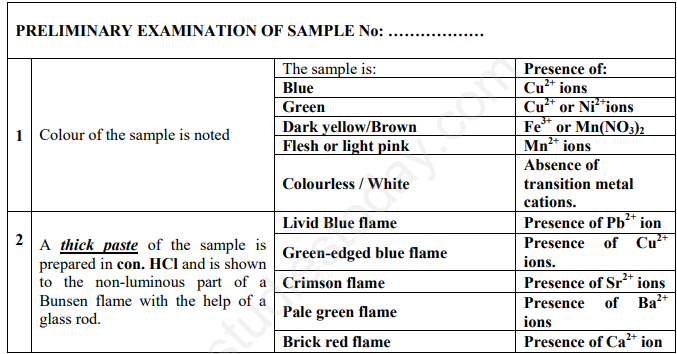
PRELIMINARY EXAMINATION
Question 1. Colour of the sample is noted.
Answer: Blue sample indicates presence of \(\text{Cu}^{2+}\) ions.
Green sample indicates presence of \(\text{Cu}^{2+}\) or \(\text{Ni}^{2+}\) ions.
Dark yellow or brown sample indicates presence of \(\text{Fe}^{3+}\) or \(\text{Mn}(\text{NO}_3)_2\).
Flesh or light pink sample indicates presence of \(\text{Mn}^{2+}\) ions.
Colourless or white sample indicates absence of transition metal cations.
In simple words: The initial visual colour of the salt gives a primary clue about the presence of specific metal ions.
Exam Tip: Always note the colour carefully as it immediately rules out several non-matching transition metal groups.
Question 2. A thick paste of the sample is prepared in concentrated \(\text{HCl}\) and is shown to the non-luminous part of a Bunsen flame with the help of a glass rod.
Answer: Livid blue flame indicates presence of \(\text{Pb}^{2+}\) ion.
Green-edged blue flame indicates presence of \(\text{Cu}^{2+}\) ions.
Crimson flame indicates presence of \(\text{Sr}^{2+}\) ions.
Pale green flame indicates presence of \(\text{Ba}^{2+}\) ions.
Brick red flame indicates presence of \(\text{Ca}^{2+}\) ion.
In simple words: Different metal cations impart characteristic colours to a Bunsen flame due to electronic excitation.
Exam Tip: Clean the glass rod thoroughly with concentrated \(\text{HCl}\) and heat it until it imparts no colour to the flame before testing.
ANALYSIS OF ANIONS
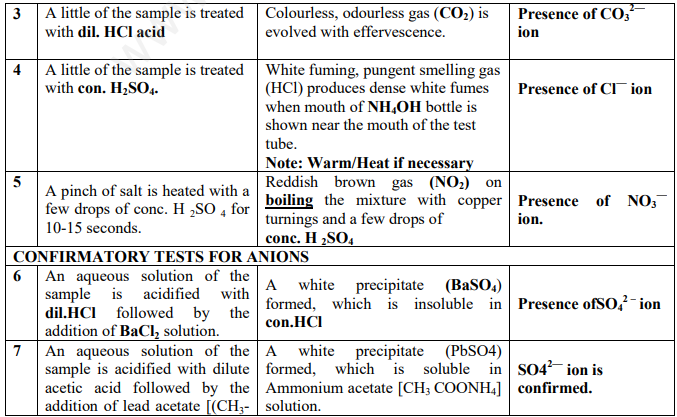
Question 3. A little of the sample is treated with dilute \(\text{HCl}\) acid.
Answer: Colourless, odourless gas (\(\text{CO}_2\)) is evolved with brisk effervescence.
Inference: Presence of \(\text{CO}_3^{2-}\) ion.
In simple words: Carbonate salts react with dilute acids to release carbon dioxide gas with fizzing.
Exam Tip: Effervescence without any smell is a classic indicator of carbonate ions.
Question 4. A little of the sample is treated with concentrated \(\text{H}_2\text{SO}_4\). (Note: Warm/Heat if necessary)
Answer: White fuming, pungent smelling gas (\(\text{HCl}\)) is produced which forms dense white fumes when a glass rod dipped in \(\text{NH}_4\text{OH}\) is brought near the mouth of the test tube.
Inference: Presence of \(\text{Cl}^-\) ion.
In simple words: Chlorides react with concentrated sulfuric acid to give hydrogen chloride gas, which forms ammonium chloride white fumes with ammonia.
Exam Tip: Do not overheat excessively to avoid choking dense fumes of sulfur dioxide or other interfering gases.
Question 5. A pinch of salt is heated with a few drops of concentrated \(\text{H}_2\text{SO}_4\) for 10 to 15 seconds.
Answer: Reddish-brown gas (\(\text{NO}_2\)) is evolved, which intensifies on boiling the mixture with copper turnings and a few drops of concentrated \(\text{H}_2\text{SO}_4\).
Inference: Presence of \(\text{NO}_3^-\) ion.
In simple words: Nitrates release reddish-brown nitrogen dioxide gas upon heating with concentrated sulfuric acid and copper.
Exam Tip: Adding copper turnings speeds up the reduction of nitrate to nitrogen dioxide, making the brown fumes clearly visible.
CONFIRMATORY TESTS FOR ANIONS
Question 6. An aqueous solution of the sample is acidified with dilute \(\text{HCl}\) followed by the addition of \(\text{BaCl}_2\) solution.
Answer: A white precipitate (\(\text{BaSO}_4\)) is formed, which is insoluble in concentrated \(\text{HCl}\).
Inference: Presence of \(\text{SO}_4^{2-}\) ion.
In simple words: Barium chloride reacts with sulfate ions to form an insoluble white precipitate of barium sulfate.
Question 7. An aqueous solution of the sample is acidified with dilute acetic acid followed by the addition of lead acetate \([\text{CH}_3\text{COO}]_2\text{Pb}\) solution.
Answer: A white precipitate (\(\text{PbSO}_4\)) is formed, which is soluble in ammonium acetate \([\text{CH}_3\text{COONH}_4]\) solution.
Inference: \(\text{SO}_4^{2-}\) ion is confirmed.
In simple words: Lead acetate forms lead sulfate white precipitate with sulfates.
Exam Tip: This serves as a secondary confirmatory test for sulfates.
Question 8. Pass the gas evolved from carbonate reaction through clear limewater.
Answer: Limewater turns milky.
Inference: \(\text{CO}_3^{2-}\) ion is confirmed.
In simple words: Carbon dioxide turns limewater milky due to the formation of insoluble calcium carbonate.
Exam Tip: Passing excess gas makes the milkiness disappear due to the formation of soluble calcium bicarbonate.
Question 9. An aqueous solution of the sample is treated with dilute \(\text{HNO}_3\) followed by \(\text{AgNO}_3\) solution.
Answer: A thick curd-like white precipitate (\(\text{AgCl}\)) is formed which dissolves in excess of \(\text{NH}_4\text{OH}\) solution.
Inference: \(\text{Cl}^-\) ion is confirmed.
In simple words: Silver nitrate precipitates chloride ions as white silver chloride, which dissolves in aqueous ammonia.
Exam Tip: Dilute nitric acid is added first to decompose any interfering carbonate or sulfite ions.
Question 10. A pinch of salt is heated with a few drops of concentrated \(\text{H}_2\text{SO}_4\) and a few copper turnings.
Answer: A reddish-brown gas is released.
Inference: \(\text{NO}_3^-\) ion is confirmed.
In simple words: Confirms nitrate by generating nitrogen dioxide gas.
Exam Tip: Always perform this test in a fume cupboard.
ANALYSIS OF CATIONS
Question 11. Agitate a pinch of the solid salt sample with \(\text{NaOH}\) solution and note its smell. (Note: Release the gas near your nose by wafting)
Answer: Smell of ammonia (\(\text{NH}_3\)) is detected, which produces dense white fumes when concentrated \(\text{HCl}\) is shown near the mouth of the test tube.
Inference: \(\text{NH}_4^+\) ion confirmed.
In simple words: Ammonium salts liberate pungent ammonia gas when heated with sodium hydroxide.
Exam Tip: Waft the vapors gently toward your nose rather than inhaling directly.
Question 12. The solid salt sample is treated with \(\text{NaOH}\) solution followed by Nessler's reagent. (Note: Do not shake the mixture)
Answer: A brown precipitate (\(\text{NH}_2\cdot\text{HgO}\cdot\text{HgI}\)) is formed.
Inference: \(\text{NH}_4^+\) ion confirmed.
In simple words: Nessler's reagent forms a characteristic brown precipitate (iodide of Millon's base) in the presence of ammonium ions.
Exam Tip: Ensure the test tube is undisturbed to get a clear brown precipitate layer.
INTER-GROUP SEPARATION OF CATIONS
Question 13. About \(1\text{ ml}\) of the sample solution is treated with dilute \(\text{HCl}\).
Answer: White precipitate of \(\text{PbCl}_2\).
Inference: Presence of Group - I cations.
In simple words: Group I cations (like lead) precipitate as chlorides with dilute hydrochloric acid.
Exam Tip: Cool the test tube under tap water if necessary, as lead chloride is slightly soluble in hot water.
Question 14. Through the above solution from Group I, \(\text{H}_2\text{S}\) gas is passed.
Answer: Black precipitate of Copper sulfide (\(\text{CuS}\)).
Inference: Presence of Group - II cations.
In simple words: Group II cations precipitate as metal sulfides in an acidic medium upon passing hydrogen sulfide gas.
Question 15. To about \(2\text{ ml}\) of the salt solution, \(2\text{ ml}\) of saturated \(\text{NH}_4\text{Cl}\) solution is added, mixed well, and then \(7\text{ ml}\) of \(\text{NH}_4\text{OH}\) solution is added and agitated.
Answer: Gelatinous white precipitate of Aluminium hydroxide \(\{\text{Al}(\text{OH})_3\}\) or brown precipitate of Ferric hydroxide \(\{\text{Fe}(\text{OH})_3\}\).
Inference: Presence of Group - III cations.
In simple words: Group III cations precipitate as hydroxides in the presence of ammonium chloride and ammonium hydroxide.
Exam Tip: Ammonium chloride is added first to suppress the high concentration of hydroxyl ions, preventing premature precipitation of higher group cations.
Question 16. Through \(2\text{ ml}\) of the above Group III solution, \(\text{H}_2\text{S}\) gas is passed.
Answer: Dirty white precipitate of Zinc sulfide (\(\text{ZnS}\)), buff precipitate of Manganese sulfide (\(\text{MnS}\)), or black precipitate of Nickel sulfide (\(\text{NiS}\)).
Inference: Presence of Group - IV cations.
In simple words: Group IV cations precipitate as sulfides in an ammoniacal alkaline medium.
Exam Tip: Ensure the solution is made alkaline with \(\text{NH}_4\text{OH}\) before passing \(\text{H}_2\text{S}\).
Question 17. To \(2\text{ ml}\) of the Group III solution, \((\text{NH}_4)_2\text{CO}_3\) (little excess) solution is added.
Answer: White precipitate of Barium carbonate (\(\text{BaCO}_3\)), Strontium carbonate (\(\text{SrCO}_3\)), or Calcium carbonate (\(\text{CaCO}_3\)).
Inference: Presence of Group - V cations.
In simple words: Group V alkaline earth metals precipitate as carbonates in the presence of ammonium chloride and ammonium carbonate.
Question 18. To \(2\text{ ml}\) of the Group III solution, disodium hydrogen phosphate is added. (Note: Scratch the sides of the test tube with a glass rod if necessary)
Answer: White crystalline precipitate of Magnesium phosphate.
Inference: Presence of \(\text{Mg}^{2+}\) ion.
In simple words: Magnesium ions form a white crystalline precipitate with disodium hydrogen phosphate in the presence of ammonium chloride and ammonia.
Question 19. To one portion of the sample solution add few drops of Potassium chromate (\(\text{K}_2\text{CrO}_4\)) solution.
Answer: Yellow precipitate of Lead chromate (\(\text{PbCrO}_4\)).
Inference: Presence of \(\text{Pb}^{2+}\) ion confirmed.
In simple words: Lead ions form a brilliant yellow precipitate with potassium chromate.
Exam Tip: Acidify slightly with acetic acid if any interfering basic lead salts are present.
Question 20. To another portion of the sample solution add few drops of Potassium iodide (\(\text{KI}\)) solution.
Answer: Yellow precipitate of Lead iodide (\(\text{PbI}_2\)).
Inference: Presence of \(\text{Pb}^{2+}\) ion confirmed.
In simple words: Lead iodide precipitates as golden yellow crystals upon cooling a hot aqueous solution.
Exam Tip: The yellow precipitate dissolves on boiling in water and reappears as glittering golden scales on cooling.
Question 21. To one portion of the sample solution add excess of \(\text{NH}_4\text{OH}\) solution.
Answer: Deep blue solution, \([\text{Cu}(\text{NH}_3)_4](\text{OH})_2\).
Inference: Presence of \(\text{Cu}^{2+}\) ion confirmed.
In simple words: Copper ions form a soluble tetraamminecopper(II) complex of deep blue color with excess ammonia.
Exam Tip: A pale blue precipitate initially forms which dissolves in excess ammonia to form the deep blue solution.
Question 22. Treat one portion of the above deep blue solution with dilute Acetic acid followed by few drops of \(\text{K}_4[\text{Fe}(\text{CN})_6]\) (Potassium Ferrocyanide) solution.
Answer: Chocolate coloured precipitate, \(\text{Cu}_2[\text{Fe}(\text{CN})_6]\).
Inference: Presence of \(\text{Cu}^{2+}\) ion confirmed.
In simple words: Copper reacts with potassium ferrocyanide to form a reddish-brown or chocolate precipitate.
Exam Tip: Ensure the solution is rendered acidic with acetic acid before adding the ferrocyanide reagent.
Question 23. To one portion of the sample solution \(\text{NaOH}\) solution is added drop by drop.
Answer: White precipitate, \(\text{Al}(\text{OH})_3\), which dissolves in excess of \(\text{NaOH}\).
Inference: Presence of \(\text{Al}^{3+}\) ion confirmed.
In simple words: Aluminium hydroxide is amphoteric and dissolves in excess sodium hydroxide to form a clear soluble aluminate.
Exam Tip: Add sodium hydroxide very slowly drop by drop to observe the initial gelatinous precipitation.
Question 24. Another portion of the sample solution is acidified with dilute \(\text{HCl}\) followed by the addition of blue litmus solution, followed by dropwise addition of \(\text{NH}_4\text{OH}\) without shaking.
Answer: A floating blue precipitate is formed (known as the Floating Blue Lake).
Inference: Presence of \(\text{Al}^{3+}\) ion confirmed.
In simple words: Aluminium hydroxide adsorbs blue litmus dye, forming a characteristic floating blue lake in the solution.
Question 25. To one part of the diluted salt solution, \(\text{K}_4[\text{Fe}(\text{CN})_6]\) (Potassium ferrocyanide) solution is added.
Answer: A Prussian blue colouration, \(\text{Fe}_4[\text{Fe}(\text{CN})_6]_3\).
Inference: \(\text{Fe}^{3+}\) ion confirmed.
In simple words: Ferric ions react with potassium ferrocyanide to produce an intense Prussian blue coordination complex.
Exam Tip: Keep the solution dilute; otherwise, a thick blue precipitate will form instead of a clear blue coloration.
Question 26. To the second part of the diluted salt solution, Potassium thiocyanate (\text{KCNS}) solution is added.
Answer: A blood-red colouration, \(\text{Fe}(\text{CNS})_3\).
Inference: \(\text{Fe}^{3+}\) ion confirmed.
In simple words: Ferric ions form a soluble blood-red iron(III) thiocyanate complex with thiocyanate ions.
Exam Tip: Mineral acids should be dilute so they do not interfere with the thiocyanate complex formation.
Question 27. To one portion of the sample solution, \(\text{NaOH}\) solution is added dropwise without shaking.
Answer: White precipitate \(\{\text{Zn}(\text{OH})_2\}\) dissolves in excess of \(\text{NaOH}_{(\text{aq})}\).
Inference: \(\text{Zn}^{2+}\) ion confirmed.
In simple words: Zinc hydroxide is amphoteric and dissolves in excess alkali to form soluble zincates.
Exam Tip: Zinc salts give a white gelatinous precipitate with sodium hydroxide.
Question 28. To the second part of the sample solution, \(\text{K}_4[\text{Fe}(\text{CN})_6]\) (Potassium Ferrocyanide) solution is added.
Answer: Greenish/bluish-white precipitate, \(\text{Zn}_2[\text{Fe}(\text{CN})_6]\).
Inference: \(\text{Zn}^{2+}\) ion confirmed.
In simple words: Zinc ions react with potassium ferrocyanide to form a white or greenish-white zinc ferrocyanide precipitate.
Exam Tip: The precipitate turns bluish-white upon standing due to minor iron contamination or oxidation.
Question 29. To one portion of the sample solution add \(\text{NaOH}\) solution dropwise without shaking.
Answer: A white precipitate \(\{\text{Mn}(\text{OH})_2\}\) is formed which turns brown (\(\text{MnO}_2\)).
Inference: \(\text{Mn}^{2+}\) ion confirmed.
In simple words: Manganese hydroxide precipitates as white, rapidly oxidizing in air to brown hydrated manganese dioxide.
Exam Tip: Oxidation is accelerated by exposure to atmospheric oxygen, turning the precipitate dark brown.
Question 30. A quarter spatula of solid sample is treated with \(\frac{1}{2}\text{ ml}\) of concentrated \(\text{HNO}_3\) followed by the addition of \(1\text{ ml}\) of Sodium bismuthate solution.
Answer: A purple colour is formed which changes to brown on standing.
Inference: \(\text{Mn}^{2+}\) ion confirmed.
In simple words: Sodium bismuthate oxidizes manganese salts to permanganate, producing a characteristic purple color.
Exam Tip: Shake the sodium bismuthate bottle well before use as the reagent settles at the bottom.
Question 31. To one portion of the sample solution add 10 drops of Dimethyl glyoxime reagent followed by excess of \(\text{NH}_4\text{OH}\) solution.
Answer: A scarlet-red precipitate.
Inference: \(\text{Ni}^{2+}\) ion confirmed.
In simple words: Nickel forms a brilliant scarlet-red chelate complex with dimethylglyoxime in ammoniacal medium.
Exam Tip: This is an extremely sensitive and specific test for nickel ions.
Question 32. To the second portion of the sample solution add bromine water solution followed by \(\text{NaOH}\) solution, boil and then keep aside.
Answer: A black precipitate.
Inference: \(\text{Ni}^{2+}\) ion confirmed.
In simple words: Bromine water and alkali oxidize nickel to black nickelic hydroxide.
Exam Tip: Ensure sufficient boiling to coagulate the black precipitate properly.
Question 33. To one portion of the sample solution add a few drops of Potassium chromate (\(\text{K}_2\text{CrO}_4\)) solution.
Answer: A yellow (\(\text{BaCrO}_4\)) precipitate.
Inference: \(\text{Ba}^{2+}\) ion confirmed.
In simple words: Barium ions react with potassium chromate to form a yellow precipitate of barium chromate.
Exam Tip: Add acetic acid beforehand if the solution is strongly alkaline to prevent precipitation of other hydroxides.
Question 34. To another portion of the sample solution add a few drops of dilute \(\text{H}_2\text{SO}_4\) acid. (Note: Do this test only if the \(\text{K}_2\text{CrO}_4\) test is positive)
Answer: A white (\(\text{BaSO}_4\)) precipitate.
Inference: \(\text{Ba}^{2+}\) ion confirmed.
In simple words: Dilute sulfuric acid precipitates barium sulfate as a white solid.
Exam Tip: Serves as the second confirmatory test for barium.
Question 35. A portion of the sample solution is treated with acetic acid followed by ammonium sulphate solution.
Answer: Scanty white (\(\text{SrSO}_4\)) precipitate.
Inference: \(\text{Sr}^{2+}\) ion confirmed.
In simple words: Strontium sulfate precipitates as a scanty white solid upon standing with ammonium sulfate.
Question 36. A thick paste of the sample is prepared in concentrated \(\text{HCl}\) and is shown to the non-luminous part of a Bunsen flame with a glass rod.
Answer: Crimson coloured flame.
Inference: \(\text{Sr}^{2+}\) ion confirmed.
In simple words: Strontium salts impart a characteristic crimson red color to the Bunsen burner flame.
Exam Tip: Use a clean cobalt glass filter if necessary to distinguish strontium crimson from other red flames.
Question 37. To one portion of the sample solution add a few drops of Ammonium Oxalate \(\{(\text{NH}_4)_2\text{C}_2\text{O}_4\}\) solution.
Answer: A white (\(\text{CaC}_2\text{O}_4\)) precipitate formed which dissolves in concentrated \(\text{HCl}\).
Inference: \(\text{Ca}^{2+}\) ion confirmed.
In simple words: Calcium ions form an insoluble white precipitate with ammonium oxalate in neutral or ammoniacal medium.
Exam Tip: The precipitate is soluble in mineral acids like hydrochloric acid.
Question 38. Another portion is made neutral by adding \(\text{NH}_4\text{OH}\), boiled till smell of ammonia is gone, cooled, and then 2 drops of \(\text{NH}_4\text{Cl}\) and a few drops of \(\text{K}_4[\text{Fe}(\text{CN})_6]\) are added.
Answer: A white (\(\text{Ca}(\text{NH}_4)\text{K}[\text{Fe}(\text{CN})_6]\)) precipitate.
Inference: \(\text{Ca}^{2+}\) ion confirmed.
In simple words: Neutral calcium solutions yield a white double salt precipitate with potassium ferrocyanide.
Exam Tip: The solution must be strictly neutral; acidic or alkaline media will cause this test to fail.
Question 39. 2 drops of salt solution are treated with 3 drops of Magneson reagent and 3 drops of \(\text{NaOH}\) solution.
Answer: Blue precipitate or blue solution.
Inference: \(\text{Mg}^{2+}\) ion confirmed.
In simple words: Magneson reagent adsorbs onto magnesium hydroxide to form a distinct deep blue lake.
Exam Tip: Add sodium hydroxide carefully to develop the proper blue lake color.
Experiment Number. ------------
Date: --------------
AIM:
ANALYSIS OF ANIONS
Please click the link below to download CBSE Class 11 Chemistry Salt Analysis Assignment
Free study material for Chemistry
CBSE Class 11 Chemistry Assignments for Salt Analysis
Revision Assignment: Salt Analysis (CBSE)
Review targeted chapter assignments for Class 11 Chemistry Salt Analysis. Built according to official CBSE guidelines, these downloadable problem sets help students build accuracy and prepare effectively for school tests.
Maximize Exam Scores with Chapter Practice Sets
- Syllabus Compliance: Sets reflect current CBSE evaluation criteria and official marking frameworks.
- Multi-Format Practice: Includes varied problem types designed to deepen comprehension across all sub-topics.
- Time Management: Routine practice optimizes pacing to finish school examinations comfortably within schedule.
How to Approach Chemistry Salt Analysis Assignments
- Textbook Review: Always study the core NCERT book for Class 11 Chemistry prior to beginning the assignment.
- Independent Attempt: Solve Salt Analysis questions on your own initially before cross-checking with expert solutions.
- Error Tracking: Record challenging concepts in a dedicated notebook and practice online MCQ tests for revision.
FAQs
You can download free PDF assignments for Class 11 Chemistry Salt Analysis from StudiesToday.com. These practice sheets have been updated for the 2026-27 session covering all concepts from latest NCERT textbook.
Yes, our teachers have given solutions for all questions in the Class 11 Chemistry Salt Analysis assignments. This will help you to understand step-by-step methodology to get full marks in school tests and exams.
Yes. These assignments are designed as per the latest CBSE syllabus for 2026. We have included huge variety of question formats such as MCQs, Case-study based questions and important diagram-based problems found in Salt Analysis.
Practicing topicw wise assignments will help Class 11 students understand every sub-topic of Salt Analysis. Daily practice will improve speed, accuracy and answering competency-based questions.
Yes, all printable assignments for Class 11 Chemistry Salt Analysis are available for free download in mobile-friendly PDF format.