

Class 6 Science Competency-Based Questions: CBSE Class 6 Science Around Us VBQs
Access comprehensive Value Based Questions (VBQs) for Chapter 15 Air Around Us using the CBSE Class 6 Science Around Us VBQs. Designed to align with the 2026-27 CBSE academic guidelines, these competency-based resources help Class 6 Science students apply theoretical knowledge to real-world scenarios.
Download Chapter 15 Air Around Us VBQ PDF with Solutions
Access the complete VBQ PDF for Class 6 Science below. Regular practice with these targeted competency-based questions builds familiarity with expected application-level question patterns to help secure higher marks.
Choose The Correct Answer.
Question. Moving air is known as:
a) Wind
b) Water vapour
c) Ozone
d) Wind mill
Answer : A
Question. Air contains highest percentage of which gas?
a) Oxygen
b) Nitrogen
c) Smoke
d) Carbon dioxide
Answer : B
Question. Earthworms come out of soil during:
a) Heavy rains
b) Cold weather
c) Snow
d) Hot weather
Answer : A
Question. Which gas is a supporter of combustion?
a) Nitrogen
b) Carbon dioxide
c) Smoke
d) Oxygen
Answer : D
Fill In The Blanks.
a). Plants gives out oxygen gas and breathe in carbon dioxide gas.
b). Nitrogen gas cannot be used directly from the atmosphere.
c). Earth is protected from the harmful rays of sun by ozone layer.
d). Atmosphere is important for the water cycle.
Write True Or False.
Question. Carbon dioxide gas is required for the burning of fuel.
Answer : False
Question. Air contains equal amount of oxygen and nitrogen.
Answer : False
Question. Oxygen gas protects us from the harmful UV rays of the sun.
Answer : False
Question. Aquatic animals breathe carbon dioxide which is dissolved in water.
Answer : False
Question. Composition of air always remain the same.
Answer : False
Match The Column:-
| Column A | Column B |
| 1. Most abundant gas in the air | a. Ozone |
| 2. Gas required for photosynthesis | b. Water vapour |
| 3. Gas used for respiration | c. Carbon dioxide |
| 4. Form of water present in the air | d. Nitrogen |
| 5. Layer that protect us from harmful rays of the sun | e. Oxygen |
Answer : (1) - (d), (2) - (c), (3) - (e), (4) - (b), (5) - (a),
Very Short Answer Type Questions.
Question. Name one component of air that does not support burning.
Answer : Carbon dioxide.
Question. Which gas is essential for breathing of animals?
Answer : Oxygen.
Question. Name the components of air.
Answer : Air consists of various gases like nitrogen (78%), oxygen (21%), carbon dioxide (0.03%), some noble gases and water vapours etc.
Short Answer Type Questions.
Question. Why does a lump of cotton wool shrink in water?
Answer : Lump of cotton wool has air among gaps of cotton fibres. When water replaces the air from these gaps, the cotton lump becomes heavy and also shrinks due to removal of air gaps..
Question. Which gas in the atmosphere is essential for respiration?
Answer : Oxygen gas.
Question. How will you show that air dissolves in water?
Answer : Heat the glass vessel filled with water. Before they start boiling bubbles occur, these bubbles are due to air present in water. This experiment concludes air is present in the water.
Long Answer Type Questions.
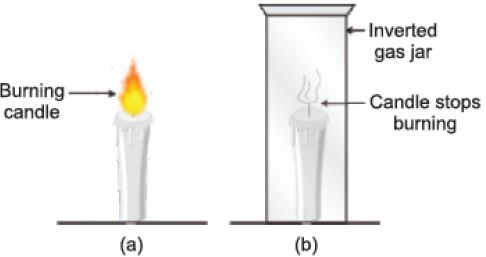
Question. How will you show that air supports burning?
Answer : (a) Take a small burning candle. (b) Cover the burning candle with a glass jar. After few minutes the candle is extinguished. This experiment proves that air supports burning.
Question. How is the balance of carbon dioxide and oxygen gases are maintained in the atmosphere?
Answer : Animals and plants use oxygen from air during respiration and release carbon dioxide gas in air. But green plants release oxygen gas by using carbon dioxide during photosynthesis.
Free study material for Science
CBSE Value-Based Study Material for Class 6 Science
Moral Practice Exercises: Class 6 Science Chapter 15 Air Around Us
Access targeted moral and value-driven questions for Class 6 Science Chapter 15 Air Around Us. Designed to align with official CBSE guidelines, these problem sets test deep comprehension beyond standard textbook answers.
NCERT-Aligned VBQ Solutions
Each question includes structured solution guides mapped directly to standard CBSE textbooks, helping students evaluate their reasoning and correct mistakes early.
Complete Your Chapter Revision
Explore our wider library of free chapter notes, worksheets, and online mock tests to support your ongoing revision and secure top-tier academic results.
FAQs
The latest collection of Value Based Questions for Class 6 Science Chapter 15 Air Around Us is available for free on StudiesToday.com. These questions are as per 2026 academic session to help students develop analytical and ethical reasoning skills.
Yes, all our Science VBQs for Chapter 15 Air Around Us come with detailed model answers which help students to integrate factual knowledge with value-based insights to get high marks.
VBQs are important as they test student's ability to relate Science concepts to real-life situations. For Chapter 15 Air Around Us these questions are as per the latest competency-based education goals.
In the current CBSE pattern for Class 6 Science, Chapter 15 Air Around Us Value Based or Case-Based questions typically carry 3 to 5 marks.
Yes, you can download Class 6 Science Chapter 15 Air Around Us VBQs in a mobile-friendly PDF format for free.