

Official CBSE VBQs for Class 6 Science
Review targeted competency-based resources with the CBSE Class 6 Science Light Shadows and Reflection VBQs. Built according to official CBSE standards for the 2026-27 academic year, these downloadable Class 6 Science VBQs support holistic learning and critical reasoning for Chapter 11 Light Shadows and Reflection.
Competency-Based Practice for Science
Access the complete VBQ PDF for Class 6 Science below. Regular practice with these targeted competency-based questions builds familiarity with expected application-level question patterns to help secure higher marks.
Choose The Correct Answer.
Question. An object, through which we can see partially, but not very clearly, is
a) A rubber ball
b) A sheet of plane glass
c) A sheet of tracing paper
d) A compact disc
Answer : C
Question. For shadow formation, we require :
a) An opaque object
b) A source of light
c) The screen to obtain the shadow
d) All of the above
Answer : D
Question. When Sun (during evening) is behind an object, the size of its shadow in comparison to that of the object would be
a) Smaller
b) Larger
c) Almost zero
d) Equal
Answer : B
Question. Objects, like moon, which do not emit light of their own, are called
a) Luminous objects
b) Absorbers of light
c) Non-luminous objects
d) Reflectors of light
Answer : C
Question. The image, formed by a pin hole camera, is
a) Inverted and diminished
b) Inverted and enlarged
c) Erect and enlarged
d) Erect and diminished
Answer : A
Fill In The Blanks.
a). An object that allow light to pass through them partially are known as translucent objects.
b). Light source like the Sun that emit light of their own are called luminous objects.
c). Never ever look directly at the Sun because it could be extremely dangerous for the eyes.
d). The change in direction of propagation of light when light allowed to fall on polished surface is called reflection of light.
e). Due to reflection phenomena rooms are lighted up in day time though no direct sunlight enters the room.
Write True Or False.
Question. Shadow of opaque object is always black.
Answer : True
Question. Moon is a luminous object.
Answer : False
Question. Due to reflection of light, rooms are lighted up during day time though no direct sunlight enters the room.
Answer : True
Question. We can clearly see through transparent material.
Answer : True
Question. Light doesn’t travel in straight line path.
Answer : False
Match The Column ‘A’ With Column ‘B’.
| A | B |
| 1. Natural source of light | a. Light moves along a straight path |
| 2. CFL, LED and tube light | b. Opaque object |
| 3. Rectilinear propagation of light | c. Shadow cast by a heavenly body |
| 4. Eclipse | d. Man-made source of light |
| 5. Cardboard, wood and metal | e. Sun, stars and firefly |
Answer : (1) - (e), (2) - (d), (3) - (a), (4) - (c), (5) - (b),
ACTIVITY- To distinguish transparent, opaque and translucent objects.
Question. Classify different objects depending on whether an object allows light to pass through it completely, partially or not at all.
Answer : Transparent, translucent and opaque objects.
Question. Classify the objects given in following table as transparent, opaque or translucent.
| Object/ Material | Transparent/ Opaque/ Translucent |
| Water | Transparent |
| Tissue Paper | Translucent |
| Stone | Opaque |
| Air | Transparent |
| Book | Opaque |
| Mirror | Opaque |
| Thin Cloth | Translucent |
ACTIVITY- To show that screen is compulsory for the formation of shadow.
Question. For shadow formation, how many things are required?
Answer : Three i.e. a source of light, an opaque object and a screen.
Question. A shadow is observed, on a screen, when an ______ object comes in-between screen and a source of light.
Answer : Opaque.
ACTIVITY- To observe reflection of lght.
Question. A mirror does not change the direction of light that falls on it. (true/ false)
Answer : False.
Question. A polished or shining surface like plane mirror produces ___________ reflection.
Answer : Regular.
ACTIVITY- To study factors on which size and colour of shadow depends.
Question. The size of shadow of a given opaque object depends on relative _____ of source of light and the opaque object.
Answer : Position.
Question. What may be the colour of opaque object, shadow will always be ________. (black/ white)
Answer : Black.
ACTIVITY- To show that light travels in a straight line.
Question. Light travels in __________ line path
Answer : Straight.
Question. Light cannot pass through _________ material.
Answer : Opaque.
ACTIVITY- To construct a pinhole camera.
Question. Pin hole camera is based on the fact that in ordinary conditions light travel in ____ path.
Answer : Straight line.
Question. The images formed by pin hole camera is _______ and ________.
Answer : Inverted and smaller in size.
Very Short Answer Type Questions.
Question. State the type of path that light ordinarily follows while going from one point to another.
Answer : Straight line path.
Question. State the relative position of Sun, Earth and the Moon during solar eclipse.
Answer : During solar eclipse moon is between sun and earth.
Question. Two identical bed sheets, of pink and grey colour are hanging on a rope under the Sun. What would be the colour of shadow of these two bed sheets?
Answer : Black.
Question. In a completely dark room, if you hold a mirror in front of you, will you see a reflection of yourself in the mirror?
Answer : No.
Question. Fishes do not cast shadow in water. Why?
Answer : Due to absence of a screen at proper distance.
Short Answer Type Questions.
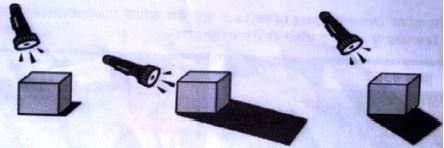
Question. Why shadow in afternoon is smaller than shadow formed in the morning?
Answer : In afternoon the Sun is above the object, So forms a smaller shadow. In morning sunlight falls obliquely and forms larger shadow.
Question. What is regular reflection?
Answer : When light fall on polished or shining surface like plane mirror, these surfaces reflect light in a well defined regular manner, this is called regular reflection. Sometimes regular reflection also forms images.
Long Answer Type Questions.
Question. Using diagram, show the formation of image by pinhole camera.
Answer :

Question. Using suitable diagrams show that size of shadow formed, depends on relative position of the source of light and the opaque object.
Answer :
Free study material for Science
CBSE Value-Based Study Material for Class 6 Science
Download VBQs for Class 6 Science Chapter 11 Light Shadows and Reflection
Explore curated Value-Based Questions (VBQs) for Chapter 11 Light Shadows and Reflection, structured according to the latest CBSE curriculum for Class 6 Science. These problems focus on ethical and real-world themes to strengthen analytical reasoning.
Expert Guidance for Chapter 11 Light Shadows and Reflection VBQs
Built using the official NCERT book for Class 6 Science, these solved problem sets provide reliable guidance. Cross-reference your answers with our expert-verified keys for complete conceptual clarity.
Enhance Analytical Depth for Class 6 Science
Explore our wider library of free chapter notes, worksheets, and online mock tests to support your ongoing revision and secure top-tier academic results.
FAQs
The latest collection of Value Based Questions for Class 6 Science Chapter 11 Light Shadows and Reflection is available for free on StudiesToday.com. These questions are as per 2026 academic session to help students develop analytical and ethical reasoning skills.
Yes, all our Science VBQs for Chapter 11 Light Shadows and Reflection come with detailed model answers which help students to integrate factual knowledge with value-based insights to get high marks.
VBQs are important as they test student's ability to relate Science concepts to real-life situations. For Chapter 11 Light Shadows and Reflection these questions are as per the latest competency-based education goals.
In the current CBSE pattern for Class 6 Science, Chapter 11 Light Shadows and Reflection Value Based or Case-Based questions typically carry 3 to 5 marks.
Yes, you can download Class 6 Science Chapter 11 Light Shadows and Reflection VBQs in a mobile-friendly PDF format for free.