

Value Based Questions (VBQs) for Class 6 Science
Explore authentic value-based practice materials through the CBSE Class 6 Science Water VBQs. Tailored for Class 6 learners, utilizing these Science VBQs ensures thorough preparation and strengthens moral reasoning skills before final CBSE evaluations.
Practice Class 6 Science VBQs: Chapter 14 Water
Navigate directly to the solved Science Value Based Questions using the digital viewer below. Each practice set includes detailed solutions, allowing students to instantly cross-check their work and understand the ethical dimensions of the topic.
Choose The Correct Answer.
Question. How much part of earth is covered with water?
a) Two third
b) Half
c) One third
d) Three fourth
Answer : A
Question. Process of conversion of gas to liquid is called:
a) Evaporation
b) Melting
c) Condensation
d) Boiling
Answer : C
Question. Fog appearing on a cold winter morning is the result of:
a) Condensation
b) Evaporation
c) Precipitation
d) None
Answer : A
Question. About how much percentage of water is present in human body:
a) 60%
b) 70%
c) 80%
d) 90%
Answer : B
Question. Which of the source of water is not used for drinking:
a) River
b) Ocean
c) Dam
d) Lake
Answer : B
Fill In The Blanks.
a). The process of changing of water into its vapour is called evaporation.
b). The process of changing water vapour into water is called condensation.
c). No rainfall for a year or more may be lead to drought in that region.
d). Excessive rains may cause flood.
e). Three states of water are solid, liquid and gas.
f). In plants, transpiration takes place through stomata.
Write True Or False.
Question. Ice on cooling changes to steam.
Answer : False
Question. Evaporation of water takes place in sunlight.
Answer : True
Question. We should not repair the pipe having leakage.
Answer : False
Question. Water in ocean is fit for drinking.
Answer : False
Question. Drip irrigation method is useful for farming.
Answer : True
Match The Column:-
| 1. Water conservation | a. Solid form of water |
| 2. Snow | b. Sunny day |
| 3. Precipitation | c. Rainwater harvesting |
| 4. Evaporation | d. Ground water |
| 5. Fresh water | e. Rain from clouds |
Answer : (1) - (c), (2) - (a), (3) - (e), (4) - (b), (5) - (d),
ACTIVITY- To estimate the quantity of water used.
Question. Does every person use same quantity of water every day?
Answer : No.
ACTIVITY- Inter-conversion of three states of water.
Question. What happens to ice-cream when it is taken out of the refrigerator?
Answer : Ice-cream melts and converts into liquid form.
Question. What is the state of ice-cream?
Answer : Solid.
ACTIVITY- Evaporation of water in clothes.
Question. What happens when you spill water on the floor in hot summer days?
Answer : Water evaporates in the air.
Question. Why cow dung cakes are kept in sunlight?
Answer : To evaporate the water content in cow dung cakes, so that they dry up.
ACTIVITY- To understand condensation of water.
Question. Why do we observe water droplets outside water bottle when taken out from a refrigerator?
Answer : Due to condensation of atmospheric water vapours on touching cool water bottle.
Very Short Answer Type Questions.
Question. What is the advantage of drip irrigation?
Answer : With drip irrigation water is saved.
Question. What is transpiration?
Answer : Transpiration is the process of releasing excess water by plants into air.
Question. What is the effect of temperature on evaporation?
Answer : Rate of evaporation increases with rise in temperature.
Question. What are the main sources of water?
Answer : Rain, rivers and ground water.
Question. Differentiate between ground water and surface water.
Answer : Surface water exists in lakes, rivers and other water bodies. But ground water exists under the surface of earth.
Short Answer Type Questions.
Question. Define condensation. Give two examples?
Answer : The process of changing vapours into liquid form is called condensation. Examples: Formation of clouds and fog appearing on a cold winter morning.
Question. What is drought and what are its effects?
Answer : Very low rainfall over a prolonged period is called drought.
Effects of drought- (1). It leads to the death of many animals.
(2). Plant life is affected.
(3). It leads to shortage of water and food.
Question. Explain formation of clouds.
Answer : When the air moves up, it gets cooler and cooler. After reaching sufficient heights, the air becomes so cool that the water vapours present in it condenses to form tiny drops of water called droplets which remain floating in air and thus clouds are formed.
Question. Explain floods and its effects.
Answer : An overflow of large amount of water due to heavy rain is known as flood.
Effects of floods- (1). Many people and animals die during floods.
(2). Water supply and electricity are disrupted.
(3). Wide spread of communicable diseases.
(4). Roads, bridges, houses and automobiles are destroyed.
Question. Write three ways to conserve water.
Answer : (1) Use drip irrigation method.
(2). Rain water harvesting.
(3). Stopping the leakage of water pipes and taps as soon as possible.
Long Answer Type Questions.
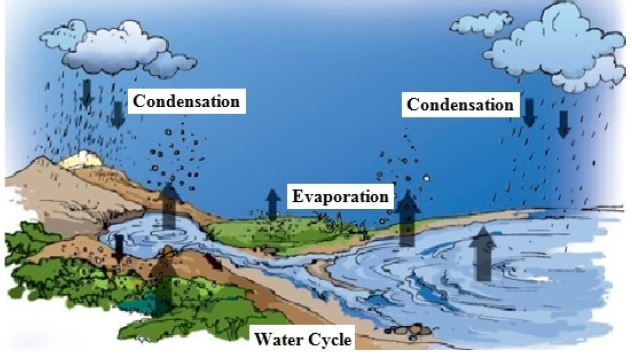
Question. Explain water cycle with diagram.
Answer : Water cycle is a cyclic process in which water is circulated between the earth and the atmosphere. In the presence of sunlight, water from water bodies like ocean, lakes, rivers etc. evaporates. This process is known as evaporation. These water vapours make clouds at heights by condensation. From clouds water falls back to earth in form of rain and snow.
Question. Explain the uses of water.
Answer : (1). About 70% of human body consists of water.
(2). Water helps to control our body temperature.
(3). Water helps to excrete waste products from our body.
(4). Water is important for growth of plants.
(5). Water maintains the temperature of earth.
(6). Water is essential for our many daily life activities.
Question. Why there is need to conserve water? Write techniques of rain water harvesting.
Answer : Fresh clean water is available in limited amount. With rising population, the demand of water is increasing day by day. So it is the need to conserve water and use it carefully. Techniques of rain water harvesting- (1). Rain water is collected on the roof of the house or building. It is then stored in storage tanks. This water can be used as per requirement.
(2). Rainwater is allowed to go into the ground directly to recharge ground water.
Free study material for Science
CBSE Value-Based Study Material for Class 6 Science
Chapter VBQs with Solutions (CBSE)
Access targeted moral and value-driven questions for Class 6 Science Chapter 14 Water. Designed to align with official CBSE guidelines, these problem sets test deep comprehension beyond standard textbook answers.
Verified Answers for Class 6 Science Chapter 14 Water
Each question includes structured solution guides mapped directly to standard CBSE textbooks, helping students evaluate their reasoning and correct mistakes early.
More Study Resources for Chapter 14 Water
Practicing value-based problems regularly connects abstract concepts to everyday experiences, ensuring stronger performance across school examinations and board assessments.
FAQs
The latest collection of Value Based Questions for Class 6 Science Chapter 14 Water is available for free on StudiesToday.com. These questions are as per 2026 academic session to help students develop analytical and ethical reasoning skills.
Yes, all our Science VBQs for Chapter 14 Water come with detailed model answers which help students to integrate factual knowledge with value-based insights to get high marks.
VBQs are important as they test student's ability to relate Science concepts to real-life situations. For Chapter 14 Water these questions are as per the latest competency-based education goals.
In the current CBSE pattern for Class 6 Science, Chapter 14 Water Value Based or Case-Based questions typically carry 3 to 5 marks.
Yes, you can download Class 6 Science Chapter 14 Water VBQs in a mobile-friendly PDF format for free.