

Official NCERT Solutions for Class 10 Mathematics: Chapter 11 Areas Related to Circles
Explore reliable textbook solutions for Chapter 11 Areas Related to Circles tailored for Class 10 learners. Utilizing these Mathematics answers ensures thorough preparation and strengthens foundational knowledge before final NCERT evaluations.
Chapter-wise Solutions for Mathematics: Chapter 11 Areas Related to Circles
Access the complete solution PDF for Class 10 Mathematics below. Regular practice with these targeted textbook answers builds familiarity with standard question patterns and helps secure higher marks in final school evaluations.
Exercise 12.1
Q.1) The radii of two circles are 19 cm and 9 cm respectively. Find the radius of the circle which has circumference equal to the sum of the circumferences of the two circles.
Sol.1) Radius (𝑟1) of 1st circle = 19 cm
Radius (𝑟2) or 2nd circle = 9 cm
Let the radius of 3rd circle be 𝑟.
Circumference of 1st circle = 2𝜋𝑟1 = 2𝜋 (19) = 38𝜋
Circumference of 2nd circle = 2𝜋𝑟2 = 2𝜋 (9) = 18𝜋
Circumference of 3rd circle = 2𝜋𝑟
Given that,
Circumference of 3rd circle = Circumference of 1st circle + Circumference of 2nd circle
= 2𝜋𝑟 = 38𝜋 + 18𝜋 = 56𝜋
= 𝑟 = 56𝜋/2𝜋 = 28
Therefore, the radius of the circle which has circumference equal to the sum of the circumference of the given two circles is 28 𝑐𝑚.
Q.2) The radii of two circles are 8 cm and 6 cm respectively. Find the radius of the circle having area equal to the sum of the areas of the two circles.
Sol.2) Radius (𝑟1) of 1st circle = 8 cm
Radius (𝑟2) of 2nd circle = 6 cm
Let the radius of 3rd circle be 𝑟.
Area of 1st circle = 𝜋𝑟12 = 𝜋(8)2 = 64𝜋
Area of 2nd circle = 𝜋𝑟22 = 𝜋(6)2 = 36𝜋
Given that,
Area of 3rd circle = Area of 1st circle + Area of 2nd circle
𝜋𝑟2 = 𝜋𝑟12 + 𝜋𝑟22
𝜋𝑟2 = 64𝜋 + 36𝜋
𝜋𝑟2 = 100𝜋
𝑟2 = 100
𝑟 = ±10
However, the radius cannot be negative. Therefore, the radius of the circle having area equal to the sum of the areas of the two circles is 10 cm.
Q.3) Given figure depicts an archery target marked with its five scoring areas from the centre outwards as Gold, Red, Blue, Black and White. The diameter of the region representing Gold score is 21 cm and each of the other bands is 10.5 cm wide. Find the area of each of the five scoring regions. [𝑈𝑠𝑒 𝜋 = 22/7]
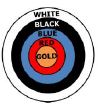
Sol.3) Diameter of Gold circle (first circle) = 21 𝑐𝑚
Radius of first circle, 𝑟1 = 21/2 𝑐𝑚 = 10.5 𝑐𝑚
Each of the other bands is 10.5 𝑐𝑚 wide,
∴ Radius of second circle, 𝑟2 = 10.5 𝑐𝑚 + 10.5 𝑐𝑚 = 21𝑐𝑚
∴ Radius of third circle, 𝑟3 = 21 𝑐𝑚 + 10.5 𝑐𝑚 = 31.5 𝑐𝑚
∴ Radius of fourth circle, 𝑟4 = 31.5 𝑐𝑚 + 10.5 𝑐𝑚 = 42 𝑐𝑚
∴ Radius of fifth circle, 𝑟5 = 42 𝑐𝑚 + 10.5 𝑐𝑚 = 52.5 𝑐𝑚
Area of gold region = 𝜋 𝑟1
2 = 𝜋 (10.5)2 = 346.5 𝑐𝑚2
Area of red region = Area of second circle - Area of first circle
= 𝜋 𝑟22 − 346.5 𝑐𝑚2
= 𝜋(21)2 − 346.5 𝑐𝑚2
= 1386 − 346.5 𝑐𝑚2 = 1039.5 𝑐𝑚2
Area of blue region = Area of third circle - Area of second circle
= 𝜋 𝑟32 – 1386 𝑐𝑚2
= 𝜋(31.5)2 − 1386 𝑐𝑚2
= 3118.5 − 1386 𝑐𝑚2 = 1732.5 𝑐𝑚2
Area of black region = Area of fourth circle - Area of third circle
= 𝜋 𝑟42 − 3118.5 𝑐𝑚2
= 𝜋(42)2 − 1386 𝑐𝑚2
= 5544 − 3118.5 𝑐𝑚2 = 2425.5 𝑐𝑚2
Area of white region = Area of fifth circle - Area of fourth circle
= 𝜋 𝑟52 − 5544 𝑐𝑚2
= 𝜋(52.5)2 − 5544 𝑐𝑚2
= 8662.5 − 5544 𝑐𝑚2 = 3118.5 𝑐𝑚2
Therefore, areas of gold, red, blue , black & white regions are 346.5𝑐𝑚2, 1039.5𝑐𝑚2,
1732.5𝑐𝑚2, 2425.5𝑐𝑚2 & 3118.5𝑐𝑚2 respectively.
Q.4) The wheels of a car are of diameter 80 cm each. How many complete revolutions does each wheel make in 10 minutes when the car is travelling at a speed of 66 km per hour?
Sol.4) Diameter of the wheels of a car = 80 𝑐𝑚
Circumference of wheels = 2𝜋𝑟 = 2𝑟 × 𝜋 = 80 𝜋 𝑐𝑚
Distance travelled by car in 10 minutes =
66 × 1000 × 100 × 10/60 = 1100000 𝑐𝑚/𝑠
No. of revolutions = Distance travelled by car/Circumference of wheels
= 1100000/80
𝜋 = 1100000 × 7/80×22 = 4375
Therefore, each wheel of the car will make 4375 revolutions.
Q.5) Tick the correct answer in the following and justify your choice : If the perimeter and the area of a circle are numerically equal, then the radius of the circle is
(A) 2 units (B) 𝜋 units (C) 4 units (D) 7 units
Sol.5) Let the radius of the circle be 𝑟.
∴ Perimeter of the circle = Circumference of the circle = 2𝜋𝑟
∴ Area of the circle = 𝜋 𝑟2
A/q,
2𝜋𝑟 = 𝜋 𝑟2
⇒ 2 = 𝑟
Thus, the radius of the circle is 2 units.
Hence, (A) is correct answer.
Exercise 12.2
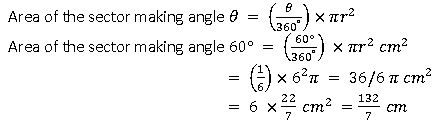
Q.1) Unless stated otherwise, use 𝜋 = 22/7. Find the area of a sector of a circle with radius 6cm if angle of the sector is 60°.
Sol.1)
Q.2) Find the area of a quadrant of a circle whose circumference is 22 cm.
Sol.2) Quadrant of a circle means sector is making angle 90°.
Circumference of the circle = 2𝜋𝑟 = 22 𝑐𝑚

Q.3) The length of the minute hand of a clock is 14 cm. Find the area swept by the minute hand in 5 minutes.
Sol.3) We know that in 1 hour (i.e., 60 minutes), the minute hand rotates 360°. In 5 minutes, minute hand will rotate =
Therefore, the area swept by the minute hand in 5 minutes will be the area of a sector of 30° in a circle of 14 cm radius.
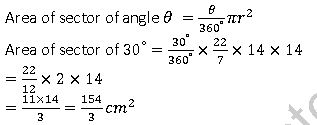
Therefore, the area swept by the minute hand in 5 minutes is 154/3 𝑐𝑚2
Q.4) A chord of a circle of radius 10 cm subtends a right angle at the centre. Find the area of the corresponding: [𝑈𝑠𝑒 𝜋 = 3.14]
(i) Minor segment (ii)Major sector
Sol.4) Radius of the circle = 10 𝑐𝑚
Major segment is making 360° − 90° = 270°
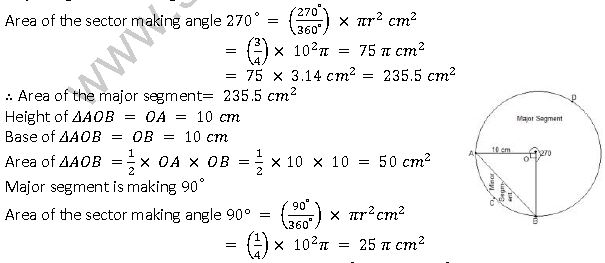
= 25 × 3.14 𝑐𝑚2 = 78.5 𝑐𝑚2
Area of the minor segment = Area of the sector making angle 90° − Area of 𝛥𝐴𝑂𝐵
= 78.5 𝑐𝑚2 − 50 𝑐𝑚2 = 28.5 𝑐𝑚2
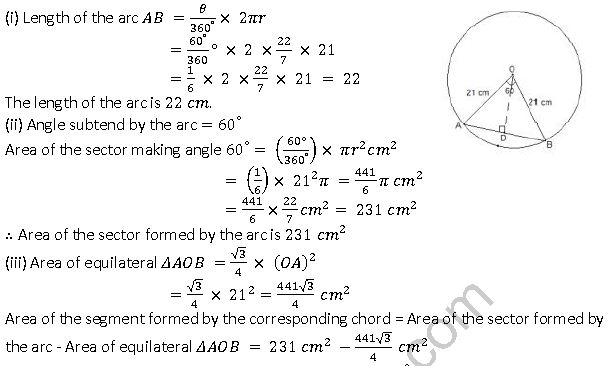
Q.5) In a circle of radius 21 cm, an arc subtends an angle of 60° at the centre. Find: (i) the length of the arc (ii) area of the sector formed by the arc (iii) area of the segment formed by the corresponding chord
Sol.5) Radius of the circle = 21 ....
Q.6) A chord of a circle of radius 15 cm subtends an angle of 60° at the centre. Find the areas of the corresponding minor and major segments of the circle. (𝑈𝑠𝑒 𝜋 = 3.14 and √3 = 1.73)
Sol.6) Radius of the circle = 15 𝑐𝑚
𝛥𝐴𝑂𝐵 is isosceles as two sides are equal.
∴ ∠𝐴 = ∠𝐵
Sum of all angles of triangle = 180°
∠𝐴 + ∠𝐵 + ∠𝐶 = 180°
⇒ 2 ∠𝐴 = 180° − 60°
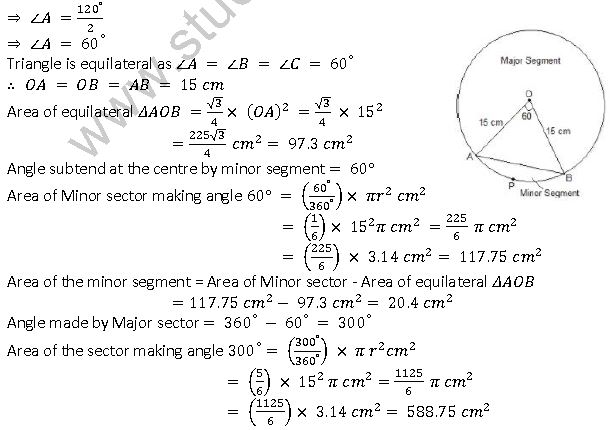
Area of major segment = Area of Minor sector + Area of equilateral 𝛥𝐴𝑂𝐵
= 588.75 𝑐𝑚2 + 97.3 𝑐𝑚2 = 686.05 𝑐𝑚2
Q.7) A chord of a circle of radius 12 𝑐𝑚 subtends an angle of 120° at the centre. Find the area of the corresponding segment of the circle. [𝑈𝑠𝑒 𝜋 = 3.14 and √3 = 1.73]
Sol.7) Radius of the circle, 𝑟 = 12 𝑐𝑚
Draw a perpendicular OD to chord AB. It will bisect AB.
∠𝐴 = 180° − (90 + 60°) = 30°
cos 30° = 𝐴𝐷/𝑂𝐴
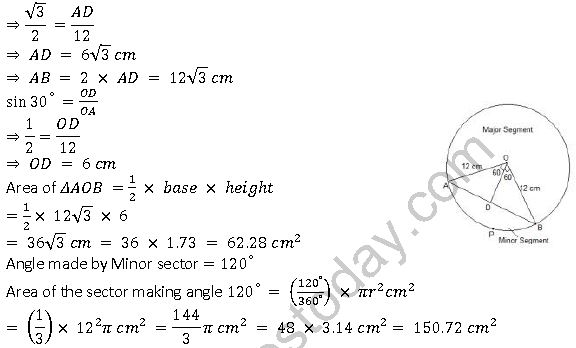
∴ Area of the corresponding Minor segment = Area of the Minor sector - Area of 𝛥𝐴𝑂𝐵
= 150.72 𝑐𝑚2 − 62.28 𝑐𝑚2 = 88.44 𝑐𝑚
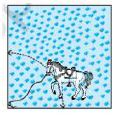
Q.8) A horse is tied to a peg at one corner of a square shaped grass field of side 15 m by means of a 5 m long rope (see Fig.). Find
(i) the area of that part of the field in which the horse can graze.
(ii) the increase in the grazing area if the rope were 10𝑚 long instead of 5m.
(𝑈𝑠𝑒 𝜋 = 3.14)
Sol.8) Side of square field = 15 𝑚
Length of rope is the radius of the circle, 𝑟 = 5 𝑚
Since, the horse is tied at one end of square field,
it will graze only quarter of the field with radius 5 𝑚.
(i) Area of circle = 𝜋𝑟2 = 3.14 × 52 = 78.5 𝑚2
Area of that part of the field in which the horse can graze = 1/4 of area of the circle = 78.5/4 = 19.625 𝑚2
(ii) Area of circle if the length of rope is increased to 10 𝑚 = 𝜋𝑟2
= 3.14 × 102 = 314 𝑚2
Area of that part of the field in which the horse can graze = 1/4 of area of the circle
= 314/4 = 78.5 𝑚2
Increase in grazing area = 78.5 𝑚2 − 19.625 𝑚2 = 58.875 𝑚2
Q.9) A brooch is made with silver wire in the form of a circle with diameter 35 mm. The wire is also used in making 5 diameters which divide the circle into 10 equal sectors as shown in Fig. Find:
(i) the total length of the silver wire required.
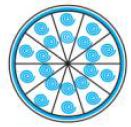
(ii) the area of each sector of the brooch.
Sol.9) Number of diameters = 5
Length of diameter = 35 𝑚𝑚
∴ Radius = 35/2 𝑚𝑚
(i) Total length of silver wire required = Circumference of the circle + Length of 5 diameter = 2𝜋𝑟 + (5 × 35)𝑚𝑚

Q.10) An umbrella has 8 ribs which are equally spaced (see Fig.). Assuming umbrella to be a flat circle of radius 45 cm, find the area between the two consecutive ribs of the umbrella
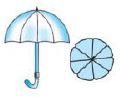
Sol.10) Number of ribs in umbrella = 8
Radius of umbrella while flat = 45 𝑐𝑚
Area between the two consecutive ribs of the umbrella = Total area/Number of ribs
Total Area = 𝜋𝑟2
= 22/7 × (45)2 = 6364.29 𝑐𝑚2
∴ Area between the two consecutive ribs = 6364.29/8
𝑐𝑚2 = 795.5 𝑐𝑚
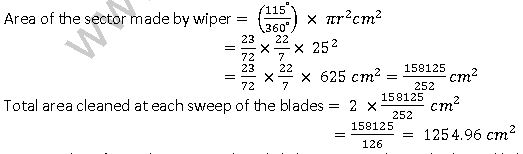
Q.11) A car has two wipers which do not overlap. Each wiper has a blade of length 25 cm sweeping through an angle of 115°. Find the total area cleaned at each sweep of the blades.
Sol.11) Angle of the sector of circle made by wiper = 115°
Radius of wiper = 25 cm
Q.12) To warn ships for underwater rocks, a lighthouse spreads a red coloured light over a sector of angle 80° to a distance of 16.5 km. Find the area of the sea over which the ships are warned. (Use 𝜋 = 3.14)

Sol.12) Let O bet the position of Lighthouse.
Distance over which light spread i.e. radius, 𝑟 = 16.5 𝑘𝑚
Angle made by the sector = 80°
Area of the sea over which the ships are warned = Area made by the sector.
Area of sector = (80°/360°) × 𝜋𝑟2 𝑘𝑚2
= 2/9 × 3.14 × (16.5)2 𝑘𝑚2 = 189.97 𝑘𝑚2
Q.13) A round table cover has six equal designs as shown in Fig. If the radius of the cover is 28 cm, find the cost of making the designs at the rate of Rs.0.35 per 𝑐𝑚2 (𝑈𝑠𝑒 √3 = 1.7)
Sol.13) Number of equal designs = 6
Radius of round table cover = 28 cm
Cost of making design = 𝑅𝑠. 0.35 𝑝𝑒𝑟 𝑐𝑚2
∠𝑂 = 360°/6 = 60°
𝛥𝐴𝑂𝐵 is isosceles as two sides are equal. (Radius of the circle)
∴ ∠𝐴 = ∠𝐵 Sum of all angles of triangle = 180°
∠𝐴 + ∠𝐵 + ∠𝑂 = 180°
⇒ 2 ∠𝐴 = 180° − 60°

Area of design = Area of sector 𝐴𝐶𝐵 - Area of equilateral 𝛥𝐴𝑂𝐵
= 410.66 𝑐𝑚2 − 333.2 𝑐𝑚2 = 77.46 𝑐𝑚2
Area of 6 design = 6 × 77.46 𝑐𝑚2= 464.76 𝑐𝑚2
Total cost of making design = 464.76 𝑐𝑚2 × 𝑅𝑠. 0.35 𝑝𝑒𝑟 𝑐𝑚2 = 𝑅𝑠. 162.66
Q.14) Tick the correct answer in the following :
Area of a sector of angle p (in degrees) of a circle with radius R is
(A) 𝑝/180 × 2𝜋𝑅 (B) 𝑝/180 × 𝜋𝑅2 (C) 𝑝/360 × 2𝜋𝑅 (D) 𝑝/720 × 2𝜋𝑅2
Sol.14) Area of a sector of angle 𝑝 = 𝑝/360 × 𝜋𝑅2
= 𝑝/360 × 2/2 × 𝜋𝑅2
= 2𝑝/720 × 2𝜋𝑅2
Hence, Option (D) is correct.
Exercise 12.3
Q.1) Unless stated otherwise, use 𝜋 = 22/7
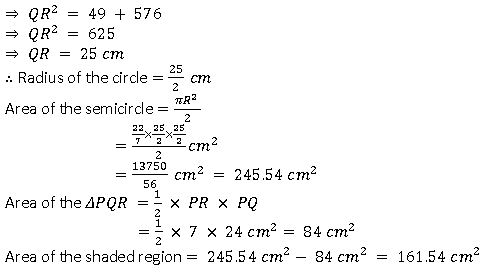
Find the area of the shaded region in Fig., if 𝑃𝑄 = 24 𝑐𝑚, 𝑃𝑅 = 7 𝑐𝑚 and O is the centre of the circle.
Sol.1) 𝑃𝑄 = 24 𝑐𝑚 and 𝑃𝑅 = 7 𝑐𝑚 ∠𝑃 = 90° (Angle in the semicircle)
∴ 𝑄𝑅 is hypotenuse of the circle = Diameter of the circle.
By Pythagoras theorem, 𝑄𝑅2 = 𝑃𝑅2 + 𝑃𝑄2
⇒ 𝑄𝑅2 = 72 + 242
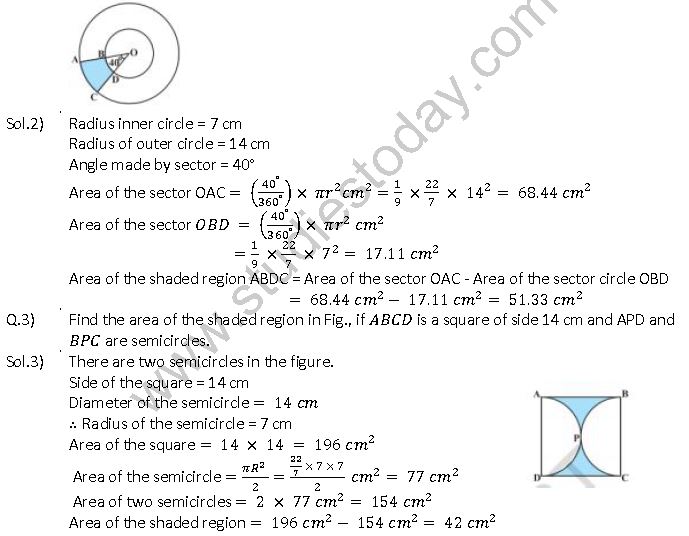
Q.2) Find the area of the shaded region in Fig., if radii of the two concentric circles with centre O are 7 cm and 14 cm respectively and ∠𝐴𝑂𝐶 = 40°.
Q.4) Find the area of the shaded region in Fig., where a circular arc of radius 6 cm has been drawn with vertex O of an equilateral triangle 𝑂𝐴𝐵 of side 12 cm as centre.
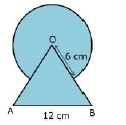
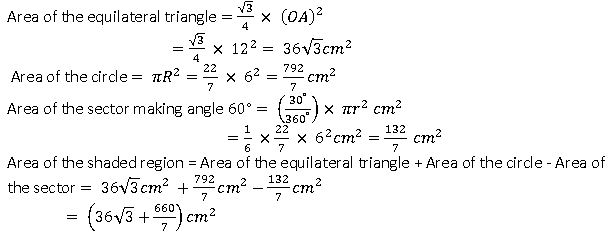
Sol.4) 𝑂𝐴𝐵 is an equilateral triangle with each angle equal to 60°.
Area of the sector is common in both. Radius of the circle = 6 𝑐𝑚.
Side of the triangle = 12 𝑐𝑚.
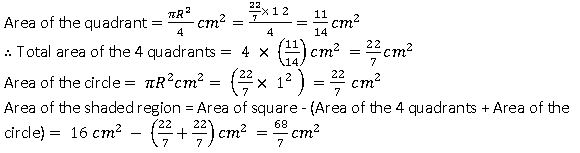
Q.5) From each corner of a square of side 4 𝑐𝑚 a quadrant of a circle of radius 1 𝑐𝑚 is cut and also a circle of diameter 2 𝑐𝑚 is cut as shown in Fig. Find the area of the remaining portion of the square.
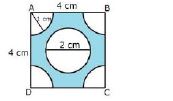
Sol.5) Side of the square = 4 cm
Radius of the circle = 1 cm
Four quadrant of a circle are cut from corner and one circle of radius are cut from middle.
Area of square = (𝑠𝑖𝑑𝑒)2 = 42 = 16 𝑐𝑚2
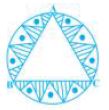
Q.6) In a circular table cover of radius 32 cm, a design is formed leaving an equilateral triangle ABC in the middle as shown in Fig. Find the area of the design.
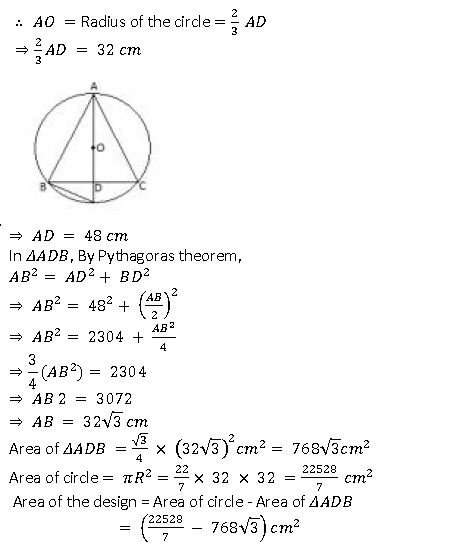
Sol.6) Radius of the circle = 32 𝑐𝑚
Draw a median AD of the triangle passing through the centre of the circle.
⇒ 𝐵𝐷 = 𝐴𝐵/2
Since, AD is the median of the triangle
Q.7) In Fig., ABCD is a square of side 14 cm. With centres A, B, C and D, four circles are drawn such that each circle touch externally two of the remaining three circles. Find the area of the shaded region.
Sol.7) Side of square = 14 𝑐𝑚
Four quadrants are included in the four sides of the square.
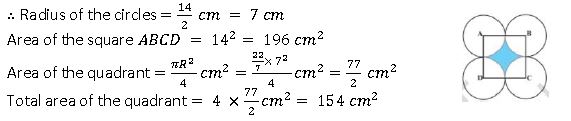
Area of the shaded region = Area of the square 𝐴𝐵𝐶𝐷 - Area of the quadrant
= 196 𝑐𝑚2 − 154 𝑐𝑚2 = 42 𝑐𝑚2
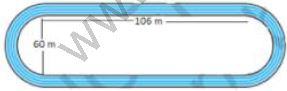
Q.8) Fig. depicts a racing track whose left and right ends are semi-circular. The distance between the two inner parallel line segments is 60 m and they are each 106 m long. If the track is 10 m wide, find :
(i) the distance around the track along its inner edge (ii) the area of the track
Sol.8) Width of track = 10 𝑚
Distance between two parallel lines = 60 𝑚
Length of parallel tracks = 106 𝑚
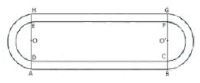
𝐷𝐸 = 𝐶𝐹 = 60 𝑚
Radius of inner semicircle, 𝑟 = 𝑂𝐷 = 𝑂′𝐶 = 60/2 𝑚 = 30 𝑚
Radius of outer semicircle, 𝑅 = 𝑂𝐴 = 𝑂′𝐵 = 30 + 10 𝑚 = 40 𝑚
Also, 𝐴𝐵 = 𝐶𝐷 = 𝐸𝐹 = 𝐺𝐻 = 106 𝑚
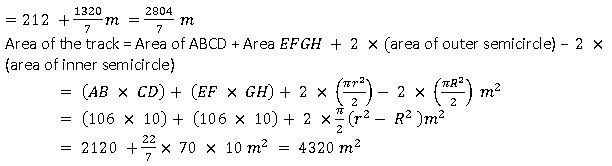
Distance around the track along its inner edge = 𝐶𝐷 + 𝐸𝐹 + 2 × (Circumference of inner semicircle)
= 106 + 106 + (2 × 𝜋𝑟)𝑚
= 212 + (2 × 22/7 × 30) 𝑚
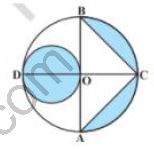
Q.9) In Fig., AB and CD are two diameters of a circle (with centre O) perpendicular to each other and OD is the diameter of the smaller circle. If OA = 7 cm, find the area of the shaded region.
Sol.9) Radius of larger circle, 𝑅 = 7 𝑐𝑚
Radius of smaller circle, 𝑟 = 7/2 𝑐𝑚
Height of 𝛥𝐵𝐶𝐴 = 𝑂𝐶 = 7 𝑐𝑚
Base of 𝛥𝐵𝐶𝐴 = 𝐴𝐵 = 14 𝑐𝑚
Area of 𝛥𝐵𝐶𝐴 = 1/2 × 𝐴𝐵 × 𝑂𝐶 = 1/2 × 7 × 14 = 49 𝑐𝑚2
Area of larger circle = 𝜋𝑅2 = 22/7 × 7 2 = 154 𝑐𝑚2
Area of larger semicircle = 154/2 𝑐𝑚2 = 77 𝑐𝑚2
Area of smaller circle = 𝜋𝑟 2 = 22/7 × 7/2 × 7/2 = 77/2 𝑐𝑚2
Area of the shaded region = Area of larger circle - Area of triangle - Area of larger
semicircle + Area of smaller circle Area of the shaded region
= (154 − 49 − 77 + 77/2) 𝑐𝑚2 = 133/2 𝑐𝑚2 = 66.5 𝑐𝑚
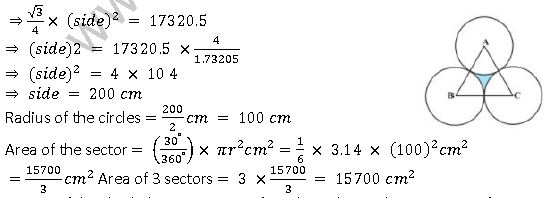
Q.10) The area of an equilateral triangle ABC is 17320.5 𝑐𝑚2 . With each vertex of the triangle as centre, a circle is drawn with radius equal to half the length of the side of the triangle (see Fig.). Find the area of the shaded region. (Use 𝜋 = 3.14 and √3 = 1.73205)
Sol.10) ABC is an equilateral triangle.
∴ ∠𝐴 = ∠𝐵 = ∠𝐶 = 60°
There are three sectors each making 60°.
Area of 𝛥𝐴𝐵𝐶 = 17320.5 𝑐𝑚2
Q.11) On a square handkerchief, nine circular designs each of radius 7 cm are made (see Fig.).
Find the area of the remaining portion of the handkerchief.
Sol.11) Number of circular design = 9
Radius of the circular design = 7 cm
There are three circles in one side of square handkerchief.
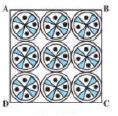
∴ Side of the square = 3 × diameter of circle
= 3 × 14 = 42 𝑐𝑚
Area of the square = 42 × 42 𝑐𝑚2 = 1764 𝑐𝑚2
Area of the circle = 𝜋𝑟2 = 22/7 × 7 × 7 = 154 𝑐𝑚2
Total area of the design = 9 × 154 = 1386 𝑐𝑚2
Area of the remaining portion of the handkerchief = Area of the square - Total area of the design = 1764 − 1386 = 378 𝑐𝑚2
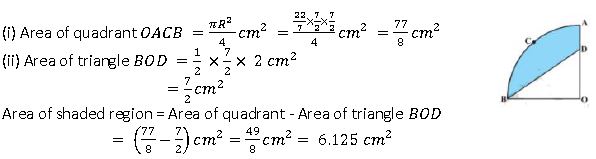
Q.12) In Fig., 𝑂𝐴𝐶𝐵 is a quadrant of a circle with centre O and radius 3.5 cm. If 𝑂𝐷 = 2 𝑐𝑚,
find the area of the (i) quadrant 𝑂𝐴𝐶𝐵, (ii) shaded region.
Sol.12) Radius of the quadrant = 3.5 𝑐𝑚 = 7/2 𝑐𝑚
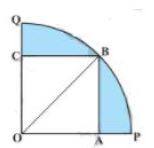
Q.13) In Fig., a square 𝑂𝐴𝐵𝐶 is inscribed in a quadrant 𝑂𝑃𝐵𝑄. If 𝑂𝐴 = 20 𝑐𝑚, find the area of the shaded region. (Use 𝜋 = 3.14)
Sol.13) Side of square = 𝑂𝐴 = 𝐴𝐵 = 20 𝑐𝑚
Radius of the quadrant = 𝑂𝐵
𝑂𝐴𝐵 is right angled triangle
By Pythagoras theorem in 𝛥𝑂𝐴𝐵 ,
𝑂𝐵2 = 𝐴𝐵2 + 𝑂𝐴2
⇒ 𝑂𝐵2 = 202 + 202
⇒ 𝑂𝐵2 = 400 + 400
⇒ 𝑂𝐵2 = 800
⇒ 𝑂𝐵 = 20√2 𝑐𝑚
Area of the quadrant = 𝜋𝑅2/4 𝑐𝑚2
= 3.14/4 × (20√2)2 𝑐𝑚2 = 628 𝑐𝑚2
Area of the square = 20 × 20 = 400 𝑐𝑚2
Area of the shaded region = Area of the quadrant - Area of the square
= 628 − 400 𝑐𝑚2 = 228 𝑐𝑚2
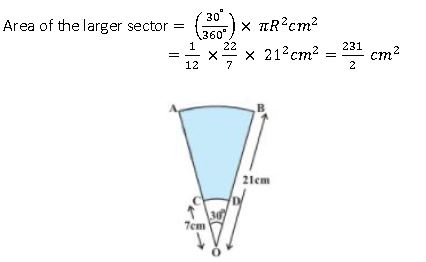
Q.14) AB and CD are respectively arcs of two concentric circles of radii 21 𝑐𝑚 and 7 𝑐𝑚 and centre O (see Fig.). If ∠𝐴𝑂𝐵 = 30°, find the area of the shaded region.
Sol.14) Radius of the larger circle, 𝑅 = 21 𝑐𝑚
Radius of the smaller circle, 𝑟 = 7 𝑐𝑚
Angle made by sectors of both concentric circles = 30°
Free study material for Mathematics
Mathematics Class 10 Curriculum Solutions: Chapter 11 Areas Related to Circles
Chapter Exercise Answers for Class 10 Mathematics
Explore reliable textbook solutions for Chapter 11 Areas Related to Circles tailored for Class 10 learners. Utilizing these complete exercise answers ensures your preparation aligns exactly with official NCERT standards for Mathematics.
Detailed Answer Guides for Chapter 11 Areas Related to Circles
Clear, methodical explanations accompany every challenging problem within the Class 10 Mathematics text. Engaging with these detailed answers lays a solid foundation for advanced learning and improves foundational clarity for upcoming assessments.
Complete Preparation Kit for Class 10 Exams
Frequent review of these structured answers builds strong analytical capabilities and response efficiency. Maximize your academic readiness by combining these textbook solutions with our curated study materials and mock evaluations for Class 10 Mathematics.
FAQs
The complete and updated NCERT Solutions Class 10 Mathematics Chapter 11 Areas Related to Circles is available for free on StudiesToday.com. These solutions for Class 10 Mathematics are as per latest NCERT curriculum.
Yes, our experts have revised the NCERT Solutions Class 10 Mathematics Chapter 11 Areas Related to Circles as per 2026 exam pattern. All textbook exercises have been solved and have added explanation about how the Mathematics concepts are applied in case-study and assertion-reasoning questions.
Toppers recommend using NCERT language because NCERT marking schemes are strictly based on textbook definitions. Our NCERT Solutions Class 10 Mathematics Chapter 11 Areas Related to Circles will help students to get full marks in the theory paper.
Yes, we provide bilingual support for Class 10 Mathematics. You can access NCERT Solutions Class 10 Mathematics Chapter 11 Areas Related to Circles in both English and Hindi medium.
Yes, you can download the entire NCERT Solutions Class 10 Mathematics Chapter 11 Areas Related to Circles in printable PDF format for offline study on any device.