

Official NCERT Solutions for Class 10 Mathematics: Chapter 02 Polynomials
Explore reliable textbook solutions for Chapter 02 Polynomials tailored for Class 10 learners. Utilizing these Mathematics answers ensures thorough preparation and strengthens foundational knowledge before final NCERT evaluations.
Chapter-wise Solutions for Mathematics: Chapter 02 Polynomials
View or download the dedicated Chapter 02 Polynomials solution resource below. Engaging with these textbook answers under focused study conditions ensures continuous academic progress and mastery of the 2026-27 curriculum for Mathematics.
Exercise 2.1
Q.1) The graphs of 𝑦 = 𝑝(𝑥) are given in following figure, for some polynomials 𝑝(𝑥). Find the number of zeroes of 𝑝(𝑥), in each case.
Sol.1) (i) The number of zeroes is 0 as the graph does not cut the x-axis at any point.
(ii)The number of zeroes is 1 as the graph intersects the x-axis at only 1 point.
(iii) The number of zeroes is 3 as the graph intersects the x-axis at 3 points.
(iv) The number of zeroes is 2 as the graph intersects the x-axis at 2 points.
(v)The number of zeroes is 4 as the graph intersects the x-axis at 4 points.
(vi) The number of zeroes is 3 as the graph intersects the x-axis at 3 `points.
Exercise 2.2
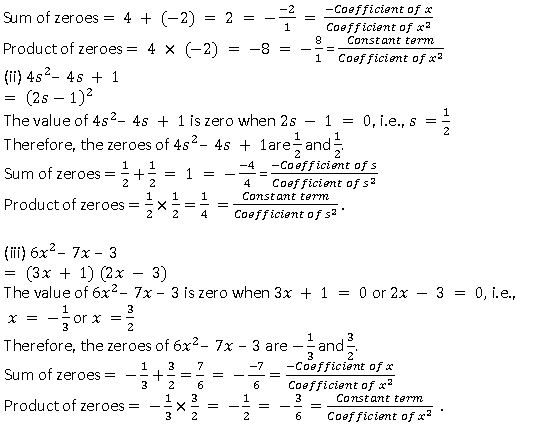
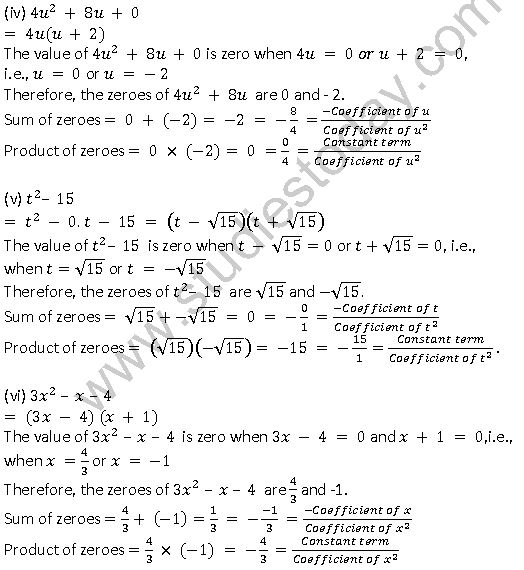
Q.1) Find the zeroes of the following quadratic polynomials and verify the relationship between the zeroes and the coefficients.
(i) 𝑥2– 2𝑥 – 8 (ii) 4𝑠2– 4𝑠 + 1 (iii) 6𝑥2– 3 – 7𝑥
(iv) 4𝑢2 + 8𝑢 (v) 𝑡2– 15 (vi) 3𝑥2 – 𝑥 – 4
Sol.1) (i) 𝑥2– 2𝑥 – 8
= (𝑥 − 4) (𝑥 + 2)
The value of 𝑥2– 2𝑥 – 8 is zero when 𝑥 − 4 = 0 or 𝑥 + 2 = 0, i.e.,
when x = 4 or x = -2
Therefore, the zeroes of 𝑥2– 2𝑥 – 8 are 4 and -2.
Q.2) Find a quadratic polynomial each with the given numbers as the sum and product of its zeroes respectively.
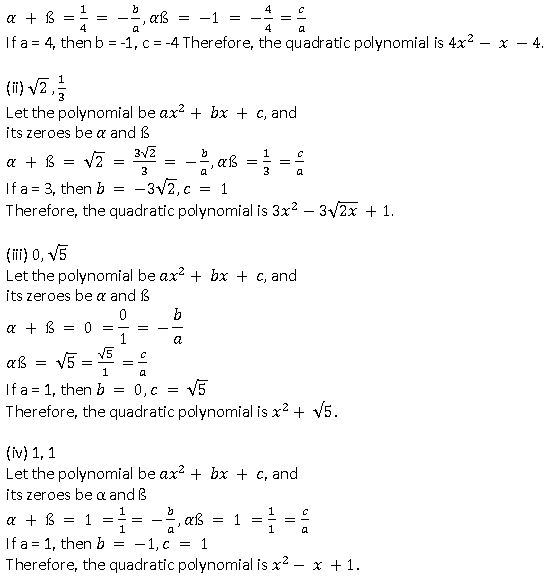
(i) 1/4, −1 (ii) √2, 1/3
(iii) 0, √5 (iv) 1,1 (v) −(1/4), 1/4
(vi) 4,1
Sol.2) (i) 1/4, −1
Let the polynomial be 𝑎𝑥2 + 𝑏𝑥 + 𝑐, and its zeroes be 𝛼 and ß
Exercise 2.3
Q.1) Divide the polynomial 𝑝(𝑥) by the polynomial 𝑔(𝑥) and find the quotient and remainder in each of the following:
(i) 𝑝(𝑥) = 𝑥3 – 3𝑥2 + 5𝑥 – 3, 𝑔(𝑥) = 𝑥2 – 2
(ii) 𝑝(𝑥) = 𝑥4 – 3𝑥2 + 4𝑥 + 5, 𝑔(𝑥) = 𝑥2 + 1 – 𝑥
(iii) 𝑝(𝑥) = 𝑥4 – 5𝑥 + 6, 𝑔(𝑥) = 2 – 𝑥2
Sol.1) (i) 𝑝(𝑥) = 𝑥3 – 3𝑥2 + 5𝑥 – 3, 𝑔(𝑥) = 𝑥2 – 2
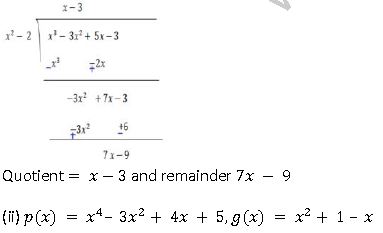
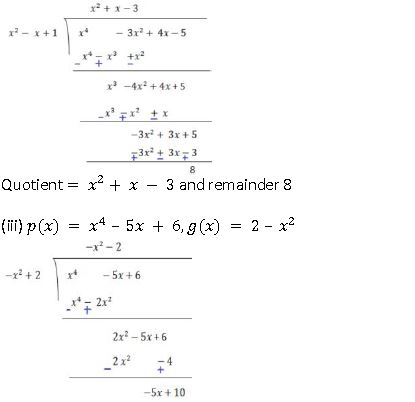
Quotient = −𝑥2 − 2 and remainder −5𝑥 + 10
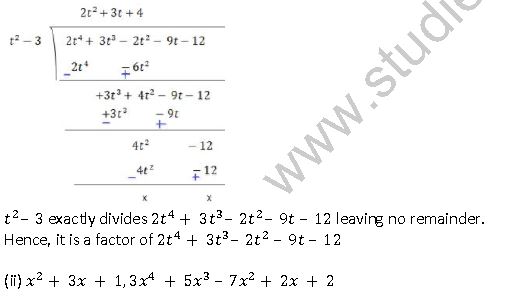
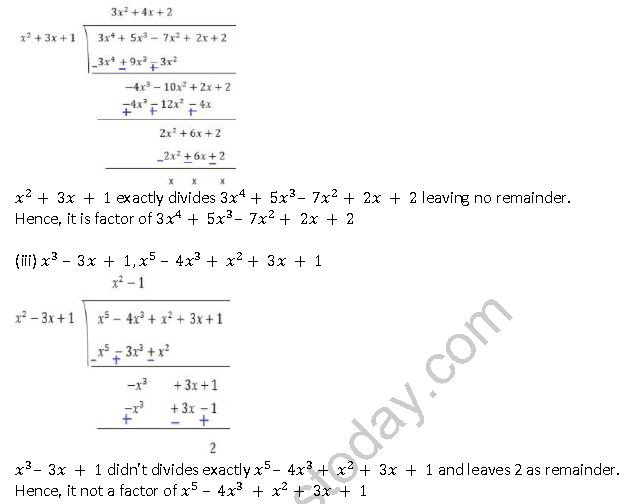
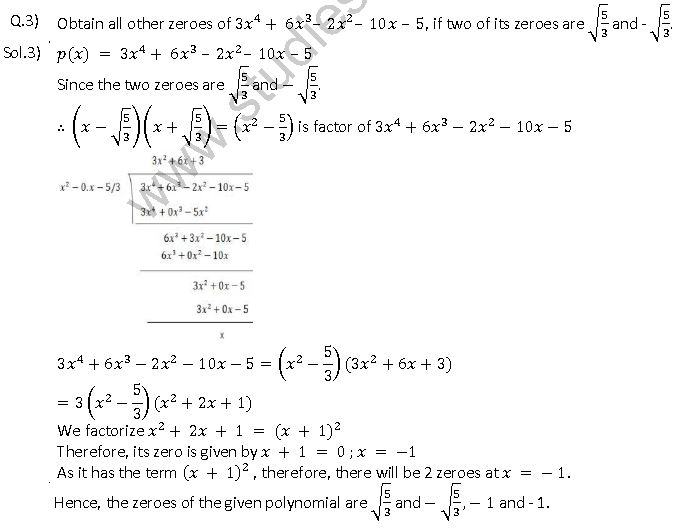
Q.2) Check whether the first polynomial is a factor of the second polynomial by dividing the second polynomial by the first polynomial:
(i) 𝑡2– 3, 2𝑡4 + 3𝑡3– 2𝑡2 – 9𝑡 – 12
(ii) 𝑥2 + 3𝑥 + 1, 3𝑥4 + 5𝑥3 – 7𝑥2 + 2𝑥 + 2
(iii) 𝑥3 – 3𝑥 + 1, 𝑥5 – 4𝑥3 + 𝑥2 + 3𝑥 + 1
Sol.2) (i) 𝑡2– 3, 2𝑡4 + 3𝑡3– 2𝑡2 – 9𝑡 – 12
Q.4) On dividing 𝑥3 − 3𝑥2 + 𝑥 + 2 by a polynomial 𝑔(𝑥), the quotient and remainder were 𝑥 − 2 and −2𝑥 + 4, respectively. Find 𝑔(𝑥).
Sol.4) Here in the given question,
Dividend = 𝑥3 − 3𝑥2 + 𝑥 + 2
Quotient = 𝑥 − 2
Remainder = −2𝑥 + 4
Divisor = 𝑔(𝑥)
We know that, 𝐷𝑖𝑣𝑖𝑑𝑒𝑛𝑑 = 𝑄𝑢𝑜𝑡𝑖𝑒𝑛𝑡 × 𝐷𝑖𝑣𝑖𝑠𝑜𝑟 + 𝑅𝑒𝑚𝑎𝑖𝑛𝑑𝑒𝑟
⇒ 𝑥3 − 3𝑥2 + 𝑥 + 2 = (𝑥 − 2) × 𝑔(𝑥) + (−2𝑥 + 4)
⇒ 𝑥3 − 3𝑥2 + 𝑥 + 2 − (−2𝑥 + 4) = (𝑥 − 2) × 𝑔(𝑥)
⇒ 𝑥3 − 3𝑥2 + 3𝑥 − 2 = (𝑥 − 2) × 𝑔(𝑥)
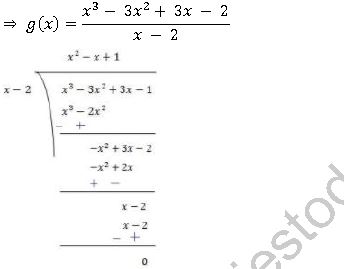
∴ 𝑔(𝑥) = (𝑥2 − 𝑥 + 1)
Q.5) Give examples of polynomial 𝑝(𝑥), 𝑔(𝑥), 𝑞(𝑥) and 𝑟(𝑥), which satisfy the division algorithm and
(i) 𝑑𝑒𝑔 𝑝(𝑥) = 𝑑𝑒𝑔 𝑞(𝑥) (ii) 𝑑𝑒𝑔 𝑞(𝑥) = 𝑑𝑒𝑔 𝑟(𝑥) (iii) 𝑑𝑒𝑔 𝑟(𝑥) = 0
Sol.5) (i) Let us assume the division of 6𝑥2 + 2𝑥 + 2 by 2
Here, 𝑝(𝑥) = 6𝑥2 + 2𝑥 + 2
𝑔(𝑥) = 2
𝑞(𝑥) = 3𝑥2 + 𝑥 + 1
𝑟(𝑥) = 0
Degree of 𝑝(𝑥) and 𝑞(𝑥) is same i.e. 2.
Checking for division algorithm,
𝑝(𝑥) = 𝑔(𝑥) × 𝑞(𝑥) + 𝑟(𝑥) Or,
6𝑥2 + 2𝑥 + 2 = 2𝑥 (3𝑥2 + 𝑥 + 1)
Hence, division algorithm is satisfied.
(ii) Let us assume the division of 𝑥2 + 𝑥 by 𝑥2 ,
Here, 𝑝(𝑥) = 𝑥3 + 𝑥
𝑔(𝑥) = 𝑥2
𝑞(𝑥) = 𝑥 and 𝑟(𝑥) = 𝑥
Clearly, the degree of 𝑞(𝑥) and 𝑟(𝑥) is the same i.e., 1.
Checking for division algorithm,
𝑝(𝑥) = 𝑔(𝑥) × 𝑞(𝑥) + 𝑟(𝑥)
𝑥3 + 𝑥 = (𝑥2) × 𝑥 + 𝑥
𝑥3 + 𝑥 = 𝑥3 + 𝑥
Thus, the division algorithm is satisfied.
(iii) Let us assume the division of 𝑥3 + 1 by 𝑥2
Here, 𝑝(𝑥) = 𝑥3 + 1
𝑔(𝑥) = 𝑥2
𝑞(𝑥) = 𝑥 and 𝑟(𝑥) = 1
Clearly, the degree of 𝑟(𝑥) is 0.
Checking for division algorithm,
𝑝(𝑥) = 𝑔(𝑥) × 𝑞(𝑥) + 𝑟(𝑥)
𝑥3 + 1 = (𝑥2 ) × 𝑥 + 1
𝑥3 + 1 = 𝑥3 + 1
Thus, the division algorithm is satisfied.
Exercise 2.4
Q.1) Verify that the numbers given alongside of the cubic polynomials below are their zeroes.
Also verify the relationship between the zeroes and the coefficients in each case:
(i) 2𝑥3 + 𝑥2 − 5𝑥 + 2; 1/2, 1, −2 (ii) 𝑥3 − 4𝑥2 + 5𝑥 – 2; 2, 1, 1
Sol.1) (i) 𝑝(𝑥) = 2𝑥3 + 𝑥2 − 5𝑥 + 2
Now for zeroes, putting the given value in 𝑥.
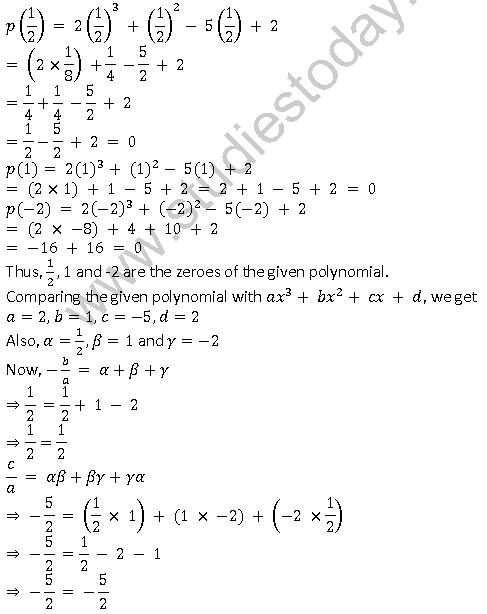
−(𝑑/𝑎) = 𝛼𝛽𝛾
⇒ −(2/2) = (1/2 × 1 × −2)
⇒ −1 = 1
Thus, the relationship between zeroes and the coefficients are verified.
(ii) 𝑝(𝑥) = 𝑥3 − 4𝑥2 + 5𝑥 – 2
Now for zeroes, putting the given value in 𝑥.
𝑝(2) = 23 − 4(2)2 + 5(2) − 2
= 8 − 16 + 10 − 2 = 0
𝑝(1) = 1 3 − 4(1)2 + 5(1) − 2
= 1 − 4 + 5 − 2 = 0
𝑝(1) = 13 − 4(1)2 + 5(1) − 2
= 1 − 4 + 5 − 2 = 0
Thus, 2, 1 and 1 are the zeroes of the given polynomial.
Comparing the given polynomial with 𝑎𝑥3 + 𝑏𝑥2 + 𝑐𝑥 + 𝑑, we get
𝑎 = 1, 𝑏 = −4, 𝑐 = 5, 𝑑 = −2
Also, 𝛼 = 2, 𝛽 = 1 and 𝛾 = 1
Now, −(𝑏/𝑎) = 𝛼 + 𝛽 + 𝛾
⇒ 4/1 = 2 + 1 + 1
⇒ 4 = 4
𝑐/𝑎 = 𝛼𝛽 + 𝛽𝛾 + 𝛾𝛼
⇒ 5/1 = (2 × 1) + (1 × 1) + (1 × 2)
⇒ 5 = 2 + 1 + 2
⇒ 5 = 5 (−𝑑/𝑎) = 𝛼𝛽𝛾
⇒ 2/1 = (2 × 1 × 1)
⇒ 2 = 2
Thus, the relationship between zeroes and the coefficients are verified.
Q.2) Find a cubic polynomial with the sum, sum of the product of its zeroes taken two at a time, and the product of its zeroes as 2, –7, –14 respectively.
Sol.2) Let the polynomial be 𝑎𝑥3 + 𝑏𝑥2 + 𝑐𝑥 + 𝑑 and the zeroes be 𝛼, 𝛽 and 𝛾
Then, 𝛼 + 𝛽 + 𝛾 = −(−2/1) = 2 = −(𝑏/𝑎)
𝛼𝛽 + 𝛽𝛾 + 𝛾𝛼 = −7 = − 7/1 = 𝑐/𝑎
𝛼𝛽𝛾 = −14 = − (14/1)
= − (𝑑/𝑎)
∴ 𝑎 = 1, 𝑏 = −2, 𝑐 = −7 and 𝑑 = 14
So, one cubic polynomial which satisfy the given conditions will be 𝑥3 − 2𝑥2 − 7𝑥 + 14
Q.3) If the zeroes of the polynomial 𝑥3– 3𝑥2 + 𝑥 + 1 are 𝑎– 𝑏, 𝑎, 𝑎 + 𝑏, find 𝑎 and 𝑏.
Sol.3) Since, (𝑎 − 𝑏), 𝑎, (𝑎 + 𝑏) are the zeroes of the polynomial 𝑥3– 3𝑥2 + 𝑥 + 1.
Therefore, sum of the zeroes
= (𝑎 − 𝑏) + 𝑎 + (𝑎 + 𝑏) = − (−3/1) = 3
⇒ 3𝑎 = 3
⇒ 𝑎 = 1
∴ Sum of the products of is zeroes taken two at a time
= 𝑎(𝑎 − 𝑏) + 𝑎(𝑎 + 𝑏) + (𝑎 + 𝑏) (𝑎 − 𝑏) = 1/1 = 1
𝑎2 − 𝑎𝑏 + 𝑎2 + 𝑎𝑏 + 𝑎2 − 𝑏2 = 1
⇒ 3𝑎2 − 𝑏2 = 1
Putting the value of 𝑎,
⇒ 3(1)2 − 𝑏2 = 1
⇒ 3 − 𝑏2 = 1
⇒ 𝑏2 = 2
⇒ 𝑏 = ±√2
Hence, 𝑎 = 1 and 𝑏 = ±√2
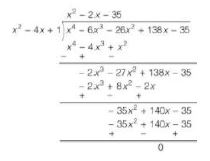
Q.4) If two zeroes of the polynomial 𝑥4– 6𝑥3 – 26𝑥2 + 138𝑥 – 35 are 2 ± √3, find other zeroes.
Sol.4) 2 + √3 and 2 − √3 are two zeroes of the polynomial
𝑝(𝑥) = 𝑥4– 6𝑥3 – 26𝑥2 + 138𝑥 – 35.
Let 𝑥 = 2 ± √3 So, 𝑥 − 2 = ±√3
On squaring, we get 𝑥2 − 4𝑥 + 4 = 3,
⇒ 𝑥2 − 4𝑥 + 1 = 0
Now, dividing 𝑝(𝑥) by 𝑥2 − 4𝑥 + 1
∴ 𝑝(𝑥) = 𝑥4 − 6𝑥3 − 26𝑥2 + 138𝑥 − 35
= (𝑥2 − 4𝑥 + 1) (𝑥2 − 2𝑥 − 35)
= (𝑥2 − 4𝑥 + 1) (𝑥2 − 7𝑥 + 5𝑥 − 35)
= (𝑥2 − 4𝑥 + 1) [𝑥(𝑥 − 7) + 5 (𝑥 − 7)]
= (𝑥2 − 4𝑥 + 1) (𝑥 + 5) (𝑥 − 7)
∴ (𝑥 + 5) and (𝑥 − 7) are other factors of 𝑝(𝑥).
∴ − 5 and 7 are other zeroes of the given polynomial
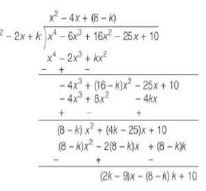
Q.5) If the polynomial 𝑥4– 6𝑥3 + 16𝑥2– 25𝑥 + 10 is divided by another polynomial 𝑥2 – 2𝑥 + 𝑘, the remainder comes out to be 𝑥 + 𝑎, find 𝑘 and 𝑎.
Sol.5) On dividing 𝑥4– 6𝑥3 + 16𝑥2– 25𝑥 + 10 by 𝑥2– 2𝑥 + 𝑘
∴ Remainder = (2𝑘 − 9)𝑥 − (8 − 𝑘)𝑘 + 10
But the remainder is given as 𝑥 + 𝑎.
On comparing their coefficients,
2𝑘 − 9 = 1
⇒ 𝑘 = 10
⇒ 𝑘 = 5 and,
−(8 − 𝑘)𝑘 + 10 = 𝑎
⇒ 𝑎 = −(8 − 5)5 + 10 = − 15 + 10 = −5
Hence, 𝑘 = 5 and 𝑎 = −5
Free study material for Mathematics
Mathematics Class 10 Curriculum Solutions: Chapter 02 Polynomials
Textbook Solutions for Class 10 Mathematics Chapter 02 Polynomials
Explore reliable textbook solutions for Chapter 02 Polynomials tailored for Class 10 learners. Utilizing these complete exercise answers ensures your preparation aligns exactly with official NCERT standards for Mathematics.
Mastering Theoretical and Practical Questions
Beyond providing final answers, these guides offer step-by-step breakdowns for complex queries in the Class 10 Mathematics module. This approach helps students balance theoretical depth with practical problem-solving skills required for NCERT exams.
Effective Self-Study and Homework Assistance
These resources act as an effective roadmap for daily homework tasks and independent study. Supplement your review of Chapter 02 Polynomials with official sample papers and interactive practice tests available on our platform free of charge.
FAQs
The complete and updated NCERT Solutions Class 10 Mathematics Chapter 2 Polynomials is available for free on StudiesToday.com. These solutions for Class 10 Mathematics are as per latest NCERT curriculum.
Yes, our experts have revised the NCERT Solutions Class 10 Mathematics Chapter 2 Polynomials as per 2026 exam pattern. All textbook exercises have been solved and have added explanation about how the Mathematics concepts are applied in case-study and assertion-reasoning questions.
Toppers recommend using NCERT language because NCERT marking schemes are strictly based on textbook definitions. Our NCERT Solutions Class 10 Mathematics Chapter 2 Polynomials will help students to get full marks in the theory paper.
Yes, we provide bilingual support for Class 10 Mathematics. You can access NCERT Solutions Class 10 Mathematics Chapter 2 Polynomials in both English and Hindi medium.
Yes, you can download the entire NCERT Solutions Class 10 Mathematics Chapter 2 Polynomials in printable PDF format for offline study on any device.