

Download NCERT Solutions for Class 10 Mathematics Chapter 10 Circles
Review structured textbook solutions for Class 10 Mathematics Chapter 10 Circles. Built according to NCERT guidelines for the 2026-27 academic year, these downloadable answers support daily revision and problem-solving accuracy.
Access NCERT Solutions and Answers
View or download the dedicated Chapter 10 Circles solution resource below. Engaging with these textbook answers under focused study conditions ensures continuous academic progress and mastery of the 2026-27 curriculum for Mathematics.
Exercise 10.1
Q.1) How many tangents can a circle have?
Sol.1) A circle can have infinite tangents.
Q.2) Fill in the blanks :
(i) A tangent to a circle intersects it in ............... point(s).
(ii) A line intersecting a circle in two points is called a .............
(iii) A circle can have ............... parallel tangents at the most.
(iv) The common point of a tangent to a circle and the circle is called ............
Sol.1) (i) one (ii) secant (iii) two (iv) point of contact
Q.3) A tangent PQ at a point P of a circle of radius 5 cm meets a line through the centre O at a point Q so that 𝑂𝑄 = 12 𝑐𝑚. Length PQ is :
(A) 12 cm (B) 13 cm (C) 8.5 cm (D) √119 𝑐𝑚
Sol.3) The line drawn from the centre of the circle to the tangent is perpendicular to the tangent.
∴ 𝑂𝑃 ⊥ 𝑃𝑄
By Pythagoras theorem in 𝛥𝑂𝑃𝑄,
𝑂𝑄2 = 𝑂𝑃2 + 𝑃𝑄2
⇒ (12)2 = 52 + 𝑃𝑄2
⇒ 𝑃𝑄2 = 144 − 25
⇒ 𝑃𝑄2 = 119
⇒ 𝑃𝑄 = √119 𝑐𝑚
(D) is the correct option

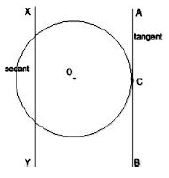
Q.4) Draw a circle and two lines parallel to a given line such that one is a tangent and the other, a secant to the circle.
Sol.4) AB and XY are two parallel lines where AB is the tangent to the circle at point C while XY is the secant to the circle
Exercise: 10.2
Q.1) In Q.1 to 3, choose the correct option and give justification.
From a point Q, the length of the tangent to a circle is 24 cm and the distance of Q from the centre is 25 cm. The radius of the circle is
(A) 7 cm (B) 12 cm (C) 15 cm (D) 24.5 cm
Sol.1) The line drawn from the centre of the circle to the tangent is perpendicular to the tangent.
∴ 𝑂𝑃 ⊥ 𝑃𝑄
also, 𝛥𝑂𝑃𝑄 is right angled.
𝑂𝑄 = 25 𝑐𝑚 and 𝑃𝑄 = 24 𝑐𝑚 (Given)
By Pythagoras theorem in 𝛥𝑂𝑃𝑄,
𝑂𝑄2 = 𝑂𝑃2 + 𝑃𝑄2
⇒ (25)2 = 𝑂𝑃2 + (24)2
⇒ 𝑂𝑃2 = 625 − 576
⇒ 𝑂𝑃2 = 49
⇒ 𝑂𝑃 = 7 𝑐𝑚
The radius of the circle is option (A) 7 cm.
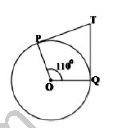
Q.2) In Fig. 10.11, if TP and TQ are the two tangents to a circle with centre O so that ∠POQ =
110°, then ∠PTQ is equal to (A) 60° (B) 70° (C) 80° (D) 90°
Sol.2) OP and OQ are radii of the circle to the tangents TP and TQ respectively.
∴ 𝑂𝑃 ⊥ 𝑇𝑃 and,
∴ 𝑂𝑄 ⊥ 𝑇𝑄 ∠𝑂𝑃𝑇 = ∠𝑂𝑄𝑇 = 90°
In quadrilateral 𝑃𝑂𝑄𝑇, Sum of all interior angles = 360°
∠𝑃𝑇𝑄 + ∠𝑂𝑃𝑇 + ∠𝑃𝑂𝑄 + ∠𝑂𝑄𝑇 = 360°
⇒ ∠𝑃𝑇𝑄 + 90° + 110° + 90° = 360°
⇒ ∠𝑃𝑇𝑄 = 70°
∠𝑃𝑇𝑄 is equal to option (B) 70°.
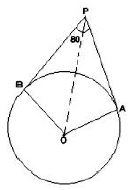
Q.3) If tangents PA and PB from a point P to a circle with centre O are inclined to each other at angle of 80°, then ∠ 𝑃𝑂𝐴 is equal to
(A) 50° (B) 60° (C) 70° (D) 80°
Sol.3) OA and OB are radii of the circle to the tangents PA and PB respectively.
∴ 𝑂𝐴 ⊥ 𝑃𝐴 and,
∴ 𝑂𝐵 ⊥ 𝑃𝐵 ∠𝑂𝐵𝑃 = ∠𝑂𝐴𝑃 = 90°
In quadrilateral AOBP, Sum of all interior angles = 360°
∠𝐴𝑂𝐵 + ∠𝑂𝐵𝑃 + ∠𝑂𝐴𝑃 + ∠𝐴𝑃𝐵 = 360°
⇒ ∠𝐴𝑂𝐵 + 90° + 90° + 80° = 360°
⇒ ∠𝐴𝑂𝐵 = 100°
Now, In 𝛥𝑂𝑃𝐵 and 𝛥𝑂𝑃𝐴,
𝐴𝑃 = 𝐵𝑃 (Tangents from a point are equal)
𝑂𝐴 = 𝑂𝐵 (Radii of the circle)
𝑂𝑃 = 𝑂𝑃 (Common side)
∴ 𝛥𝑂𝑃𝐵 ≅ 𝛥𝑂𝑃𝐴 (by SSS congruence condition)
Thus ∠𝑃𝑂𝐵 = ∠𝑃𝑂𝐴 ∠𝐴𝑂𝐵 = ∠𝑃𝑂𝐵 + ∠𝑃𝑂𝐴
⇒ 2 ∠𝑃𝑂𝐴 = ∠𝐴𝑂𝐵
⇒ ∠𝑃𝑂𝐴 = 100°/2 = 50°
∠𝑃𝑂𝐴 is equal to option (A) 50°
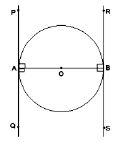
Q.4) Prove that the tangents drawn at the ends of a diameter of a circle are parallel.
Sol.4) Let AB be a diameter of the circle.
Two tangents PQ and RS are drawn at points A and B respectively.
Radii of the circle to the tangents will be perpendicular to it.
∴ 𝑂𝐵 ⊥ 𝑅𝑆 and,
∴ 𝑂𝐴 ⊥ 𝑃𝑄
∠𝑂𝐵𝑅 = ∠𝑂𝐵𝑆 = ∠𝑂𝐴𝑃 = ∠𝑂𝐴𝑄 = 90°
From the figure, ∠𝑂𝐵𝑅 = ∠𝑂𝐴𝑄 (Alternate interior angles)
∠𝑂𝐵𝑆 = ∠𝑂𝐴𝑃 (Alternate interior angles)
Since alternate interior angles are equal, lines PQ and RS will be parallel.
Hence Proved that the tangents drawn at the ends of a diameter of a circle are parallel.
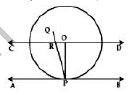
Q.5) Prove that the perpendicular at the point of contact to the tangent to a circle passes through the centre.
Sol.5) Let AB be the tangent to the circle at point P with centre O.
We have to prove that PQ passes through the point O.
Suppose that PQ doesn't passes through point O. Join OP.
Through O, draw a straight line CD parallel to the tangent AB.
PQ intersect CD at R and also intersect AB at P.
𝐴𝑆, 𝐶𝐷 // 𝐴𝐵
𝑃𝑄 is the line of intersection,
∠𝑂𝑅𝑃 = ∠𝑅𝑃𝐴 (Alternate interior angles) but also,
∠𝑅𝑃𝐴 = 90° (𝑃𝑄 ⊥ 𝐴𝐵)
⇒ ∠𝑂𝑅𝑃 = 90° ∠𝑅𝑂𝑃 + ∠𝑂𝑃𝐴 = 180° (Co-interior angles)
⇒ ∠𝑅𝑂𝑃 + 90° = 180°
⇒ ∠𝑅𝑂𝑃 = 90°
Thus, the 𝛥𝑂𝑅𝑃 has 2 right angles i.e.
∠𝑂𝑅𝑃 and ∠𝑅𝑂𝑃 which is not possible.
Hence, our supposition is wrong.
∴ 𝑃𝑄 passes through the point O.
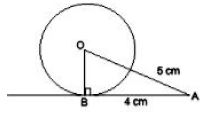
Q.6) The length of a tangent from a point A at distance 5 cm from the centre of the circle is 4 cm. Find the radius of the circle.
Sol.6) AB is a tangent drawn on this circle from point 𝐴.
∴ 𝑂𝐵 ⊥ 𝐴𝐵
𝑂𝐴 = 5𝑐𝑚 and 𝐴𝐵 = 4 𝑐𝑚 (Given)
In 𝛥𝐴𝐵𝑂, By Pythagoras theorem in
𝛥𝐴𝐵𝑂, 𝑂𝐴2 = 𝐴𝐵2 + 𝐵𝑂2
⇒ 52 = 42 + 𝐵𝑂2
⇒ 𝐵𝑂2 = 25 − 16
⇒ 𝐵𝑂2 = 9
⇒ 𝐵𝑂 = 3
∴ The radius of the circle is 3 cm
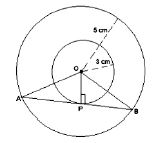
Q.7) Two concentric circles are of radii 5 cm and 3 cm. Find the length of the chord of the larger circle which touches the smaller circle
Sol.7) Let the two concentric circles with centre 𝑂.
𝐴𝐵 be the chord of the larger circle which touches the smaller circle at point P.
∴ 𝐴𝐵 is tangent to the smaller circle to the point 𝑃.
⇒ 𝑂𝑃 ⊥ 𝐴𝐵
By Pythagoras theorem in 𝛥𝑂𝑃𝐴,
𝑂𝐴2 = 𝐴𝑃2 + 𝑂𝑃2
⇒ 52 = 𝐴𝑃2 + 32
⇒ 𝐴𝑃2 = 25 − 9
⇒ 𝐴𝑃 = 4
In 𝛥𝑂𝑃𝐵, Since 𝑂𝑃 ⊥ 𝐴𝐵,
𝐴𝑃 = 𝑃𝐵 (Perpendicular from the center of the circle bisects the chord)
𝐴𝐵 = 2𝐴𝑃 = 2 × 4 = 8 𝑐𝑚
∴ The length of the chord of the larger circle is 8 cm
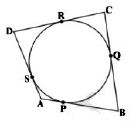
Q.8) A quadrilateral ABCD is drawn to circumscribe a circle (see Fig.). Prove that 𝐴𝐵 + 𝐶𝐷 = 𝐴𝐷 + 𝐵𝐶
Sol.8) From the figure we observe that,
DR = DS (Tangents on the circle from point D) … (i)
AP = AS (Tangents on the circle from point A) … (ii)
BP = BQ (Tangents on the circle from point B) … (iii)
CR = CQ (Tangents on the circle from point C) … (iv)
Adding all these equations,
𝐷𝑅 + 𝐴𝑃 + 𝐵𝑃 + 𝐶𝑅 = 𝐷𝑆 + 𝐴𝑆 + 𝐵𝑄 + 𝐶𝑄
⇒ (𝐵𝑃 + 𝐴𝑃) + (𝐷𝑅 + 𝐶𝑅) = (𝐷𝑆 + 𝐴𝑆) + (𝐶𝑄 + 𝐵𝑄)
⇒ 𝐶𝐷 + 𝐴𝐵 = 𝐴𝐷 + 𝐵𝐶
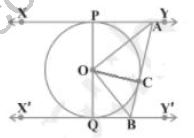
Q.9) In the given figure, 𝑋𝑌 and 𝑋’𝑌’ are two parallel tangents to a circle with centre O and another tangent AB with point of contact C intersecting 𝑋𝑌 at A and 𝑋’𝑌’ at B.
Sol.9) We joined O and C
A/q,
In 𝛥𝑂𝑃𝐴 and 𝛥𝑂𝐶𝐴,
𝑂𝑃 = 𝑂𝐶 (Radii of the same circle)
𝐴𝑃 = 𝐴𝐶 (Tangents from point A)
𝐴𝑂 = 𝐴𝑂 (Common side)
∴ 𝛥𝑂𝑃𝐴 ≅ 𝛥𝑂𝐶𝐴 (SSS congruence criterion)
⇒ ∠𝑃𝑂𝐴 = ∠𝐶𝑂𝐴 … (i)
Similarly, 𝛥𝑂𝑄𝐵 ≅ 𝛥𝑂𝐶𝐵
∠𝑄𝑂𝐵 = ∠𝐶𝑂𝐵 … (ii)
Since POQ is a diameter of the circle, it is a straight line.
∴ ∠𝑃𝑂𝐴 + ∠𝐶𝑂𝐴 + ∠𝐶𝑂𝐵 + ∠𝑄𝑂𝐵 = 180°
From equations (i) and (ii),
2∠𝐶𝑂𝐴 + 2∠𝐶𝑂𝐵 = 180°
⇒ ∠𝐶𝑂𝐴 + ∠𝐶𝑂𝐵 = 90°
⇒ ∠𝐴𝑂𝐵 = 90°
Q.10) Prove that the angle between the two tangents drawn from an external point to a circle is supplementary to the angle subtended by the line-segment joining the points of contact at the centre.
Sol.10) Let us consider a circle centered at point O.
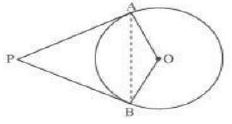
Let P be an external point from which two tangents PA and PB are drawn to the circle which are touching the circle at point A and B respectively and AB is the line segment, joining point of contacts A and B together such that it subtends ∠𝐴𝑂𝐵 at center O of the circle.
It can be observed that
𝑂𝐴 (radius) ⊥ 𝑃𝐴 (tangent)
Therefore, ∠𝑂𝐴𝑃 = 90°
Similarly, 𝑂𝐵 (radius) ⊥ 𝑃𝐵 (tangent)
∠𝑂𝐵𝑃 = 90°
In quadrilateral 𝑂𝐴𝑃𝐵,
Sum of all interior angles = 360°
∠𝑂𝐴𝑃 + ∠𝐴𝑃𝐵 + ∠𝑃𝐵𝑂 + ∠𝐵𝑂𝐴 = 360°
90° + ∠𝐴𝑃𝐵 + 180° + ∠𝐵𝑂𝐴 = 360°
∠𝐴𝑃𝐵 + ∠𝐵𝑂𝐴 = 180°
Hence, it can be observed that the angle between the two tangents drawn from an external point to a circle is supplementary to the angle subtended by the line segment joining the points of contact at the centre.
Q.11) Prove that the parallelogram circumscribing a circle is a rhombus.
Sol.11) ABCD is a parallelogram,
∴ 𝐴𝐵 = 𝐶𝐷 ... (i)
∴ 𝐵𝐶 = 𝐴𝐷 ... (ii)
From the figure, we observe that,
DR = DS (Tangents to the circle at D)
CR = CQ (Tangents to the circle at C)
BP = BQ (Tangents to the circle at B)
AP = AS (Tangents to the circle at A) Adding all these,
𝐷𝑅 + 𝐶𝑅 + 𝐵𝑃 + 𝐴𝑃 = 𝐷𝑆 + 𝐶𝑄 + 𝐵𝑄 + 𝐴𝑆
⇒ (𝐷𝑅 + 𝐶𝑅) + (𝐵𝑃 + 𝐴𝑃) = (𝐷𝑆 + 𝐴𝑆) + (𝐶𝑄 + 𝐵𝑄)
⇒ 𝐶𝐷 + 𝐴𝐵 = 𝐴𝐷 + 𝐵𝐶 ... (iii)
Putting the value of (i) and (ii) in equation (iii) we get,
2𝐴𝐵 = 2𝐵𝐶
⇒ 𝐴𝐵 = 𝐵𝐶 ... (iv)
By Comparing equations (i), (ii), and (iv) we get,
𝐴𝐵 = 𝐵𝐶 = 𝐶𝐷 = 𝐷𝐴
∴ 𝐴𝐵𝐶𝐷 is a rhombus.
Q.12) A triangle ABC is drawn to circumscribe a circle of radius 4 cm such that the segments BD and DC into which BC is divided by the point of contact D are of lengths 8 cm and 6 cm respectively (see Fig.). Find the sides AB and AC.
Sol.12) In 𝛥𝐴𝐵𝐶,
Length of two tangents drawn from the same point to the circle are equal,
∴ 𝐶𝐹 = 𝐶𝐷 = 6𝑐𝑚
∴ 𝐵𝐸 = 𝐵𝐷 = 8𝑐𝑚
∴ 𝐴𝐸 = 𝐴𝐹 = 𝑥
We observed that,
𝐴𝐵 = 𝐴𝐸 + 𝐸𝐵 = 𝑥 + 8
𝐵𝐶 = 𝐵𝐷 + 𝐷𝐶 = 8 + 6 = 14
𝐶𝐴 = 𝐶𝐹 + 𝐹𝐴 = 6 + 𝑥
Now semi perimeter of circles,
⇒ 2𝑠 = 𝐴𝐵 + 𝐵𝐶 + 𝐶𝐴
= 𝑥 + 8 + 14 + 6 + 𝑥 = 28 + 2𝑥
⇒ 𝑠 = 14 + 𝑥

= 2 × 1/2
(4𝑥 + 24 + 32) = 56 + 4𝑥 ... (ii)
Equating equation (i) and (ii) we get,
√(14 + 𝑥)48𝑥 = 56 + 4𝑥
Squaring both sides,
48𝑥 (14 + 𝑥) = (56 + 4𝑥)2
⇒ 48𝑥 = [4(14 + 𝑥)]2/14 + 𝑥
⇒ 48𝑥 = 16 (14 + 𝑥)
⇒ 48𝑥 = 224 + 16𝑥
⇒ 32𝑥 = 224
⇒ 𝑥 = 7 𝑐𝑚
Hence, 𝐴𝐵 = 𝑥 + 8 = 7 + 8 = 15 𝑐𝑚
𝐶𝐴 = 6 + 𝑥 = 6 + 7 = 13 𝑐𝑚
Q.13) Prove that opposite sides of a quadrilateral circumscribing a circle subtend supplementary angles at the centre of the circle.
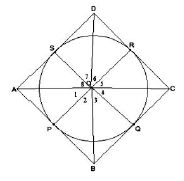
Sol.13) Let ABCD be a quadrilateral circumscribing a circle with O such that it touches the circle
at point P, Q, R, S.
Join the vertices of the quadrilateral ABCD to the center of the circle.
In 𝛥𝑂𝐴𝑃 and 𝛥𝑂𝐴𝑆,
𝐴𝑃 = 𝐴𝑆 (Tangents from the same point)
𝑂𝑃 = 𝑂𝑆 (Radii of the circle)
𝑂𝐴 = 𝑂𝐴 (Common side)
𝛥𝑂𝐴𝑃 ≅ 𝛥𝑂𝐴𝑆 (SSS congruence condition)
∴ ∠𝑃𝑂𝐴 = ∠𝐴𝑂𝑆
⇒ ∠1 = ∠8
Similarly, we get,
∠2 = ∠3
∠4 = ∠5
∠6 = ∠7
Adding all these angles,
∠1 + ∠2 + ∠3 + ∠4 + ∠5 + ∠6 + ∠7 + ∠8 = 360°
⇒ (∠1 + ∠8) + (∠2 + ∠3) + (∠4 + ∠5) + (∠6 + ∠7) = 360°
⇒ 2 ∠1 + 2 ∠2 + 2 ∠5 + 2 ∠6 = 360°
⇒ 2(∠1 + ∠2) + 2(∠5 + ∠6) = 360°
⇒ (∠1 + ∠2) + (∠5 + ∠6) = 180°
⇒ ∠𝐴𝑂𝐵 + ∠𝐶𝑂𝐷 = 180°
Similarly, we can prove that ∠ 𝐵𝑂𝐶 + ∠ 𝐷𝑂𝐴 = 180°
Hence, opposite sides of a quadrilateral circumscribing a circle subtend supplementary angles at the centre of the circle
Free study material for Mathematics
Free NCERT Textbook Explanations: Class 10 Mathematics Chapter 10 Circles
Chapter Exercise Answers for Class 10 Mathematics
Explore reliable textbook solutions for Chapter 10 Circles tailored for Class 10 learners. Utilizing these complete exercise answers ensures your preparation aligns exactly with official NCERT standards for Mathematics.
Detailed Answer Guides for Chapter 10 Circles
Beyond providing final answers, these guides offer step-by-step breakdowns for complex queries in the Class 10 Mathematics module. This approach helps students balance theoretical depth with practical problem-solving skills required for NCERT exams.
Complete Preparation Kit for Class 10 Exams
Frequent review of these structured answers builds strong analytical capabilities and response efficiency. Maximize your academic readiness by combining these textbook solutions with our curated study materials and mock evaluations for Class 10 Mathematics.
FAQs
The complete and updated NCERT Solutions Class 10 Mathematics Chapter 10 Circles is available for free on StudiesToday.com. These solutions for Class 10 Mathematics are as per latest NCERT curriculum.
Yes, our experts have revised the NCERT Solutions Class 10 Mathematics Chapter 10 Circles as per 2026 exam pattern. All textbook exercises have been solved and have added explanation about how the Mathematics concepts are applied in case-study and assertion-reasoning questions.
Toppers recommend using NCERT language because NCERT marking schemes are strictly based on textbook definitions. Our NCERT Solutions Class 10 Mathematics Chapter 10 Circles will help students to get full marks in the theory paper.
Yes, we provide bilingual support for Class 10 Mathematics. You can access NCERT Solutions Class 10 Mathematics Chapter 10 Circles in both English and Hindi medium.
Yes, you can download the entire NCERT Solutions Class 10 Mathematics Chapter 10 Circles in printable PDF format for offline study on any device.