

Download CBSE Class 5 Environmental Studies Sample Papers
Explore authentic exam practice materials through the CBSE Class 5 EVS Sample Paper Set 05. Tailored for Class 5 learners, utilizing these Environmental Studies sample papers ensures thorough preparation and strengthens time management skills before final CBSE evaluations.
Access CBSE Sample Papers and Solutions
View or download the dedicated CBSE Class 5 EVS Sample Paper Set 05 resource below. Engaging with these sample papers under timed conditions ensures continuous academic progress and mastery of the 2026-27 exam format.
CBSE Class 5 EVS Sample Paper Set E. It’s always recommended to practice as many sample papers as possible before the examinations. Students can download the sample papers and also question papers of previous years to practice and score better marks in examinations. Refer to other links too for more sample papers.
Q.1 Fill in the blanks. (10)
a) Muscles are attached to bones by ________.
b) There are ________ different blood groups.
c) When a person loses a lot of water he/she suffers from ________.
d) The lack of iron in our body causes ________.
e) The strength of an earthquake is measured on the ________ scale.
f) A barrier across a river is called ________.
g) The holes on leaves through which gases enter and leave are called________.
h) A person who tests blood, urine, and so on, is called a ________.
i) The spinal cord is thick bunch of ________.
j) Plants help to increase rainfall by throwing out ________.
Q.2 Write ‘True’ or ‘False’ against the following statement. (1×5=5)
a) Trains and planes do not cause noise pollution.
b) Without the sun there would be no living beings on the earth.
c) The silvery substance in the bulb of a thermometer is called mercury.
d) We use premolars and molars to chew our food.
e) The muscles in our heart and food pipe are voluntary muscles.
Q.3 Choose the correct option. (½×10=5)
a) Air enters our lungs through the –
i) arteries ii) bronchi
b) We need calcium for –
i) strong bones ii) making skin
c) The organs that strains out waste from blood are the –
i) brain ii) kidneys
d) Malaria and dengue are spread by –
i) flies ii) mosquitoes
e) The substance that gives leaves their colour is –
i) cotyledon ii) chlorophyll
f) When there are very few of a particular kind of animal in the world, it is called –
i) extinct ii) endangered
g) Plants are called ‘producers’ because –
i) they produce food ii) they clean the air
h) Fat in our body helps us –
i) to protect us from illness ii) to keep us warm
i) Deficiency of vitamin B causes –
i) Beriberi ii) Cholera
j) Shrubs are –
i) plants with weak stems which grow along the ground
ii) Bushy plants with woody stems
Q.4 Match the following and rewrite them with their correct options. (1×5=5)
a) Vitamin A i) Goitre
b) Pesticides ii) A biennial plant
c) Sugarcane plant iii) Night blindness
d) Banyan tree iv) Chemicals that kill insects and their babies
e) Iodine v) A perennial plant
Q.5 Give answers in one word. (1×10=10)
a) Name the international organization that gives medical help to people.
b) Give one example of a herb.
c) Name the type of teeth that tear the food.
d) Name any one body-building food.
e) Which bone of our skull can move?
f) Name one disease that is spread by flies.
g) What does ORS stand for?
h) Name the place in the hospital where operations are done.
i) Name the violent storms that usually occur near the sea.
j) Name a deficiency disease.
Q.6 Define them. (any 6) (1×6=6)
a) Surgery b) Organ system
c) Blood bank d) Nutrients
e) Micro organism f) Drought
g) Internal organs
Q.7 Differentiate between. (any two) (2×2=4)
a) Tap and Fibrous root
b) Voluntary and Involuntary muscles
c) Communicable and Non-communicable diseases
Q.8 Write short notes. (any two) (2×3=6)
a) Hinge Joint b) Mobile Health Van c) Noise Pollution
Q.9 Short answer questions. (any ten) (1×10=10)
a) Name the organs of the nervous system.
b) How do proteins help our body?
c) What should you do to avoid getting tetanus?
d) What is the main function of a flower in a plant?
e) Why is it bad to use plastic?
f) What does nutrient mean?
g) From where does someone can get blood?
h) Mention one way in which animals help plants.
i) How does someone get a heatstroke?
j) What are marine animals?
k) Why should we use unleaded petrol?
Q.10 Long answer questions. (any five) (5×3=15)
a) What happens to food in the mouth?
b) What does the stem of a plant do?
c) Why is cutting down of forest harmful?
d) What happens to the people who do not get enough vitamin C?
e) What should one do in case of nosebleed?
f) How can modern means of communication harm our health?
Q.11 Value based question.
Meera was in the habit of wasting food everyday. One day while going to an educational trip, she saw some poor children searching for food in the garbage. Her teacher explained that these children are very poor and they are trying to get something which they can eat, as they were very hungry. It disturbed Meera a lot. She decided not to waste food in future.
On the basis of the above situation, answer the following questions. (1×4=4)
a) What was Meera in the habit of?
b) What were the poor children doing in the garbage?
c) What message does this passage give to you ?
d) State True / False.
Picking eatables from the garbage and eating them is good for health.
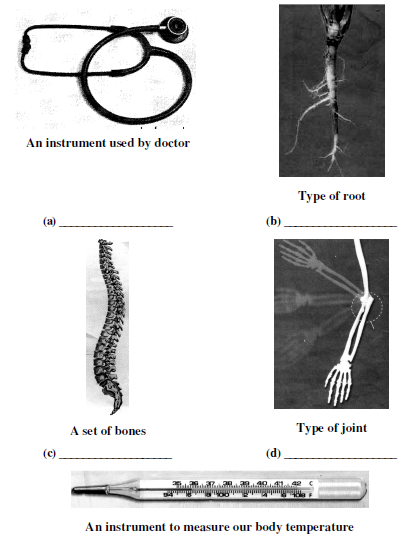
Q.12 Diagrammatic questions.
a) Draw a neat and labelled diagram of ‘The layers of the earth’. (5)
b) See the given pictures carefully and identify them.
(Read the given clues)
Please click the link below to download CBSE Class 5 EVS Sample Paper Set E.
Free study material for Environmental Studies
Download CBSE Sample Papers: Class 5 Environmental Studies
Download Sample Paper: CBSE Class 5 EVS Sample Paper Set 05 (Class 5 Environmental Studies)
Access structured sample papers for Class 5 Environmental Studies. Solving the CBSE Class 5 EVS Sample Paper Set 05 provided above helps students understand official exam blueprints and tackle anticipated question formats with confidence.
Why Practice Class 5 Environmental Studies Sample Papers?
- Curriculum Insights: Clarify chapter-wise weightage rules and question trends across Class 5.
- Gap Analysis: Check performance drops across sets to isolate specific Class 5 Environmental Studies topics needing extra attention.
- Time Efficiency: Working through objective and descriptive problems builds critical pacing to finish exams comfortably.
How to Analyze Your Performance in CBSE Class 5 EVS Sample Paper Set 05
- Verify Answers: Compare your responses against professional teacher solutions provided in the sample paper keys.
- Error Analysis: Class 5 learners must review incorrect answers carefully to understand underlying mistakes.
- Concept Reinforcement: Consult the official NCERT book for Class 5 Environmental Studies when stuck before re-attempting problems.
FAQs
You can download the complete PDF for CBSE Class 5 EVS Sample Paper Set 05 for free from StudiesToday.com. Our resources for Class 5 Environmental Studies are updated for the latest academic session and follow the official exam pattern.
Yes, CBSE Class 5 EVS Sample Paper Set 05 comes with detailed, teacher-verified solutions. We have provided step-by-step answers for Environmental Studies to help students of Class 5 understand correct methodology and marking scheme.
Practicing this Environmental Studies paper helps in time management and identifying important topics. For Class 5, solving mock papers is the best way to gain confidence and reduce exam-day anxiety.
Yes, all our study materials for Class 5 Environmental Studies are provided in a mobile-friendly PDF format. You can easily download CBSE Class 5 EVS Sample Paper Set 05 on your mobile device.