

Official Class 3 Mathematics Worksheets: Money
Access printable practice worksheets for Money designed to align with the 2026-27 academic syllabus for Class 3 Mathematics. These structured exercises help students evaluate their conceptual understanding and improve exam readiness.
Chapter-wise Practice Material: Money
Navigate directly to the printable exercises for Money using the digital viewer below. Each practice set allows students to isolate specific topics for thorough review and uninterrupted practice alongside standard textbooks.
LEARNING OBJECTIVES
This lesson will help you to:-
• know about money and its use
• learn various denominations of money and coins used in India.
• understand the conversion of rupees and paise.
• enable a child to count the money.
Real Life Examples
• People make budget for their money. Budget means to plan how and where to spend money.
• People save money in banks or invest for future.
• People collect coins and notes of older times.
QUICK CONCEPT REVIEW
• What is Money? Money is an object or record that is generally accepted as payment for goods and services.
• Money is also known as currency.
• The unit of currency in India is Rupees which is denoted by following symbol: `
• Other important currencies in the world are USD $
(United States Dollar which is used in America), GBP
(UK Pound Sterling £) used in United Kingdom and Euro used in Europe.
• Money in India comes in form of paper as well as coins.
• 1 Rupee = 100 paisa
10 coins of 10 paisa make one Rupee.
2 coins of 50 paisa make one Rupee.
4 coins of 25 paisa make one Rupee.
1 coin of 50 paisa and 2 coins of 25 paisa make one Rupee.
Historical preview
• In ancient days before money was invented, the barter system was used.
• Barter is a system where people used to exchange their products with each other because they didn’t use money at that time.
• The history of the rupee traces back to 15th century, when the first “rupee” is believed to be introduced by Sher Shah Suri (1486– 1545).
• The paper based notes available in India are of ₹2000, ₹500, ₹100, ₹50, ₹20, ₹10, ₹5 as shown below:
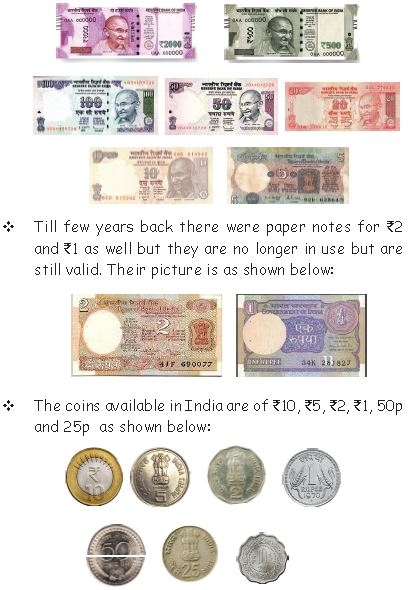
Example: How many ₹ 10 ten are Contained in ₹ 500
Solution: As 500 ÷ 10 = 50
So, 50 notes of ₹ 10 are contained in ₹ 500
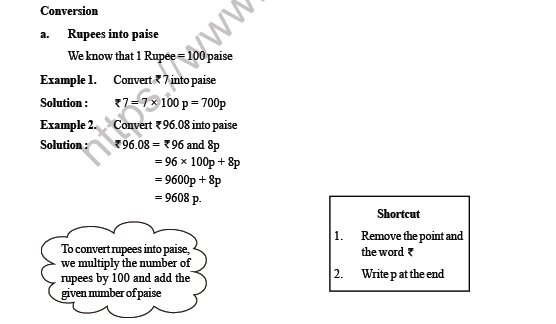
Conversion of Rupees and Paise we can convert rupees to paise and paise to rupees.
1 rupee = 100 paise
₹ 1 = 100 P
Example: Convert of ₹ 5.50 into paise.
Solution: A 1 ₹ = 100 paise.
So, ₹ 5.50 = 550 paise
Converting Paise into Rupees.
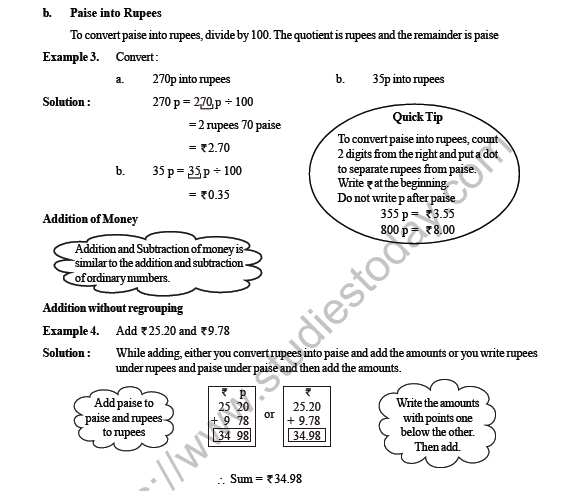
To convert paise into rupees, divide paise by 100.
100 paise ₹ 1
Example: Convert 5100 Paise into rupees.
Solution: 5100 paise = ₹ 5100/100
= ₹ 51
Converting Paise into Rupees and Paise
To convert paise into rupees and paise, divide paise by 100, then quotient is rupee part and the number forming the remainder is the paise.
Example: Convert 7689 paise into rupees and paise.
Sol:

7689 paise = 7689/100 rupees
When we divide 7689 by 100, we get 76 quotient and 89 as remainder So, 7689 paise =76 rupees 89 paise = ₹ 76.89
Amazing Facts
• Paper notes are called bank notes as they are issued by the Reserve Bank of India (RBI)
• Coins of 50p, 25p and 10p are not in use in.
• Picture of Mahatma Gandhi, father of the nation, is printed on every note
• Every note contains signature of RBI Governor
• As the value of currency increases, the size of the paper note also increases.
Misconcept/ Concept
Misconcept: If a paper note is mutilated or torn, then you feel that it cannot be used as no shopkeeper is ready to take it.
Concept: Torn or spoilt notes can be exchanged in banks and they will give you money depending on the condition of the note.
1. Mona went to purchase books and gave following money to cashier. Four coins of ₹ 2, two notes of Rupees 20, three notes of ₹ 100. If the price of books were ₹ 326, how much change will she get back?

(a) ₹ 20
(b) ₹ 22
(c) ₹ 25
(d) ₹ 28
Answer : B
2. Simran bought 6 chocolates. All the chocolates were of the same price. The total cost was ₹ 88.50. How much money did each chocolate cost?
(a) 14 rupees
(b) 14 rupees and 05 paisa
(c) 14 rupees and 50 paisa
(d) 14 rupees and 75 paisa
Answer : D
3. If Jessica bought oranges for ₹ 75 and she paid ₹ 100 to fruit seller, which expression shows the correct amount of change that she will get back? (Mental Mathematics)
(a) 100 + 75
(b) 100 − 75
(c) 100 ÷ 75
(d) 100 × 75
Answer : B
4. Arrange the following amounts of money in ascending order?
₹ 2.75 ₹ 1.75 ₹ 2.25 ₹ 2.50 ₹ 1.50 ₹ 0.75
(a) ₹ 0.75 < ₹ 1.50 < ₹ 1.75 < ₹ 2.50 < ₹ 2.25 < ₹ 2.75
(b) ₹ 1.75 < ₹ 1.50 < ₹ 0.75 < ₹ 2.25 < ₹ 2.50 < ₹ 2.75
(c) ₹ 0.75 < ₹ 1.50 < ₹ 1.75 < ₹ 2.25 < ₹ 2.50 < ₹ 2.75
(d) ₹ 0.75 < ₹ 1.75 < ₹ 1.50 < ₹ 2.25 < ₹ 2.50 < ₹ 2.75
Answer : C
5. Arrange the following amounts of money in descending order?
₹ 10.75 ₹ 10.65 ₹ 11.25 ₹ 11.05 ₹ 12.50 ₹ 10.55
(a) ₹ 12.50 > ₹ 11.25 > ₹ 11.05 > ₹ 10.75 > ₹ 10.65 > ₹ 10.55
(b) ₹ 12.50 > ₹ 11.05 > ₹ 11.25 > ₹ 10.75 > ₹ 10.65 > ₹ 10.55
(c) ₹ 12.50 > ₹ 11.25 > ₹ 11.05 > ₹ 10.55 > ₹ 10.65 > ₹ 10.75
(d) ₹ 12.50 > ₹ 11.25 > ₹ 11.05 > ₹ 10.65 > ₹ 10.75 > ₹ 10.55
Answer : A
6. Identify the total value of the combination of money.
₹ 5, ₹ 10, ₹ 20, ₹ 50, ₹ 500, 50 p, 25 p
(a) ₹ 600,25 p
(b) ₹ 550, 75 p
(c) ₹ 480, 50 p
(d) ₹ 585, 75 p
Answer : D
7. Identify the total value of the combination of money. (Mental Mathematics)
₹ 10, ₹ 10, ₹ 5, ₹ 1, ₹ 2, ₹ 50, ₹ 100
(a) ₹ 175
(b) ₹ 80
(c) ₹ 178
(d) ₹ 115
Answer : C
8. Raghu earned ₹ 5 everyday during september. How much money did he earn in the whole month?
(a) ₹ 200
(b) ₹ 180
(c) ₹ 150
(d) ₹ 70
Answer : C
9. In May, Arpita earned ₹ 10 everyday for helping her mother in doing house hold chores, she spent ₹ 95. How much she is left with?
(a) ₹ 215
(b) ₹ 180
(c) ₹ 200
(d) ₹ 310
Answer : A
Direction (Qs. 10 to 13): Fill in the blanks in questions 10 to 13 to get the resultant money.
10. ₹ 20 + ₹ 40 + ________ = ₹ 160 (Mental Mathematics)
(a) ₹ 50
(b) ₹ 100
(c) ₹ 70
(d) ₹ 60
Answer : B
11. ₹ 30 + ₹ 80 + ₹ 25 + ________ = ₹ 150, 50 paise
(a) ₹ 50, 50 paise
(b) ₹ 25, 50 paise
(c) ₹ 20, 25 paise
(d) ₹ 15, 50 paise
Answer : D
12. ₹ 15 + ₹ 25 + ________ = ₹ 100 (Mental Mathematics)
(a) ₹ 60
(b) ₹ 70
(c) ₹ 80
(d) ₹ 50
Answer : A
13. ₹ 75 + ₹ 20 + ________ = ₹ 150 (Mental Mathematics)
(a) ₹ 45
(b) ₹ 50
(c) ₹ 55
(d) ₹ 70
Answer : C
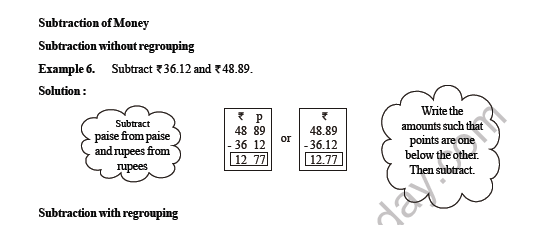
14. Subtract: ₹ 889.75 – ₹ 465.55
(a) ₹ 424.20
(b) ₹ 525.20
(c) ₹ 428.20
(d) ₹ 464.20
Answer : A
15. How many paise are there in ₹ 5.50?
(a) 550 paise
(b) 560 paise
(c) 570 paise
(d) 580 paise
Answer : A
16. A calculator costs ₹ 145. How many calculator can be pruchased for ₹ 1234 if one book is also purchased for ₹ 74 along with?
(a) 9
(b) 8
(c) 7
(d) 6
Answer : B
17. How many coins are obtained by converting ₹ 114 into 20 paise coins? (2014, Tricky)
(a) 5600
(b) 5500
(c) 5700
(d) 5400
Answer : C
18. Peter had ₹ 55. He bought a book for ₹ 24.50. How much money he has now?
(a) ₹ 30.90
(b) ₹ 30.50
(c) ₹ 30.75
(d) ₹ 34.50
Answer : B
19. What is the value of ₹ 27.50 in paise?
(a) 2175 paise
(b) 7500 paise
(c) 1750 paise
(d) 2750 paise
Answer : D
20. Cody bought 12 note books for ₹ 216. What is the price of one note book?
(a) ₹ 16
(b) ₹ 15
(c) ₹ 18
(d) ₹ 17
Answer : C
21. Raju distributed ₹ 124.80 equally among 8 boys. How much did each boy get?
(a) ₹ 15.60
(b) ₹ 16
(c) ₹ 14.60
(d) ₹ 15
Answer : A
Direction (Qs. 22 to 26): Consider the prices of these items below to answer questions.
₹ 4.50 per banana
₹ 170 for one clock
₹ 2.75 per pencil
₹ 7.50 per chocolate
22. The cost of one dozen bananas will be _____.
(a) ₹ 45
(b) ₹ 48
(c) ₹ 54
(d) ₹ 52
Answer : C
23. If Ajay wants to buy one pencil and two chocolates, how much he needs to pay?
(a) ₹ 15
(b) ₹ 16.50
(c) ₹ 17
(d) ₹ 17.75
Answer : D
24. Four chocolates can be bought for ₹ 30 and two pencils can be brought for ₹ 5. This statement is ____.
(a) True
(b) False
(c) Insufficient information
(d) None of these
Answer : B
25. If he has a five hundred rupees note. He wants to buy as many clocks he can with this amount. How many clocks can he buy?
(a) 1
(b) 2
(c) 3
(d) 4
Answer : B
26. Which of the following statement is not true?
(a) Cost of (2 bananas + 1 pencil) > Cost of 1 chocolate
(b) Cost of (1 bananas + 1 pencil) < Cost of 1 chocolate
(c) Cost of (1 bananas + 2 pencil) > Cost of 1 chocolate
(d) Cost of (2 bananas + 2 pencil) > Cost of 2 chocolate
(a) ₹ 15.60
(b) ₹ 16
(c) ₹ 14.60
(d) ₹ 15
Answer : D
27. Which one of the following coins does not exist in Indian currency?
(a) ₹ 2
(b) ₹ 1
(c) ₹ 5
(d) ₹ 1.5
Answer : D
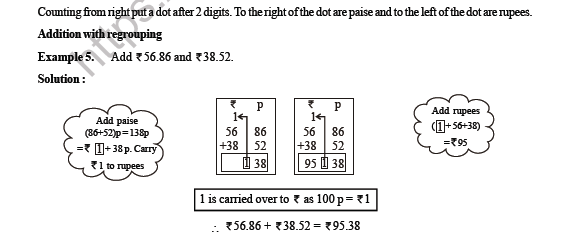
28. Add ₹ 456.50 + ₹ 345.75 = ____________.
(a) ₹ 802.25
(b) ₹ 800.20
(c) ₹ 768.30
(d) ₹ 800
Answer : A
29. Find the sum of ₹ 343.35, ₹ 175.50 and ₹ 8.55.
(a) ₹ 580.40
(b) ₹ 512.50
(c) ₹ 527.40
(d) ₹ 509.50
Answer : C
30. Divide: ₹ 680.60 into 6 equal parts.
(a) ₹ 113.43
(b) ₹ 112.43
(c) ₹ 123.45
(d) ₹ 110.40
Answer : A
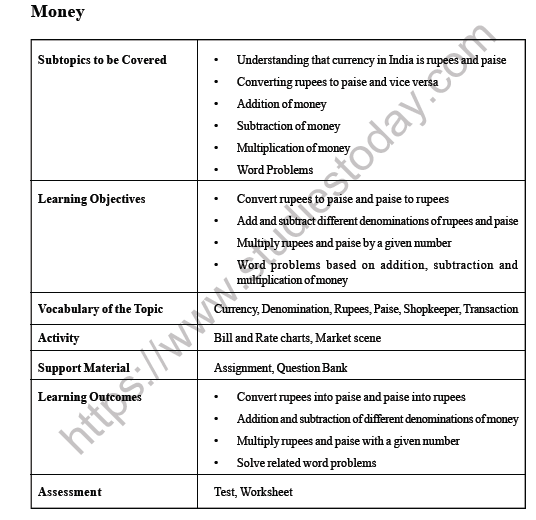
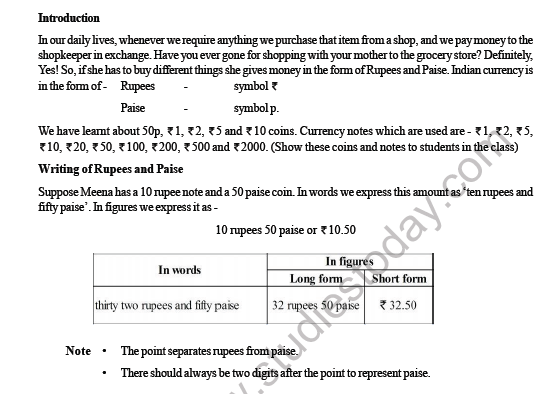
Please click on below link to download CBSE Class 3 Maths Money Worksheet
Free study material for Mathematics
Download CBSE Practice Material: Class 3 Mathematics Money
Chapter Practice Questions for Class 3 Mathematics
Access structured practice worksheets for Money designed in alignment with the latest CBSE curriculum for Class 3 Mathematics. These printable problem sets help students build accuracy and prepare effectively for school tests.
Expert Practice Material for Class 3 Mathematics
Each worksheet is structured around standard CBSE textbooks, allowing students to check their working steps and correct mistakes early in their revision.
Complete Your Chapter Revision
Wrap up your chapter revision by testing your knowledge against standard question formats. Everything on our platform is provided free of charge.
FAQs
You can download the teacher-verified PDF for CBSE Class 3 Maths Money Worksheet from StudiesToday.com. These practice sheets for Class 3 Mathematics are designed as per the latest CBSE academic session.
Yes, our CBSE Class 3 Maths Money Worksheet includes a variety of questions like Case-based studies, Assertion-Reasoning, and MCQs as per the 50% competency-based weightage in the latest curriculum for Class 3.
Yes, we have provided detailed solutions for CBSE Class 3 Maths Money Worksheet to help Class 3 and follow the official CBSE marking scheme.
Daily practice with these Mathematics worksheets helps in identifying understanding gaps. It also improves question solving speed and ensures that Class 3 students get more marks in CBSE exams.
All our Class 3 Mathematics practice test papers and worksheets are available for free download in mobile-friendly PDF format. You can access CBSE Class 3 Maths Money Worksheet without any registration.