

Download Class 3 Mathematics Worksheets for Fun with Numbers
Access printable practice worksheets for Fun with Numbers designed to align with the 2026-27 academic syllabus for Class 3 Mathematics. These structured exercises help students evaluate their conceptual understanding and improve exam readiness.
Access Fun with Numbers Questions and Exercises
View or download the dedicated Fun with Numbers practice resource below. Engaging with these objective and subjective questions daily ensures continuous academic progress and mastery of the 2026-27 curriculum.
LEARNING OBJECTIVES
This lesson will help you to:—
→ know about place value, face value, expanded form of numbers and number names.
→ understand ascending and descending order.
→ understand even and odd number.
→ the number which end up with 0, 2, 4, 6 or 8 is called even number.
→ understand skip counting.
QUICK CONCEPT REVIEW NUMBER NAMES
We know that a number’s name is derived from where the digits are placed in the number.
For example: The number name of 87654 is Eighty seven thousand six hundred and fifty four.
Few more examples for you:
(a) 32436 – Thirty two thousand four hundred and thirty six.
(b) 12652 – Twelve thousand six hundred and fifty two
Amazing Facts
• Zero (0) is the only number which cannot be represented by Roman numerals.
• Abacus is considered as "Origin of the calculator".
• While writing number names from 0 to 1000 the letter “A” only appears in 1,000 (“one thousand”)
PLACE VALUE
The value of a digit due to its position in a number is called its place value.
| Ten thousands |
Thousands | Hundreds | Tens | Ones |
| 10000 | 1000 | 100 | 10 | 1 |
For example: If we have to place 87654 we will show it like this
| Ten thousands |
Thousands | Hundreds | Tens | Ones |
| 8 | 7 | 6 | 5 | 4 |
FACE VALUE
Face value of a digit in a number is the digit itself.
For example– Face value of 9 in 1892 is 9.
Let's understand the concept of place value and face value with few more examples.
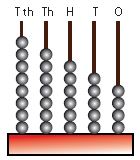
→ For a 5-digit number 87654:
• Place value of 4 = 4 ones = 4, Face value of 4 = 4
• Place value of 5 = 5 tens = 50, Face value of 5 = 5
• Place value of 6 = 6 hundreds = 600, Face value of 6 = 6
• Place value of 7 = 7 thousands = 7000, Face value of 7 = 7
• Place value of 8 = 8 ten thousands = 80000, Face value of 8 = 8
EXPANDED FORM OF NUMBER
We find that when we add the place values of all the digits in a number we get the number.
For example:-
300 + 80 + 6 is the expanded form of 386.
Let’s get it clear with few more examples:
(a) 819 = 800 + 10 + 9
(b) 206 = 200 + 6
(c) 467 = 400 + 60 + 7
Try It!
Example : Find the sum of place values of digit 4 and 5 in the number 69457.
Solution: Place value of 4 = 400
Place value of 5 = 50.
\ Sum = 400 + 50 = 450
ASCENDING AND DESCENDING NUMBERS
→ Arranging numbers in ascending order means arranging them from smaller to greater.
→ Arranging numbers in descending order means arranging them from greater to smaller.
→ Let the series of numbers be 30, 12, 18, 17, 22, 48, 40, and 28.
• Ascending order of these numbers is 12, 17, 18, 22, 28, 30, 40, 48.
• Descending order of these numbers is 48, 40, 30, 28, 22, 18, 17, 12.
Successor and Predecessor
Successor of a number is 1 more than the given number
Predecessor of a number is 1 less than the given number.
Example: Successor of 10 is 10 + 1 = 11 and Predecessor 10 – 1 = 9.
Historical preview
• The first true written positional numeral system is considered to be the Hindu Arabic numeral system. This was established by the 7th century.
EVEN AND ODD NUMBERS
→ Numbers which are divisible by 2 are called even numbers.
For example : 2, 4, 6 etc.
→ The number which end up with 1, 3, 5, 7 or 9 is called odd number. These numbers are not divisible by 2
For examples : 3, 5, 7 etc.
ROUNDING OFF TO THE NEAREST TENS
If the ones place is less than 5, round down the number to previous tens.
If the ones place is more than 5, round up the number to next tens.
Example: Round off 23 to the nearest 10s.
Sol: 23 is nearer to 20 than 30
So it is rounded off to 20.
ROUNDING OFF TO THE NEAREST HUNDRED
If the tens place has a digit less than 5, it is rounded down to previous hundreds.
If the tens place has a digit greater than or equal to 5, round up the number to next hundreds.
Example: Round off 360 to the nearest 100s.
Sol: 360 is nearer to 400 than 300
So, it is rounded up to 400.
ROUNDING OFF TO THE NEAREST THOUSAND
If the hundreds place has a digit less than 5, the number is rounded down to previous thousands.
If the hundreds place has a digit more than or equal to 5, the number is rounded up to next thousands.
Example: Round off 7267 to the nearest 1000s.
Sol: 7267 is nearer to 7000 than 8000
So, it is rounded down to 7000.
Do You Know
• Successor is also known as after number.
• Predecessor is also known as before number
SKIP COUNTING
→ In skip counting, value of the numbers increase uniformly
(a) Skip counting of 2 can be done as – 2, 4, 6, 8, 10 … .
(b) Skip counting of 3 can be done as – 3, 6, 9, 12, 15 … .
(c) Skip count in fives following 50 can be done as 55, 60, 65, 70 …
• Here, every number is five number more than the previous number
Question. A father bought 20 chocolates and distributes them to Ram, Shyam, and Kiran.
Ram gets 5, Shyam gets 6 and Kiran gets ____ chocolates.
(a) 6
(b) 7
(c) 8
(d) 9
Answer : (D) Chocolates to Kiran = 20 – 5 – 6 = 9.
Question. The largest 2 digit number whose tens place is even and unit place is odd is _____ .
(a) 99
(b) 89
(c) 88
(d) 98
Answer : (B) 89 is the largest 2 digit number whose tens place is even (8) and unit place is odd (9).
Question. Find the odd one out from the following list of numbers:
40 20 10 25 50
(a) 40
(b) 25
(c) 50
(d) 10
Answer : (B) Except 25 all are multiples of 10.
Question. Find the odd one out from the following list of numbers:
14 2 12 5 10
(a) 2
(b) 5
(c) 10
(d) 14
Answer : (B) Except 5 all are even numbers.
Direction: Consider the following statement to answer questions a and b.
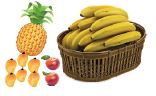
A fruit basket contains 1 dozen bananas, 2 apples, 1 pineapple and half dozen mangoes
Question a. The total numbers of fruits in the basket are ____.
(a) 21
(b) 10
(c) 27
(d) 04
Answer : (A) Total fruits = 1 dozen bananas (12) + 2 apples + 1 pineapple + half dozen mangoes (6)
= 12 + 2 + 1 + 6 = 21
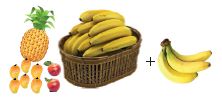
Question b. If 3 more bananas are added to these fruits, then the total number of fruits in the basket will be ____.
(a) 1 Dozen
(b) 2 Dozen
(c) 25
(d) 26
Answer : (B) If 3 more bananas added than total fruits now in basket = 21 + 3 = 24 = 2 dozen
Question. The smallest three digit number which is even and is a multiple of 3 is ______.
(a) 100
(b) 102
(c) 103
(d) 105
Answer : (B) 102 is even and is divisible by 3 to get 34 as result.
Question. Rachna prepared 24 cookies and gave half to her little brother. How many cookies are left with Rachna?
(a) Half
(b) 12
(c) 18
(d) 24
Answer : (B) 24 ÷ 2 = 12
Question. The sum of numbers from 1 to 10 is _____.
(a) 41
(b) 40
(c) 48
(d) 55
Answer : (D) 1 + 2 + 3 + 4 + 5 + 6 + 7 + 8 + 9 + 10 = 55.
Question. Rohan has 967 coins with him. How would he write 967 in words?
(a) Seven hundred ninety six
(b) Seven hundred sixty nine
(c) Nine hundred seventy six
(d) Nine hundred sixty seven
Answer : (D) 9 is at hundred place, 6 is at tens place and 7 is at unit place. Hence, it will be written as Nine hundred sixty seven.
Question. Choose the correct number for the given number name.
Thirty two thousand four hundred and twelve
(a) 43,212
(b) 32,412
(c) 12,324
(d) 23,412
Answer : B
Question. Find the smallest three digit number from the following:
341, 199, 111, 627, 245
(a) 341
(b) 111
(c) 199
(d) 245
Answer : B
Question. What is the place value of the underlined digit in the number given 38,455.
(a) Hundred
(b) Thousand
(c) Tens
(d) Ones
Answer : A
Question. Choose the correct option:
(a) 371 > 231
(b) 591 < 326
(c) 140 > 200
(d) 529 = 226
Answer : A
Question. Find the successor of the given statement.
435 + 6 × 9
(a) 409
(b) 490
(c) 309
(d) 390
Answer : (B) Successor of (435 + 6 × 9) = 435 + 6 × 9 + 1 = 490
Question. Find the largest three digit number from the following:
341, 199, 111, 627, 245
(a) 627
(b) 341
(c) 245
(d) 199
Answer : A
Question. What is the expanded form of the given number 14,543.
(a) 14 + 5 + 4 + 3
(b) 10,000 + 4,000 + 500 + 40 + 3
(c) 1400 + 54 + 3
(d) 1400 + 50 + 43
Answer : B
Question. Choose the correct number name for the number given 87,162.
(a) Eighty seven thousand one hundred and sixty two.
(b) Eight thousand seven thousand one thousand sixty two.
(c) Eight hundred seven thousand sixteen and two
(d) Eighty seven hundred sixteen and two
Answer : A
Question. What is the face value of the underlined digit in the number given 92,138.
(a) 8
(b) 9
(c) 3
(d) 1
Answer : C
Question. How many thousands are there in the sum of 2508, 1392 and 1967?
(a) 7
(b) 8
(c) 5
(d) 4
Answer : D
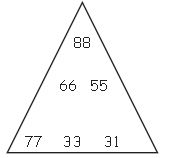
Question. Subtract the smallest number from biggest number given inside the triangle
(a) 33
(b) 44
(c) 57
(d) 60
Answer : (C) 88 – 31 = 57
Question. The expanded form of the number, 55432 is:
(a) 50000 + 5400 + 432
(b) 50000 + 5000 + 400 + 30 + 2
(c) 50000 + 5000 + 4000 + 32
(d) 500 + 50 + 5 + 0
Answer : B
Question. What is the difference of place and face value of 4 in the number, 3451?
(a) 404
(b) 396
(c) 400
(d) 963
Answer : (B) 400 – 4 = 396
Question. The difference between the place value of 6 and 9 in the number 6593 is :
(a) 5108
(b) 5901
(c) 5910
(d) 9510
Answer : (C) 6000 – 90 = 5910
Question. Reena had four numbers (4, 7, 9, 5). She used each number only one time to make a larger number. If she put 9 at ten’s place, what would be the largest number she could make?
(a) 9754
(b) 7594
(c) 7954
(d) 7495
Answer : B
Question. What number comes before 8 tens and 8 ones?
(a) 78
(b) 87
(c) 89
(d) 90
Answer : B
Question. How many tens make 120?
(a) 10
(b) 11
(c) 12
(d) 9
Answer : C
Question. The sum of greatest two digit number and smallest one digit number is:
(a) 9
(b) 102
(c) 100
(d) 500
Answer : (C) 99 + 1 = 100
Question. What is the least whole number you can make using all the following digits?
3 5 1
(a) 135
(b) 315
(c) 531
(d) 351
Answer : A
Question. There are ____________ thousands in 9643.
(a) 96
(b) 9
(c) 6
(d) 964
Answer : (B) 9643 has 9 thousands.
Free study material for Mathematics
Fun with Numbers Practice Sheet and Solutions for Class 3 Mathematics
Fun with Numbers Printable Worksheet for Class 3 Mathematics
Explore reliable practice questions for Fun with Numbers tailored for Class 3 Mathematics learners. Use these structured worksheets to evaluate preparedness and strengthen problem-solving skills.
How to Use These Practice Sheets
Built using the official NCERT book for Class 3 Mathematics, these practice materials provide reliable academic guidance. Pair your practice with our recommended NCERT solutions to master optimal problem-solving approaches.
Enhance Speed with Online Practice
Wrap up your chapter revision by testing your knowledge against standard question formats. Everything on our platform is provided free of charge.
FAQs
You can download the teacher-verified PDF for CBSE Class 3 Maths Fun with Numbers Worksheet from StudiesToday.com. These practice sheets for Class 3 Mathematics are designed as per the latest CBSE academic session.
Yes, our CBSE Class 3 Maths Fun with Numbers Worksheet includes a variety of questions like Case-based studies, Assertion-Reasoning, and MCQs as per the 50% competency-based weightage in the latest curriculum for Class 3.
Yes, we have provided detailed solutions for CBSE Class 3 Maths Fun with Numbers Worksheet to help Class 3 and follow the official CBSE marking scheme.
Daily practice with these Mathematics worksheets helps in identifying understanding gaps. It also improves question solving speed and ensures that Class 3 students get more marks in CBSE exams.
All our Class 3 Mathematics practice test papers and worksheets are available for free download in mobile-friendly PDF format. You can access CBSE Class 3 Maths Fun with Numbers Worksheet without any registration.