

Step-by-Step Textbook Solutions for Class 5 Mathematics Chapter 03 How Many Squares
Review structured textbook solutions for Class 5 Mathematics Chapter 03 How Many Squares. Built according to NCERT guidelines for the 2026-27 academic year, these downloadable answers support daily revision and problem-solving accuracy.
Download Chapter 03 How Many Squares Textbook Solutions PDF
View or download the dedicated Chapter 03 How Many Squares solution resource below. Engaging with these textbook answers under focused study conditions ensures continuous academic progress and mastery of the 2026-27 curriculum for Mathematics.
1. Ziri tried to make some other tiles. She started with a square of 2 cm side and made shapes like these. Look at these carefully and find out:
Q. Which of these shapes will tile a floor (without any gaps)? Discuss. What is the area of these shapes?
Q. Make designs in your copy by tiling those shapes.
Q. Now you create your own new tiles out of a square. Can you do the same with a triangle? Try doing it.
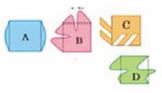
Ans. The shapes C and D will tile a floor (without any gaps)
The area of each of these shapes (i.e. tiles) is
2 2 square cm = 4 square cm.
2. Make a pattern using your tile. Trace the shape to repeat it on a page, but remember there must be no gaps between them. Ziri made a pattern using her yellow tiles. (You know the area of her tile.)
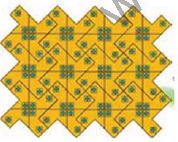
Answer these:
Q. How many tiles has she used?
Q. What is the area of the floor pattern Ziri has made here?
Ans. She has used 12 tiles.
The area of the floor pattern Ziri has made here is (12 3) square cm= 36 square cm.
3. Did you get all the 12 shapes using 5 squares?
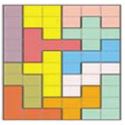
Draw all the 12 shapes on a sheet of cardboard and cut them.
Ans. Yes, I get all the 12 shapes using 5 squares as shown above.
All the 12 shapes may be drawn on a sheet of cardboard and also cut them as desired.
4. Ziri went to a shop and was surprised to see the different designs of tiles on the floor. Aren’t these beautiful! Can you find the tile which is repeated to make each of these floor patterns? Circle a tile in each pattern.
Ans. A tile in each pattern is shown as encircle.
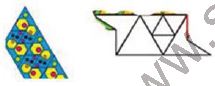
5. After looking at the patterns Ziri wanted to make her own yellow tile. You too make a tile this way.
Step 1: Take a piece of cardboard or thick paper. Draw a square of side 3 cm on it.

Step 2: Draw a triangle on any one of the sides of this square.

Step 3: Draw another triangle of the same size on another side of the square.
But this time draw it inside the square.

Step 4: Cut this shape from the cardboard. Your tile is ready! What is it’s area?

Ans. It’s area is 3 3 square cm i.e. 9 square cm.
6. Here is a rectangle of area 20 square cm.
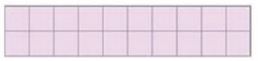
a) Draw one straight line in this rectangle to divide it into two equal triangles.
What is the area of each of the triangles?
b) Draw one straight line in this rectangle to divide it into two equal rectangles. What is the area of each of the smaller rectangles?
c) Draw two straight lines in this rectangle to divide it into one rectangle and two equal triangles.
d) What is the area of the rectangle?
e) What is the area of each of the triangles?
Ans. (a) One straight line is drawn in the given rectangle to divide it in two equal triangle as: shown below.
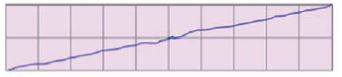
Area of each of the triangles is half of the given rectangle. Area of this rectangle is 20 square cm. So, the area of each of the triangles is 10 squares cm.
(b) One straight line is drawn in the given rectangle to divide it into two equal rectangles as shown below:
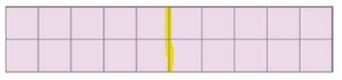
Area of each of the smaller rectangles is half of the given rectangle. Area of the given rectangle is 20 square cm. So, the area of each of two rectangles is 10 square cm.
(c) Two straight lines are drawn in the given rectangle to divide it into one rectangle and two equal triangles as shown below:
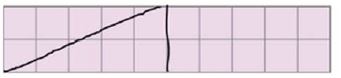
(d) Area of the new rectangle is half of the given rectangle. Area of the given rectangle is 20 square cm. So, the area of the smaller rectangle is 10 square cm.
(e) Area of the each of the triangles is half of the rectangle of area 10 square cm.
So, the area of each of the triangles is 5 square cm.
Question. QuestionIn how many different ways can you move from square X to square Y through the grid in exactly 4 steps. If moving diagonally is also allowed.
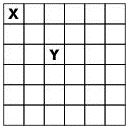
(a) 6
(b) 8
(c) 10
(d) more than 10
Answer : D
Question. Which of the following pair of shapes when joined together (by placing them edge to edge) can form a SQUARE? (The shapes can be turned if required)
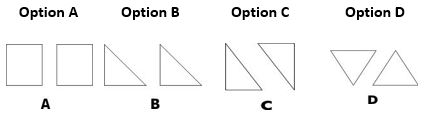
Answer : B
Question. A figure is drawn on a piece of squared paper:
What is the length of the border of this figure?
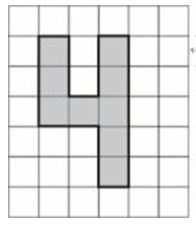
(a)
(b)
(c)
(d)
Answer : C
Free study material for Mathematics
Mathematics Class 5 Curriculum Solutions: Chapter 03 How Many Squares
Official NCERT Solutions for Chapter 03 How Many Squares
Review comprehensive exercise answers for Class 5 Mathematics Chapter 03 How Many Squares. Fully updated to match current NCERT syllabus guidelines, these textbook solutions help students verify their work and maintain accurate study notes.
Step-by-Step Explanations for Chapter 03 How Many Squares
Clear, methodical explanations accompany every challenging problem within the Class 5 Mathematics text. Engaging with these detailed answers lays a solid foundation for advanced learning and improves foundational clarity for upcoming assessments.
Next Steps in Your Mathematics Revision
Consistent practice with these solution guides cultivates faster problem-solving habits and clearer logical structuring. For a complete preparation experience, pair these textbook answers with our dedicated revision notes and sample papers for Class 5 Mathematics.
FAQs
The complete and updated NCERT Solutions Class 5 Mathematics Chapter 3 How Many Squares is available for free on StudiesToday.com. These solutions for Class 5 Mathematics are as per latest NCERT curriculum.
Yes, our experts have revised the NCERT Solutions Class 5 Mathematics Chapter 3 How Many Squares as per 2026 exam pattern. All textbook exercises have been solved and have added explanation about how the Mathematics concepts are applied in case-study and assertion-reasoning questions.
Toppers recommend using NCERT language because NCERT marking schemes are strictly based on textbook definitions. Our NCERT Solutions Class 5 Mathematics Chapter 3 How Many Squares will help students to get full marks in the theory paper.
Yes, we provide bilingual support for Class 5 Mathematics. You can access NCERT Solutions Class 5 Mathematics Chapter 3 How Many Squares in both English and Hindi medium.
Yes, you can download the entire NCERT Solutions Class 5 Mathematics Chapter 3 How Many Squares in printable PDF format for offline study on any device.