

Official NCERT Solutions for Class 5 Mathematics: Chapter 04 Parts and Wholes
Review structured textbook solutions for Class 5 Mathematics Chapter 04 Parts and Wholes. Built according to NCERT guidelines for the 2026-27 academic year, these downloadable answers support daily revision and problem-solving accuracy.
Chapter-wise Solutions for Mathematics: Chapter 04 Parts and Wholes
View or download the dedicated Chapter 04 Parts and Wholes solution resource below. Engaging with these textbook answers under focused study conditions ensures continuous academic progress and mastery of the 2026-27 curriculum for Mathematics.
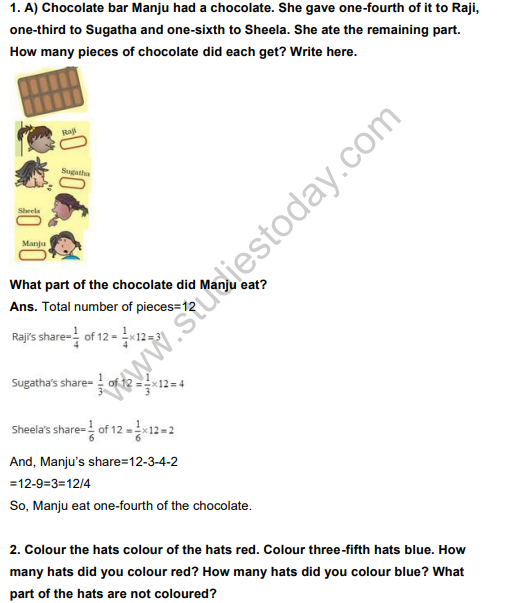
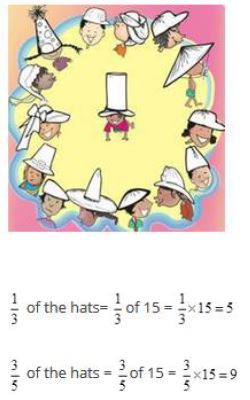
Five hats were coloured red.
Nine hats were coloured blue.
Number of hats left uncoloured=15-5-9=1
Thus, 1/15 of the hats are not coloured.
3. Equal part of a triangle
(a) The white triangle is divide into three equal parts. Fill each one-third part with a different colour.
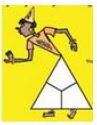
Can you show that these parts are equal? Think how?
Ans. (a) Since, one triangle is divided into three equal parts, therefore, each part is one-third 1/3 of the whole triangle. Let us 1/3 in each part and colour them in different colour as shown in the above figure.
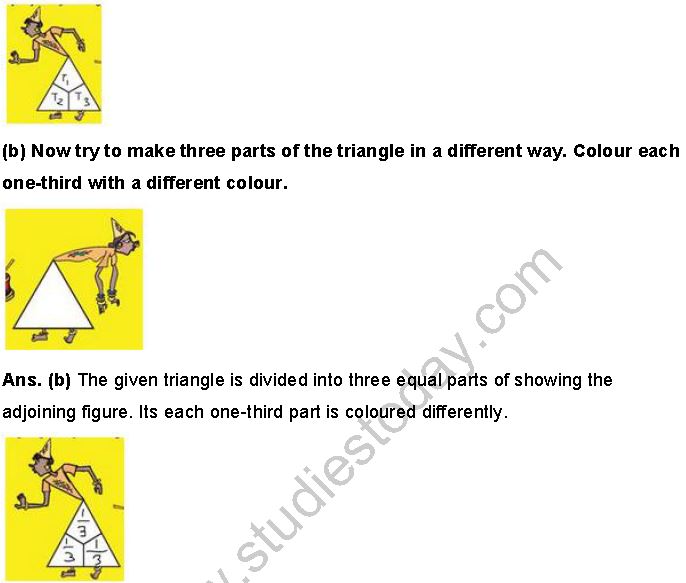
In order to show that these parts are equal. Let us name them, as T1, T2 and T3.
Trace any of them, say T1. Now place traced part over T2 and T3.We find that T1 cover T1, T2 and T3 are of the same shape and size. Hence, these triangles are equal.
4. How will you check that each part is really one-sixth of that rectangle?
Ans. Trace a rectangle equal to any one of the six parts of one of the figure. Put the trace out rectangle on the remaining parts one by one. It overlaps completely.
This shown that each all part is one sixth of the given rectangle. In the same, we can find out in case of the other figure.
5. The green rectangle is bigger than the blue one.
Can we say that 1/6 of the green rectangle is bigger than 1/6 of the blue rectangle.
Ans. Yes, we can say that 1/6 of the green rectangle is bigger than 1/6 of the blue rectangle.
6. Patterns in Parts
Make different patterns by colouring some squares in the grids A, B, C, D.
What part of the grid did you colour? What part of the grid remained white?
Write.
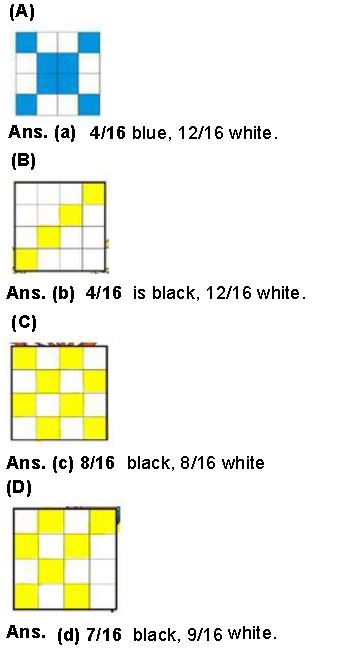
7. Look at grid A again. Is the grid coloured:
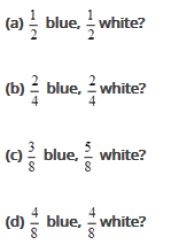
Mark (X) on the wrong answer.
Ans. (c) is the wrong answer.
8. Ramu’s Vegetable Field Ramu’s vegetable field has 9 equal parts. What vegetables does he grow?
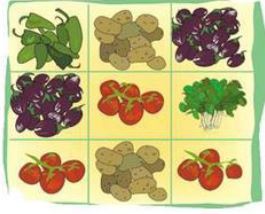
(1) Which vegetable grows in the biggest part of the field? What part?
(2) On what part of the field does he grow potatoes?
(3) What parts of the field is used to grow spinach? What part is used for brinjals?
Ans. Ramu grows chillies, potatoes, brinjals, tomatoes and spinach.
(1) Tomatoes grows in the biggest part of his field. It grows in one-third part of the field.
(2) He grows potatoes on 2/9 part of the field.
(3) 1/9 part of field is used to grow spinach. 2/9 art of the field is used for brinjals.
9. Ramu wanted to give these vegetables to his friends. He gave A boobacker one-fifth of these tomatoes and 1/3 of the potatoes. Srija got 2/5 of the tomatoes and 3/6 of the potatoes. Nancy got the rest of these vegetables.
Circle A boobacker’s share in blue. Circle Srija’s share in yellow.
Q. How many potatoes and tomatoes did Nanacy get?
Ans. A boobacker’s share is encircled in blue colour (double line) and that the Srija in yellow (single line) as
Nancy got 3 potatoes and 8 tomatoes.
10. Game: Who colours the Circle Fast?
This game is to be played in groups of 4. Each player has to make a circle as shown. Each one has to make 15 tokens on slips on paper.
Write
Write 1/2, 1/3, 1/4, 1/6, 1/12, 2/12, 3/12, 4/12, 11/12 to make your tokens.
Shuffle, the tokens and make a pile in the middle of the group. Now you are ready to start the game.
The first player takes a token from the pile, colours that part of the picture, and puts the token under the pile. The next player does the same, and so on.
The winner is the one who first colours the circle completely.
Who won the game?
What are the winner’s tokens?
Write the tokens you got.
What part of the circle did you colour?
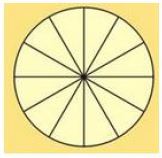
Ans. Each of the 4 players should make a circle as shown. Each one of them should make 15 tokens on slips of paper and write 1/2, 1/3, 1/4, 1/6, 1/12, 2/12, 3/12, 4/12, 11/12 to make the above and tokens. Let us play the game as directed.
I won the game.
The winner’s tokens are 1/2 and 6/12 .
I got tokens bearing numbers 1/2 and 6/12.
I coloured the circle completely.
11. Cutting the halwa Ramesh bought a piece of halwa for his children Ammu and Anu. He divided it equally for them.
(a) Each will get 1/2 part of halwa.
Ans. This piece is too big. We can’t eat it. They said. So, he divided the piece into half again. Now, many pieces will Ammu get? 2 pieces.
(b) What part of the halwa is it? 2/4
Ans. Make it even smaller. Dad they asked. So, he again cut the halwa into smaller pieces. Ok, thank you, Dad.
(c) Now how many pieces will each get?
Ans. Now each of them will get 4 pieces.
(d) What part of the halwa is each piece now?
Ans. Each piece now is 1/8 of the halwa.
(e) If Ramesh had cut the halwa into 6 equal parts how many pieces would each have got? Look at your answers for questions 1 to 4 and write:
1/2 = ……=…..=…..=……=…..
Ans. If Ramesh had cut the halwa into 6 equal parts, then each would get 3 pieces.
1/2 = 2/4 = 3/6 = 4/6 = 5/10 = 6/12
12. Rupees and Paise
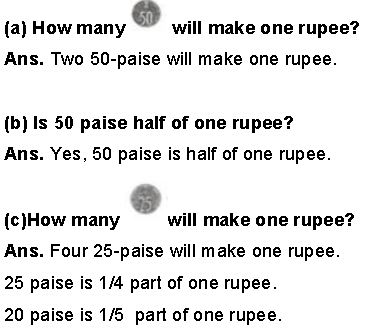
(d) How many 10-paise will make one rupee?
Ans. Ten 10-paise will make one rupee.
13. School Magazine
A School has decided to bring out a magazine every quarter of the year. How many magazines will they have in a year? If they want to print it at the end of each quarter of a year, which are the months for printing? Mark the number for those months.
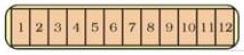
Ans. Every quarter of the year means every 1/4 of the year. It is exhibited on the strip as under:
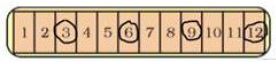
They will have four magazines in a year.
In order to print the magazine at the end of each quarter of the year, they should print it in the months of March, June, September and December. These months are encircled on the strip.
14. Sleeping Beauty!
Have you heard of Kumbhakarna, the brother of Ravana? He is famous for sleeping for half a year.
Most people sleep about 8 hours a day. Then what part of a day is it?
So what part of a year do they sleep? A person 60 years old must have slept ….years.
Ans. Yes, I have heard of Kumbhakarna, the brother of Ravana.
Most of the people sleeps for one-third of a day.
Because one-third of 60 years
= (1/3 x 600) years = 20 years.
Therefore, a person of 60 years old must have slept 20 years.
15. Keerti’s Shopping List
Look at the yellow price list.
(a) How much does 2kg of tomato cost?
(b) How much does 1/2 kg of tomato cost?
(c) Kiran wants 2(1/2) kg of tomato. How much will it cost?
(d) How much does 3(1/3) kg of potato cost?
(e) What is the price of 3(1/4) kg of carrot?
(f) He bought a gourd of weight 3(3/4) kg and it costs……
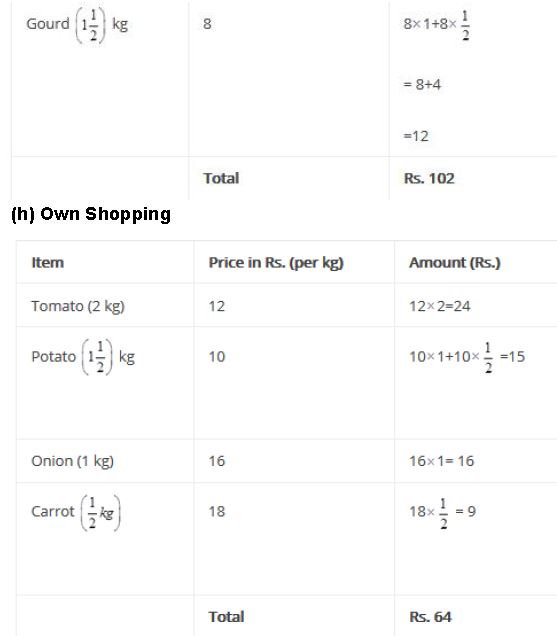
(g) Look at the shopping list in Keerti’s hand. How much will she have to pay to buy all the these?
(h) Make a bill of your own for vegetables you want to buy. Find the total money you will have to pay.
Ans. (a) 2kg of tomato costs = Rs. 12 x 2 = Rs. 24
(b) 1/2 kg of tomato costs = Rs. 12 x 1/2 = Rs. 6
(c) Cost of 2(1/2) kg of tomato
= Cost of 2kg of tomatoes + Cost of kg of tomato
= Rs. 12 x 2 + Rs. 12 x 1/2 = Rs. 24 + Rs.6 = Rs. 30
(d) Cost of 3(1/2) kg of potato
= Cost of 3 kg of potato + Cost of 1/2 kg of potato
= 10 x 3 + Rs. 10 x 1/2 = Rs. 30 + Rs. 5 = Rs. 35
16. Raheem’s Journey
(a) Raheem has to travel 1(1/4) km to reach school. What distance does he travel to go to school and come back home?
Ans. The distance travelled by Raheem to go to school and come back
= 1(1/4) km x 2 = 5/4 km 2 = 5/2 km = 2(1/2) km
(b) Lata bought a pencil and a pen for seven and a half rupees. She gave Rs. 10. The shopkeeper gave back the money in half and quarter rupees. What are the coin she get?
Ans. She might have got either of
(1) One 50-paise coin and eight 25-paise coins.
(2) Two 50-paise coins and six 25-paise coins.
(3) Three 50-paise coins and four 25-paise coins.
(4) Four 50-paise coins and two 25-paise coins.
17. At the railway station Your attention please. Mangalore Express coming from Mangalore and going
to Thiruvananthapuram is now running late by half an hour.
Oh the train is late today. The right time is a quarter to 7.
(a) What time is the train expected to come today?
Ans. The expected time of the train to come today is quarter past 7.
(b) Nazia gets off at a station after 2(1/2) hours from this station. What time will she get off?
Ans. Nazia will get off at quarter to 10.
(c) Shaji will take 5 hours to reach Ernakulam by this train. At what time will he reach there?
Ans. Shaji will reach Ernakulam by this train at a quarter past 12.
Question. Which of these sets of coins has the greatest value?
(a) 6 fifty paise coins
(b) 4 one-rupee coins
(c) 3 two rupee coins
(d) 3 rupees
Answer : C
Question. How many parts should be shaded in figure Q to make it represent the same fraction as the unshaded part of figure P?
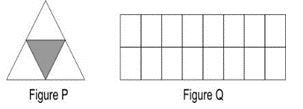
(a) 3
(b) 4
(c) 8
(d) 12
Answer : D
Question. What part of the picture below is shaded?
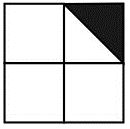
(a) 1/2
(b) 1/4
(c) 1 / 8
(d) 1/16
Answer : C
Question. Which number should come in place of ............ ?
1/7 + 2/7 + ......../7 = 1 (3/7)
(a) 1
(b) 2
(c) 3
(d) 7
Answer : D
Question. What is the decimal fraction shown by the shaded part of the figure given below?

(a) 0.4
(b) 0.5
(c) 0.6
(d) 2.5
Answer : A
Question. Komal eats one full bar of chocolate. Then she divides another one into 5 equal parts and eats 3 of those parts. The total number of chocolates that she has eaten is
(a) 4/5
(b) 3/5
(c) 8/10
(d) 8/5
Answer : D
Question. What fraction of a year is 5 months?
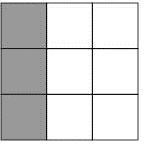
(a) 1/3
(b) 3/10
(c) 1/9
(d) 3/6
Answer : A
Question. How many one-fourths need to be added to 2 & 1/4 to make 4?
(a) 3
(b) 4
(c) 5
(d) 7
Answer : D
Question. If this clock shows the time at this moment, how many minutes ago was the time exactly 10 o'clock?
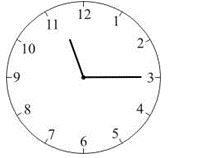
(a) 6
(b) 15
(c) 25
(d) 75
Answer : D
Question. 5 + (2/6 + 2/6 + 2/6) = 5 + (a + a + a).
Here “a” stands for:
(a) 3/4
(b) 1/3
(c) 3
(d) 4
Answer : B
Question. Which circle is two thirds shaded?
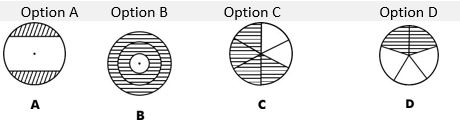
Answer : C
Question. What is the maximum number of 1 meter long pieces that we can get from this rope?

(a) 8
(b) 9
(c) 80
(d) 85
Answer : A
Question. In which figure does the shaded part represent a fraction that is MORE than 3/4 ?
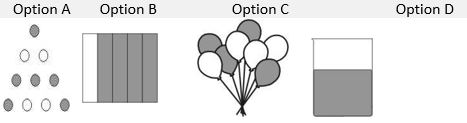
Answer : B
Free study material for Mathematics
Free NCERT Textbook Explanations: Class 5 Mathematics Chapter 04 Parts and Wholes
Official NCERT Solutions for Chapter 04 Parts and Wholes
Review comprehensive exercise answers for Class 5 Mathematics Chapter 04 Parts and Wholes. Fully updated to match current NCERT syllabus guidelines, these textbook solutions help students verify their work and maintain accurate study notes.
Step-by-Step Explanations for Chapter 04 Parts and Wholes
Beyond providing final answers, these guides offer step-by-step breakdowns for complex queries in the Class 5 Mathematics module. This approach helps students balance theoretical depth with practical problem-solving skills required for NCERT exams.
Next Steps in Your Mathematics Revision
Frequent review of these structured answers builds strong analytical capabilities and response efficiency. Maximize your academic readiness by combining these textbook solutions with our curated study materials and mock evaluations for Class 5 Mathematics.
FAQs
The complete and updated NCERT Solutions Class 5 Mathematics Chapter 4 Parts and Wholes is available for free on StudiesToday.com. These solutions for Class 5 Mathematics are as per latest NCERT curriculum.
Yes, our experts have revised the NCERT Solutions Class 5 Mathematics Chapter 4 Parts and Wholes as per 2026 exam pattern. All textbook exercises have been solved and have added explanation about how the Mathematics concepts are applied in case-study and assertion-reasoning questions.
Toppers recommend using NCERT language because NCERT marking schemes are strictly based on textbook definitions. Our NCERT Solutions Class 5 Mathematics Chapter 4 Parts and Wholes will help students to get full marks in the theory paper.
Yes, we provide bilingual support for Class 5 Mathematics. You can access NCERT Solutions Class 5 Mathematics Chapter 4 Parts and Wholes in both English and Hindi medium.
Yes, you can download the entire NCERT Solutions Class 5 Mathematics Chapter 4 Parts and Wholes in printable PDF format for offline study on any device.