

Mathematics Objective Questions and Answers: Chapter 03 Coordinate Geometry
Explore reliable objective questions for Chapter 03 Coordinate Geometry tailored for Class 9 learners. Utilizing these Mathematics multiple-choice formats ensures thorough preparation and strengthens problem-solving speed for upcoming school assessments.
Download Chapter 03 Coordinate Geometry MCQs with Answers
View or download the dedicated Chapter 03 Coordinate Geometry MCQ resource below. Practicing these 50 objective questions regularly builds familiarity with standard exam patterns and helps secure higher marks in final Mathematics evaluations.
1 What is the intersection of X and Y axes called?
(A) Origin
(B) Null point
(C) Common point
(D) Ordinate
Answer : A
2 What is the distance of t he point (2, 3) from the X-axis?
(A) 2 units
(C) 3 units
(B) 5 units
(D) 6 units
Answer : C
3 What is the distance of the point (3, 2) from theY-axis?
(A) 2 units
(C) 5 units
(B) 3 units
(D) 6 units
Answer : B
4 Where does the point (-2, 0) lie?
(A) On positive X-axis.
(B) On positive Y-axis.
(C) On negative X-axis.
(D) On negative Y-axis.
Answer : C
5 Where does the point (0,-2) lie?
(A) On positive X-axis.
(B) On positive Y-axis.
(C) On negative X-axis.
(D) On negative Y-axis.
Answer : D
6 Where does the point (3, 0) lie?
(A) On posit ve X-axis.
(B) On positive Y-axis.
(C) On negative X-axis.
(D) On negative Y-axis.
Answer : A
7 The points P(3, p) and Q(q, 5) represent the same point R. What are the respective values of p and q?
(A) 5 and 3
(C) 3 and 5
(B) - 5 and 3
(D) 3 and -5
Answer : A
8 What is the distance of a point (0,-3) from the origin?
(A) 0 units
(B) - 3 units
(C) cannot be determined
(D) 3 units
Answer : D
(9-12): Observe the given coordinate plane and answer the following questions.
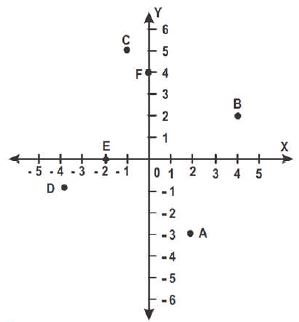
9 What are the coordinates of point C?
(A) (0,0)
(B) (-1,5)
(C) (2, - 3)
(D) (4, 2)
Answer : B
10 What are the coordinates of pointE?
(A) (0, - 2)
(B) (1, - 2)
(C) (-2, 1)
(D) (-2, 0)
Answer : D
11 What are the coordinat es of point D?
(A) (-4, - 1)
(B) (4,2)
(C) (0,4)
(D) (- 1,5)
Answer : A
12 What is they-coordinate of point F?
(A) - 3
(B) 0
(C) 4
(D) - 2
Answer : C
13 The points A(-a, -a), B(a, -a) C(-a, a), D(-a, a) form a polygon.
Where does the origin lie?
(A) On the vertex of the polygon.
(B) On the side of the polygon.
(C) Outside the polygon.
(D) At the point where the diagonals of the polygon meet.
Answer : C
(14- 16): Observe the given coordinate plane and answer the following questions
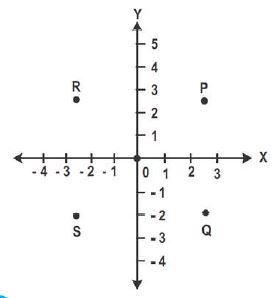
14 In which quadrant is the point (3, 3) ?
(A) Q1
(C) Q2
(B) Q3
(D) Q4
Answer : A
15 Which point is represented by the ordered pair (-3,-1)?
(A) p
(C) R
(B) Q
(D) S
Answer : D
16 What are the coordinates of the point Q?
(A) (- 2, 2)
(C) (3, 3)
(B) (2, - 2)
(D) (-3,-1)
Answer : B
17 What are the coordinates of origin ?
(A) (0, 1)
(C) (0, 0)
(B) (1, 0)
(D) (1, 1)
Answer : C
18 Which of the following quadrants has/ have points with a positive abscissa?
(A) I and II quadrant s
(B) I and IV quadrants
(C) I quadrant only
(D) IV quadrant only
Answer : B
19 Identify the co-ordinates of the point which lies on y-axis at a distance of 4 unit s in negative direction of y-axis.
(A) (0,4)
(C) (0, -4)
(B) (4, 0)
(D) (-4, 0)
Answer : C
20 In which of the fo llow ing quadrants ordinate of a point negative?
(A) Ill and IV quadrants
(B) Ill quadrant on ly
(C) II and Ill quadrants
(D) IV quadrant only
Answer : A
21 The point s (-5, 2) and (2, -5) lie in which of the following ?
(A) The same quadrant s.
(B) II and Ill quadrants respectively.
(C) II and IV quadrant s respectively.
(D) IV and and Ill quadrants respectively.
Answer : C
22 Which of the following points lieon the y- axis?
(A) (0,4)
(B) (- 2, 0)
(C) (3,0)
(D) (-1,-1)
Answer : A
23 Identify the ordered pairs that result in a quadrilateral.
(A) (1, - 1), (2, - 2), (4, - 4), (6, - 6)
(B) (1, 0), (-3, 0), (6, 0), (-8, 0)
(C) (3, 2), (2, 3), (- 4, 5), (5, - 3)
(D) (0, - 5), (0, 0), (0, 3), (0, 5)
Answer : C
24 The perpendicular dist ance of a point from the x-axis is 2 units and its perpendicular distance from they-axis is 3 units. Find the co-ordinates of the point if it lies in the Ill Quadrant .
(A) (- 3, - 2)
(B) (- 2, - 3)
(C) (3, - 2)
(D) (- 3, 2)
Answer : A
25 The perpendicular dist ance of a point from the x-axis is 4 unit s and its perpendicular distance from the y-axis is 5 units. What are the co-ordinates of such a point if it lies in the II Quadrant ?
(A) (-4, 5)
(B) (-5, 4)
(C) (-4, - 5)
(D) (5, - 4)
Answer : B
26 Which of the following pointslie on x-axis?
A (0, 2), B(0, 6), C(-3, 0), D(0, -3), E (0 , 4), F(6, 0), G(3 , 0)
(A) C, E and F
(C) C, Hand F
(B) D, E and B
(D) C, Hand B
Answer : C
27 Study the given graph.
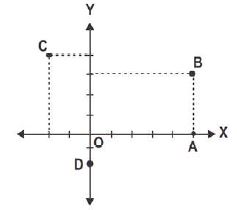
What are the co-ordinates of A, B, C and D?
(A) A (5, 3), B (0, 5), C (-2, 4), D (0, 2)
(B) A (0, 5), B (3, 5), C (4, -2), D (0, -2)
(C) A (5, 0), B (5, 3), C (-2, 4) D (-2, 0)
(D) A (5, 0), B (5, 3), C (-2, 4), D (0, -2)
Answer : D
28 In t he given graph, Δ ABC and Δ ABD are equilateral triangles.
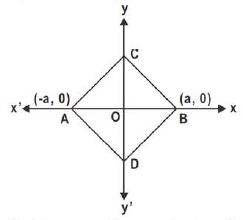
Find the respective coordinates of points C and D.
(A) (0, a√3) (0, a√3)
(B) (0,-a√3) (o, a√3)
(C) (0, a√3) (0, - a√3)
(D) (a√3,o) (-a√3,o)
Answer : C
29 Plot the points P(1, 0), 0(4, O) and 5(1, 3). Find the coordinates of the point R such that PQRS is a square.
(A) (3A)
(B) (4, 3)
(C) (3, -4)
(D) (-3, 4)
Answer : B
30 What is the number of quadrants of a cartesian plane?
(A) 1
(B) 2
(C) 3
(D) 4
Answer : D
31 Points A(-a, -a), B(a, - a), C(a, a) and D(x, y) form a square. In which of the following q uadrants does the point D lie?
(A) II
(B) Ill
(C) I
(D) IV
Answer : A
32 What is the ordinate of a point on the y-axis?
(A) A positive number
(B) A negative number
(C) 0
(D) All t he above
Answer : D
33 Which of the following are the signs of the coordinates of a point in the II quadrant ?
(A) (+, +)
(B) h + )
(C) (- , -)
(D) (+ , -)
Answer : B
34 What are the signs of the coordinates of a point in the Ill quadrant ?
(A) (+ , +)
(B) (h +)
(C) (+ , -)
(D) (- , -)
Answer : D
35 Study the given graph.
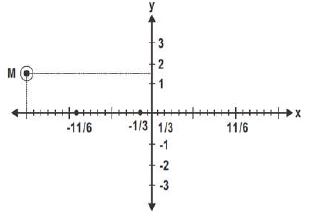
Identify the coordinates of the point M.
(A) (- 13/6, 1/2)
(B) ( -3, 3/2)
(C) (- 13/3, 1/2)
(D) ( -3/2, 3)
Answer : B
36 Which of the following statements is true?
(A) Ordinate is positive to the right of the origin.
(B) Ordinate is negative to the left of the origin.
(C) Ordinate is negative below x-axis.
(D) Ordinate is negative above x-axis.
Answer : C
37 Identify the correct statement.
(A) Ordinate is negative to the right of the origin.
(B) Abscissa is negative to the left of the origin.
(C) Ordinate is positive below x-axis.
(D) Abscissa is negative above x-axis.
Answer : B
38 Which of the following is true about the ordinat e?
(A) It is positive above x-axis.
(B) It is positive above y-axis.
(C) It is positive to the right of the origin.
(D) It is negative to the left of the origin.
Answer : A
39 Which figure is formed by joining point s O(0,0),B(16,0) and ((16, 12) on a graph paper?
(A) A triangle
(B) A square
(C) A right angled triangle
(D) A line
Answer : C
40 Which quadrilateral is formed by joining the point s (1, 1 ), (2, 4), (8, 4) and (1 0, 1 )?
(A) A triangle
(C) A rectangle
(B) A square
(D) A trapezium
Answer : D
41 Which of the following represent s the point (- 2, 5)?
(A) Moving 2 units towards right and 5 units upwards.
(B) Moving 2 units towards left and 5 units upwards.
(C) Moving 2 units towards right and 5 units downwards.
(D) Moving 2 units towards left and 5 units downwards.
Answer : B
Question. Point (–3, –2) lies in the quadrant:
(a) I
(b) II
(c) III
(d) IV
Question. Point (5, –4) lies in the quadrant:
(a) I
(b) II
(c) III
(d) IV
Question. Point (1, 7) lies in the quadrant:
(a) I
(b) II
(c) III
(d) IV
Question. Point (–6, 4) lies in the quadrant:
(a) I
(b) II
(c) III
(d) IV
Question. The point (–4, –3) means:
(a) x = –4, y = –3
(b) x = –3, y = –4
(c) x = 4, y = 3
(d) None of these
Question. Point (0, 4) lies on the:
(a) I quadrant
(b) II quadrant
(c) x – axis
(d) y – axis
Question. Point (5, 0) lies on the:
(a) I quadrant
(b) II quadrant
(c) x – axis
(d) y – axis
Question. On joining points (0, 0), (0, 2), (2,2) and (2, 0) we obtain a:
(a) Square
(b) Rectangle
(c) Rhombus
(d) Parallelogram
Question. Point (–2, 3) lies in the:
(a) I quadrant
(b) II quadrant
(c) III quadrant
(d) IV quadrant
Question. Point (0, –2) lies:
(a) on the x-axis
(b) in the II quadrant
(c) on the y-axis
(d) in the IV quadrant
Question. Signs of the abscissa and ordinate of a point in the first quadrant are respectively:
(a) +, +
(b) –, +
(c) +, –
(d) –, –
Question. Signs of the abscissa and ordinate of a point in the second quadrant are respectively:
(a) +, +
(b) –, +
(c) +, –
(d) –, –
Question. Signs of the abscissa and ordinate of a point in the third quadrant are respectively:
(a) +, +
(b) –, +
(c) +, –
(d) –, –
Question. Signs of the abscissa and ordinate of a point in the fourth quadrant are respectively:
(a) +, +
(b) –, +
(c) +, –
(d) –, –
Question. Point (–1, 0) lies in the:
(a) on the negative direction of x – axis
(b) on the negative direction of y – axis
(c) in the III quadrant
(d) in the IV quadrant
Question. Point (0, –2) lies in the:
(a) on the negative direction of x – axis
(b) on the negative direction of y – axis
(c) in the I quadrant
(d) in the II quadrant
Question. Abscissa of the all the points on x – axis is:
(a) 0
(b) 1
(c) –1
(d) any number
Question. Ordinate of the all the points on x – axis is:
(a) 0
(b) 1
(c) –1
(d) any number
Question. Abscissa of the all the points on y – axis is:
(a) 0
(b) 1
(c) –1
(d) any number
Question. Ordinate of the all the points on y – axis is:
(a) 0
(b) 1
(c) –1
(d) any number
Question. A point both of whose coordinates are negative will lie in:
(a) I quadrant
(b) II quadrant
(c) x – axis
(d) y – axis
Question. A point both of whose coordinates are positive will lie in:
(a) I quadrant
(b) II quadrant
(c) x – axis
(d) y – axis
Question. If y – coordinate of a point is zero, then this point always lies:
(a) I quadrant
(b) II quadrant
(c) x – axis
(d) y – axis
Question. If x – coordinate of a point is zero, then this point always lies:
(a) I quadrant
(b) II quadrant
(c) x – axis
(d) y – axis
Question. The point (1, –1), (2, –2), (4, –5), (–3,–4) lies in:
(a) II quadrant
(b) III quadrant
(c) IV quadrant
(d) do not lie in the same quadrant
Question. The point (1, –2), (2, –3), (4, –6), (2,–7) lies in:
(a) II quadrant
(b) III quadrant
(c) IV quadrant
(d) do not lie in the same quadrant
Question. The point (–5, 2) and (2,–5) lies in:
(a) same quadrant
(b) II and III quadrant, respectively
(c) II and IV quadrant, , respectively
(d) IV and II quadrant, respectively
Question. The point whose ordinate is 4 and which lies on y – axis is:
(a) (4, 0)
(b) (0, 4)
(c) (1, 4)
(d) (4, 2)
Question. Abscissa of a point is positive in:
(a) I and II quadrant
(b) I and IV quadrant
(c) I quadrant only
(d) II quadrant only
Question. The perpendicular distance of the point P(3,4) from the y – axis is:
(a) 3
(b) 4
(c) 5
(d) 7
Question. The point (–2, –5) lies in the
(a) I quadrant
(b) II quadrant
(c) III quadrant
(d) IV quadrant
Question. The sign of x-coordinate of a point lying in third quadrant is
(a) +
(b) –
(c) ±
(d) IV quadrant
Question. The signs of respective x-coordinate and y-coordinates of a point lying 2nd quadrant are
(a) –, +
(b) –, –
(c) +, –
(d) +, +
Question. The point (0, 4) lies on
(a) I quadrant
(b) negative x – axis
(c) positive x – axis
(d) y – axis
Question. The y-coordinate of any point lying on x-axis is
(a) 0
(b) 1
(c) –1
(d) any number
Question. The point where the two axes meet, is called
(a) x-coordinate
(b) y- coordinate
(c) quadrant
(d) origin
Question. The point (–5, 4) and (4, –5) are situated in
(a) same quadrant
(b) I and III quadrant, respectively
(c) Different quadrants
(d) IV and II quadrant, respectively
Question. The figure obtained by plotting the points (2, 3), (–2, 3),( –2, –3) and (2, –3) is a
(a) trapezium
(b) rectangle
(c) square
(d) rhombus
Question. In the given figure, on the sides the respective coordinates of points P and Q respectively are:
(a) (–2, –2), (1, 3)
(b) (–2, –2), (–1, 3)
(c) (–2, 2), (1, –3)
(d) (–2, 2), (1, 3)

Question. The point (0, –3) lies on
(a) negative side of y – axis
(b) negative side of x – axis
(c) positive side of x – axis
(d) positive side of y – axis
Question. If the coordinates of two points P and Q are (2, –3) and (–6, 5), then the value of (x-coordinate of P) – (x-coordinate of Q) is
(a) 2
(b) –6
(c) –8
(d) 8
Question. The point whose y-coordinate is 3 in the given figure is
(a) P
(b) Q
(c) R
(d) S
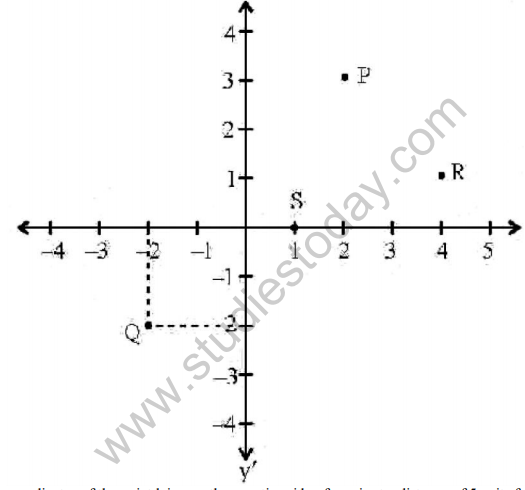
Question. The coordinates of the point lying on the negative side of x-axis at a distance of 5 units from origin are
(a) (0, 5)
(b) (0, –5)
(c) (–5, 0)
(d) (5, 0)
Question. The distance of the (4, –3) from x – axis is
(a) 3 units
(b) –3 units
(c) 4 units
(d) 5 units
Question. The origin lies on
(a) x-axis only
(b) both axes
(c) y-axis only
(d) none of the axes
Attempt Mock Tests on this topic
Free study material for Mathematics
Multiple Choice Questions (MCQs) for Class 9 Mathematics Chapter 03 Coordinate Geometry
Download Multiple Choice Questions: Chapter 03 Coordinate Geometry (Class 9 Mathematics)
Review structured objective questions for Class 9 Mathematics Chapter 03 Coordinate Geometry. Built according to official CBSE guidelines, these MCQ sets support daily revision and core concept reinforcement.
Concept Clarification for Chapter 03 Coordinate Geometry
Built using the official NCERT book for Class 9, these Mathematics objective sets provide reliable academic guidance. Pair your practice with our recommended NCERT solutions to master optimal problem-solving approaches.
Additional Study Resources for Class 9 Mathematics
Follow up your worksheet practice by attempting the interactive online Mathematics MCQ test for this chapter to evaluate your execution speed. All platform resources are free to access.
FAQs
You can get most exhaustive CBSE Class 9 Maths Coordinate Geometry MCQs for free on StudiesToday.com. These MCQs for Class 9 Mathematics are updated for the 2026-27 academic session as per CBSE examination standards.
Yes, our CBSE Class 9 Maths Coordinate Geometry MCQs include the latest type of questions, such as Assertion-Reasoning and Case-based MCQs. 50% of the CBSE paper is now competency-based.
By solving our CBSE Class 9 Maths Coordinate Geometry MCQs, Class 9 students can improve their accuracy and speed which is important as objective questions provide a chance to secure 100% marks in the Mathematics.
Yes, Mathematics MCQs for Class 9 have answer key and brief explanations to help students understand logic behind the correct option as its important for 2026 competency-focused CBSE exams.
Yes, you can also access online interactive tests for CBSE Class 9 Maths Coordinate Geometry MCQs on StudiesToday.com as they provide instant answers and score to help you track your progress in Mathematics.