

Multiple Choice Questions (MCQs) for Class 9 Mathematics: Chapter 04 Linear Equations in Two Variables
Review structured MCQ sets for Class 9 Mathematics Chapter 04 Linear Equations in Two Variables. Built according to official CBSE guidelines, these downloadable questions support daily revision and core concept reinforcement.
Practice Chapter 04 Linear Equations in Two Variables MCQs for Class 9 Mathematics
Access the complete set of multiple-choice questions for Chapter 04 Linear Equations in Two Variables below. This focused format allows students to isolate specific topics for thorough review and uninterrupted practice alongside official CBSE textbooks.
Question. Which equation satisfies the data given in the table?
| X | –1 | 0 | 1 | 2 |
| Y | –3 | –1 | 1 | 3 |
(A) y = x – 2
(B) y = 2x – 1
(C) y = 3x – 3
(D) y = x + 1
Answer : B
Question. How many linear equations in x and y can be satisfied by x = 2, y = 3?
(A) Only one
(B) Only two
(C) Infinitely many
(D) None of these
Answer : C
Question. If (2, 0) is a solution of the linear equation 2x + 3y = k, then the value of k is ______.
(A) 4
(B) 6
(C) 5
(D) 2
Answer : A
Question. If the graph of the equation 4x + 3y = 12 cuts the coordinate axes at A and B, then hypotenuse of right triangle AOB is of length
(A) 4 units
(B) 3 units
(C) 5 units
(D) None of these
Answer : C
Question. ax + by + c = 0 does not represent an equation of line, if ______.
(A) a = c = 0, b ≠ 0
(B) b = c = 0, a ≠ 0
(C) a = b = 0
(D) c = 0, a ≠ 0, b ≠ 0
Answer : C
Question. A straight line parallel to the y-axis has equation ______.
(A) x = a
(B) y = a
(C) y = x
(D) y = –x
Answer : A
Question. A and B are friends. A is elder to B by 5 years. B’s sister C is half the age of B while A’s father D is 8 years older than twice the age of B. If the present age of D is 48 years, find the present ages of A, B and C respectively.
(A) 50 years, 25 years, 20 years
(B) 40 years, 20 years, 15 years
(C) 20 years, 15 years, 10 years
(D) 25 years, 20 years, 10 years
Answer : D
Question. Mayank and Sujata, two students of class 9th together contributed ₹1000 to PPM relief fund.
(i) Find the linear equation satisfying the data.
(ii) If Sujata contributed ₹475, then how (₹) much Mayank contributed?
(i) (ii)
(A) 2x + y = 1000 575
(B) x + y = 1000 525
(C) 0⋅x + 1⋅y = 100 575
(D) 2x + 2y = 500 525
Answer : B
Question. The graph of the linear equation 2x + 3y = 6 is a line which meets the x-axis at the point
(A) (0, 2)
(B) (2, 0)
(C) (3, 0)
(D) (0, 3)
Answer : C
Question. In the rectangular coordinate system given below, the shaded region is bounded by two straight lines. Which of the following is not an equation of one of the boundary lines ?
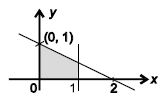
(A) x = 0
(B) x = 1
(C) x – y = 0
(D) x + 2y = 2
Answer : C
Question. Point (4, 1) lies on the line ______.
(A) x + 2y = 5
(B) 2x + y = – 6
(C) x + 2y = 6
(D) x + y = 16
Answer : C
Question. The equation x = 7 in two variables, can be written as ______.
(A) 1⋅x + 1⋅y = 7
(B) 1⋅x + 0⋅y = 7
(C) 0⋅x + 1⋅y = 7
(D) None of these
Answer : B
Question. If ∠A and ∠B are complementary angles and m∠A is x, which equation can be used to find m ∠B which is denoted by y?
(A) y = (90° + x)
(B) y = (90° – x)
(C) y = (180° – x)
(D) y = (x + 180°)
Answer : B
Question. The cost of a note book is twice the cost of a pen. If the cost of a note book is ₹ x and that of a pen is ₹ y, then a linear equation in two variables to represent the given condition is ______.
(A) x + 2y = 0
(B) x – 2y = 0
(C) 2x + y = 0
(D) 2x – y = 0
Answer : B
Question. A part of monthly expenses of a family on milk is fixed which is ₹700 and remaining varies with quantity of milk taken extra at the rate of ₹25 per litre. Taking quantity of milk required extra as x litres and total expenditure on milk as ₹y, write a linear equation from the above information.
(A) –25 x + y = 700
(B) 20 x + y = 500
(C) 20 x + 10y = 300
(D) x + 25 y = 900
Answer : A
Question. The equations representing the given graph is ______.

(A) 7x + 2y = 11; y – 2x = 3
(B) 2x + 7y = 11; 5x + (35y/2) = 25
(C) 3x – 7y = 10; 8y – 6x = 4
(D) 3x – 4y = 1; 8y – 6x = 4
Answer : D
Question. If the temperature of a liquid can be measured in kelvin units as x°K or in Fahrenheit units as y°F. The relation between the two systems of measurement of temperature is given by the linear equation.
y = 9/5(x - 273) + 32
(i) Find the temperature of the liquid in Fahrenheit if the temperature of the liquid is 313° K.
(ii) If the temperature is 158° F, then find the temperature in Kelvin.
(i) (ii)
(A) 112° F 150° K
(B) 112° F 243° K
(C) 104° F 343° K
(D) 104° F 150° K
Answer : C
Question. Fill in the blanks.
(i) A linear equation in two variables has P solutions(s).
(ii) The graph of Q line has an equation of the form x = k.
(iii) A line parallel to x-axis cuts the y-axis at R point(s).
(iv) Distance between the graph of equation y = 2 and y = –4 is S units.
P Q R S
(A) Zero Horizontal Zero 2
(B) Infinite Horizontal Two 6
(C) Infinite Vertical One 6
(D) Zero Vertical One 2
Answer : C
Question. The point (a, – a) always lies on ______.
(A) x + y = 0
(B) x – y = 0
(C) x = – a
(D) y = a
Answer : A
Question. The equation of the line whose graph passes through the origin is ______.
(A) 4x + 2y = – 1
(B) x + y = 1
(C) 8x + 7y = 0
(D) 8x – 1 = 4y
Answer : C
Question. Rakesh has ₹x more than Mohan has, and together they have a total of ₹y. Which of the following options represents the amount of money that Mohan has ?
(A) ₹ (y−x/2)
(B) ₹ (y−x/2)
(C) ₹ (y - x/2)
(D) ₹ (2y – x)
Answer : A
Question. The graph of y = 6 is a line
(A) Parallel to x-axis at a distance of 6 units from the origin.
(B) Parallel to y-axis at a distance of 6 units from the origin.
(C) Making an intercept of 6 units on the x-axis.
(D) Making an intercept of 6 units on both the axes.
Answer : A
Question. If the point (3, 4) lies on the graph of the equation 3y = ax + 7, then the value of a is ______.
(A) 2/3
(B) 1
(C) 4/3
(D) 5/3
Answer : D
Question. Which of the following is the graph of x + y = 6 and x – y = 2?
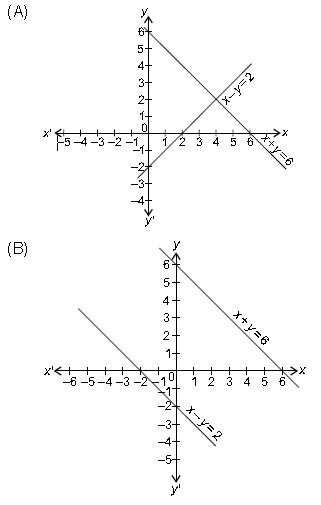
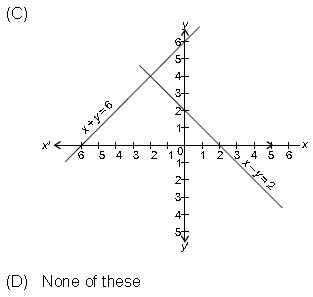
Answer : A
Question. Match the linear equations in column-I with their solutions in column-II.
Column-I Column-II
(P) 4x + 3y = 24 (i) (2, –3)
(Q) x/2 – y/3 = 2 (ii) (2, 3)
(R) 3x + 5y = 15 (iii) (3, 4)
(S) x - y/3 = y − 3 (iv) (9/3, 6/5)
(A) (P) → (ii), (Q) → (i), (R) → (iv), (S) → (iii)
(B) (P) → (iii), (Q) → (i), (R) → (iv), (S) → (ii)
(C) (P) → (ii), (Q) → (iv), (R) → (i), (S) → (iii)
(D) (P) → (iii), (Q) → (iv), (R) → (i), (S) → (ii)
Answer : B
Question. The solution of the equation x – 2y = 4 is:
(a) (0, 2)
(b) (4, 0)
(c) (1, 1)
(d) (2, 0)
Question. In graphical representation of y = – 4, line is:
(a) parallel to x – axis
(b) parallel to y – axis
(c) passes through origin
(d) None of these.
Question. Solution of the equation 2x + 1 = x + 3 is:
(a) 3
(b) 1
(c) 2
(d) 4
Question. The graph of line x – y = 0 passes through:
(a) (2, 3)
(b) (3, 4)
(c) (5, 6)
(d) (0, 0)
Question. The graph of line x + y = 7 intersect the x-axis at:
(a) (7, 0)
(b) (0, 7)
(c) (–7, 0)
(d) (0, –7)
Question. Point (4, 1) lies on the line:
(a) x + 2y = 5
(b) x + 2y = –6
(c) x + 2y = 6
(d) x + 2y = 16
Question. Graph of x = 2 is a line:
(a) parallel to x – axis
(b) parallel to y – axis
(c) passes through origin
(d) None of these.
Question. The linear equation 2x – 5y = 7 has
(a) a unique solution
(b) two solutions
(c) infinitely many solutions
(d) no solutions.
Question. The equation 2x + 5y = 7 has a unique solution, if x, y are:
(a) natural numbers
(b) positive numbers
(c) real numbers
(d) rational numbers.
Question. If (2, 0) is a solution of the linear equation 2x + 3y = k, then the value of k is
(a) 4
(b) 6
(c) 5
(d) 2
Question. Any solution of the linear equation 2x + 0y + 9 = 0 in two variables is of the form
(a) ( -9/2 ,m)
(b) (n,9/2)
(c) (0, 9/2)
(d) (–9, 0)
Question. The graph of the linear equation 2x + 3y = 6 cuts the y-axis at the point
(a) (2, 0)
(b) (0, 3)
(c) (3, 0)
(d) (0, 2)
Question. The equation x = 7, in two variables, can be written as
(a) x + 0y = 7
(b) 0x + y = 7
(c) 0x + 0y = 7
(d) x + y = 7
Question. Any point on the x – axis is of the form
(a) (x, y)
(b) (0, y)
(c) (x, 0)
(d) (x, x)
Question. Any point on the y = x is of the form
(a) (a, a)
(b) (0, a)
(c) (a, 0)
(d) (a, –a)
Question. The equation of x –axis is of the form
(a) x = 0
(b) y = 0
(c) x + y = 0
(d) x = y
Question. Graph of y = 6 is a line:
(a) parallel to x – axis at a distance 6 units from the origin
(b) parallel to y – axis at a distance 6 units from the origin
(c) making an intercept 6 on the x –axis.
(d) making an intercept 6 on both the axes.
Question. x=5, y=2 is a solution of the linear equation
(a) x + 2y = 7
(b) 5x + 2y = 7
(c) x + y = 7
(d) 5x + y = 7
Question. If a linear equation has solutions (–2, 2), (0, 0) and (2, –2), then its is of the form
(a) y – x = 0
(b) x + y = 0
(c) –2x + y = 0
(d) –x + 2y = 0
Question. The positive solutions of the equation is ax + by + c = 0 always lie in the
(a) 1st quadrant
(b) 2nd quadrant
(c) 3rd quadrant
(d)4th quadrant
Question. The graph of the linear equation 2x + 3y = 6 is a line which meets the x axis at the point
(a) (2, 0)
(b) (0, 3)
(c) (3, 0)
(d) (0, 2)

Question. If we multiply or divide both sides of a linear equation with a non-zero number, then the solution of the linear equation:
(a) changes
(b) remains the same
(c) changes in case of multiplication only
(d) changes in case of division only
Question. How many linear equation in x and y can be satisfied by x = 1 and y = 2?
(a) only one
(b) two
(c) infinitely many
(d) three
Question. The point of the form (a, a) always lies on:
(a) x – axis
(b) y – axis
(c) on the line y = x
(d) on the x + y =0
Question. The point of the form (a, –a) always lies on:
(a) x = a
(b) y = –a
(c) y = x
(d) x + y =0
Question. Which of the following is not a linear equation in two variables?
(a) ax + by = c
(b) ax2 + by = c
(c) 2x + 3y = 5
(d) 3x + 2y = 6
Question. The graph of ax + by + c = 0 is
(a) a straight line parallel to x–axis
(b) a straight line parallel to y–axis
(c) a general straight line
(d) a line in the 2nd and 3rd quadant
Question. The solution of a linear equation in two variables is
(a) a number which satisfies the given equation
(b) an ordered pair which satisfies the given equation
(c) an ordered pair, whose respective values when substituted for x and y in the given equation, satisfies it
(d) none of these
Question. One of the solution of a linear equation in two variables is
(a) (3, 2)
(b) (3, –2)
(c) (2, 3)
(d) (–2, –3)
Question. The ordered pair (m, n) satisfies the equation ax + by + c = 0 if
(a) am + bn = 0
(b) c = 0
(c) am + bn + c = 0
(d) am + bn – c = 0
Question. The equation of x – axis is
(a) a = 0
(b) y = 0
(c) x = 0
(d) y = k
Question. From the graph of a line, we can find the coordinates of
(a) only two point lying on the line
(b) only two points only lying on the line.
(c) only finite number of points lying on the line.
(d) only infinite number of points lying on the line.
Question. A linear equation in two variables has
(a) no solution
(b) only one solution
(c) only two solutions
(d) infinitely many solutions
Question. An equation of the form ax + by + c = 0 represents a linear equation in two variables, if
(a) a = 0, b ≠ 0
(b) a ≠ 0, b = 0
(c) a = 0, b = 0
(d) a = 0, b ≠ 0
Question. The graph of the linear equation in two variables y = mx is
(a) a line parallel to x – axis
(b) a line parallel to y – axis
(c) a line passing through the origin
(d) not a straight line
Attempt Mock Tests on this topic
Free study material for Mathematics
Download Chapter MCQs: Class 9 Mathematics Chapter 04 Linear Equations in Two Variables
About Chapter 04 Linear Equations in Two Variables MCQs for Class 9 Mathematics
Explore reliable practice questions for Chapter 04 Linear Equations in Two Variables tailored for Class 9 Mathematics learners. Use these multiple-choice formats to evaluate preparedness and strengthen problem-solving skills.
How to Verify Your MCQ Answers
Each question includes structured solution keys mapped directly to standard CBSE textbooks, helping students evaluate their reasoning and correct mistakes early in their revision.
Enhance Speed with Online MCQ Tests
Wrap up your chapter revision by testing your knowledge against standard question formats. Everything on our platform is provided free of charge.
FAQs
You can get most exhaustive CBSE Class 9 Maths Linear Equations in Two Variables MCQs Set 01 for free on StudiesToday.com. These MCQs for Class 9 Mathematics are updated for the 2026-27 academic session as per CBSE examination standards.
Yes, our CBSE Class 9 Maths Linear Equations in Two Variables MCQs Set 01 include the latest type of questions, such as Assertion-Reasoning and Case-based MCQs. 50% of the CBSE paper is now competency-based.
By solving our CBSE Class 9 Maths Linear Equations in Two Variables MCQs Set 01, Class 9 students can improve their accuracy and speed which is important as objective questions provide a chance to secure 100% marks in the Mathematics.
Yes, Mathematics MCQs for Class 9 have answer key and brief explanations to help students understand logic behind the correct option as its important for 2026 competency-focused CBSE exams.
Yes, you can also access online interactive tests for CBSE Class 9 Maths Linear Equations in Two Variables MCQs Set 01 on StudiesToday.com as they provide instant answers and score to help you track your progress in Mathematics.