

Refer to CBSE Class 11 Chemistry HOTs The P Block Elements. We have provided exhaustive High Order Thinking Skills (HOTS) questions and answers for Class 11 Chemistry Chapter 11 The p-Block Elements. Designed for the 2026-27 exam session, these expert-curated analytical questions help students master important concepts and stay aligned with the latest CBSE, NCERT, and KVS curriculum.
Chapter 11 The p-Block Elements Class 11 Chemistry HOTS with Solutions
Want to boost your grades in Chemistry? Solving Class 11 Chemistry HOTS Questions is a great way to build strong logic. Review the step-by-step answers below to increase your speed and feel fully ready for your Class 11 exams.
Download HOTS: Chapter 11 The p-Block Elements (Class 11 Chemistry)
Question. H3BO3 on heating up to 373 K yields
(a) boric anhydride
(b) orthoboric acid
(c) metaboric acid
(d) tetraboric acid
Answer : C
Question. In reaction BF3 + 3LiBH4 → 3LiF + X ; X is
(a) B4H10
(b) B2H6
(c) BH3
(d) B3H8
Answer : B
Question. Soldiers of Napolean army while at alps during freezing winter suffered a serious problem as regards to the tin buttons of their uniforms. White metallic tin buttons got converted to grey powder. This transformation is related to
(a) a change in the partial pressure of oxygen in the air
(b) a change in the crystalline structure of tin
(c) an interaction with nitrogen of the air at very low temperatures
(d) an interaction with water vapours contained in the humid air
Answer : B
Question. The dissolution of Al(OH)3 by a solution of NaOH results in the formation of
(a) [Al(H2O)4 (OH)]2+
(b) [Al(H2O)2 (OH)4]-
(c) [Al(H2O)3(OH)3]
(d) [Al(H2O)6 (OH)3]
Answer : B
Question. When aluminium is heated in atomoshere of nitrogen it forms :
(a) AlN
(b) Al2N
(c) Al3N
(d) Al2N3
Answer : A
Question. The tendency of X in BX3 (X = F, Cl, OMe, NMe) to form a p - bond with boron follows the order
(a) BCl3 < BF3 < B(OMe)3 < B(NMe2)3
(b) BF3 < BCl3 < B(OMe)3 < B(NMe2)3
(c) BCl3 < B(NMe2)3 < B(OMe)3 < BF3
(d) BCl3 < BF3 < B(NMe2)3 < B(OMe)3
Answer : A
Question. PbO2 is obtained from
(a) the reaction of PbO with HCl
(b) thermal decomposition of Pb(NO3)2 at 200 °C
(c) the reaction of Pb3O4 with HNO3
(d) the reaction of Pb with air at room temperature
Answer : C
Question. The role of fluorspar (CaF2) which is added in small quantities in the electrolytic reduction of alumina dissolved in fused cryolite (Na3AlF6) is
(a) as a catalyst
(b) to make the fused mixture very conducting
(c) to increase the temperature of the melt.
(d) to decrease the rate of oxidation of carbon at the anode.
Answer : B
Question. Aluminium chloride exists as dimer, (Al2Cl6) in solid state as well as in solution of non-polar solvents such as benzene. When dissolved in water, it gives
(a) [Al(OH)6]3- +3HCl
(b) [Al(H2O)6]3+ + 3Cl-
(c) Al3+ + 3Cl-
(d) Al2O3+6HCl
Answer : B
Question. Diborane is prepared on large scale by
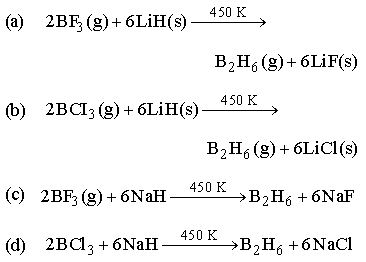
Answer : A
Question. Silicon dioxide is formed by the reaction of
(a) SiCl4 + H2O
(b) SiO2 + HF
(c) SiO2 + NaOH
(d) SiCl4 + NaOH
Answer : A
Question. What is not correct about carbon monoxide ?
(a) Carbon in CO is sp hybridised and is linear molecule
(b) CO is a ligand because it has a lone pair of electrons on the carbon atom
(c) CO is the reducing agent in metallurgy of iron
(d) CO has the structure C = O
Answer : D
Question. The gas evolved on heating CaF2 and SiO2 with concentrated H2SO4, on hydrolysis gives a white gelatinous precipitate. The precipitate is
(a) hydrofluorosilicic acid
(b) silica gel
(c) silicic acid
(d) calciumfluorosilicate
Answer : D
Question. On heating Pb(NO3)2, the products formed are:
(a) PbO, N2, O2
(b) Pb (NO2)2, O2
(c) PbO, NO2, O2
(d) Pb, N2, O2
Answer : C
Question. An allotrope of carbon which exhibits only two types of C - C bond distance of 143.5 pm and 138.3 pm, is
(a) charcoal
(b) graphite
(c) diamond
(d) fullerene
Answer : D
Question. A solid element (symbol Y) conducts electricity and forms two chlorides YCln (colourless volatile liquid) and YCln-2 (a colourless solid).
To which one of the following groups of the periodic table does Y belong?
(a) 13
(b) 14
(c) 15
(d) 16
Answer : B
Question. The reducing power of divalent species decreases in the order
(a) Ge > Sn > Pb
(b) Sn > Ge > Pb
(c) Pb > Sn > Ge
(d) None of these
Answer : A
Question. SiF4 gets hydrolysed giving........
(a) SiO2
(b) Si(OH)2F2
(c) H2SiF6
(d) Si(OH)4
Answer : D
Question. The product of the following reaction are:

(a) SiC and CO2
(b) SiO and CO
(c) SiC and CO
(d) Si and CO
Answer : C
Numeric Value Answer
Question. In aluminates, the coordination number of Al is
Answer : 6
Question. In a molecule of C60 Buckminsterfullerene, what is the sum of six-membered and five membered rings?
Answer : 32
Question. How many orbitals of boron are involved in hybridisation in B2H6?
Answer : 4
Question. What is the sum for the molecular masses of constituents of producer gas?
Answer : 56
Question. How many oxides of the following are nonamphoteric in nature? CO2, SiO2, SnO2 and CaO
Answer : 3
Free study material for Chemistry
CBSE Class 11 Chemistry Chapter 11 The p-Block Elements HOTS Questions and Answers
High Order Thinking Skills: Chapter 11 The p-Block Elements Overview
Strengthen your preparation for Class 11 Chemistry examinations with specialized Chapter 11 The p-Block Elements HOTS worksheets. These structured problems are curated to match official CBSE guidelines and help tackle difficult board-level questions.
Verified Solutions for Better Concept Clarity
Each question in this set is mapped directly to the official NCERT book for Class 11. Review the detailed answer keys provided below each problem to verify your solution steps and correct mistakes early.
Additional Revision and Practice Tests
Wrap up your chapter revision by testing your speed with our interactive Chemistry quizzes. Access all curriculum-aligned study resources online without any restrictions.
FAQs
You can download the teacher-verified PDF for CBSE Class 11 Chemistry HOTs The P Block Elements from StudiesToday.com. These questions have been prepared for Class 11 Chemistry to help students learn high-level application and analytical skills required for the 2026-27 exams.
In the 2026 pattern, 50% of the marks are for competency-based questions. Our CBSE Class 11 Chemistry HOTs The P Block Elements are to apply basic theory to real-world to help Class 11 students to solve case studies and assertion-reasoning questions in Chemistry.
Unlike direct questions that test memory, CBSE Class 11 Chemistry HOTs The P Block Elements require out-of-the-box thinking as Class 11 Chemistry HOTS questions focus on understanding data and identifying logical errors.
After reading all conceots in Chemistry, practice CBSE Class 11 Chemistry HOTs The P Block Elements by breaking down the problem into smaller logical steps.
Yes, we provide detailed, step-by-step solutions for CBSE Class 11 Chemistry HOTs The P Block Elements. These solutions highlight the analytical reasoning and logical steps to help students prepare as per CBSE marking scheme.