

Find CBSE Class 11 Chemistry HOTs States of Matter right below. We offer complete High Order Thinking Skills (HOTS) questions and answers for Class 11 Chemistry Chapter 05 States of Matter. Designed to support your 2026-27 exam session goals, these expert questions match standard curriculum patterns from CBSE, NCERT, and KVS.
Class 11 Chemistry Chapter 05 States of Matter HOTS Questions & Answers
Working through Class 11 Chemistry HOTS Questions helps you master complex topics in Chemistry. Rely on the clear explanations given below to sharpen your analytical skills and prepare well for your Class 11 evaluations.
Chapter 05 States of Matter HOTS Solutions for Class 11 Chemistry
Question. A container contains 1 mole of a gas at 1 atm pressure and 27 °C, while its volume is 24.6 litres.
If its pressure is 10 atm and temperature 327°C, then new volume is
(a) 2.56 litres
(b) 3.15 litres
(c) 4.92 litres
(d) 5.44 litres
Answer : C
Question. Equal weights of methane and hydrogen are mixed in an empty container at 25ºC. The fraction of the total pressure exerted by hydrogen is :
(a) 1/2
(b) 8/9
(c) 9/1
(d) 17/16
Answer : B
Question. A spherical balloon of 21 cm diameter is to be filled up with hydrogen at N.T.P. from a cylinder containing the gas at 20 atmospheres at 27ºC. If the cylinder can hold 2.82 litres of water, calculate the number of balloons that can be filled up.
(a) 9
(b) 8
(c) 12
(d) 10
Answer : D
Question. One mole of gas A and three moles of a gas B are placed in flask of volume 100 litres at 27°C. Calculate the total partial pressure of the gases in the mixture.
(a) 1.0 atm.
(b) 0.9 atm
(c) 0.985 atm
(d) 10.850 atm.
Answer : C
Question. 14 g of N2 and 36 g of ozone are at the same pressure and temperature. Their volumes will be related as
(a) 2VN2 = 3VO3
(b) 3VN2 = 2VO3
(c) 3VN2 = 4VO3
(d) 4VN2 = 3VO3
Answer : B
Question. The pressure (P) and volume (V) isotherm of avan der Waals’ gas, at the temperature at which it undergoes gas to liquid transition, is correctly represented by
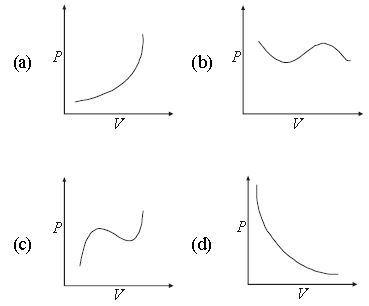
Answer : B
Question. 16 g of oxygen and 3 g of hydrogen are mixed and kept at 760 mm of Hg pressure and 0°C. The total volume occupied by the mixture will be nearly
(a) 22.4 litres
(b) 33.6 litres
(c) 448 litres
(d) 44800 mL
Answer : D
Question. 600 c.c. of a gas at a pressure of 750 mm of Hg is compressed to 500 c.c. Taking the temperature to remain constant, the increase in pressure, is
(a) 150 mm of Hg
(b) 250 mm of Hg
(c) 350 mm of Hg
(d) 450 mm of Hg
Answer : A
Question. X mL of H2 gas effuses through a hole in a container in 5 seconds. The time taken for the effusion of the same volume of the gas specified below under identical conditions is :
(a) 10 seconds : He
(b) 20 seconds : O2
(c) 25 seconds : CO
(d) 55 seconds : CO2
Answer : B
Question. Oxygen is present in 1 litre flask at a pressure of 7.6 × 10⁻¹⁰ mm of Hg. Calculate the number of oxygen molecules in the flask at 0ºC.
(a) 2.8 ×10⁸
(b) 2.7 × 10¹⁰
(c) 0.27×10¹⁰
(d) 3.0 ×10⁹
Answer : B
Question. The root mean square speeds at STP for the gases H2, N2, O2 and HBr are in the order :
(a) H2 < N2.< O2 < HBr
(b) HBr < O2 < N2 < H2
(c) H2 < N2 = O2 < HBr
(d) HBr < O2 < H2 < N2.
Answer : B
Question. A given volume of ozonised oxygen (containing 60% oxygen by volume) required 220 sec to effuse while an equal volume of oxygen took 200 sec only under identical conditions. If density of O2 is 1.6 g/L then find density of O3.
(a) 1.936 g/L
(b) 2.16 g/L
(c) 3.28 g/L
(d) 2.24 g/L
Answer : D
Question. A container of volume 2.24 L can withstand a maximum pressure of 2 atm at 298 K before exploding. The maximum amount of nitrogen (in g) that can be safely put in this container at this temperature is closest to
(a) 2.8
(b) 5.6
(c) 1.4
(d) 4.2
Answer : D
Question. At 300 K, the density of a certain gaseous molecule at 2 bar is double to that of dinitrogen (N2) at 4 bar. The molar mass of gaseous molecule is :
(a) 28 g mol–1
(b) 56 g mol–1
(c) 112 g mol–1
(d) 224 g mol–1
Answer : C
Question. Two flasks A and B of equal volumes maintained at temperatures 300K and 600K contain equal mass of H2 and CH4 respectively. The ratio of total translational kinetic energy of gas in flask A to that in flask B is
(a) unity
(b) 2
(c) 4
(c) 0.25
Answer : C
Question. Calculate the total pressure in a 10.0 L cylinder which contains 0.4 g helium, 1.6 g oxygen and 1.4 g nitrogen at 27 °C.
(a) 0.492 atm
(b) 49.2 atm
(c) 4.52 atm
(d) 0.0492 atm
Answer : A
Question. I, II, and III are three isotherms, respectively, at T1, T2 and T3. Temperature will be in order
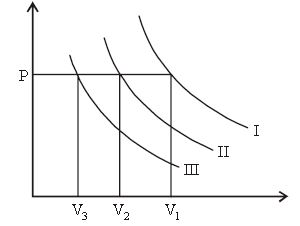
(a) T1 = T2 = T3
(b) T1 < T2 < T3
(c) T1 > T2 > T3
(d) T1 > T2 = T3
Answer : C
Question. The root mean square speed of hydrogen in √5 times than that of nitrogen. If T is the temperature of the gas, then :
(a) TH2 = TN2
(b) TH2 > TN2
(c) TH2 < TN2
(d) TH2 = √TN2
Answer : C
Question. For one mole of a van der Waals gas, the compressibility factor Z(= PV/RT) at a fixed volume will certainly decrease if [Given: “a”, “b” are standard parameters for van der Waals gas]
(a) “b” increases and “a” decreases at constant temperature
(b) “b” decreases and “a” increases at constant temperature
(c) temperature increases at constant “a” and “b” values
(d) “b” increases at constant “‘a” and temperature
Answer : B
Question. A mixture of Ne and Ar kept in a closed vessel at 250 K has a total K.E. = 3kJ. The total mass of Ne and Ar is 30 g. Find mass % of Ne in gaseous mixture at 250 K.
(a) 61.63
(b) 38.37
(c) 50%
(d) 28.3
Answer : D
Numeric Value Answer
Question. A gas diffuse1/5 times as fast as hydrogen. If its molecular weight is 10y. What will be the value of y?
Answer : 5
Question. The root mean square speed of 4g of helium gas is 450 m/s. What is the value of total kinetic energy (J) of this sample?
Answer : 405
Question. At 400 K, the root mean square (rms) speed of a gas X (molecular weight = 40) is equal to the most probable speed of gas Y at 60 K. The molecular weight of the gas Y is
Answer : 4
Question. If an ideal gas at 100 K is heated to 109 K in a rigid container, the pressure increases by X%.
What is the value of X?
Answer : 9
Question. The rate of diffusion of methane at a given temperature is twice that of a gas X. If the molecular weight of X is 8y then what will be the value of y?
Answer : 8
Question. One mole of a gas changed from its initial state (15L, 2 atm) to final state (4L, 10 atm) reversibly. If this change can be represented by a straight line in P – V curve maximum temperature (approximate), the gas attained is x × 102K. Then find the value of x.
Answer : 7
Question. At 300 K, the average kinetic energy of a deuterium molecule is n times than that of a hydrogen molecule. Find the value of n.
Answer : 1
Question. A flask has 10 gas particles, out of which four particles are moving at 7 ms–1 and the remaining are moving at the same speed of ‘X’ ms–1. If the r.m.s. of the gas is 5 ms–1, what is the value of X?
Answer : 3
Question. A flask containing air at 107°C and 722 mm of Hg is cooled to 100 K and 760 mm of Hg. If density in the initial condition 1 g/cm3, then what is the final density (g/cm3)?
Answer : 4
Question. If the ratio of critical temperature to critical pressure for a real gas is mb/R, then what is the integer value of m?
Answer : 8
Free study material for Chemistry
Download Class 11 Chemistry Chapter 05 States of Matter HOTS Practice Questions
Preparing with Chapter 05 States of Matter HOTS Exercises
Download high-level analytical questions for Chapter 05 States of Matter. Designed in alignment with the latest CBSE syllabus for Class 11 Chemistry, these problem sets test deep conceptual understanding and prepare students for complex exam questions.
Verified Solutions for Better Concept Clarity
Each question in this set is mapped directly to the official NCERT book for Class 11. Review the detailed answer keys provided below each problem to verify your solution steps and correct mistakes early.
Additional Revision and Practice Tests
Looking for more practice? Explore our complete library of Class 11 Chemistry worksheets, chapter notes, and online mock tests. Everything is provided free of charge to support your academic goals.
FAQs
You can download the teacher-verified PDF for CBSE Class 11 Chemistry HOTs States of Matter from StudiesToday.com. These questions have been prepared for Class 11 Chemistry to help students learn high-level application and analytical skills required for the 2026-27 exams.
In the 2026 pattern, 50% of the marks are for competency-based questions. Our CBSE Class 11 Chemistry HOTs States of Matter are to apply basic theory to real-world to help Class 11 students to solve case studies and assertion-reasoning questions in Chemistry.
Unlike direct questions that test memory, CBSE Class 11 Chemistry HOTs States of Matter require out-of-the-box thinking as Class 11 Chemistry HOTS questions focus on understanding data and identifying logical errors.
After reading all conceots in Chemistry, practice CBSE Class 11 Chemistry HOTs States of Matter by breaking down the problem into smaller logical steps.
Yes, we provide detailed, step-by-step solutions for CBSE Class 11 Chemistry HOTs States of Matter. These solutions highlight the analytical reasoning and logical steps to help students prepare as per CBSE marking scheme.