

Find CBSE Class 11 Chemistry HOTs The S Block Elements right below. We offer complete High Order Thinking Skills (HOTS) questions and answers for Class 11 Chemistry Chapter 10 The s-Block Elements. Designed to support your 2026-27 exam session goals, these expert questions match standard curriculum patterns from CBSE, NCERT, and KVS.
Download Class 11 Chemistry Chapter 10 The s-Block Elements HOTS Practice
Working through Class 11 Chemistry HOTS Questions helps you master complex topics in Chemistry. Rely on the clear explanations given below to sharpen your analytical skills and prepare well for your Class 11 evaluations.
Class 11 Chemistry Chapter 10 The s-Block Elements Advanced HOTS Questions
Question. Which of the following is not correct ?
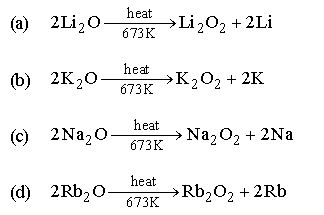
Answer : A
Question. The stability of the following alkali metal chlorides follows the order
(a) LiCl > KCl > NaCl > CsCl
(b) CsCl > KCl > NaCl > LiCl
(c) NaCl > KCl > LiCl > CsCl
(d) KCl > CsCl > NaCl > LiCl
Answer : D
Question. The element which on burning in air gives peroxide is
(a) lithium
(b) sodium
(c) rubidium
(d) caesium
Answer : B
Question. Which property of sodium is being used in street lights ?
(a) It shows photoelectric effect
(b) It has low melting point
(c) Sodium atom emits photons in the yellow region of visible spectrum, due to electrically stimulated transitions
(d) Sodium vapours show golden colour
Answer : C
Question. Philosopher's wool on heating with BaO at 1100°C produces:
(a) Ba + ZnCl2
(b) BaCdO2
(c) BaZnO2
(d) BaO2+ Zn
Answer : C
Question. Sodium thiosulphate, Na2S2O3. 5H2O is used in photography to
(a) reduce the silver bromide grains to metallic silver
(b) convert the metallic silver to silver salt
(c) remove undecomposed AgBr as soluble silver thiosulphate complex.
(d) remove reduced silver
Answer : C
Question. Sodium sulphate is soluble in water whereas barium sulphate is sparingly soluble because
(a) the hydration energy of sodium sulphate is more than its lattice energy
(b) the lattice energy of sodium sulphate is equal to its hydration energy
(c) the hydration energy of sodium sulphate is less than its lattice energy
(d) None of these
Answer : A
Question. Which of the following statements about Na2O2 is not correct?
(a) It is diamagnetic in nature
(b) It is derivative of H2O2
(c) Na2O2 oxidises Cr3+ to CrO42- in acid medium.
(d) It is the super oxide of sodium
Answer : D
Question. Metallic magnesium is prepared by
(a) reduction of MgO by coke
(b) electrolysis of aqueous solution of Mg(NO3)2
(c) displacement of Mg by iron from MgSO4 solution
(d) electrolysis of molten MgCl2
Answer : D
Question. Hesenclever ’s process is a method for the manufacture of
(a) NaOH
(b) HNO3
(c) H2SO4
(d) Bleaching powder
Answer : D
Question. Which of the following compounds are paramagnetic in nature?
(a) KO2
(b) K2O2
(c) Na2O2
(d) Rb2O2
Answer : A
Question. Causticisation is a process in which
(a) soap is prepared by treating vegetable oils with caustic soda
(b) paper is formed
(c) petroleum is treated with caustic soda before fractional distillation
(d) caustic soda is manufactured by treating sodium carbonate with lime.
Answer : D
Question. Lithopone is
(a) BaO + ZnSO4
(b) BaS + ZnSO4
(c) ZnS + BaSO4
(d) ZnO + BaSO4
Answer : C
Question. Equimolar solutions of the following compounds are prepared separately in water. Which will have the lowest pH value ?
(a) BeCl2
(b) SrCl2
(c) CaCl2
(d) MgCl2
Answer : A
Question. 100 mL of tap water containing Ca(HCO3)2 was titrated with N/50 HCl with methyl orange as indicator. If 30 mL of HCl were required, calculate the temporary hardness as parts of CaCO3 per 106 parts of water.
(a) 150 ppm
(b) 300 ppm
(c) 450 ppm
(d) 600 ppm
Answer : B
Question. Which of the following sulphates have the highest solubility in water?
(a) MgSO4
(b) BaSO4
(c) CaSO4
(d) BeSO4
Answer : D
Question. An inorganic compound which on heating first melts, then solidifies and liberates O2 gas, the inorganic compound is
(a) Al2O3
(b) KMnO4
(c) MnO2
(d) KClO3
Answer : D
Question. Li has the maximum value of ionisation potential among alkali metals i.e. lithium has the minimum tendency to ionise to give Li+ ion. Thus, in aq. solution lithium is
(a) Strongest reducing agent
(b) Poorest reducing agent
(c) Strongest oxidising agent
(d) Poorest oxidising agent
Answer : A
Question. Thermal stability of alkaline earth metal carbonates decreases in order
(a) BaCO3 > SrCO3 > CaCO3 > MgCO3
(b) BaCO3 > SrCO3 > MgCO3 > CaCO3
(c) CaCO3 > SrCO3 > MgCO3 > BaCO3
(d) None of these
Answer : A
Question. Chemical A is used for water softening to remove temporary hardness. A reacts with Na2CO3 to generate caustic soda. When CO2 is bubbled through A, it turns cloudly. What is the chemical formula of A
(a) CaCO3
(b) CaO
(c) Ca(OH)2
(d) Ca(HCO3)2
Answer : C
Question. Which one of the following salts does not impart colour to the flame ?
(a) KI
(b) LiCl
(c) CaCl2
(d) MgCl2
Answer : D
Question. Which of the following metal carbonate is decomposed on heating?
(a) MgCO3
(b) Na2CO3
(c) K2CO3
(d) Rb2CO3
Answer : A
Question. Which of the following has correct increasing basic strength?
(a) MgO < BeO < CaO < BaO
(b) BeO < MgO < CaO < BaO
(c) BaO < CaO < MgO < BeO
(d) CaO < BaO < BeO < MgO
Answer : B
Question. Which of the following is used as a scavenger in metallurgy?
(a) Be
(b) Mg
(c) Ca
(d) Sr
Answer : C
Free study material for Chemistry
Download Class 11 Chemistry Chapter 10 The s-Block Elements HOTS Practice Questions
Challenging Questions for Class 11 Chemistry Chapter 10 The s-Block Elements
Master core concepts in Chapter 10 The s-Block Elements with these targeted Higher Order Thinking Skills (HOTS) problems. Built for Class 11 Chemistry students following the CBSE curriculum, these exercises challenge analytical thinking and improve problem-solving speed.
Verified Solutions for Better Concept Clarity
Each question in this set is mapped directly to the official NCERT book for Class 11. Review the detailed answer keys provided below each problem to verify your solution steps and correct mistakes early.
Additional Revision and Practice Tests
Looking for more practice? Explore our complete library of Class 11 Chemistry worksheets, chapter notes, and online mock tests. Everything is provided free of charge to support your academic goals.
FAQs
You can download the teacher-verified PDF for CBSE Class 11 Chemistry HOTs The S Block Elements from StudiesToday.com. These questions have been prepared for Class 11 Chemistry to help students learn high-level application and analytical skills required for the 2026-27 exams.
In the 2026 pattern, 50% of the marks are for competency-based questions. Our CBSE Class 11 Chemistry HOTs The S Block Elements are to apply basic theory to real-world to help Class 11 students to solve case studies and assertion-reasoning questions in Chemistry.
Unlike direct questions that test memory, CBSE Class 11 Chemistry HOTs The S Block Elements require out-of-the-box thinking as Class 11 Chemistry HOTS questions focus on understanding data and identifying logical errors.
After reading all conceots in Chemistry, practice CBSE Class 11 Chemistry HOTs The S Block Elements by breaking down the problem into smaller logical steps.
Yes, we provide detailed, step-by-step solutions for CBSE Class 11 Chemistry HOTs The S Block Elements. These solutions highlight the analytical reasoning and logical steps to help students prepare as per CBSE marking scheme.