NCERT Book Class 11 Physics Part 2 Oscillations

Read and download the Chapter 13 Oscillations PDF from the official NCERT Book for Class 11 Physics. Updated for the 2025-26 academic session, you can access the complete Physics textbook in PDF format for free.

NCERT Class 11 Physics Chapter 13 Oscillations Digital Edition

For Class 11 Physics, this chapter in NCERT Book Class 11 Physics Part 2 Oscillations provides a detailed overview of important concepts. We highly recommend using this text alongside the NCERT Solutions for Class 11 Physics to learn the exercise questions provided at the end of the chapter.

Chapter 13 Oscillations NCERT Book Class Class 11 PDF (2025-26)

14.1 INTRODUCTION
In our daily life we come across various kinds of motions. You have already learnt about some of them, e.g., rectilinear motion and motion of a projectile. Both these motions are non-repetitive. We have also learnt about uniform circular motion and orbital motion of planets in the solar system. In these cases, the motion is repeated after a certain interval of time, that is, it is periodic. In your childhood, you must have enjoyed rocking in a cradle or swinging on a swing. Both these motions are repetitive in nature but different from the periodic motion of a planet. Here, the object moves to and fro about a mean position. The pendulum of a wall clock executes a similar motion. Examples of such periodic to and fro motion abound: a boat tossing up and down in a river, the piston in a steam engine going back and forth, etc. Such a motion is termed as oscillatory motion. In this chapter we study this motion.
The study of oscillatory motion is basic to physics; its concepts are required for the understanding of many physical phenomena. In musical instruments, like the sitar, the guitar or the violin, we come across vibrating strings that produce pleasing sounds. The membranes in drums and diaphragms in telephone and speaker systems vibrate to and fro about their mean positions. The vibrations of air molecules make the propagation of sound possible. In a solid, the atoms vibrate about their equilibrium positions, the average energy of vibrations being proportional to temperature. AC power supply give voltage that oscillates alternately going positive and negative about the mean value (zero).
The description of a periodic motion, in general, and oscillatory motion, in particular, requires some fundamental concepts, like period, frequency, displacement, amplitude and phase. These concepts are developed in the next section.


14.2 PERIODIC AND OSCILLATORY MOTIONS
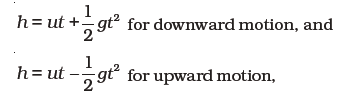
Fig. 14.1 shows some periodic motions. Suppose an insect climbs up a ramp and falls down, it comes back to the initial point and repeats the process identically. If you draw a graph of its height above the ground versus time, it would look something like Fig. 14.1 (a). If a child climbs up a step, comes down, and repeats the process identically, its height above the ground would look like that in Fig. 14.1 (b). When you play the game of bouncing a ball off the ground, between your palm and the ground, its height versus time graph would look like the one in Fig. 14.1 (c). Note that both the curved parts in Fig. 14.1 (c) are sections of a parabola given by the Newton’s equation of motion (see section 3.6),
NCERT Class 11 Physics Part 2 Osciliations
 
 
with different values of u in each case. These are examples of periodic motion. Thus, a motion that repeats itself at regular intervals of time is called periodic motion.


Click on the below link to download NCERT Class 11 Physics Part 2 Oscillations

Chapter 06 System of Particles and Rotational Motion
NCERT Book Class 11 Physics Part 1 Systems Of Particles and Rotational Motion
~ NCERT Class 11 Physics (Old Chapters)
NCERT Book Class 11 Physics Part 1 Physical World

NCERT Book Class 11 Physics Chapter 13 Oscillations

Download the official NCERT Textbook for Class 11 Physics Chapter 13 Oscillations, updated for the latest academic session. These e-books are the main textbook used by major education boards across India. All teachers and subject experts recommend the Chapter 13 Oscillations NCERT e-textbook because exam papers for Class 11 are strictly based on the syllabus specified in these books. You can download the complete chapter in PDF format from here.

Download Physics Class 11 NCERT eBooks in English

We have provided the complete collection of NCERT books in English Medium for all subjects in Class 11. These digital textbooks are very important for students who have English as their medium of studying. Each chapter, including Chapter 13 Oscillations, contains detailed explanations and a detailed list of questions at the end of the chapter. Simply click the links above to get your free Physics textbook PDF and start studying today.

Benefits of using NCERT Class 11 Textbooks

The Class 11 Physics Chapter 13 Oscillations book is designed to provide a strong conceptual understanding. Students should also access NCERT Solutions and revision notes on studiestoday.com to enhance their learning experience.

Where can I download the latest NCERT Book Class 11 Physics Part 2 Oscillations in PDF for 2025-26?

You can download the latest, teacher-verified PDF for NCERT Book Class 11 Physics Part 2 Oscillations for free on StudiesToday.com. These digital editions are updated as per 2025-26 session and are optimized for mobile reading.

Does this Physics book follow the latest NCERT rationalized syllabus?

Yes, our collection of Class 11 Physics NCERT books follow the 2026 rationalization guidelines. All deleted chapters have been removed and has latest content for you to study.

Why is it better to download NCERT Book Class 11 Physics Part 2 Oscillations chapter-wise?

Downloading chapter-wise PDFs for Class 11 Physics allows for faster access, saves storage space, and makes it easier to focus in 2026 on specific topics during revision.

Are these NCERT books for Class 11 Physics sufficient for scoring 100%?

NCERT books are the main source for NCERT exams. By reading NCERT Book Class 11 Physics Part 2 Oscillations line-by-line and practicing its questions, students build strong understanding to get full marks in Physics.