NCERT Book Class 11 Physics Part 2 Mechanical Properties Of Fluids

Read and download the Chapter 09 Mechanical Properties of Fluids PDF from the official NCERT Book for Class 11 Physics. Updated for the 2025-26 academic session, you can access the complete Physics textbook in PDF format for free.

NCERT Class 11 Physics Chapter 09 Mechanical Properties of Fluids Digital Edition

For Class 11 Physics, this chapter in NCERT Book Class 11 Physics Part 2 Mechanical Properties Of Fluids provides a detailed overview of important concepts. We highly recommend using this text alongside the NCERT Solutions for Class 11 Physics to learn the exercise questions provided at the end of the chapter.

Chapter 09 Mechanical Properties of Fluids NCERT Book Class Class 11 PDF (2025-26)

10.1 INTRODUCTION
In this chapter, we shall study some common physical properties of liquids and gases. Liquids and gases can flow and are therefore, called fluids. It is this property that distinguishes liquids and gases from solids in a basic way. Fluids are everywhere around us. Earth has an envelop of air and two-thirds of its surface is covered with water. Water is not only necessary for our existence; every mammalian body constitute mostly of water. All the processes occurring in living beings including plants are mediated by fluids. Thus understanding the behaviour and properties of fluids is important.
How are fluids different from solids? What is common in liquids and gases? Unlike a solid, a fluid has no definite shape of its own. Solids and liquids have a fixed volume, whereas a gas fills the entire volume of its container. We have learnt in the previous chapter that the volume of solids can be changed by stress. The volume of solid, liquid or gas depends on the stress or pressure acting on it. When we talk about fixed volume of solid or liquid, we mean its volume under atmospheric pressure. The difference between gases and solids or liquids is that for solids or liquids the change in volume due to change of external pressure is rather small.
In other words solids and liquids have much lower compressibility as compared to gases.
Shear stress can change the shape of a solid keeping its volume fixed. The key property of fluids is that they offer very little resistance to shear stress; their shape changes by application of very small shear stress. The shearing stress of fluids is about million times smaller than that of solids.
 
10.2 PRESSURE
A sharp needle when pressed against our skin pierces it. Our skin, however, remains intact when a blunt object with a wider contact area (say the back of a spoon) is pressed against it with the same force. If an elephant were to step on a man’s chest, his ribs would crack. A circus performer across whose chest a large, light but strong wooden plank is placed first, is saved from this accident. Such everyday experiences convince us that both the force and its coverage area are important. Smaller the area on which the force acts, greater is the impact. This impact is known as pressure.
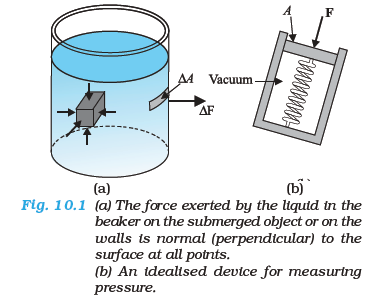
When an object is submerged in a fluid at rest, the fluid exerts a force on its surface. This force is always normal to the object’s surface. This is so because if there were a component of force parallel to the surface, the object will also exert a force on the fluid parallel to it; as a consequence of Newton’s third law. This force will cause the fluid to flow parallel to the surface. Since the fluid is at rest, this cannot happen. Hence, the force exerted by the fluid at rest has to be perpendicular to the surface in contact with it. This is shown in Fig.10.1(a).
The normal force exerted by the fluid at a point may be measured. An idealised form of one such pressure-measuring device is shown in Fig. 10.1(b). It consists of an evacuated chamber with a spring that is calibrated to measure the force acting on the piston. This device is placed at a point inside the fluid. The inward force exerted by the fluid on the piston is balanced by the outward spring force and is thereby measured.


NCERT Class 11 Physics Part 2 Mechanical Properties Of Fluids


Click on the below link to download NCERT Class 11 Physics Part 2 Mechanical Properties Of Fluids

Chapter 06 System of Particles and Rotational Motion
NCERT Book Class 11 Physics Part 1 Systems Of Particles and Rotational Motion
~ NCERT Class 11 Physics (Old Chapters)
NCERT Book Class 11 Physics Part 1 Physical World

NCERT Book Class 11 Physics Chapter 09 Mechanical Properties of Fluids

Download the official NCERT Textbook for Class 11 Physics Chapter 09 Mechanical Properties of Fluids, updated for the latest academic session. These e-books are the main textbook used by major education boards across India. All teachers and subject experts recommend the Chapter 09 Mechanical Properties of Fluids NCERT e-textbook because exam papers for Class 11 are strictly based on the syllabus specified in these books. You can download the complete chapter in PDF format from here.

Download Physics Class 11 NCERT eBooks in English

We have provided the complete collection of NCERT books in English Medium for all subjects in Class 11. These digital textbooks are very important for students who have English as their medium of studying. Each chapter, including Chapter 09 Mechanical Properties of Fluids, contains detailed explanations and a detailed list of questions at the end of the chapter. Simply click the links above to get your free Physics textbook PDF and start studying today.

Benefits of using NCERT Class 11 Textbooks

The Class 11 Physics Chapter 09 Mechanical Properties of Fluids book is designed to provide a strong conceptual understanding. Students should also access NCERT Solutions and revision notes on studiestoday.com to enhance their learning experience.

Where can I download the latest NCERT Book Class 11 Physics Part 2 Mechanical Properties Of Fluids in PDF for 2025-26?

You can download the latest, teacher-verified PDF for NCERT Book Class 11 Physics Part 2 Mechanical Properties Of Fluids for free on StudiesToday.com. These digital editions are updated as per 2025-26 session and are optimized for mobile reading.

Does this Physics book follow the latest NCERT rationalized syllabus?

Yes, our collection of Class 11 Physics NCERT books follow the 2026 rationalization guidelines. All deleted chapters have been removed and has latest content for you to study.

Why is it better to download NCERT Book Class 11 Physics Part 2 Mechanical Properties Of Fluids chapter-wise?

Downloading chapter-wise PDFs for Class 11 Physics allows for faster access, saves storage space, and makes it easier to focus in 2026 on specific topics during revision.

Are these NCERT books for Class 11 Physics sufficient for scoring 100%?

NCERT books are the main source for NCERT exams. By reading NCERT Book Class 11 Physics Part 2 Mechanical Properties Of Fluids line-by-line and practicing its questions, students build strong understanding to get full marks in Physics.