NCERT Book Class 11 Physics Part 2 Mechanical Properties Of Solids

Read and download the Chapter 08 Mechanical Properties of Solids PDF from the official NCERT Book for Class 11 Physics. Updated for the 2025-26 academic session, you can access the complete Physics textbook in PDF format for free.

NCERT Class 11 Physics Chapter 08 Mechanical Properties of Solids Digital Edition

For Class 11 Physics, this chapter in NCERT Book Class 11 Physics Part 2 Mechanical Properties Of Solids provides a detailed overview of important concepts. We highly recommend using this text alongside the NCERT Solutions for Class 11 Physics to learn the exercise questions provided at the end of the chapter.

Chapter 08 Mechanical Properties of Solids NCERT Book Class Class 11 PDF (2025-26)

9.1 INTRODUCTION
In Chapter 7, we studied the rotation of the bodies and then realised that the motion of a body depends on how mass is distributed within the body. We restricted ourselves to simpler situations of rigid bodies. A rigid body generally means a hard solid object having a definite shape and size. But in reality, bodies can be stretched, compressed and bent. Even the appreciably rigid steel bar can be deformed when a sufficiently large external force is applied on it. This means that solid bodies are not perfectly rigid.
A solid has definite shape and size. In order to change (or deform) the shape or size of a body, a force is required. If you stretch a helical spring by gently pulling its ends, the length of the spring increases slightly. When you leave the ends of the spring, it regains its original size and shape. The property of a body, by virtue of which it tends to regain its original size and shape when the applied force is removed, is known as elasticity and the deformation caused is known as elastic deformation. However, if you apply force to a lump of putty or mud, they have no gross tendency to regain their previous shape, and they get permanently deformed. Such substances are called plastic and this property is called plasticity. Putty and mud are close to ideal plastics.
The elastic behaviour of materials plays an important role in engineering design. For example, while designing a building, knowledge of elastic properties of materials like steel, concrete etc. is essential. The same is true in the design of bridges, utomobiles, ropeways etc. One could also ask — Can we design an aeroplane which is very light but sufficiently strong? Can we design an artificial limb which is lighter but stronger? Why does a railway track have a particular shape like I? Why is glass brittle while brass is not? Answers to such questions begin with the study of how relatively simple kinds of loads or forces act to deform different solids bodies. In this chapter, we shall study the elastic behaviour and mechanical properties of solids which would answer many such questions.
 
9.2 ELASTIC BEHAVIOUR OF SOLIDS
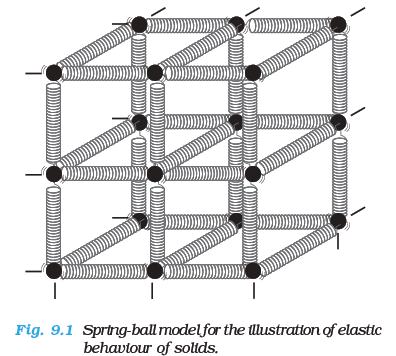
We know that in a solid, each atom or molecule is surrounded by neighbouring atoms or molecules. These are bonded together by interatomic or intermolecular forces and stay in a stable equilibrium position. When a solid is deformed, the atoms or molecules are displaced from their equilibrium positions causing a change in the interatomic (or intermolecular) distances. When the deforming force is removed,the interatomic forces tend to drive them back to their original positions. Thus the body regains its original shape and size. The restoring mechanism can be visualised by taking a model of spring-ball system shown in the Fig. 9.1. Here the balls represent atoms and springs represent interatomic forces.

NCERT Class 11 Physics Part 2 Mechanical Properties Of Solids


Click on the below link to download NCERT Class 11 Physics Part 2 Mechanical Properties Of Solids

Chapter 06 System of Particles and Rotational Motion
NCERT Book Class 11 Physics Part 1 Systems Of Particles and Rotational Motion
~ NCERT Class 11 Physics (Old Chapters)
NCERT Book Class 11 Physics Part 1 Physical World

NCERT Book Class 11 Physics Chapter 08 Mechanical Properties of Solids

Download the official NCERT Textbook for Class 11 Physics Chapter 08 Mechanical Properties of Solids, updated for the latest academic session. These e-books are the main textbook used by major education boards across India. All teachers and subject experts recommend the Chapter 08 Mechanical Properties of Solids NCERT e-textbook because exam papers for Class 11 are strictly based on the syllabus specified in these books. You can download the complete chapter in PDF format from here.

Download Physics Class 11 NCERT eBooks in English

We have provided the complete collection of NCERT books in English Medium for all subjects in Class 11. These digital textbooks are very important for students who have English as their medium of studying. Each chapter, including Chapter 08 Mechanical Properties of Solids, contains detailed explanations and a detailed list of questions at the end of the chapter. Simply click the links above to get your free Physics textbook PDF and start studying today.

Benefits of using NCERT Class 11 Textbooks

The Class 11 Physics Chapter 08 Mechanical Properties of Solids book is designed to provide a strong conceptual understanding. Students should also access NCERT Solutions and revision notes on studiestoday.com to enhance their learning experience.

Where can I download the latest NCERT Book Class 11 Physics Part 2 Mechanical Properties Of Solids in PDF for 2025-26?

You can download the latest, teacher-verified PDF for NCERT Book Class 11 Physics Part 2 Mechanical Properties Of Solids for free on StudiesToday.com. These digital editions are updated as per 2025-26 session and are optimized for mobile reading.

Does this Physics book follow the latest NCERT rationalized syllabus?

Yes, our collection of Class 11 Physics NCERT books follow the 2026 rationalization guidelines. All deleted chapters have been removed and has latest content for you to study.

Why is it better to download NCERT Book Class 11 Physics Part 2 Mechanical Properties Of Solids chapter-wise?

Downloading chapter-wise PDFs for Class 11 Physics allows for faster access, saves storage space, and makes it easier to focus in 2026 on specific topics during revision.

Are these NCERT books for Class 11 Physics sufficient for scoring 100%?

NCERT books are the main source for NCERT exams. By reading NCERT Book Class 11 Physics Part 2 Mechanical Properties Of Solids line-by-line and practicing its questions, students build strong understanding to get full marks in Physics.