NCERT Book Class 11 Physics Part 1 Systems Of Particles and Rotational Motion

Read and download the Chapter 06 System of Particles and Rotational Motion PDF from the official NCERT Book for Class 11 Physics. Updated for the 2025-26 academic session, you can access the complete Physics textbook in PDF format for free.

NCERT Class 11 Physics Chapter 06 System of Particles and Rotational Motion Digital Edition

For Class 11 Physics, this chapter in NCERT Book Class 11 Physics Part 1 Systems Of Particles and Rotational Motion provides a detailed overview of important concepts. We highly recommend using this text alongside the NCERT Solutions for Class 11 Physics to learn the exercise questions provided at the end of the chapter.

Chapter 06 System of Particles and Rotational Motion NCERT Book Class Class 11 PDF (2025-26)

7.1 INTRODUCTION
In the earlier chapters we primarily considered the motion of a single particle. (A particle is ideally represented as a point mass having no size.) We applied the results of our study even to the motion of bodies of finite size, assuming that motion of such bodies can be described in terms of the motion of a particle.
Any real body which we encounter in daily life has a finite size. In dealing with the motion of extended bodies (bodies of finite size) often the idealised model of a particle is inadequate. In this chapter we shall try to go beyond this inadequacy. We shall attempt to build an understanding of
the motion of extended bodies. An extended body, in the first place, is a system of particles. We shall begin with the consideration of motion of the system as a whole. The centre of mass of a system of particles will be a key concept here. We shall discuss the motion of the centre of mass of a system of particles and usefulness of this concept in understanding the motion of extended bodies.
A large class of problems with extended bodies can be solved by considering them to be rigid bodies. Ideally a rigid body is a body with a perfectly definite and unchanging shape. The distances between all pairs of particles of such a body do not change. It is evident from this definition of a rigid body that no real body is truly rigid, since real bodies deform under the influence of forces. But in many situations the deformations are negligible. In a number of situations involving bodies such as wheels, tops, steel beams, molecules and planets on the other hand, we can ignore that they warp (twist out of shape), bend or vibrate and treat them as rigid.
 
7.1.1 What kind of motion can a rigid body have?
Let us try to explore this question by taking some examples of the motion of rigid bodies. Let us begin with a rectangular 
 
 NCERT Class 11 Physics Part 1 Systems Of Particles and Rotational Motion
 
 
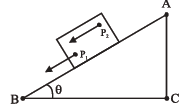
Fig 7.1 Translational (sliding) motion of a block down an inclined plane.
(Any point like P1 or P2 of the block moves with the same velocity at any instant of time.)
 
block sliding down an inclined plane without any sidewise movement. The block is taken as a rigid body. Its motion down the plane is such that all the particles of the body are moving together, i.e. they have the same velocity at any instant of time. The rigid body here is in pure translational motion (Fig. 7.1).
In pure translational motion at any instant of time, all particles of the body have the same velocity.


Click on the below link to download NCERT Class 11 Physics Part 1 Systems Of Particles and Rotational Motion
Chapter 06 System of Particles and Rotational Motion
NCERT Book Class 11 Physics Part 1 Systems Of Particles and Rotational Motion
~ NCERT Class 11 Physics (Old Chapters)
NCERT Book Class 11 Physics Part 1 Physical World

NCERT Book Class 11 Physics Chapter 06 System of Particles and Rotational Motion

Download the official NCERT Textbook for Class 11 Physics Chapter 06 System of Particles and Rotational Motion, updated for the latest academic session. These e-books are the main textbook used by major education boards across India. All teachers and subject experts recommend the Chapter 06 System of Particles and Rotational Motion NCERT e-textbook because exam papers for Class 11 are strictly based on the syllabus specified in these books. You can download the complete chapter in PDF format from here.

Download Physics Class 11 NCERT eBooks in English

We have provided the complete collection of NCERT books in English Medium for all subjects in Class 11. These digital textbooks are very important for students who have English as their medium of studying. Each chapter, including Chapter 06 System of Particles and Rotational Motion, contains detailed explanations and a detailed list of questions at the end of the chapter. Simply click the links above to get your free Physics textbook PDF and start studying today.

Benefits of using NCERT Class 11 Textbooks

The Class 11 Physics Chapter 06 System of Particles and Rotational Motion book is designed to provide a strong conceptual understanding. Students should also access NCERT Solutions and revision notes on studiestoday.com to enhance their learning experience.

Where can I download the latest NCERT Book Class 11 Physics Part 1 Systems Of Particles and Rotational Motion in PDF for 2025-26?

You can download the latest, teacher-verified PDF for NCERT Book Class 11 Physics Part 1 Systems Of Particles and Rotational Motion for free on StudiesToday.com. These digital editions are updated as per 2025-26 session and are optimized for mobile reading.

Does this Physics book follow the latest NCERT rationalized syllabus?

Yes, our collection of Class 11 Physics NCERT books follow the 2026 rationalization guidelines. All deleted chapters have been removed and has latest content for you to study.

Why is it better to download NCERT Book Class 11 Physics Part 1 Systems Of Particles and Rotational Motion chapter-wise?

Downloading chapter-wise PDFs for Class 11 Physics allows for faster access, saves storage space, and makes it easier to focus in 2026 on specific topics during revision.

Are these NCERT books for Class 11 Physics sufficient for scoring 100%?

NCERT books are the main source for NCERT exams. By reading NCERT Book Class 11 Physics Part 1 Systems Of Particles and Rotational Motion line-by-line and practicing its questions, students build strong understanding to get full marks in Physics.